To avoid these ads, REGISTER NOW!

Small roof over man door without posts?

Innovate1

Well-known member
Joined
Jul 28, 2014
Messages
4,286
Location
Illinois near St. Louis, Missouri
Wanted to put a small roof over the man door and wondering about doing it without posts to support the outer edge. Walls are 2x6 and thinking of about 3' of overhang and about 4 or 5 ft wide for a 3' door. Pitch on the main roof is 6/12 so something similar would seem to fit although I realize a steeper pitch would make it stronger.

I don't really want braces going down and into the building - That's great structurally but any water would follow the braces into and possibly past the siding.

The critical joints appear to be the "porch" roof rafters to the building at the top where they are in tension. For a 3' wide roof the height at the building would be 18". Any downward pressure would result in twice that amount of tension at the top attachment.

Anyone done something like this?

If I do posts a lot of places want to put a round footing down below frost depth. How important is this vs. putting them on a floating slab?
 
To avoid these ads, REGISTER NOW!

The Cobbler

Super Moderator
Staff member
Joined
Oct 24, 2013
Messages
25,856
Location
Niagara Region, Ontario, Canada
....
I don't really want braces going down and into the building - That's great structurally but any water would follow the braces into and possibly past the siding.

Anyone done something like this?

If I do posts a lot of places want to put a round footing down below frost depth. How important is this vs. putting them on a floating slab?

....

My circa 1950 house has a roof over the back door, with "braces" to the house. they are well inboard of the drip line of the covering and have never been replaced, nor show signs of needing replacement after all these years . they were covered in aluminum in mid 90's and again, zero issues.

as far s putting posts on floating slabs, supporting a structure that does not have frost heave is asking for trouble
 

Jackfre

Well-known member
Joined
Dec 26, 2010
Messages
4,408
Location
N CA
I have a similar porch on the kitchen door. The porch ridge, a 4x8 or 10 extends about 8’ into the house. It sits on top of the second floor structure to which it is attached. I do have a knee brace at each side. They are more decorative but are tied into the structure. That ridge beam was easy to do as it extended into a shallow roof area used for storage.
 

readhead

Well-known member
Joined
Dec 8, 2012
Messages
6,177
Location
Durango, Co.
How about a couple of tension rods running from the front edge of the new roof back up to the existing wall.
 

matt_i

Well-known member
Joined
Mar 14, 2008
Messages
10,725
Location
SE Michigan
The risk is, if your building is on a frost protected foundation and the porch is not, the structure can get smashed by forces it cannot resist. So then you get to strip off the interior and exterior cladding/siding (hacking away more or less at your precisely finished building), fix the frame by less-than-desirable techniques and then dig proper holes for the posts to sit on protected foundation. So if you went right to "dig proper holes" then you get to skip cutting apart your nice finished building to repair it. I would investigate the sonotube and a post hole digger.

Relative to supporting the cantilever its all about connecting the wooden members in tension as you mention. I think you have to design some steel supports (like 1/4" to 3/8" thick weldments) shaped like an inverted "y" that resist the tension and transfer the forces into fasteners in shear (or thru-bolted for friction). Also of some concern is that the cripples (the studs over the door frame) aren't helping a lot. I would double or triple the king studs each side of the door frame in preparation for the added bending load at midspan. On those kings I would use GRK-RSS into the bottom and top wall plates -- into the endgrain. It will be better/stronger than using 16d - hot dipped galvanized even.
 

MushCreek

Well-known member
Joined
Jan 14, 2015
Messages
9,763
Location
Upstate South Carolina
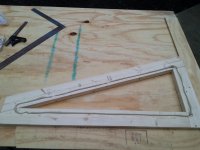
I just built small roofs for the two man doors on my barn. I built heavy triangular brackets, which are through-bolted into the barn framing. I sealed the brackets with caulking as I bolted them up, but they're under the overhang, and won't likely get wet anyhow.
 

Attachments

  • IMG_20191219_114730819_BURST000_COVER.jpg
    IMG_20191219_114730819_BURST000_COVER.jpg
    145.5 KB · Views: 301

yeldogt

Well-known member
Joined
Jan 2, 2012
Messages
18,184
You make it as a unit with a steep roof .. it becomes a self supporting triangle. They look better steep IMO as well. You can also do a 1/2 hip ...this required the center truss to be reinforced. I used plywood on the last one I did a long time ago ... they have a lot of parts.

On the eave side if it has two stories you can extend the roof line ... if the slope is correct.
 

Copymutt

Well-known member
Joined
Sep 3, 2016
Messages
3,387
Location
Colorado
In snow load country i would use a gable to direct the snow to the sides of the door. Basic carpentry with supports kicked back to the wall, properly flashed, no issues.
 

yeldogt

Well-known member
Joined
Jan 2, 2012
Messages
18,184
Here is a screen shot of building I did ... shows both types I like.
 

Attachments

  • Untitled 2.jpg
    Untitled 2.jpg
    19.8 KB · Views: 185

HalfTonTom

Well-known member
Joined
Nov 2, 2018
Messages
684
Location
Waterford, NY
The coolest over man door awning I've ever seen was an early '50's rear window assembly from a Studebaker. I guess the amount of projection from the wall would depend on how much of the vehicle's roof you use. Got an old Stude laying around?
 
OP
I

Innovate1

Well-known member
Joined
Jul 28, 2014
Messages
4,286
Location
Illinois near St. Louis, Missouri
Car hoods are an interesting touch but I'm not really a car guy. If I could fit some airplane part that would be cool - maybe half a bump cowl from an antique. :)

Here's a link that's a bit too fancy for the shop but I like the sturdy supports.
https://www.addicted2decorating.com/how-to-build-a-small-portico-above-a-door-part-1-the-basic-frame.html

My door is around the corner from the OHDs and gable end and I will be approaching from the front so a simple slope that matches the 6:12 roof pitch might be best. I could put a gutter on the front and keep the downspout to the rear much easier than with the peaked roof in my link.

We have a bit of snow here but not terrible. Worse I have seen is 12" and that's very unusual. Usually less than 6"on the ground at any time and none most of the time.
 
Last edited:

yeldogt

Well-known member
Joined
Jan 2, 2012
Messages
18,184
Car hoods are an interesting touch but I'm not really a car guy. If I could fit some airplane part that would be cool - maybe half a bump cowl from an antique. :)

Here's a link that's a bit too fancy for the shop but I like the sturdy supports.
https://www.addicted2decorating.com/how-to-build-a-small-portico-above-a-door-part-1-the-basic-frame.html

Mine door is around the corner from the OHDs and gable end and I will be approaching from the front so a simple slope that matches the 6:12 roof pitch might be best. I could put a gutter on the front and keep the downspout to the rear much easier than with the peaked roof in my link.

We have a bit of snow here but not terrible. Worse I have seen is 12" and that's very unusual. Usually less than 6"on the ground at any time and none most of the time.

I like the first picture that she used for inspiration -- perfect for a craftsman. The one she built is not the correct style ... especially for a 50's brick
 
Last edited:

strutaeng

Well-known member
Joined
Dec 12, 2011
Messages
2,262
Location
Dallas, TX
Do you know how to weld? A cantilevered frame attached to the wall would be pretty easily done with steel. By cantilevered I mean just verticals bolted to the wall and roof members at a slope (no kickers or diagonals.) Can be built with steel angles, channels, or whatever.

You really need a wall tall enough to give you room from the door header to the roof for this, like a 2-story wall or gable wall.

Tension ties are also a cool idea. Ideally, the roof should be heavy enough to resist wind uplift forces, since cables will buckle if weight of roof is less than uplift wind forces in high wind event.
 
To avoid these ads, REGISTER NOW!

sweetk30

Well-known member
Joined
Jan 2, 2011
Messages
2,306
Location
finger lakes area upstate ,ny
been on my shop prob 4 years now and i live in a high wind area . hasnt gone anywere yet .

few min of time with 1x1 angle iron to make frame that bolts to hood and shop wall studs with lag's .

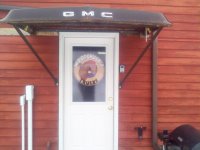
1970 GMC k2500 hood off my dad's old truck . :thumbup:
 

Attachments

  • 1209191236a.jpg
    1209191236a.jpg
    107.5 KB · Views: 143
OP
I

Innovate1

Well-known member
Joined
Jul 28, 2014
Messages
4,286
Location
Illinois near St. Louis, Missouri
Ran through some numbers on the basic 3' extension 5' wide with 6:12 pitch. Since the load is evenly distributed it is like a concentrated load at 18" from the building as far as tension on the top attachment to the wall. With the height of the eave board it is 18 + 6 = 24" high so the tension on the top element will be slightly less than the roof load (18/24 less) but I will assume equal for design margin.

Using the load on the main trusses to get the basic load per sq ft. Span is 30' of 1273 lbs load at each end. That is:

1273/(2'*16.33') = 39 lbs/sq ft of roof.

Our canopy is 15 sq ft so 39 x 15 = 585 lbs

Planning 5 rafters for the porch so approximately 117 lb each (won't share exactly equally but a good for rough numbers).

Ran the numbers on a 2 x 6 SPF #2 stud and this is well within the capability (under 50% of allowed load). Ran the numbers as a joist since it is side load.

If I use a 2 x 4 ledger board at the top attachment with two lags into the rafter and two into the stud each lag will need to support 117 / 2 = 59 lbs each

Using the calculator here:
https://www.awc.org/codes-standards/calculators-software/connectioncalc

4" long 1/4" lags (2" engagement in stud) will have pullout of between 211 and 384 lbs (I can't enter the exact thickness for 1.5" flat piece and 1/2" ply so I used more and less).

This more than double what is needed and I could just use one lag or a slightly smaller screw/lag. Two screws just seems better than only one.

Bottom line is this looks very doable without lower bracing.
 

Ben W

Well-known member
Joined
Oct 20, 2008
Messages
67
Location
NY
Totally agree. Your ledger board attached to the building wall is the key. Make sure you find the studs/posts with your lags. I'd use Ledgerloks or a GRK structural screws over the old style hex lag bolts. Plywood fastened to your first ledger board out to the fascia end will take the tension so that also needs to be fastened well. Maybe plywood the underside too to send the compression back into the building. This roof is going to want to rack so make sure you've got bracing between the opposing rafters, etc. And with this size, you could probably build it on the ground and then with help lift it into place and secure your ledger to the building.

I think you'll be fine, but either with your no-post option above or the non-frost depth columns, what's the worst that's going to happen? You get a little bit of movement and either live with it or decide you want to fix it. Not building to frost depth matters with concrete, sheetrock, keeping doors aligned, etc., but with a roof that can flex (shingles?) you probably wouldn't even know that it's happening. And if you have free-draining soil, then you might not even see movement. I wonder how the pioneers survived.
 

Ben W

Well-known member
Joined
Oct 20, 2008
Messages
67
Location
NY
Love the hood/roof options. Thinking about using a CJ tailgate for mine. Mount the hinges to the building and rig a chain to hold it in place.
 
OP
I

Innovate1

Well-known member
Joined
Jul 28, 2014
Messages
4,286
Location
Illinois near St. Louis, Missouri
I am thinking of putting up a temporary platform - probably just nail braces to the rough framing for the door with some plywood on top. Then build it on top and remove the platform. I can do it myself that way. Roof deck should prevent racking but may add some bracing on the bottom too.
 

Dustball

Well-known member
Joined
Jun 25, 2011
Messages
2,081
Location
Hudson, WI

Attachments

  • 20160606_195447.jpg
    20160606_195447.jpg
    118.8 KB · Views: 126
  • IMG_20160910_113343937.jpg
    IMG_20160910_113343937.jpg
    150.4 KB · Views: 153
  • 20160606_195156.jpg
    20160606_195156.jpg
    120.7 KB · Views: 129
  • IMG_20190302_132434618.jpg
    IMG_20190302_132434618.jpg
    153 KB · Views: 144
OP
I

Innovate1

Well-known member
Joined
Jul 28, 2014
Messages
4,286
Location
Illinois near St. Louis, Missouri
I did a very similar thing when I did mine except that I sandwiched each truss with plywood glued and screwed to eliminate any chance of sagging over time.

I sized it so 4 foot wide sheets fit on top perfectly without cutting so it's about 44 inches of overhang.

Looks great. I was thinking of doing exactly that width for a 4' wide sheet at the slope but decided I didn't really need 44" wide and cut back slightly to 36".
 

spudley

Well-known member
Joined
Dec 27, 2016
Messages
702
Location
Northeast Wisconsin
I did a very similar thing when I did mine except that I sandwiched each truss with plywood glued and screwed to eliminate any chance of sagging over time.

I sized it so 4 foot wide sheets fit on top perfectly without cutting so it's about 44 inches of overhang.
Very nice. I especially like the pic with a wee bit of snow load. :thumbup:
 
OP
I

Innovate1

Well-known member
Joined
Jul 28, 2014
Messages
4,286
Location
Illinois near St. Louis, Missouri
You may want to go 6 feet I made this one and it's too small.

Looking at where my wall studs are I decided to go to 6 feet wide to catch another stud on each side of the door - this gives attachment to 4 full length studs, 2 on each side of the door. This gives a lot of margin on loading stress with out doing the angled braces below. 3 feet out from the building seems like enough - it's never going to keep you dry when the wind is strong but an extra 6" didn't seem that much different. Want to stay with 6:12 pitch to match the main roof.

Dustball, What's the slope and how did you secure the top of the roof? That's where the tension to pull away from the house is.
 

yeldogt

Well-known member
Joined
Jan 2, 2012
Messages
18,184
Matching the main roof slope is typically best -- but, often steeper will look fine. Going less becomes is normally a problem as it is very noticeable ...

The load will drop as the pitch increases .... The key is to use a plywood triangle brace .. it becomes self supporting. The load is not all that great
 

Dustball

Well-known member
Joined
Jun 25, 2011
Messages
2,081
Location
Hudson, WI
Looking at where my wall studs are I decided to go to 6 feet wide to catch another stud on each side of the door - this gives attachment to 4 full length studs, 2 on each side of the door. This gives a lot of margin on loading stress with out doing the angled braces below. 3 feet out from the building seems like enough - it's never going to keep you dry when the wind is strong but an extra 6" didn't seem that much different. Want to stay with 6:12 pitch to match the main roof.

Dustball, What's the slope and how did you secure the top of the roof? That's where the tension to pull away from the house is.
Slope is 4:12.

Upper ledger is screwed to every wall stud along the length using Ledgerlok screws. The top of every truss is fastened to the ledger using Simpson ridge rafter connectors and eight SD connector screws. I chose the ridge rafter connector because it has vertical screws that I drove down into the top of the ledger. Those structural screws would have to shear or the ledger board would have to split in half vertically for the connection to fail. In addition to the connectors, I also screwed the entire top length of the sheathing directly to the ledger. A whole lot of screws would have to shear for the assembly to fail. I jumped up and down on it and there was no noticeable bounce.
 

DugMine

New member
Joined
Aug 13, 2025
Messages
1
I did a very similar thing when I did mine except that I sandwiched each truss with plywood glued and screwed to eliminate any chance of sagging over time.

I sized it so 4 foot wide sheets fit on top perfectly without cutting so it's about 44 inches of overhang.
How did you attach the trusses to the upper ledger?
 

larry4406

Well-known member
Joined
Jan 27, 2006
Messages
19,134
Location
Northern Virginia
Nice work Larry!
Thanks Dan! It came out quite nice. Finished picture from 3-4 years ago when the Hardy siding was being installed and metal roof was installed.

Still need to demo the failing block wing walls and failing steps. Then the conduit to the septic can be run straight.

Quite the improvement over the prior abortion. Oddly the concrete foundation rough opening was for a 5/0 door yet a small 2/6 door was in place with wood infill framing.

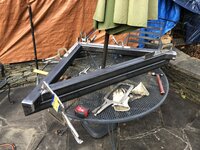
The tube steel brackets enabled me to fix the roof and siding and divorce it from the hardscape. The new door was a leftover from the day job.
1755539273502.png1755539444810.jpeg1755539495832.jpeg
 
To avoid these ads, REGISTER NOW!
Top Bottom