To avoid these ads, REGISTER NOW!

Smoked ground on welder table 110v plugs

MatBirch

Well-known member
Joined
Oct 10, 2013
Messages
419
Location
Filer, Idaho
This is causing us serious safety concerns!
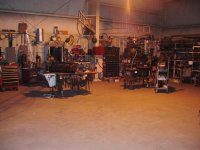
We have a bank of 4 welding tables, all in a row, all with independent circuits for the welders, and all with independent circuits for a 110v cord reel beneath each table. The reels are metal housing, and attached directly to the metal tables, but the cord passes straight through with no connections. 99% of the time, only a Dewalt double insulated 4-1/2” grinder is plugged in.
The guys almost always attach their ground clamp to the table, not to the work.


We just had a small fire caused by current being carried back on the ground wire of one of the cord reels. It took us a few minutes of sleuthing to figure out what had happened. At first it was assumed that the cord had been pinched or damaged. It does not appear that the hot wire’s insulation was ever compromised. This never allowed it to short out, which was leaving that ground wire energized with pretty high current right up till the end! Had someone contacted that, we’d be having a very different conversation.

We know the weld current is flowing back through the ground, but can’t figure out how? The cord is isolated from the table. Every receptacle is grounded, as is the j box. Every welder receptacle is grounded properly as well. I inspected the plugs on each of the other reels, and they all show signs of significant heat I believe each station’s conduit shares a common ground for both the welder plugs and 110v circuit though.
We need to get a handle on this fast! What are we doing wrong???
 
To avoid these ads, REGISTER NOW!

240sxguy

Well-known member
Joined
Jan 6, 2009
Messages
1,158
Location
Madison, wi
Was the plugged in grinder laying on the fab table at the time? Perhaps the grinder itself was the return path.
 

sberry

Banned
Joined
Jun 18, 2005
Messages
35,747
Location
Brethren, Michigan
Yes,,, this can be a problem and here is what I did. I have a steel building, a rod runs to my benches as welder ground. You can cut a groove and pour in a building wire to lug similar but,,, all connected. Feed the electric to the welders from a home with leads or a cord, even overhead some can be out of the way... but the only have 120 to the bench, I have an isolated ground recept in the middle so I feed the 120 with 2 wire circuit gfci. The benches are electrically grounded but its thru the common welding ground. Benches welded to an imbed in the steel, welded right together. There is no problem with 2 wire tools. We use common stand alone wire feed so we carry the work ground on its own but I stick and plasma on the common.
 
Last edited:

sberry

Banned
Joined
Jun 18, 2005
Messages
35,747
Location
Brethren, Michigan
I knew some of the basic geometry but today would have used a steel channel facing up and a lid as a raceway to the imbeds, if this is a busy shop it could certainly pay to handle power with electrically insulated/isolated circuit.
 

sberry

Banned
Joined
Jun 18, 2005
Messages
35,747
Location
Brethren, Michigan
You want the circuit electrically grounded but not bonded or frame of welder bonded to benches. With the cord reels hook them to gfci and don't ground them. If its electrically grounded but no other connecting pathways then the equipment ground will become a welding pathway in the event someone forgets to move clamp? If the benches are connected some way or partially connected and share any common welding ground.
 

sberry

Banned
Joined
Jun 18, 2005
Messages
35,747
Location
Brethren, Michigan
It takes a little to get your mind around it. There are some solutions. If time is money here then some groove cutting may be in order or some welding machine drops. I added a second cheaper boom to drop on the end of one of my benches, its out of the way, not a problem, another I want clear. Grind a groove in the floor, put a conduit and a copper wire as interconnector and building bond. Feed 120 2 wire gfci.
Essentially install a grounded raceway bond the equipment to it similar to a piped where the conduit is ground,,, (heavy enough to carry welding current) , don't provide a small ground wire, ground the raceway.
 

sberry

Banned
Joined
Jun 18, 2005
Messages
35,747
Location
Brethren, Michigan
I put recepts on all sides, no moving parts, can plug direct. I do have 1 reel I use on occasion, it's simple 10A and use it for grinder off bench.
 

Attachments

  • booth cab.jpg
    booth cab.jpg
    112.2 KB · Views: 40
  • bench welder 3.jpg
    bench welder 3.jpg
    149.6 KB · Views: 40

wyliesdiesels

Well-known member
Joined
Aug 14, 2012
Messages
20,073
Location
Modesto, CA
Need some more info here

What model welders are you using?

What voltage are they being fed with? 120v or 240v?

What type of outlet are you using for them?

Is the conduit metal or plastic?

Which type of welding are you doing?

Are the ground clamp cords showing any signs of connection issues in the welder or clamp?
 

Bretny

Well-known member
Joined
Jul 31, 2017
Messages
3,918
Location
Dutchess county NY
I bet grounding your table to earth will fix this problem. Only thing I can think of is power from welding is trying to get to ground and that s the easiest path.
 

sberry

Banned
Joined
Jun 18, 2005
Messages
35,747
Location
Brethren, Michigan
Power is trying to get back to the source that created it, on a welder its the welder, on AC its the transformer or service main. Lets say 2 benches here, not connected but grounded to electric system. If someone fails to move a weld work lead and strikes an arc on the other the weld current will take the electric ground,,,, if they were not grounded but each had a grounded tool sitting on them it would take that. This is a worry with crane rails, bridge cranes, they worry about the load cable taking weld currents.
 
To avoid these ads, REGISTER NOW!

wyliesdiesels

Well-known member
Joined
Aug 14, 2012
Messages
20,073
Location
Modesto, CA
I bet grounding your table to earth will fix this problem. Only thing I can think of is power from welding is trying to get to ground and that s the easiest path.

Aww no

Electricity does not go to earth.

Electricity returns to the source. In this case, the welder.
 
Last edited:

cabranch47

Well-known member
Joined
Jun 8, 2011
Messages
103
Location
Louisiana
Would this be true even with a transformer welder. I thought the leads would be isolated from the supply circuit.
 
OP
M

MatBirch

Well-known member
Joined
Oct 10, 2013
Messages
419
Location
Filer, Idaho
Ok, thanks guys. A few notes-
We are a truck/van bodybuilder specializing in aluminum. This happened in our parts fab department where they produce all of our cabinets, boxes, hoods, etc.

Each station is equipped with a Miller EX360 power supply with an XR-Alumafeed wire feeder. They are each wired to 50amp dedicated circuits.
Also a Syncrowave350 and Syncrowave 2500 are each on dedicated 60 amp circuits.
All 3 phase.

The 115v cord reels are Alemite retractable cord reels.

All power comes in to the station through EMT, mounted on unistrut bolted to the concrete floor.

All machine are in excellent condition, and the ground clamps and wires are in good shape.

I spoke with my lead electrician as well, and we like the idea of the non grounded GFCI. also, I plan to bond the tables to the steel building frame.
 

MoonRise

Well-known member
Joined
Nov 5, 2010
Messages
4,031
Location
NJ
The welding lead 'ground' should be more technically be called the "work lead".

Which sometimes helps to let folks understand which 'ground' is involved in the electrical flow.

Electrical ground = "ground" or EGC ("equipment grounding conductor")

Welding lead 'ground' = "work lead"

The two 'ground' connections are NOT the same thing!

Then there is the 'grounding' or "bonding" of the metal work tables. Which you NEED to do, both for electrical Code safety (metal equipment has to be "bonded" to the "ground" connection so that any electrical fault can be "cleared" by flowing the fault current through the equipment ground back to the overcurrent protection device which should then trip and open the circuit and NOT through a worker) and for your GTAW high-frequency aspect for RFI mitigation.

example: https://www.mikeholt.com/instructor2/img/product/pdf/1292448885sample.pdf

Don't just start changing wiring without figuring out WHAT specifically is wrong.

Check for voltage between ALL the possible wiring/tables/machines/conduit/etc and find out where the voltage is coming from.

Once you KNOW what the problem source is, THEN you can address how to fix it.
 

sberry

Banned
Joined
Jun 18, 2005
Messages
35,747
Location
Brethren, Michigan
Yes, thru my babble I meant to say that the benches need to be electrically grounded. Mine are grounded, just not with a wire with the conductors that supply the current. Bonded with the steel raceway that supplies it and a connection for welding current.
 
Last edited:

TRWham

Well-known member
Joined
Aug 11, 2017
Messages
1,971
Location
East Cobb County, Georgia
The welding lead 'ground' should be more technically be called the "work lead".

Which sometimes helps to let folks understand which 'ground' is involved in the electrical flow.
...

I think you'll find all of them are involved to some extent in proportion to the impedance and potential difference across each path. Every single Coulomb gets back home, but not always by the same route as his friends. If the EGC in the cord supplying the reel is a better option than any other available path, then the majority of the return current will be carried there.
 

SGKent

Banned
Joined
Feb 12, 2010
Messages
1,959
Location
Citrus Heights CA
I am not an electrician however I do understand electronics. You can be dealing with voltage bias, resistance, or RF energy here. The fact that the 120V circuit grounds going to the lights would carry voltage can only mean that the electrical path is easier to go thru them than the grounding provided for the welders. Keep in mind that welders can be high frequency and RF like that see things differently than DC does. If for example one were to coil the work lead ground wire in a neat set of many loops to hang it, it is just like making a choke winding - electrically that cable could have great conductivity but RF would see it as impedance like a choke. Could you bleed off enough energy to fry a ground wire - I don't know. But I did know a radio engineer who lost both breasts because he failed to notice the overalls he was wearing had metal buttons when he climbed that radio tower that day. The RF cooked them. You are putting energy into the tables when you weld, but if the working lead has corrosion, is too small, or is acting like a choke because it is kept in neat small coils, you could have potential on the tables that wants to find its way home.
 

Bogie1632

Well-known member
Joined
Feb 18, 2018
Messages
1,303
Location
Southeastern Wisconsin
Following. This thread has me curious so spitballing this more as a question than a solution.

Disconnect the reels from the tables and lay them, and any power tools, on an insulator like a rubber mat on the table. Problem goes away would that not mean that when mounted that the welders sending some electrons via path of least resistance down through the reel or tool casing versus the welders cables? More so of this is a reverse polarity setup as well? Would a DMM pick that up in a test like this between the reel housing and table during welding?

Again, just spitballing and may be way off. Welded quite a bit, but not professionally. Never had a situation like this occur so its peaking my interest.

Good luck.

V/R
Bogie
 

SGKent

Banned
Joined
Feb 12, 2010
Messages
1,959
Location
Citrus Heights CA
According to American National Standards Institute (ANSI) Z49.1, "Safety in Welding, Cutting and Allied Processes," the workpiece or the metal table that the workpiece rests on must be grounded. You must connect the workpiece or work table to a suitable ground, such as a metal building frame. The ground connection should be independent of or separate from the welding circuit connection.

this
 
To avoid these ads, REGISTER NOW!
Top Bottom