

You are using an out of date browser. It may not display this or other websites correctly.
You should upgrade or use an alternative browser.
You should upgrade or use an alternative browser.
Snap-On 25" ratchet durability/use
- Thread starter 90zcar
- Start date
Well ima cheep as and have been getting by with an ez red 24 inch ratchet. Zero issues with it. Got her used from the snappy man for a solid 30 bucks.....
Now i Mostly use my new Mac 18inch 3/8ths drive flex head. But that's just for the fun of it.
Now i Mostly use my new Mac 18inch 3/8ths drive flex head. But that's just for the fun of it.
I have used the 1/2" 2ft ratchet for big nuts and bolts on suspension and chassis pieces. Some times there is not much room to swing a breaker bar, and using a breaker bar would be tedious. Especially on big stuff that does not spin off easy.
I have used the 3ft bar where the 2ft bar was flexing too much. I picked up the 18" flex dual 80 after the 24" flex dual, for the places that won't fit. It took a fee times but wishing I had one, several times made it an easier choice.
I have used the 3ft bar where the 2ft bar was flexing too much. I picked up the 18" flex dual 80 after the 24" flex dual, for the places that won't fit. It took a fee times but wishing I had one, several times made it an easier choice.
Are the older 936 ratchets rated to 700lbs also?
I've never seen any official Snap On literature indicating such, so I'd have to say no. Dual 80 has a lot of teeth engaged and reacting load. It really is a better system, not just hype.
The other advantage is half the required motion to get to the next click. With a short ratchet, 60 teeth, 80 teeth, doesn't much matter in swing room. The difference is a fraction of an inch. With a 25" ratchet, the difference is over 2". A 936 needs over 4" to get to the next ratchet tooth. A Dual 80 (SHLF80A) needs just less than 2".
As for breakers, how do you guys turn an engine to align timing marks? I put this ratchet on the crank pulley and ratchet the engine around. Should be able to check crank angle sensors like this with a DMM.
EZDUZIT duzzent gettit. I've probably been wrenching longer than he has. In the old days we used breakers and 12pt sockets (so we could position the breaker more advantageously) because the ratchets weren't as strong as breakers. When you broke your ratchet, even the guy at Sears would raise his bushy eyebrow and ask how long the pipe was that you used. The inference was clear: using a ratchet to crack stuff free was improper use of the tool. It was wasteful. The breaker was the "right tool".
That was over 10 years ago. The new ratchets (Snap On isn't the only one) are as strong as breaker bars. I consider breaker bars now obsolete. Also, I would only ever use a 12pt socket for a 12point bolt. In the old days, we had them to facilitate breaker usage. That question comes up from time to time because Sears and others still have 12points as part of their standard sets and guys here want to know why. Rarely do we get the answer right: 12pts were used with breaker bars to help put the bar where we needed it to be to crack stuff free.
I was recently doing a shade tree brake job on a land rover. I was swapping rotors. The caliper bolts are real cad plated high strength bolts, torqued to 300Nm (250-ishftlbs). I couldn't squeeze my gun behind the wheel (for a stupid reason not worth discussing) so I had to ratchet those bolts out. and they were stiff the whole way out because they were high quality bolts in tight holes and slightly corroded. That SHLF80A saved my ***. Especially as I get older, or at the end of a long day, I appreciate my long handled tools.
Last edited:
ez-duzit
Well-known member
...EZDUZIT duzzent gettit. I've probably been wrenching longer than he has...
Got my first set of tools in the '50's.
Re: Snap-On 25" ratchet durability/use
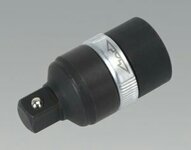
If you need a really long flex head ratchet you can just buy a ratchet adapter
for your breaker bar like this one for 10% of the cost... It wont be as strong
but you can break the fastener loose with your breaker bar and then put on
the adapter if the fastener wont just spin out.
Also... you have never "needed" 12 point sockets to help get a good angle
on a fastener with a breaker bar... If you cant get a six point socket on it
because of the 60 degree change, just remove the socket from the breaker
bar turn it one quater of a turn (90 degrees) and put it back on the breaker bar.
When you place it back on the fastener it will look like it's moved 30 degrees
just like a 12 point socket. [emoji106]
I've never seen any official Snap On literature indicating such, so I'd have to say no. Dual 80 has a lot of teeth engaged and reacting load. It really is a better system, not just hype.
The other advantage is half the required motion to get to the next click. With a short ratchet, 60 teeth, 80 teeth, doesn't much matter in swing room. The difference is a fraction of an inch. With a 25" ratchet, the difference is over 2". A 936 needs over 4" to get to the next ratchet tooth. A Dual 80 (SHLF80A) needs just less than 2".
As for breakers, how do you guys turn an engine to align timing marks? I put this ratchet on the crank pulley and ratchet the engine around. Should be able to check crank angle sensors like this with a DMM.
EZDUZIT duzzent gettit. I've probably been wrenching longer than he has. In the old days we used breakers and 12pt sockets (so we could position the breaker more advantageously) because the ratchets weren't as strong as breakers. When you broke your ratchet, even the guy at Sears would raise his bushy eyebrow and ask how long the pipe was that you used. The inference was clear: using a ratchet to crack stuff free was improper use of the tool. It was wasteful. The breaker was the "right tool".
That was over 10 years ago. The new ratchets (Snap On isn't the only one) are as strong as breaker bars. I consider breaker bars now obsolete. Also, I would only ever use a 12pt socket for a 12point bolt. In the old days, we had them to facilitate breaker usage. That question comes up from time to time because Sears and others still have 12points as part of their standard sets and guys here want to know why. Rarely do we get the answer right: 12pts were used with breaker bars to help put the bar where we needed it to be to crack stuff free.
I was recently doing a shade tree brake job on a land rover. I was swapping rotors. The caliper bolts are real cad plated high strength bolts, torqued to 300Nm (250-ishftlbs). I couldn't squeeze my gun behind the wheel (for a stupid reason not worth discussing) so I had to ratchet those bolts out. and they were stiff the whole way out because they were high quality bolts in tight holes and slightly corroded. That SHLF80A saved my ***. Especially as I get older, or at the end of a long day, I appreciate my long handled tools.
If you need a really long flex head ratchet you can just buy a ratchet adapter
for your breaker bar like this one for 10% of the cost... It wont be as strong
but you can break the fastener loose with your breaker bar and then put on
the adapter if the fastener wont just spin out.
Also... you have never "needed" 12 point sockets to help get a good angle
on a fastener with a breaker bar... If you cant get a six point socket on it
because of the 60 degree change, just remove the socket from the breaker
bar turn it one quater of a turn (90 degrees) and put it back on the breaker bar.
When you place it back on the fastener it will look like it's moved 30 degrees
just like a 12 point socket. [emoji106]
Last edited:
I use a 40" from Grip(grand rapids industrial). Same as the Titan. It's under $50What are you guys using for 36" 3/4" breakers?
The Toolest Guy
Banned
Has no one mentioned the fact that a breaker bar has a smaller head profile than a ratchet. This can allow it access to different areas.
Re: Snap-On 25" ratchet durability/use
Tools in the UK are so expensive, I can see why you would recommend this. I think Snap On stuff is more pounds than dollars. I bought my SHLF80 here on GJ for the equivalent of £65.If you need a really long flex head ratchet you can just buy a ratchet adapter
for your breaker bar like this one for 10% of the cost... It wont be as strong
but you can break the fastener loose with your breaker bar and then put on
the adapter if the fastener wont just spin out.
Also... you have never "needed" 12 point sockets to help get a good angle
on a fastener with a breaker bar... If you cant get a six point socket on it
because of the 60 degree change, just remove the socket from the breaker
bar turn it one quater of a turn (90 degrees) and put it back on the breaker bar.
When you place it back on the fastener it will look like it's moved 30 degrees
just like a 12 point socket. [emoji106]
Re: Snap-On 25" ratchet durability/use
Oh it wasn't so much a recommendation... More just an alternative for other viewers who happen to read this thread and didn't want to spend, or couldn't afford, the money for the Snappy.Tools in the UK are so expensive, I can see why you would recommend this. I think Snap On stuff is more pounds than dollars. I bought my SHLF80 here on GJ for the equivalent of £65.
cliftonbros89
Well-known member
What are you guys using for 36" 3/4" breakers?
I use mine for tractor lugs, stuff like that. I've actually got one that's closer to 48". Sounds like overkill I know. But it's came in handy more often that I thought. Some of the equipment I work on is old rusted stuff or even something newer that has a fitting that's never been touched from the factory. High torque situations. Also, keeps from sticking a cheater pipe on a 1/2" breaker bar & risking blowing the end to pieces.
Verg
Well-known member
the 24'' 1/2 drive Snappy ratchet was one of the best tools i have bought more useful then i could have ever imagined. Would not say Snappy (its sooo buttery) is a must but a 2' ratchet comes highly recommended.
trackwelder
Well-known member
I rarely use a breaker bar anymore. Today's long handled ratchets are the only way to work. If it breaks I just grab a spare and get back to it.
WhiffySpark
Well-known member
- Joined
- Oct 22, 2009
- Messages
- 6,252
Young guys just coming into the field don't seem to know any better. Perhaps they didn't have anyone to show them the ropes. And so don't know to use a breaker bar instead of an unwieldy 24" ratchet.
I've broke at least 10 breaker bars. With no Cheater pipes. I've yet to break the ratchet
I didnt even own a breaker bar until last week. He had the 36 and it was gifted. Idk what I'm going to use it for but its ******* awesome

Do you have asperger's?I've never seen any official Snap On literature indicating such, so I'd have to say no. Dual 80 has a lot of teeth engaged and reacting load. It really is a better system, not just hype.
The other advantage is half the required motion to get to the next click. With a short ratchet, 60 teeth, 80 teeth, doesn't much matter in swing room. The difference is a fraction of an inch. With a 25" ratchet, the difference is over 2". A 936 needs over 4" to get to the next ratchet tooth. A Dual 80 (SHLF80A) needs just less than 2".
As for breakers, how do you guys turn an engine to align timing marks? I put this ratchet on the crank pulley and ratchet the engine around. Should be able to check crank angle sensors like this with a DMM.
EZDUZIT duzzent gettit. I've probably been wrenching longer than he has. In the old days we used breakers and 12pt sockets (so we could position the breaker more advantageously) because the ratchets weren't as strong as breakers. When you broke your ratchet, even the guy at Sears would raise his bushy eyebrow and ask how long the pipe was that you used. The inference was clear: using a ratchet to crack stuff free was improper use of the tool. It was wasteful. The breaker was the "right tool".
That was over 10 years ago. The new ratchets (Snap On isn't the only one) are as strong as breaker bars. I consider breaker bars now obsolete. Also, I would only ever use a 12pt socket for a 12point bolt. In the old days, we had them to facilitate breaker usage. That question comes up from time to time because Sears and others still have 12points as part of their standard sets and guys here want to know why. Rarely do we get the answer right: 12pts were used with breaker bars to help put the bar where we needed it to be to crack stuff free.
I was recently doing a shade tree brake job on a land rover. I was swapping rotors. The caliper bolts are real cad plated high strength bolts, torqued to 300Nm (250-ishftlbs). I couldn't squeeze my gun behind the wheel (for a stupid reason not worth discussing) so I had to ratchet those bolts out. and they were stiff the whole way out because they were high quality bolts in tight holes and slightly corroded. That SHLF80A saved my ***. Especially as I get older, or at the end of a long day, I appreciate my long handled tools.
Do you have asperger's?
No, do you have a triple digit IQ? I can type slower. Try sounding out each word. Start with this one: A-S-S-H-O-L-E
Last edited:
Mohawk Dave
Well-known member
I use mine for tractor lugs, stuff like that. I've actually got one that's closer to 48". Sounds like overkill I know. But it's came in handy more often that I thought. Some of the equipment I work on is old rusted stuff or even something newer that has a fitting that's never been touched from the factory. High torque situations. Also, keeps from sticking a cheater pipe on a 1/2" breaker bar & risking blowing the end to pieces.
Same here. Besides, why the heck would I want to fight something. Work smart, not hard. I have the 24" SO 1/2 rat. BUT I also have the 36" SO 3/4 BB/rat and the 40" Titan 3/4" Breaker. All awesome.
the 24'' 1/2 drive Snappy ratchet was one of the best tools i have bought more useful then i could have ever imagined. Would not say Snappy (its sooo buttery) is a must but a 2' ratchet comes highly recommended.
Agreed. I use the 24" 1/2" SO rat all the time on my ton trucks. Once again, work smart, not hard.
tcsalvage
Well-known member
Glad you guys like the ratchet I designed, it still works great for me and I have only had one failure with it, the pawl inside broke an ear. I came up with the idea when I rung off the end of a breaker bar and threw it in the drawer on top of a flex head and the openings for the heads lined up. It took about 6 months of bugging the snappy guy before it showed up  and he sold a dozen or so when guys seen mine on the truck. If you are wondering why I didn't just build one from the ratchet/breaker bar its because snappy wouldn't have warrantied it. Also it wasn't free (been nice) but deeply ''discounted'' and I use the snot out of it since I'm not as young as I used to be.
and he sold a dozen or so when guys seen mine on the truck. If you are wondering why I didn't just build one from the ratchet/breaker bar its because snappy wouldn't have warrantied it. Also it wasn't free (been nice) but deeply ''discounted'' and I use the snot out of it since I'm not as young as I used to be.truckdriver
Well-known member
Modern ratchets have the same weak spot as breaker bars, the flex joint. I you think a breaker bar is stronger than a ratchet you're a fool. As far as lugs go, do you not have an impact? Impact wins over a breaker or ratchet if it fits.
Last edited:
Modern ratchets have the same weak spot as breaker bars, the flex joint. I you think a breaker bar is stronger than a ratchet you're a fool. As far as lugs go, do you not have an impact? Impact wins over a breaker or ratchet if it fits.
Nope. That may have been true once.
The flex on either a breaker or a flex head ratchet is now stronger than the square drive in shear. Only trick is maintaining the manufacturers' recommended torque spec on the flex joints screw. The flex should be difficult to move. If the head is floppy, that can lead to failure of the flex joint.
BTW, the last test I saw had several makers' ratchets failing at the drive and not the ratchet. This isn't just a Snap On selling point.
Glad you guys like the ratchet I designed, it still works great for me and I have only had one failure with it, the pawl inside broke an ear. I came up with the idea when I rung off the end of a breaker bar and threw it in the drawer on top of a flex head and the openings for the heads lined up. It took about 6 months of bugging the snappy guy before it showed up
How much did Snap On pay you for that? I had an idea for a new tool that I wanted to share with Snap On. Step one, you have to fill out a non-disclosure agreement. Then you submit your idea. If they hadn't already thought of it and want to manufacture it, they pay. And it's not a free tool. I think it was a couple thousand dollars at least.
tcsalvage
Well-known member
I didn't get a dime or a free tool, just a good discount on the ratchet. I didn't know (or care) if snappy paid for tool ideas, just thought it would make my life easier if they would build one and they did. It wasn't a lot of tooling changes on their part because the breaker bar had almost the same width as the ratchet head, all they needed to do was put one on the other and bring it to me (under warranty). Therefore no non-disclosure statement or anything else, just a nice ratchet.
Marc Benjamin
Well-known member
Let me add another factor in the mix here
SHLF80A vs SHRLF80A (quick release version)
So if were saying the SHLF80A can do around 700 lb-ft breakaway, then then I wonder if the QR version can at least do 600
?
SHLF80A vs SHRLF80A (quick release version)
So if were saying the SHLF80A can do around 700 lb-ft breakaway, then then I wonder if the QR version can at least do 600
?
Wakefield
Well-known member
Nope. That may have been true once.
The flex on either a breaker or a flex head ratchet is now stronger than the square drive in shear. Only trick is maintaining the manufacturers' recommended torque spec on the flex joints screw. The flex should be difficult to move. If the head is floppy, that can lead to failure of the flex joint.
BTW, the last test I saw had several makers' ratchets failing at the drive and not the ratchet. This isn't just a Snap On selling point.
I notice that on the flex joint with the threaded bolt or axle there is less metal in the blend area where the head width subsides down to that of the handle. I think that can be seen in the S*K flex handles when comparing older tools with the pin vs. the newer ones with the threaded axle bolt.
The bolt must be more positive at tying the two sides of the fork together and not allowing them to spread as compared to the old pin.
With a real axle bolt the lip between the threaded part and the thicker axle allows the bolt to be very tight without excessive pulling of the ears together,some China or Taiwan tools might not have that true axle bolt such as to be possible to overtorque (on the China tool the thread length might be too long for the dimension inside the fork)
It would have to be less. Honestly don't know why they even make a quick release for a ratchet that big
Sent from my iPhone using Tapatalk
Really? Never stuck a ratchet your hand doesn't really fit, wiggle the socket on a crusty fastener, do what needs doing then go to pull it back out and have the socket pop off? Quick release doesn't have this problem.
Marc Benjamin
Well-known member
Really? Never stuck a ratchet your hand doesn't really fit, wiggle the socket on a crusty fastener, do what needs doing then go to pull it back out and have the socket pop off? Quick release doesn't have this problem.
So I'm thinking you don't have any qualms over choosing a Snap-on 1/2 25" QR over a non QR if you can only choose one?
I'm thinkin the QR's of today are much much stronger than the ones of 10 even 5 years ago as well.
MaineGuide
Well-known member
I use mine for tractor lugs, stuff like that. I've actually got one that's closer to 48". Sounds like overkill I know. But it's came in handy more often that I thought. Some of the equipment I work on is old rusted stuff or even something newer that has a fitting that's never been touched from the factory. High torque situations. Also, keeps from sticking a cheater pipe on a 1/2" breaker bar & risking blowing the end to pieces.
Actually, what I meant was, what brand are you folks using for 34" breaker bars?
I understand the utility, but the industrial brands I use primarily don't seem to offer anything longer than 20"-24".
RedneckWelder
Well-known member
Actually, what I meant was, what brand are you folks using for 34" breaker bars?
I understand the utility, but the industrial brands I use primarily don't seem to offer anything longer than 20"-24".
Snap On has a 3/4 drive setup. 36" long handle, 3/4 drive ratchet head or breaker bar. Wright has a 42" 3/4 drive ratchet for a little under $200.
There are cheap ones too (Titan has a 40" 1 inch drive breaker bar, and 3/4 drive bars (for about $60). One of our guys has the 1" bar and it's nice (for about $80). Unfortunately I just get a little apprehensive about putting that metric shitton of torque on a cheap bar. If something gives way...
cliftonbros89
Well-known member
Actually, what I meant was, what brand are you folks using for 34" breaker bars?
I understand the utility, but the industrial brands I use primarily don't seem to offer anything longer than 20"-24".
Mine is a Snap On. Bought it used from a guy with a 3/4" torque wrench. I think the breaker bar is actually over 36"
So I'm thinking you don't have any qualms over choosing a Snap-on 1/2 25" QR over a non QR if you can only choose one?
I'm thinkin the QR's of today are much much stronger than the ones of 10 even 5 years ago as well.
Something for that much torque I'm still chooseing a more solid piece with less bells and whistles!
Sent from my iPhone using Tapatalk
I rarely use breaker bars anymore. I started doing real work around 15 y/o and at that time i used breaker bars in the way i thought they were supposed to be used: to break stuck fasteners loose. Pretty quickly i began breaking them and when they broke and i, surprise, still needed to finish the job, i went to 1/2" ratchets as backup and rarely broke any. I gradually came to the conclusion that breaker bars must be some kind of relic they use to fill out big tool kits that's not actually useful any more, and over time i think that assumption has basically held up.
The only reason i still own a 1/2" Cman raised panel is sentimentality over the fact that i abused the **** out of them with cheater pipes and rarely (if ever? Cant remember now) broke them.
Im with everyone else who says ratchets now are stronger than they need to be and usually more durable and actually more easily warrantied (availability) than breaker bars.
I still own a 3/8 and 1/2" breaker bar, but the only things i'll use them for as a 'go-to' tool is something i have to switch directions on where a ratchet would be annoying, like setting crank and cam gears to correct position for a timing belt, or working a nasty fastener back and forth in a narrow range to break some of the crud loose in the threads. They still have a place for me, but it's not what i thought they were for back in the day.
The only reason i still own a 1/2" Cman raised panel is sentimentality over the fact that i abused the **** out of them with cheater pipes and rarely (if ever? Cant remember now) broke them.
Im with everyone else who says ratchets now are stronger than they need to be and usually more durable and actually more easily warrantied (availability) than breaker bars.
I still own a 3/8 and 1/2" breaker bar, but the only things i'll use them for as a 'go-to' tool is something i have to switch directions on where a ratchet would be annoying, like setting crank and cam gears to correct position for a timing belt, or working a nasty fastener back and forth in a narrow range to break some of the crud loose in the threads. They still have a place for me, but it's not what i thought they were for back in the day.
rsanter
Well-known member
I have one. I like it.
It is a luxury to,own and use verses a breaker bar
Bob
It is a luxury to,own and use verses a breaker bar
Bob
So I'm thinking you don't have any qualms over choosing a Snap-on 1/2 25" QR over a non QR if you can only choose one?
I'm thinkin the QR's of today are much much stronger than the ones of 10 even 5 years ago as well.
Nope, even 600 foot pounds to shear the drive end, that would be hanging 300 pounds off a 2 foot ratchet. How often do you resort to that vs using an impact wrench?

Marc Benjamin
Well-known member
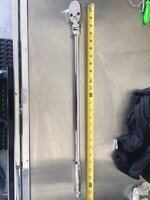
Well I ended up getting the 25" ratchet on Thursday from my snappy guy
Sent from my iPhone using Tapatalk
Nice.
NFH2740
Well-known member
Excellent tool; incredibly strong. I use mine on heavy equipment and irrigation pivots.
mrborohachi
Well-known member
I got the QR ratchet on the SEP email special Sale. I've yet to have a brake age on my TRLL72 long 1/4 QR ratchet. I can't believe it took Snappy this long to offer QR ratchet heads. Then again that's why SO truck owners give out the pocket flat blade screwdriver