To avoid these ads, REGISTER NOW!

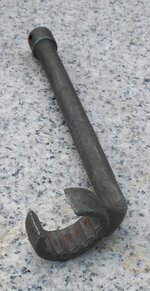
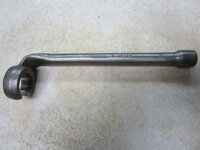
Snap-On/Blue Point odd wrench

p02716

New member
Joined
Oct 6, 2024
Messages
4
Hello All,
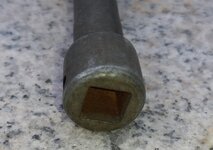
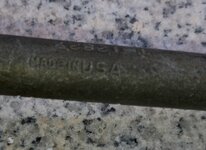
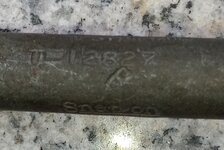
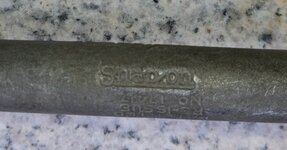
I picked up an unusual wrench at a swap meet the other day and was hoping to get some information about it. It is a 3/8 drive and does not look like it has been modified. I have attached some pictures and appreciate any and all info. I am new to the forum so I hope I did this correctly.
Thank you
 

Attachments

  • 1000004464.jpg
    1000004464.jpg
    1 MB · Views: 71
  • 1000004463.jpg
    1000004463.jpg
    903.4 KB · Views: 59
  • 1000004465.jpg
    1000004465.jpg
    614.6 KB · Views: 54
  • 1000004459.jpg
    1000004459.jpg
    612.5 KB · Views: 51
  • 1000004458.jpg
    1000004458.jpg
    710.6 KB · Views: 54
  • 1000004457.jpg
    1000004457.jpg
    485.7 KB · Views: 57
  • 1000004456.jpg
    1000004456.jpg
    846.6 KB · Views: 71
  • 1000004455.jpg
    1000004455.jpg
    1.2 MB · Views: 79
To avoid these ads, REGISTER NOW!
OP
P

p02716

New member
Joined
Oct 6, 2024
Messages
4
I don't think so unless you know of a distributor with a 1" bolt.
 

RTM

Well-known member
Joined
May 13, 2019
Messages
13,379
Location
SF Bay Area
Just to help out future searches, these are different flavors of the 1RX-32 wrench being discussed, since the search can't read picture text.
 
OP
P

p02716

New member
Joined
Oct 6, 2024
Messages
4
For which war do you think? Any idea of what year it was made?
 

Provincial

Well-known member
Joined
Sep 21, 2011
Messages
6,881
Location
Near Salem, OR
The T-12827 number should be the one that links the tool to the special application. It appears to be a standard wrench that Snap-On modified for a customer. Probably a tubing nut with limited access. 1" is a standard tubing nut size, with JIC hydraulic and SAE flare (commonly used on air brake lines back then) using it in the 5/8" diameter size.
 
To avoid these ads, REGISTER NOW!

snapmom

Well-known member
Joined
Sep 4, 2008
Messages
3,534
Location
Florida
I found this in my aircraft tools, but not sure its aircraft. Model number is T-12825, has 13/16 opening, would probably date 40s.
 

Attachments

  • IMG_8125.JPG
    IMG_8125.JPG
    780 KB · Views: 42
  • IMG_8126.JPG
    IMG_8126.JPG
    521.3 KB · Views: 39

snapmom

Well-known member
Joined
Sep 4, 2008
Messages
3,534
Location
Florida
heck, I have to many tools. Further down in the aircraft tools, another T-12827, but geometry is different. same opening . look how they added a 3/8" extension to the end of the wrench. oh, has a 45 date code.
 

Attachments

  • IMG_8127.JPG
    IMG_8127.JPG
    820.6 KB · Views: 35
  • IMG_8128.JPG
    IMG_8128.JPG
    412.1 KB · Views: 35
  • IMG_8129.JPG
    IMG_8129.JPG
    554.3 KB · Views: 30
  • IMG_8130.JPG
    IMG_8130.JPG
    384.5 KB · Views: 38

Oldtuleguy

Well-known member
Joined
Nov 4, 2017
Messages
10,470
I suspect the guys working on those maintenance crews were not above custom bending a wrench if they had to.
 

Private Lugnutz

Well-known member
Joined
Mar 30, 2012
Messages
30,914
Location
The Authentic Jersey Shore
1940 would predate the war by two years for United States direct involvement. If it were part of a lend-lease item accessory, it could very well date to 1941 and be considered wartime.
I feel like we've had this conversation before. FDR was using all the powers of the executive branch that he could muster beginning as early as late 1939 to do as much as possible short of declaring war. In 1940, the Navy was conducting operations in the North Atlantic to keep shipping lanes open, the Treasury Dept was ordering tools from mfgrs to ship to the Allies under the Lend-Lease program, and the Army and Army Air Forces were already letting contracts unprecedented in number and size for planes, ships, tanks, and other equipment, including tools. The War Production Board's publication, Major War Supply Contracts, published in late 1945, starts in June 1940, when they were an office within the Office of Emergency Management, and ends in September 1945. That's how the US Government defined wartime, and frankly, I don't know what else you would call such a build-up for war. Plomb was the earliest, under contract ("Misc. Tools" to an unspecified Army agency) in June 1940, Crescent ("Pliers," QMC), Fairmount ("Tools," QMC), Kennedy ("Toolboxes", USAAF) and Union Steel Chest Corp ("Toolboxes," Ordnance Dept) under contract in October 1940, Utica ("Pliers", Signal Corps) under contract in November 1940, and Snap-on the subject of the thread, under contract with the USAAF for "Tools" in December 1940. Bonney, Armstrong, Duro, and too many to list were under contract in the first couple months of 1941, well before Pearl Harbor.

That's not an argument for the wrenches without a date code being 1940. But they could be.
The T-12827 number should be the one that links the tool to the special application.
Model number is T-12825,
Further down in the aircraft tools, another T-12827, but geometry is different.
I can't be the only one who is seeing Stromberg part numbers every time I look at these numbers. They all started with a T- and they all had five digits. These are a little low for the Stromberg series I am used to seeing in USAAF and B.A.C. manuals (e.g., T-18xxx, T-19xxx, etc) and I'm not saying they're wrenches for Stromberg aircraft engine parts, but the similarity in nomenclature is really hard to ignore. And using process of elimination, they definitely aren't Wright, PWA, Ranger, Merlin/Packard, Continental, Hamilton, or any other I am familiar with, either.

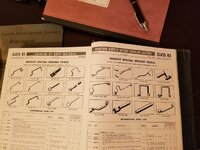
As for geometry and bends, the Air Corps had all kinds of crazy drive tool wrenches. These flare/line crowfoot wrenches are not on these pages. Posted just for effect...
20241007_205854.jpg
 

Ricky Joe

Well-known member
Joined
Sep 15, 2013
Messages
2,452
Location
Roanoke, Va.
I feel like we've had this conversation before. FDR was using all the powers of the executive branch that he could muster beginning as early as late 1939 to do as much as possible short of declaring war. In 1940, the Navy was conducting operations in the North Atlantic to keep shipping lanes open, the Treasury Dept was ordering tools from mfgrs to ship to the Allies under the Lend-Lease program, and the Army and Army Air Forces were already letting contracts unprecedented in number and size for planes, ships, tanks, and other equipment, including tools. The War Production Board's publication, Major War Supply Contracts, published in late 1945, starts in June 1940, when they were an office within the Office of Emergency Management, and ends in September 1945. That's how the US Government defined wartime, and frankly, I don't know what else you would call such a build-up for war. Plomb was the earliest, under contract ("Misc. Tools" to an unspecified Army agency) in June 1940, Crescent ("Pliers," QMC), Fairmount ("Tools," QMC), Kennedy ("Toolboxes", USAAF) and Union Steel Chest Corp ("Toolboxes," Ordnance Dept) under contract in October 1940, Utica ("Pliers", Signal Corps) under contract in November 1940, and Snap-on the subject of the thread, under contract with the USAAF for "Tools" in December 1940. Bonney, Armstrong, Duro, and too many to list were under contract in the first couple months of 1941, well before Pearl Harbor.

That's not an argument for the wrenches without a date code being 1940. But they could be.


I can't be the only one who is seeing Stromberg part numbers every time I look at these numbers. They all started with a T- and they all had five digits. These are a little low for the Stromberg series I am used to seeing in USAAF and B.A.C. manuals (e.g., T-18xxx, T-19xxx, etc) and I'm not saying they're wrenches for Stromberg aircraft engine parts, but the similarity in nomenclature is really hard to ignore. And using process of elimination, they definitely aren't Wright, PWA, Ranger, Merlin/Packard, Continental, Hamilton, or any other I am familiar with, either.

As for geometry and bends, the Air Corps had all kinds of crazy drive tool wrenches. These flare/line crowfoot wrenches are not on these pages. Posted just for effect...

20241007_205854.jpg
Lend-lease act was signed March 11, 1941. I don’t think tools made on March 12 could be considered war production, but, either way, the United States was not directly involved in the war until much later. Russia was an ally of Germany until June 22, 1941, and then became a recipient of the benefits of lend-lease. Originally it was designed to help Great Britain at the expense of American taxpayers and in opposition to the will of the people. Most of the US was not in favor of entering the war. Germany absolutely did not want the Americans to fight, and went out of his way to avoid any similar action to the sinking of the Lusitania in order to keep America out. Churchill wanted America in, since Great Britain had no viable allies after France fell in June, 1940, and even that late date found England unprepared and unable to provide meaningful aid as France was overrun. So, for tools to be considered to be manufactured for the war effort, I find it hard to designate any contract for tools to be considered wartime before lend-lease at the earliest, and the existence of contracts for tools prior to that indicates to me military necessity even though the buildup to possible involvement in war was occurring but not necessarily wartime production. The restrictions on alloys for tools were not enacted until 1942. The United States had observed that although France and England had entered into a treaty with Poland, they thought that the agreement itself would be an adequate deterrent and were woefully unprepared to render Poland assistance when Hitler called their bluff on September 1, 1939, and pacifist France and unprepared England regretted the corner into which they had painted themselves and couldn’t even mobilize before the three weeks that it took Poland to capitulate were up. More if you are interested, but this long post serves to explain why I don’t consider tools to be wartime until manufacturing restrictions were imposed.
 

john.k

Well-known member
Joined
Jun 4, 2024
Messages
1,200
Location
Brisbane Qld Australia
Lend -Lease fits quite neatly into the British running out of money .....The British borrowed $500m from a consortium of lenders in the US in September 1939 ,and kept borrowing until their credit ran out............the money didnt last long with such as ships costing $3 million each being sunk by U boats...............So when the money ran out, US industry would have gone into a deep recession ..........Lend Lease kept production going .
 

Private Lugnutz

Well-known member
Joined
Mar 30, 2012
Messages
30,914
Location
The Authentic Jersey Shore
So, for tools to be considered to be manufactured for the war effort, I find it hard to designate any contract for tools to be considered wartime before lend-lease at the earliest, and the existence of contracts for tools prior to that indicates to me military necessity even though the buildup to possible involvement in war was occurring but not necessarily wartime production.
Noted, again. Again, I have a hard time ignoring Cash-and-Carry, Two Ocean Navy Act, and other precursors that were in direct response to everything that was taking place in Europe and Asia after Germany and Japan left the League of Nations in 1933, but, most importantly, find it hard to argue with the OEM/WPB's own "wartime" records, which start in June 1940.
The restrictions on alloys for tools were not enacted until 1942.
Not true. You're probably referring to WPB Order M-21-a, but the OPB had been restricting alloys since the summer of 1941. These prewar restrictions, like the bevy of sizable prewar contracts, punctuate the view that we were making wide-sweeping wartime governance decisions before we actually declared war. Here is a chart I created for myself and colleagues on G503.com when I was immersed in the subject of how alloy restrictions may have affected Willys MA and early Willys MB toolkits.

Timeline.jpg
 

Ricky Joe

Well-known member
Joined
Sep 15, 2013
Messages
2,452
Location
Roanoke, Va.
It may be merely a semantic argument that depends on perspective in order to choose a date for the beginning of wartime. I choose to consider December 7, 1941 as the initial date of war for the United States. Prior to that, our production guidelines did not impact the majority of American citizens. Our involvement in the war consisted of supplying belligerent parties who actually were involved. Much like Wilson in 1916, under whom FDR served as Secretary of the Navy, our involvement in the Second World War was known to be a course that America would take as early as 1940, the big problem being how to do it with the semblance of honor, and after that pesky election. Even as late as 1943, American interests in Germany by large corporations such as Ford, General Motors, IBM, etc., kept America out of the North of Europe while we focused on Africa and Italy. D-Day was June of 1944, a full two and a half years after we were ostensibly at war.

I would be very interested in reading your book. Though we differ on several points, I respect your opinion and knowledge.
 

Private Lugnutz

Well-known member
Joined
Mar 30, 2012
Messages
30,914
Location
The Authentic Jersey Shore
Agreed, it very much depends on context, RJ. You are probably in a very large majority using the declaration date. And in less esoteric discussions, that is a proper view of wartime that I use myself. But what would you call a wrench on an Air Corps aircraft in action in 1943 that was made in June of 1941? And what do we call all those cash-and-carry tools found in England? Our collecting colleagues' countries were already at war if we were not officially yet.

As for the book, I am sure you would consider it pretty dry reading! :) It's just a chapter ("Factory Toolkits, Spare Parts and Accessories") in Vol. 5 of Lloyd White's Evolution of the Willys MB.
 
To avoid these ads, REGISTER NOW!
Top Bottom