

You are using an out of date browser. It may not display this or other websites correctly.
You should upgrade or use an alternative browser.
You should upgrade or use an alternative browser.
Snap-on Dual 80 question
- Thread starter TNHEMIFAN
- Start date
KnurledNut
Well-known member
There is no F80A.
In 3/8" drive ratchets, the "A" designation only affects the flex head ratchets, and it was a change made where the two pronged yoke of the flex joint itself was beefed up a little bit by adding more metal. It wasn't necessarily weak before, but it was deemed beneficial by Snap-on in order to reduce flex joint breakage warranty issues for Snap-on.
In 1/2" drive ratchets, the "A" designation indicates the newer head style head where the screws holding the cover plate on pass through the head and screw into the cover plate itself, instead of the screws passing through the coverplate and screwing into the head of the ratchet. The new "A" design is a bit stronger, and if the cover plate does ever break off, everything can be replaced easily (there's no chance of a snapped off screw threaded into the ratchet head requiring specialty removal), The internal ratchet guts are the same in both models.
In 1/2" drive ratchets, the "A" designation indicates the newer head style head where the screws holding the cover plate on pass through the head and screw into the cover plate itself, instead of the screws passing through the coverplate and screwing into the head of the ratchet. The new "A" design is a bit stronger, and if the cover plate does ever break off, everything can be replaced easily (there's no chance of a snapped off screw threaded into the ratchet head requiring specialty removal), The internal ratchet guts are the same in both models.
Last edited:
FLF8O FLF80A, sorryThere is no F80A.
FLF80 FLF80A, sorry
Supposedly the "A" revision on the 3/8 flex heads is a slightly beefed up flex joint. I cant tell a difference visually so if that added more material to the handle ears it wasnt a lot. I believe all the "A" revisions have the USA stamp returned to either the head or handle as well if someone cares about that sort of thing and were shopping for one.
Last edited:
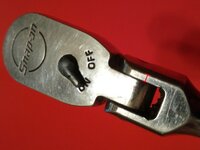
The change was indeed subtle. Snap-on reduced the curvature of the sides slightly, so more metal remained. That was it. The thickest part of the yoke and the pin length of the hinge screw remained the same, so that's why both versions use the same flex joint rebuild kit. I attached pics of the subtle difference. Notice how the flf80a is slightly thicker where marked in red. Pic1 (wood grain background) is a flf80 taken from ebay, pic2 (red background) is the newer style thicker forked flf80A also taken from ebay.
If I had to guess, I would say the change probably made the flex joint around 6-10% stronger. Not a lot, but a change like that can make a real difference in the bottom line when you are a company that warranties broken ratchets for free.
If I had to guess, I would say the change probably made the flex joint around 6-10% stronger. Not a lot, but a change like that can make a real difference in the bottom line when you are a company that warranties broken ratchets for free.
Attachments

Ricky Joe
Well-known member
I’ve never broken the yoke on a flex head, but I have worn them out to the point of being floppy. I’ve also had the pin on my TQFR torque wrench come out. I guess they could broken, but I can’t see how with proper use.
KnurledNut
Well-known member
In addition to the flex joint, there is a legal refinement to all the A revision ratchets.
All the non-A say “Pat. Pending” on the cover plate.
When the A was added, it was no longer pending and the patent numbers were added.

All the non-A say “Pat. Pending” on the cover plate.
When the A was added, it was no longer pending and the patent numbers were added.
To add to this the joint repair kit (screw and washer) is the only thing that also carries a revision letter. I kind of wonder if the screw is actually a hair longer but not enough to matter if used on older ratchets.The change was indeed subtle. Snap-on reduced the curvature of the sides slightly, so more metal remained. That was it. The thickest part of the yoke and the pin length of the hinge screw remained the same, so that's why both versions use the same flex joint rebuild kit. I attached pics of the subtle difference. Notice how the flf80a is slightly thicker where marked in red. Pic1 (wood grain background) is a flf80 taken from ebay, pic2 (red background) is the newer style thicker forked flf80A also taken from ebay.
If I had to guess, I would say the change probably made the flex joint around 6-10% stronger. Not a lot, but a change like that can make a real difference in the bottom line when you are a company that warranties broken ratchets for free.
Interesting, thanks for adding that piece of info. I didn't know about that change. The last time I checked the Snap-on site (a year or so ago for that particular item) they were still showing the original joint rebuild kit part number for the "A" series flex ratchets.To add to this the joint repair kit (screw and washer) is the only thing that also carries a revision letter. I kind of wonder if the screw is actually a hair longer but not enough to matter if used on older ratchets.
It would be really nice if the newer screw was a little bit longer, because even on the original (non-"A") flex joints the screw was often a bit short in my opinion. I have seen quite a few hinge pins that end a thread or two shy of full engagement through the fork. It was always a bit of a pet peeve to me, and something I kept an eye out for when buying used Snap-on flex ratchets. Even if a flex joint is plenty strong without full pin thread engagement thorugh the fork, the more thread engagement there is the less likely it is for the pin screw to want to slowly unscrew itself over time as the ratchet is used.
KnurledNut
Well-known member
KnurledNut
Well-known member
Supposedly the "A" revision on the 3/8 flex heads is a slightly beefed up flex joint. I cant tell a difference visually so if that added more material to the handle ears it wasnt a lot.
Since we like numbers, I pulled mine apart.
Old 2012
New 2020 (The patent number(s) have been added to both the head cover plate and handle.)
Here's what i found.....

The screw is obviously different:
Both have blue Loctite.
The pivot torx (T-25) socket-head screw diameter is the same (.25), but it is longer.
Old OAL .80 (shank length .60)
New OAL .85 (shank length .65)
The profile of both screws is raised countersunk.
The new screw head has a sharper leading edge vs. the rounded edge of the old, finishing out more flush in the handle.
Note: I see no difference in the spring. (The tension on the old was less, but that will be attributed to wear.)
As speculated, there are some very subtle handle differences.
Whether intended or simply within tolerance, only their engineers know:
1. The ears on the handle are slightly thicker.
Old .20
New .22
2. The fork outer radius shows different.
Old 10mm
New 11mm
3. The cross section (depth) of the ears shows slightly thicker.
Old .60
New .635
(YMMV. Not every ratchet will measure exactly the same due to manufacturing tolerances and finishing.)
Screws: Old/New:
Last edited: