To avoid these ads, REGISTER NOW!

Snap On G code confusion

toolcollector109

Active member
Joined
Nov 15, 2022
Messages
36
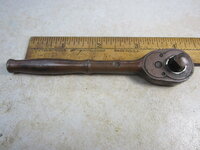
Hi I’m new to vintage tool collecting and I bought my first Snap On wrench on eBay last week. I believe it’s a G code but it’s hard to make out the full letter. It’s a Midget M-70-M with no patent numbers on it and Phillips screws in the back side. I’ve read a lot about the finishes on these tools, is there a way to 100% know what finish was used on a G code midget?

The odd thing is that it is a 9/32” drive but according to collecting Snap-On.com the 9/32” drive was not available after 1942. What am I dealing with here?
 
To avoid these ads, REGISTER NOW!
OP
T

toolcollector109

Active member
Joined
Nov 15, 2022
Messages
36
So does the G date code mean it was only made for the Military? I’m getting conflicted information about warranties. Why would a 1945 Snap On not be warranty covered if it wasn’t made for the military?
 

d42jeep

Well-known member
Joined
Oct 22, 2014
Messages
16,586
Location
Northern California
The G code means it was made in 1945. The part number starting with M means it is 9/32” drive. The belief that your ratchet would not be covered under warranty is a widely held myth. It may be that kits are no longer available, however. Mine has slotted screws. 18E2D138-94FD-415C-9B16-2E51DF024CD5.jpegB4A000A9-22AE-4FA3-A31B-D09A80B1CDCF.jpeg
-Don
 
OP
T

toolcollector109

Active member
Joined
Nov 15, 2022
Messages
36
Is there a way to know for sure what finish was used on G code tools, as opposed to other pre-War years?

This site has been helpful but there is a lot of conflicting information out there on Snap On items. Thanks.
 

d42jeep

Well-known member
Joined
Oct 22, 2014
Messages
16,586
Location
Northern California
I believe that after the end of the war in 1945, Snap-on resumed chrome plating tools. During the war there were metal restrictions precluding chrome plating.
-DonE8870084-8054-48DD-BFC5-7FEFA78D774F.jpeg83CAD3DD-DBF9-404C-A6E2-C3604322AE4D.jpeg
 
OP
T

toolcollector109

Active member
Joined
Nov 15, 2022
Messages
36
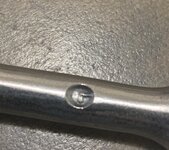
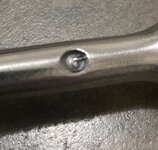
That’s the best image I could get of the mark on my wrench. It’s wierd because I could see how it’s a G, but it also doesn’t look like many of the other G code stamps I’ve seen.
 

Attachments

  • D29A1F73-5D47-49DC-8440-61EB6CC057CB.jpeg
    D29A1F73-5D47-49DC-8440-61EB6CC057CB.jpeg
    417.8 KB · Views: 15
  • CE40FB4F-B0BB-4105-8DC0-F08D1F547C05.jpeg
    CE40FB4F-B0BB-4105-8DC0-F08D1F547C05.jpeg
    374.9 KB · Views: 13
To avoid these ads, REGISTER NOW!
OP
T

toolcollector109

Active member
Joined
Nov 15, 2022
Messages
36
The G code means it was made in 1945. The part number starting with M means it is 9/32” drive. The belief that your ratchet would not be covered under warranty is a widely held myth. It may be that kits are no longer available, however. Mine has slotted screws. 18E2D138-94FD-415C-9B16-2E51DF024CD5.jpegB4A000A9-22AE-4FA3-A31B-D09A80B1CDCF.jpeg
-Don
Interesting. So it seems G date code M-70-M wrenches didn’t list the patent numbers.

What is this finish called and was it typically used on all G code wrenches of this type? Is there a way to tell?
 

d42jeep

Well-known member
Joined
Oct 22, 2014
Messages
16,586
Location
Northern California
Mine is possibly cad plated. If I were cleaning it, which I won’t, I would avoid any use of wire wheels or that type of tool. Maybe spray it off with brake cleaner and wipe it off with a shop towel. With possible cad plating it is always best to err on the side of caution.
-Don
 
OP
T

toolcollector109

Active member
Joined
Nov 15, 2022
Messages
36
Mine is possibly cad plated. If I were cleaning it, which I won’t, I would avoid any use of wire wheels or that type of tool. Maybe spray it off with brake cleaner and wipe it off with a shop towel. With possible cad plating it is always best to err on the side of caution.
-Don
I’ve heard phosphate was also common during the war years but, I’m not sure I could tell the differences in photos I’ve seen. I thought cadmium was used in the earlier wrenches, along with nickel or chrome.

Is there any safe way to clean any of the war-era finishes other than just wiping them off?
 

d42jeep

Well-known member
Joined
Oct 22, 2014
Messages
16,586
Location
Northern California
Here is a thread that talks about the hazards associated with Cadmium and other metals.
-Don
 

Private Lugnutz

Well-known member
Joined
Mar 30, 2012
Messages
30,675
Location
The Authentic Jersey Shore
So it seems G date code M-70-M wrenches didn’t list the patent numbers.
If by "list" you mean mark, some of the ratchets have the patent number stamped under the branding and model number stamping and some don't. Same for M-70L and for ratchets with "3" and "E" date codes, as far as I know. I'm not sure there's any rhyme or reason to it.
What is this finish called and was it typically used on all G code wrenches of this type? Is there a way to tell?
If by "this" you're referring to your own ratchet, judging only by the photo you posted to show the "G" stamp, it looks to me like plain steel that someone polished.
I’ve heard phosphate was also common during the war years but, I’m not sure I could tell the differences in photos I’ve seen. I thought cadmium was used in the earlier wrenches, along with nickel or chrome.
Zinc phosphate is much lighter and chalkier than cadmium, but distinguishing the two is sort of irrelevant. Snap-on tools with "2", "3", "E" and "G" tools are found in plain steel, cadmium, and zinc phosphate finishes. There's no sequence. If a wartime Snap-on tool has any finish whatsoever, (i.e., is not plain steel), I would just rub it down as Don suggested and not create any dust with anything.
 
OP
T

toolcollector109

Active member
Joined
Nov 15, 2022
Messages
36
That copper plated one is super sweet. I would love to have mine sent off for a thick copper plating, is that a service anyone offers?

If cadmium is deadly I’m wondering if these tools should even be used at all. Can’t it leech through sweat pores when you are wrenching with it? I don’t think I will ever knowingly buy a tool coated in this stuff again. What if flakes come off of it? Is there a way to determine the amount of cadmium on one of these Midget wrenches, with some allowance for worn to bare steel areas?

I got what I think is a nickel plated A-6 with a 1940 date code today so I can finally use this with my modern sockets. The wrench has spent most of this week in a ziplock bag as I’m kinda freaked out to touch it.

As I was doing additional research I realized how much cadmium is in everyday foods and in soils too via fertilizers. I also learned that lots of heavy metals like cadmium asbestos lead etc are likely in the dust that gets on houses by road and all over mailboxes and other things close to roads. This world is sick and getting sicker. I’m probably going to buy a house air purifier tonight after work.
 
Last edited:
To avoid these ads, REGISTER NOW!
Top Bottom