To avoid these ads, REGISTER NOW!

Snap-on “High Performance” spanners – what does it mean?

Samuel D

Well-known member
Joined
Apr 9, 2019
Messages
638
Snap-on is surprisingly sloppy with language and documentation. Years ago they famously used MM where they meant the SI unit mm on their metric spanners, and they still don’t put the correct space between the value and the unit, e.g. it should be 13 mm (a thin space would also be correct) rather than Snap-on’s 13mm (of course no-one needs a unit stamped on the spanner anyway, since we’re not likely to mistake 13 for inches). They randomly use the word offset to mean two separate things on their own website, fuelling confusion on forums like this one. But I digress.

I searched the catalogue and didn’t find what makes a Snap-on spanner High-Performance (sometimes spelt Hi-Performance on the packaging – that sloppiness again).

The handles of the XBM605A set seem plenty long enough to me, but maybe the “High Performance” XDHFM606 and XDHM606 sets have some other high-performance features that would be useful?
 
To avoid these ads, REGISTER NOW!

CrazyTools

Banned
Joined
May 28, 2019
Messages
88
Location
Everywhere
Snap-on is surprisingly sloppy with language and documentation. Years ago they famously used MM where they meant the SI unit mm on their metric spanners, and they still don’t put the correct space between the value and the unit, e.g. it should be 13 mm (a thin space would also be correct) rather than Snap-on’s 13mm (of course no-one needs a unit stamped on the spanner anyway, since we’re not likely to mistake 13 for inches). They randomly use the word offset to mean two separate things on their own website, fuelling confusion on forums like this one. But I digress.

I searched the catalogue and didn’t find what makes a Snap-on spanner High-Performance (sometimes spelt Hi-Performance on the packaging – that sloppiness again).

The handles of the XBM605A set seem plenty long enough to me, but maybe the “High Performance” XDHFM606 and XDHM606 sets have some other high-performance features that would be useful?


Interestingly enough I can comment to some real effect on this.

I recently picked up the XBM set which I thought were terrific (up to 32mm). They are super long, and have a great feel to them.

The "high performance" 0° offset wrenches are longer still, by about 15-20%. I found a set of the ratcheting 0° high performance box wrenches over the weekend, and when they refer to "high performance" I believe they simply mean extremely long length. The 8mm wrench from that set is as long as my 10" Snap-on 3/8" Drive ratchet for leverage.

They discuss all the crazy stuff Snap-on normally lists for how excellent their wrenches are, but it's really the length that they're marketing.

Hope that helps.
 
OP
S

Samuel D

Well-known member
Joined
Apr 9, 2019
Messages
638
Thanks. Do you know if the ring ends on the High-Performance spanners are also stronger to cope with the longer length? Or are even the short ones strong enough that it makes no difference? (In which case, though, wouldn’t the short ones have needlessly bulky heads?)

Don’t get me wrong, I’m sure any Snap-on spanner is very “high performance” indeed. They’re also beautiful compared to the roughly finished German spanners (although the functional workmanship of the German tools has its own charm). Facom spanners are nicely finished but tend to have gimmicky shapes these days, unlike the timeless Snap-on patterns. In short, it’s easy to see why Snap-on has a cult following. I’d like to own some of their nice spanners just because. The trick is finding something quintessentially Snap-on to represent that brand well while also complementing my other spanners (because I’ll use them too).
 

CrazyTools

Banned
Joined
May 28, 2019
Messages
88
Location
Everywhere
Thanks. Do you know if the ring ends on the High-Performance spanners are also stronger to cope with the longer length? Or are even the short ones strong enough that it makes no difference? (In which case, though, wouldn’t the short ones have needlessly bulky heads?)

Don’t get me wrong, I’m sure any Snap-on spanner is very “high performance” indeed. They’re also beautiful compared to the roughly finished German spanners (although the functional workmanship of the German tools has its own charm). Facom spanners are nicely finished but tend to have gimmicky shapes these days, unlike the timeless Snap-on patterns. In short, it’s easy to see why Snap-on has a cult following. I’d like to own some of their nice spanners just because. The trick is finding something quintessentially Snap-on to represent that brand well while also complementing my other spanners (because I’ll use them too).

The XBM set is great from what I'm looking at. The zero offset set is also great from 10-20mm ... and isn't hideously expensive used. Maybe 150-200, which for their longest wrenches is probably the one I would have shot for initially.

I wouldn't think there's much metallurgy difference between the regular wrenches, and these longer ones. These are the bullets off the site that seem to be important. They do discuss metallurgy, and in the case of the ratcheting version, the pawl:

• Design of unidirectional, ratcheting gear utilizes innovative Snap-on® technology, to deliver more power in less lateral space, helping to access and remove the most stubborn fasteners in tight spaces

• Ratcheting gears, with up-to 80 teeth, in conjunction with 8-tooth pawl, minimize swing arc needed to move fasteners in restricted spaces

• Gears are cold-formed and use the same proprietary steel found in Snap-on® sockets for ultimate toughness

• Flank-Drive® wrenching system on box-ends generates up to 15-20% more turning power than conventional wrenches, while minimizing risk of tool or fastener damage

• Wrenches are manufactured from special alloy steel, precision-forged and heat-treated for optimum strength and durability
 
OP
S

Samuel D

Well-known member
Joined
Apr 9, 2019
Messages
638
I recently picked up the XBM set which I thought were terrific (up to 32mm). They are super long, and have a great feel to them.
You’re certain it’s the XBM that you got? I only ask because the catalogue I have lists those up to 30 mm only.

Tempted by the XBM605A set. I don’t own any 0° offset ring spanners but have flex-head ratcheting wrenches that can be set straight for some uses (though preferably not high torque). The XBMs with their slight offset and nice length look mighty convenient for a lot of uses.
 

CrazyTools

Banned
Joined
May 28, 2019
Messages
88
Location
Everywhere
You’re certain it’s the XBM that you got? I only ask because the catalogue I have lists those up to 30 mm only.

Tempted by the XBM605A set. I don’t own any 0° offset ring spanners but have flex-head ratcheting wrenches that can be set straight for some uses (though preferably not high torque). The XBMs with their slight offset and nice length look mighty convenient for a lot of uses.

Yea, I actually have the 30/32mm wrench they don't make anymore. XBM3032A.

The XBMs are completely awesome wrenches. The thickness of the beam makes them feel better in your hand than the high performance ones. Easily my favorite set right now, and my "go to" wrench if I need one. The set I bought starts at 13mm though.
 

scubadoober

Well-known member
Joined
Aug 15, 2017
Messages
511
Years ago they famously used MM where they meant the SI unit mm on their metric spanners, and they still don’t put the correct space between the value and the unit, e.g. it should be 13 mm (a thin space would also be correct) rather than Snap-on’s 13mm (of course no-one needs a unit stamped on the spanner anyway, since we’re not likely to mistake 13 for inches).

Valid point, there is a SAE spline drive that uses numbers as well. Maybe it is to avoid confusion since they used to offer a high performance spline wrench.
 

Dave455

Well-known member
Joined
Mar 19, 2013
Messages
5,808
Location
Sussex, England
I seem to recall that the ‘High Performance’ tools were originally a range of tools especially designed for aerospace applications. There were some sockets with a thin wall, the long ring spanners / box end wrenches you refer to and a selection of U.S. Spec spline tools. This pattern of wrench is quite common in the aerospace industry so all seems logical.

I suspect the ‘aerospace’ references were dropped when they started to expand the range to include metric sizes, as very little in the aerospace world is metric. Really nice wrenches though, got a set on a deal years back, and liked them so much I bought the inch sized ones too!

I doubt very much whether the majority of tool users, or manufacturers, either know or care whether it’s “MM”or “mm” or how big the space is, and I suspect that these wrenches are designed to American ANSI spec first, ISO, DIN and JIS specs later, and SI nowhere in the running!

You’re right about the sloppiness though, certainly as far as the catalogue is concerned. For years they have listed screwdrivers by tip thickness, rather than width!! Looks like the catalogue was put together by a 17 year old who has no idea what the tools are for!
 

jimmyin3D

Banned
Joined
Apr 15, 2016
Messages
587
Location
southbay, CA
I believe they were called aviation wrenches by other tool makers but what makes them special is the long length combined with the “offset” that protrudes out to fit onto a fastener. I don’t know why they call it an offset but yeah.
 

toolmutt

Well-known member
Joined
Sep 5, 2009
Messages
2,020
Location
Texas
Yea, I actually have the 30/32mm wrench they don't make anymore. XBM3032A.

The XBMs are completely awesome wrenches. The thickness of the beam makes them feel better in your hand than the high performance ones. Easily my favorite set right now, and my "go to" wrench if I need one. The set I bought starts at 13mm though.

XBMs are my go to wrenches. I have Carlyle zero offset extra long (high performance) but only use them when I need the extra reach.
 
To avoid these ads, REGISTER NOW!

Handyandy23

Well-known member
Joined
Nov 8, 2017
Messages
1,523
Location
Ontario, Canada
I believe they were called aviation wrenches by other tool makers but what makes them special is the long length combined with the “offset” that protrudes out to fit onto a fastener. I don’t know why they call it an offset but yeah.

To me calling these "offset" wrenches make more sense than referring to the angle of the box end on combos being "offset". In terms of wheels, offset is referring to how far in or out board the mounting plane is. And to me when I think the definition of offset, it's a straight translational move.

I know "offset" is known in the wrench world as the angle, but to me it would make more sense to just call that angle instead of offset.

That's my off-topic contribution for now!
 
OP
S

Samuel D

Well-known member
Joined
Apr 9, 2019
Messages
638
To me calling these "offset" wrenches make more sense than referring to the angle of the box end on combos being "offset". In terms of wheels, offset is referring to how far in or out board the mounting plane is. And to me when I think the definition of offset, it's a straight translational move.

I know "offset" is known in the wrench world as the angle, but to me it would make more sense to just call that angle instead of offset.
Agreed. Meanwhile, Snap-on uses the word in yet another way to describe the head’s rotation around the fastener’s axis with respect to the handle, as seen here and here (last bullet point).

Even the angles are a bit vague to me. What exactly is 60° here and is that the best measure of a deep-offset spanner’s usefulness? Applies to other brands too.

I doubt very much whether the majority of tool users, or manufacturers, either know or care whether it’s “MM”or “mm” or how big the space is, and I suspect that these wrenches are designed to American ANSI spec first, ISO, DIN and JIS specs later, and SI nowhere in the running!
I’m sure you’re right about most of that but I think the German manufacturers know. It can’t be accidental that they consistently get this sort of thing right. German companies are so standards-bound by culture that they often don’t even use common abbreviations unless some authority has ratified them. So, for example, Leica camera lenses have m for metres on the distance scale but feet written out, because ft is not an official abbreviation (ignore the 22 – that just means the focal length is precisely 52.2 mm).

I realise most people couldn’t care less about any of this.
 

Wamsutta

Well-known member
Joined
Jan 8, 2014
Messages
10,876
Location
Amarillo, Texas
The ring end of the high performance spanners have always had a thinner wall thickness than their regular ring ends. Combine that with the extra long length and the zero offset makes them high performance. To add to that, high performance sockets have always been extra thin wall sockets.
 

CrazyTools

Banned
Joined
May 28, 2019
Messages
88
Location
Everywhere
The ring end of the high performance spanners have always had a thinner wall thickness than their regular ring ends. Combine that with the extra long length and the zero offset makes them high performance. To add to that, high performance sockets have always been extra thin wall sockets.

Wasmutta is correct. I just looked at my high performance ratcheting 19mm (the non-ratcheting end), and it's slightly smaller than a standard Snap-on 19mm box end wrench. It's actually the same size as the 18mm.

Effectively, the high performance is a 1MM size smaller wrench to fit in tighter places. Not sure how useful that is.
 
OP
S

Samuel D

Well-known member
Joined
Apr 9, 2019
Messages
638
Interesting. I would have expected the opposite, since thinner walls are weaker for a given alloy.
 

Wrench97

Well-known member
Joined
Jun 23, 2018
Messages
12,094
Location
Southeastern Pa
All the hi performance designations seem to comply with the SAE AS954 Standard for 12-point aerospace fasteners, mostly the ends are thinner then the normal flank drive box wrenches. That and us Americans are used to lusting after and paying more for stuff that has hi performance on the packaging................................... :3gears:
 

ChevyEFI

Well-known member
Joined
Sep 2, 2012
Messages
8,736
Location
Phoenix, AZ
Thanks. Do you know if the ring ends on the High-Performance spanners are also stronger to cope with the longer length? Or are even the short ones strong enough that it makes no difference? (In which case, though, wouldn’t the short ones have needlessly bulky heads?)

I can say you will bend an OEXLM18 wrench (long pattern combination 12pt box 18mm) long before the box end fails. The box may be slightly more robust than the "high performance" wrenches of discussion, and I don't know if the "high perf" wrenches are thicker through the beam, but it's a reference.

Facom spanners are nicely finished but tend to have gimmicky shapes these days, unlike the timeless Snap-on patterns.
You dislike the 440 series wrenches? They're definitely on my shopping list.

I believe they were called aviation wrenches by other tool makers but what makes them special is the long length combined with the “offset” that protrudes out to fit onto a fastener. I don’t know why they call it an offset but yeah.
That "feature" is slightly present on on a standard SO combo wrench. It makes them worth the price of admission when your other wrenches lack that feature and you need it.
 

Handyandy23

Well-known member
Joined
Nov 8, 2017
Messages
1,523
Location
Ontario, Canada
Interesting. I would have expected the opposite, since thinner walls are weaker for a given alloy.

To be fair, we don't really know it's the same alloy. I would expect a company like SO put a lot more engineering into it than "let's just make it longer and shave 1mm off the ends".

I'd expect they designed it to be stronger and smaller, either with a better alloy, or some sort of geometric advantage. But that's just an assumption on my part.
 

bonneyman

Well-known member
Joined
Apr 22, 2010
Messages
8,796
Location
Desert SW
I believe they were called aviation wrenches by other tool makers but what makes them special is the long length combined with the “offset” that protrudes out to fit onto a fastener. I don’t know why they call it an offset but yeah.

Big 10-4

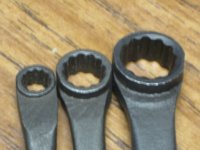
Bonney/Utica did a wrench like this back in the day, and they were called aerospace wrenches for use on jet aircraft engines. Long, basically flat, with enhanced broaching for high torque situations. Being the fasteners on those were often recessed the wrenches were made with a broached protrusion to reach into the recess and get at the fastener. Snap-On obviously duplicated all these features for modern auto mechanics, as typical engine bays these days are especially tight.
The Bonney's were made in a black oxide finish - not chrome - to eliminate flaking chips from contaminating the engine.

Unfortunately Bonney only made these in SAE. But I have a trio of them, and for certain jobs they are unmatched.
 

Attachments

  • IMG_1928.JPG
    IMG_1928.JPG
    113.5 KB · Views: 33
  • IMG_1932.JPG
    IMG_1932.JPG
    94.6 KB · Views: 24
Last edited:
To avoid these ads, REGISTER NOW!
Top Bottom