
Lookin4'67Galaxieconv
Well-known member
For as long as I've been here, I can remember people referring to the Snap On KR 1000 tool box as a tank and indestructible. There's a lot of love for them. About fifteen years ago I had a chance to get one. It was in kind of rough shape, though the price wasn't bad. But with space considerations at the time being a bit tight,I passed. I've seen others over the years but the timing didn't feel quite right, too far away, etc. Earlier this year, I finally found one that looked to be a good fit. It was in pretty decent shape, reasonably priced, and the seller seemed stable. When you need to coordinate renting a vehicle to pick something up, don't discount that. I talked to the seller about him getting a key for it as I didn't want to wrap it in saran wrap, the box had to be locked for moving. I looked at it on a Sunday and made plans to get it the following Saturday. I decided to rent a U-Haul cargo van to go and get it.
I picked it up, along with a KR 537 in excellent condition in a package deal, and made a separate deal on some tools that day that he had. The box had been owned by the seller’s father, who had passed away. He was getting ready to move and had no need for it. I brought it home on a nice spring day where the temps got well into the seventies.
What you will find when buying a 1980s Snap On box with ball bearing slides is the detents will be completely gone as most of the rubber will be disintegrated.
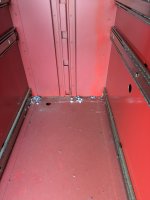
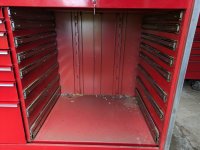
I started on the smaller drawers first. Unscrew the nut that holds the drawer to each slide, then tilt up at a 45 degree angle and work it free from the front tabs then the side tabs. I repeated this for all seven drawers.
After removing the drawers, I did a wet sand with 3000 grit paper on the top and front of each drawer, then a wax on each. If the drawer was just lightly dirty, WD 40 wipe-down on the inside. Purple power if worse. I also labelled each drawer 1 through 6, on a piece of painter's tape so I'd know exactly where they went. Drawer seven was so big there was no need to.
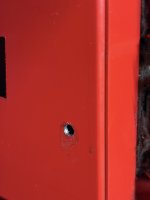
Removing the slides meant drilling out one rivet that affixes each slide to the box. Borrowing some pics from #chargedmr2 here, after he drilled his rivets out, he decided to tap the holes for machine screws, then he won't have to drill rivets out in the future in case he needs to take the slides out. My box is a 1987 model. By 1989 or 90, Snap On had switched to using screws instead of rivets on these and several of their other boxes.

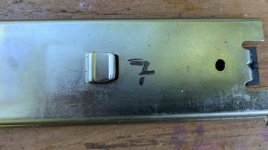
One thing I recommend on the slides is writing on the back with a magic marker the drawer number from top to bottom that the slide belongs to. This definitely makes it easier when putting the slides back in, especially the first couple rows. You don't need to label left or right because there's only one way they can go. I did not do that on the slides for the narrower drawers and it was more trouble putting them back in than when I did do it for the wider drawers.
For the slides, I bought a piece of PVC and an end cap, glued that on there, then filled it with diesel to soak the slides in. Borrowing a picture from one of #iangilly’s threads since I don't have a pic of mine. This is also where I got the tip.
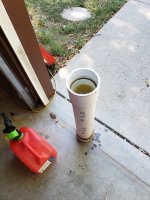
Once the slide was immersed for a few minutes, I pulled it out, drained as much of the diesel as I could back into the tube, then laid it down on my makeshift outdoor workbench. I then blew out the excess diesel with compressed air, and wiped everything else off.
Then came the new detents. As I mentioned earlier, most of them had disintegrated, though a few slides had semblances of the original ones. Took anything I could find of the old ones and pitched them, then added the new ones.

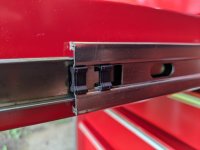
Once the slides were cleaned and had the new detents, I added some ATF for lubrication. When putting the slides back in the box, install the slides for the second drawer before you do the slides for drawer #1. I found this to be easier. When putting the drawers back in, working from bottom to top was easiest in my experience. I did not rivet them back in until I had them all in place.
The bottom drawer, which is the largest in the box, is an outlier. There are four screws on each side holding the drawer to the slide, and an additional four screws holding the slide to the box. Eight on each side, sixteen screws in all. This is actually the easiest drawer to re-install since it sits on the slide. You just need to do some contortioning, especially taking the slides out and putting them back. You need to manipulate the slide for the front two holes, lining them up with holes in the slide to be able to screw them in.
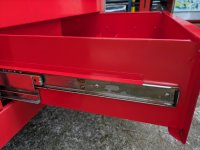
If anyone has any knowledge on the correct detents and where they go for this drawer, please let me know. Right now it works fine but rolls very free.
Also cleaned up the wheels since they were looking quite neglected.


Here's the finished product. Thanks to #chargedmr2, #buckgnarly and #iangilly for their tips.

I picked it up, along with a KR 537 in excellent condition in a package deal, and made a separate deal on some tools that day that he had. The box had been owned by the seller’s father, who had passed away. He was getting ready to move and had no need for it. I brought it home on a nice spring day where the temps got well into the seventies.
What you will find when buying a 1980s Snap On box with ball bearing slides is the detents will be completely gone as most of the rubber will be disintegrated.
I started on the smaller drawers first. Unscrew the nut that holds the drawer to each slide, then tilt up at a 45 degree angle and work it free from the front tabs then the side tabs. I repeated this for all seven drawers.
After removing the drawers, I did a wet sand with 3000 grit paper on the top and front of each drawer, then a wax on each. If the drawer was just lightly dirty, WD 40 wipe-down on the inside. Purple power if worse. I also labelled each drawer 1 through 6, on a piece of painter's tape so I'd know exactly where they went. Drawer seven was so big there was no need to.
Removing the slides meant drilling out one rivet that affixes each slide to the box. Borrowing some pics from #chargedmr2 here, after he drilled his rivets out, he decided to tap the holes for machine screws, then he won't have to drill rivets out in the future in case he needs to take the slides out. My box is a 1987 model. By 1989 or 90, Snap On had switched to using screws instead of rivets on these and several of their other boxes.
One thing I recommend on the slides is writing on the back with a magic marker the drawer number from top to bottom that the slide belongs to. This definitely makes it easier when putting the slides back in, especially the first couple rows. You don't need to label left or right because there's only one way they can go. I did not do that on the slides for the narrower drawers and it was more trouble putting them back in than when I did do it for the wider drawers.
For the slides, I bought a piece of PVC and an end cap, glued that on there, then filled it with diesel to soak the slides in. Borrowing a picture from one of #iangilly’s threads since I don't have a pic of mine. This is also where I got the tip.
Once the slide was immersed for a few minutes, I pulled it out, drained as much of the diesel as I could back into the tube, then laid it down on my makeshift outdoor workbench. I then blew out the excess diesel with compressed air, and wiped everything else off.
Then came the new detents. As I mentioned earlier, most of them had disintegrated, though a few slides had semblances of the original ones. Took anything I could find of the old ones and pitched them, then added the new ones.
Once the slides were cleaned and had the new detents, I added some ATF for lubrication. When putting the slides back in the box, install the slides for the second drawer before you do the slides for drawer #1. I found this to be easier. When putting the drawers back in, working from bottom to top was easiest in my experience. I did not rivet them back in until I had them all in place.
The bottom drawer, which is the largest in the box, is an outlier. There are four screws on each side holding the drawer to the slide, and an additional four screws holding the slide to the box. Eight on each side, sixteen screws in all. This is actually the easiest drawer to re-install since it sits on the slide. You just need to do some contortioning, especially taking the slides out and putting them back. You need to manipulate the slide for the front two holes, lining them up with holes in the slide to be able to screw them in.
If anyone has any knowledge on the correct detents and where they go for this drawer, please let me know. Right now it works fine but rolls very free.
Also cleaned up the wheels since they were looking quite neglected.
Here's the finished product. Thanks to #chargedmr2, #buckgnarly and #iangilly for their tips.
Last edited: