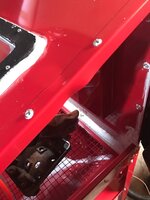
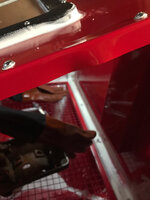
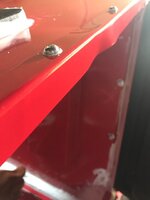
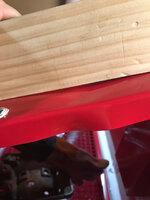
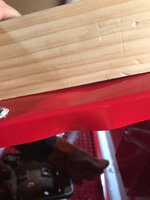
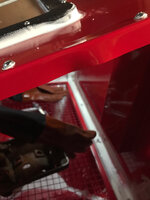
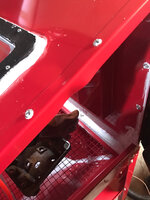
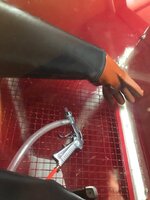
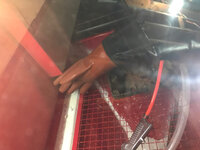
Since you have already examined the blast cabinet, can you tell us what you think caused the damage? Is a $50 Shop-Vac that powerful, or is the cabinet sheet metal too thin? Or is the design of the cabinet that inadequate? All of the above? Thanks for posting, I am thinking about buying that same cabinet. Well, I
was thinking about it, but now I'm not so sure.

Those questions could definitely open a can of worms here lol.
Quite frankly the main cause of damage is just physics at work. I will expand in case some of this isn't fresh in the minds of other readers.
The units we typically measure pressure in are either: Atmospheres (atm), torr., or Pascals (Pa.). Though here in the U.S. everyone is usually accustomed to seeing PSI. At sea level the pressure you experience on your body just walking around is 1atm which is equivalent to the following:
1atm = 760torr = 101325Pa = 14.6959psi.
You see they are all the same!
You never feel any discomfort because, among several other factors, your body is pushing back against this pressure with equal pressure. Hence you live and are none the wiser to what's happening.
When we look at the last unit (psi) what happened to the cabinet starts to make sense. When the shop vac turned on and began evacuating the cabinet of atmosphere the external pressure remained at 14.6959psi pushing against the outside, so no surprise there, what that means though, is that all of a sudden there was nothing inside the cabinet to push outward from inside.
To put this into perspective consider a solid 1 cubic foot chunk of steel just sitting on the ground. The atmospheric pressure pushing on all sides of that cube is (as above) 14.6959psi. But to really get a grip of what that means let's find out how much force there is on it.
Surface area of 1 cubic foot steel = 864 square inches then multiply by our pressure of 14.6959psi. Because Pressure = Force / Area so to find force it would be: Force=Pressure x Area.
864 sq inches (Area) x 14.6959psi (Pressure) = 56480.2N (Force)
So we have 56480.2Newtons of force on our cube just sitting outside. So we convert our value for force to something we might be more familiar with like tons.
56480.2N = 6.3486 TONS of force on the cube.
Now, the surface of the blast cabinet is obviously much larger so that value would go up even higher!
All in all, not surprising why it did what it did.
Now as for design? I think that the HF cabinet is (NOTE: for the money) more than adequate and you are getting a good machine if you pay a little attention to it while assembling it. I used latex, quick drying, caulk on every seam, bolt, nut, glass pane, etc. I have no desire to have a mess in my shop that I didn't directly create. Also, yes there are heavier duty, better made cabinets for sale. But even on a $2000.00 cabinet I would still take the extra hour and seal everything I mentioned above myself. So for those reasons this cabinet was a win in my book. The material is thinner yes, but not so much so that I was afraid of damaging it during assembly. Even a heavier cabinet could not be expected to tolerate what I accidentally subjected mine to.
Also, after spending some time talking to Mike from the Tacoma Company, they build the best upgrade kits for the HF blasters, we both agree that the HF is one of if not the best import economy blasters available. It's biggest flaws (in my opinion) are lighting, hoses, and the gun. So I have made a few mods of my own to solve some feed issues others have complained about. Biggest thing is just don't ask a machine to do something it just can't do. Here, I asked my cabinet to act as a vacuum chamber, hence the crunch.
Disclaimer: I know my math was quick and dirty but it was to convert a less well known measurement to something more easily relatable.
Btw: this is what atmospheric pressure can do!