To avoid these ads, REGISTER NOW!

Socket extension THICKNESS (thick one thin shaft)

back2class

Well-known member
Joined
Jan 7, 2009
Messages
2,723
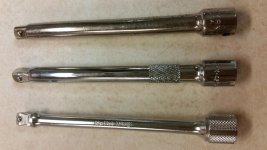
Wondering if anyone had some real world experience on how the thickness of the shafts for extensions play out in actual use. I think thin would be a little better for clearance and weight. But I have to wonder if these thinner ones twist and cause torque loss? Could be a real issue if using for very specific torque perhaps? Here is some examples from the vault pictured. The 1/2 extension pair is a brand new SK and the thin one is an older Proto. Two quality tools. The 3/8 pair is Thorsen and another thin Proto. Kind of an odd shadow on the 1/2 that makes the skinny one look a little thicker than it actually is. On a side note, most of the extensions out there seem to fall into somewhere ranging from in-between to the thick form shown..the Protos being about as thin as I have encountered. Thoughts?
 

Attachments

  • 003.jpg
    003.jpg
    90.2 KB · Views: 172
To avoid these ads, REGISTER NOW!

sometoyotaguy

Well-known member
Joined
Feb 10, 2012
Messages
885
Location
Southern Maine
The only time it should be an issue is with an impact gun. A slightly thinner one shouldn't be a problem with something that is already broken free.
 

larry_g

Well-known member
Joined
Apr 28, 2007
Messages
16,880
Location
oregon
If you have a indicating torque wrench on the extension then what you see on the TW is what is being delivered to the fastener. You lose no torque in an extension. You may lose motion but not torque. Exception being that you have a impact wrench on the extension.

Read this thread; http://www.garagejournal.com/forum/showthread.php?t=4751

lg
no neat sig line
 
Last edited:

ssdave

Banned
Joined
Apr 11, 2015
Messages
2,913
Location
Eastern Oregon
I have several of the thin proto, and generally prefer them. The springiness of them gives you a good feel for how the fastener is behaving. Hard to explain, but I like the way they feel.
 

d.mcfarland

Well-known member
Joined
Jun 18, 2012
Messages
6,572
Location
Western PA
It seems like only the older ones are thin like your picture. I'm guessing the drive end would break well before the middle of the extension ever has damage.
 

airshow

Active member
Joined
Jul 31, 2016
Messages
32
I think the start of the thicker extensions was a reflection of cheaper grade steel China, etc was using to make sockets, ratchets, etc. All my earlier (1970's and earlier) Craftsman, Proto, etc. extensions were thinner and I torqued the **** out of them without ever breaking one.

Fast-forward to the 1980's or so when China/Taiwan started to become a much bigger player in making established tool sets - Craftsman and others. The extensions became huge and quite awkward to deal with; especially 1/2" drives.

My take is even though more steel is used to make them, the price of that cheaper steel offsets a better quality extension.

BTW, I have some Sears wobblies that would be better suited for weightlifters than repairmen.
 
Last edited:

M6erfan

Well-known member
Joined
Dec 6, 2014
Messages
10,170
Location
'Merica!
I think the start of the thicker extensions was a reflection of cheaper grade steel China, etc was using to make sockets, ratchets, etc. All my earlier (1970's and earlier) Craftsman, Proto, etc. extensions were thinner and I torqued the **** out of them without ever breaking one.

^^^this^^^
 

gdocktor3

Well-known member
Joined
Apr 18, 2015
Messages
5,419
Location
Connecticut
I generally always pick my thin Proto's and Craftsman V series extensions over my fatter ones. Only time I grab the thicker Snap On's or SK's are when I need the knurled grips.
 

gdocktor3

Well-known member
Joined
Apr 18, 2015
Messages
5,419
Location
Connecticut
I think the start of the thicker extensions was a reflection of cheaper grade steel China, etc was using to make sockets, ratchets, etc. All my earlier (1970's and earlier) Craftsman, Proto, etc. extensions were thinner and I torqued the **** out of them without ever breaking one.

Fast-forward to the 1980's or so when China/Taiwan started to become a much bigger player in making established tool sets - Craftsman and others. The extensions became huge and quite awkward to deal with; especially 1/2" drives.

My take is even though more steel is used to make them, the price of that cheaper steel offsets a better quality extension.

I don't think that's the case because Snap On extensions have always been made in USA and the vintage models were thin like those, but now are all thick. Its just a better, stronger design and is now probably an industry standard. Not to mention fasteners, hand tools, thread lock, etc have all advanced so much, the thin extensions can't handle the same work load as the modern design. Mechanic's now use 24" ratchets and breaker bars regularly where most vintage ratchets you see are only 7-10" long.
 

airshow

Active member
Joined
Jul 31, 2016
Messages
32
I have a spattering of -v- extensions in 3/8 and 1/4 drives. Old Proto for 1/2 drives.

All the others are fatboys. I'm in the process of revamping my home garage, so will replace the fatboys with some good used -v-'s.
 

airshow

Active member
Joined
Jul 31, 2016
Messages
32
I was surprised to hear of the thicker SO extensions. (I only have a few SO tools). You could be right, but in manufacturing (my trade) you're always looking to cut costs, and that certainly includes material costs and material treating.

Have all top-tier toolmakers gone to the thicker extensions? Mac, Matco, Proto?
 
Last edited:

M6erfan

Well-known member
Joined
Dec 6, 2014
Messages
10,170
Location
'Merica!
Would love to see a thickness comparison of chrome extensions from various manufacturers
 

dnschmidt

Well-known member
Joined
Oct 3, 2014
Messages
7,278
Location
Phoenix, AZ
This only matters with impact extensions due to the nature of the impacting hit. There the thicker the better. On a normal extension it makes no difference whatsoever.
 

Ole Slewfoot

Well-known member
Joined
Feb 22, 2016
Messages
5,098
Location
Freedom, CA
I've broke a good few extensions, and I cant think of one that hasn't been right at the male drive end regardless of profile, brand,or expensiveness.
 

gdocktor3

Well-known member
Joined
Apr 18, 2015
Messages
5,419
Location
Connecticut
I have old Husky USA extensions that are thin also. All my thin extensions are also raw/brushed finish, no chrome. That could play a part also.
 
To avoid these ads, REGISTER NOW!

Wamsutta

Well-known member
Joined
Jan 8, 2014
Messages
10,876
Location
Amarillo, Texas
The thinner they are, the more they're going to twist under load.

When the bar diameter is smaller than the square drive size, that's a red flag.
 

BFHtime

Well-known member
Joined
Mar 31, 2012
Messages
983
Extension can twist and absorb energy, even with a ratchet when pulled hard. Longer extensions usually twist more. Longer snap-on extension are supposed to be made up of a bars of steel welded together to limit the amount the extension can twist. I have had some long extensions twist quite a bit, so it would seem like the fastener was turn on the ratchet end but nothing was moving on the fastener end. I have also broken some using a ratchet pull hard.
 

T45

Well-known member
Joined
Nov 20, 2014
Messages
3,252
I'm with the crowd that says thinner/vintage is a signifier almost always a higher end steel. If you hit them like a tuning fork, it tends to reveal they are not made of the same stuff. Wether or not this matters really comes down to alot of personal views, and if you can afford to break stuff or not. The more expensive extension sets are pricy, but having a mixture around probably isn't a bad idea -- if you can swing a couple decent ones-- in 1/4 drive, especially. Which is the one drive where its easiest to test out to the limits of cheaper tools.
 

justme-

Well-known member
Joined
May 24, 2014
Messages
787
Location
Boston suburbs
The vintage thinner ones are absolutely higher grade steel and today's are inferior to them. Manufacturers will cut costs wherever possible, so the lack of low cost high quality steel means the low grade raw material is the most cost effective option even if the need to use more, as in thicker, to handle the same load.
 

Wes J

Well-known member
Joined
Mar 13, 2016
Messages
457
Location
Peoria, IL
I highly doubt there is any difference in the steel.

The difference is the manufacturing process. The larger section extensions are easier to make. They take a steel bar and use a head forming machine to cold form the square end and bulge and form the female end. Then drill for the ball and you're done.

The thinner section extensions would require an extra step to reduce the thickness. It appears Snap On use a CNC lathe to do it. More metal removal = more $.

For the record, I think Snap On has both styles still available. I like the reduced thickness personally. More clearance and not as heavy and bulky.

 
Last edited:

Ole Slewfoot

Well-known member
Joined
Feb 22, 2016
Messages
5,098
Location
Freedom, CA
There will be a difference in the steel. in the old days, the only way to make a decent tool was to use good steel. Now you can use high technology to make a half decent tool from mediocre steel.
I do agree on cheapness being the motivator though.
 

General Geoff

Well-known member
Joined
Jan 12, 2013
Messages
3,873
Location
Allentown, Pennsylvania
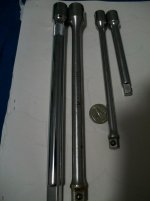
3/8" drive extensions

shaft thickness from top to bottom:

Craftsman USA early 2000s, 15/32"
SK, pre-Ideal, probably mid-late 2000s, 1/2"
Koken, early-mid 2010s, 3/8"
 

Attachments

  • 20160820_030840.jpg
    20160820_030840.jpg
    140.4 KB · Views: 43
Last edited:

jeejay

Well-known member
Joined
Jun 20, 2016
Messages
465
Wouldn't logic (or tolerances) dictate that an extension of a square drive would be the same thickness as that, and any more or less would be pointless (besides to connect another square within it)?

Just look at torque wrenches, what torque range does each drive size cover... that's the proper range in which to use a drive or extension of it.
 

Wes J

Well-known member
Joined
Mar 13, 2016
Messages
457
Location
Peoria, IL
There will be a difference in the steel. in the old days, the only way to make a decent tool was to use good steel. Now you can use high technology to make a half decent tool from mediocre steel.
I do agree on cheapness being the motivator though.

If anything, the steel is better today. Modern process controls and automation have drastically improved the quality of steel and reduced the prices.
 

T45

Well-known member
Joined
Nov 20, 2014
Messages
3,252
If anything, the steel is better today. Modern process controls and automation have drastically improved the quality of steel and reduced the prices.

I don't think this applies accross the board. I still see cheap OEM nuts and bolts all over the place.
 

lbhsbz

Well-known member
Joined
Jan 13, 2010
Messages
1,176
Location
Long Beach CA
I have noticed that the new snappy extensions are larger than what they offered 20 years ago, as I've had to replace a couple I lost and they don't fit in the old tray. Not sure why the change, breakage had never been a concern
 

PJNJ

Well-known member
Joined
Sep 20, 2013
Messages
1,047
Location
Iowa
Lots of interesting theories posted here. I have a tendency to believe the quality of the steel used by many of the companies is probably better today than in the past.

And maybe it is cheaper to make them thicker - as there may be less machining necessary.

But I think the main reason for thicker extensions may be the large expansion of the use of air/electric impact tools not only in the repair industry but also by DIY'ers. And on top of that the power (ft. lbs.) of those impact tools has increased greatly in the last 20 or so years. Thicker extensions transmit more torque and probably last longer.

Yeah, we're supposed to use impact rated extensions (and I do) but many use chrome sockets on their impacts and probably use chrome extensions too.

:beer:
 
Last edited:

geraldamy

New member
Joined
Aug 20, 2016
Messages
2
I have several of the thin proto, and generally prefer them. The springiness of them gives you a good feel for how the fastener is behaving. Hard to explain, but I like the way they feel.
o.png
 
To avoid these ads, REGISTER NOW!
Top Bottom