To avoid these ads, REGISTER NOW!

Socket-Size to Drive-Size?

IdahoMan

Well-known member
Joined
Feb 26, 2015
Messages
434
When is a socket too large, or too small, for a drive size?

Where are the official tables/charts and math for deciding when to move up or down on a size?

Ex: I have a 28mm socket that is for a 1/2"dr. That seems a little too small a drive size to me. Idk.

Thanks.
 
To avoid these ads, REGISTER NOW!

nelstomlinson

Well-known member
Joined
Jul 27, 2009
Messages
649
Location
Interior Alaska
I like to have the drive size close to the bolt shaft diameter if I'm going to be pulling hard. If the socket is much past twice the drive size, I will probably move up to a larger drive unless it's low torque.
 
OP
I

IdahoMan

Well-known member
Joined
Feb 26, 2015
Messages
434
I like to have the drive size close to the bolt shaft diameter if I'm going to be pulling hard. If the socket is much past twice the drive size, I will probably move up to a larger drive unless it's low torque.

I feel the same.
 

General Geoff

Well-known member
Joined
Jan 12, 2013
Messages
3,877
Location
Allentown, Pennsylvania
When is a socket too large, or too small, for a drive size?

It's too large when you shear the square drive off your ratchet or breaker bar.

It's too small when there isn't enough clearance for your larger drive size ratchet and socket.


If you need to stand on a 2 foot or longer bar to break it loose, you should probably be using 3/4" drive. Or switch to a rattle gun.
 
Last edited:

JulianMorrow

Banned
Joined
Jan 18, 2019
Messages
287
Location
Oklahoma
I use the smallest drive size that I can get away with. I absolutely love using 1/4” drive.

Don't agree with this as a general philosophy--with every drop in drive size, you're having to apply more force. I come from an IT/programming background, where the programmer's mantra is: "Make the machine do the work" The same should be true here: "Make the tools do the work".

Of course, one can be ridiculous and use a 1/2 drive on small 8mm fastener, when a 1/4 drive would've been sufficient. I typically use the following guide:
1/4" drive for anything below 10mm
3/8" drive for 10mm--14mm when clearance is an issue.
1/2" drive for everything else. Impact 1/2" on difficult to remove fasteners.
 
Last edited:

matt_i

Well-known member
Joined
Mar 14, 2008
Messages
10,729
Location
SE Michigan
I worked on a project where some engineer(s) put a 41mm hex on a coolant fitting.

No such thing exists commercially as you might expect. $$$$ to have custom socket CNC machined.

We took a 1-9/16" 3/4" drive impact socket which is around ~.010" oversized, took off some pounds from the OD on the lathe and welded in a 3/8" socket to get the smaller drive, which is the DC servo power tool that tightens it in production.

After that I'm convinced there are no standards when it comes to special tools. It wouldn't be very often you get into that but I have no idea how its going to be serviced in the field.....
 

CR888

Well-known member
Joined
Feb 19, 2017
Messages
1,198
I agree with what's been posted about drive square relevant to fastener size. But I like overlap in my sockets. I like 1/4" going up to 15mm, I'd even like it to go to 16mm..3/8" I like going up to 22/24mm & my 1/2" set goes from 8mm-36mm. But I have some bigger sockets up to 50mm. Sure the extreme max/min sizes are usually not ideal but its good to have that option. On a problem really stubborn fastener I like to use the biggest drive size I can. While a 22mm fastener can be dealt with using a 3/8" socket you also have the option of using 1/2" or even 3/4". Its about options combined with common sense to define what's best in a particular situation. Besides I kinda just like sockets.:thumbup:
 

DFB

Well-known member
Joined
Sep 7, 2016
Messages
5,765
Location
Southern VT/Western Mass
I cant even barely imagine often using 22mm or 7/8" sizes with 3/8" drive tools. For me most of those fasteners sizes would be truck lug nuts or tractor wheel bolts.

Well unless...maybe...it was one of those 18" Harbor freight flex head breaker bars :lol:


It all depends on the fastener though and the amount of leverage needed and really ham ******* on things like drain plugs or rusty small bolts often times can easily get things stripped or broke.

And I will admit 3/8" in half inch drive is quite the overkill
 

Professional Tool User

Well-known member
Joined
Apr 9, 2018
Messages
1,835
Location
BC
28mm isn't too small. I use my 1/2" dr 30mm socket from time to time and 1 1/8, 1 1/4, 1 5/16, and 1 1/2 are all common sizes on big rigs. This is why I retired my Canadian tire impact socket set and spent a few hundred dollars on 4 separate no size skip 1/2" Dr Princess auto pro point impact socket sets that go all the way up to 36 mm and 1 1/2. It's just more convenient to grab a 1/2" Dr socket and go with a gun, breaker bar, or a 24" flex head ratchet if space is at a premium and/or you know the fastener is not seized.
 
Last edited:

Leaflessshadetree

Well-known member
Joined
Aug 1, 2013
Messages
7,168
Location
Don't ask.
Oil filter sockets which are usually 3/8" drive?
I used one for mounting large circular connectors. I don't recall if it was 1/2" or 3/8" drive but it was probably about 3" (76mm).

Generally fasteners that require smaller end of the drive size can be easily snapped before the wrench fails.
 

Tallpilot

Well-known member
Joined
Jan 13, 2017
Messages
2,384
Location
Orlando
I like to have the drive size close to the bolt shaft diameter if I'm going to be pulling hard. If the socket is much past twice the drive size, I will probably move up to a larger drive unless it's low torque.

I feel the same.

This is a good place to start. Modern designs are much stronger than in the past and also have longer handles which is very nice. If it is very stuck I want the biggest thing that will fit. If 1/4 low profile is the only thing that fits then that is what gets used.
 

Packard V8

Well-known member
Joined
Mar 16, 2009
Messages
7,380
Location
Spokane, WA
Having pulled wrenches for sixty years, this wanting to use the smallest possible drive size is a relatively new phenomenon. Back when, most work was done with 1/2"dr.
FWIW, I watched Don Garlits completely rebuild his top fuel dragster engine in a gravel pit stall using the aforementioned Craftsman 1/2" drive set with sockets from 1/4" to 1". Those were the only sockets he carried and in that little hip-roofed box.

The local Snap-on truckie has been around forever and he says he warranties more sockets every year. Back in the day, a mechanic would be ashamed to say he broke a 1/4"dr or 3/8"dr where he should have been using 1/2".

Also, the more powerful smaller impact guns are ubiquitous; many of today's technicians will lean on a 3/8"dr chrome socket on an impact gun and then ask for a replacement when it breaks.

Your tools, your money, your decision.

jack vines,
 

woody 73

Well-known member
Joined
Apr 14, 2009
Messages
11,546
Location
The Great State Up North
It's too large when you shear the square drive off your ratchet or breaker bar.

It's too small when there isn't enough clearance for your larger drive size ratchet and socket.


If you need to stand on a 2 foot or longer bar to break it loose, you should probably be using 3/4" drive. Or switch to a rattle gun.

This ^^^
 

HFlashman

Well-known member
Joined
Apr 22, 2017
Messages
48
As a pure amateur and having discovered this site a couple of years ago, I now use 1/4 inch exclusively on the bicycles and mostly on motorcycles since I am less likely to over-torque a fastener. Both have a lot of aluminum and it is easy (I know) to create a real problem. I also use a 1/4 inch torque wrench on both as well.
 

Tallpilot

Well-known member
Joined
Jan 13, 2017
Messages
2,384
Location
Orlando
Having pulled wrenches for sixty years, this wanting to use the smallest possible drive size is a relatively new phenomenon. Back when, most work was done with 1/2"dr.
FWIW, I watched Don Garlits completely rebuild his top fuel dragster engine in a gravel pit stall using the aforementioned Craftsman 1/2" drive set with sockets from 1/4" to 1". Those were the only sockets he carried and in that little hip-roofed box.

The local Snap-on truckie has been around forever and he says he warranties more sockets every year. Back in the day, a mechanic would be ashamed to say he broke a 1/4"dr or 3/8"dr where he should have been using 1/2".

Also, the more powerful smaller impact guns are ubiquitous; many of today's technicians will lean on a 3/8"dr chrome socket on an impact gun and then ask for a replacement when it breaks.

Your tools, your money, your decision.

jack vines,

I suspect it's easier access on a top fuel dragster than a transversely mounted V6 in a Camry. But I don't disagree that small chromes on powerful impacts is warranty abuse.

As we were discussing in another thread the engineers don't seem to take ease of repair into account when designing modern engine bays or anything else for that matter (fuel tanks with no access panel to the sending unit, etc). This is forcing the use of smaller drive sizes in many cases. I suppose we could take more stuff apart to gain access but I wish you luck convincing a flat rate guy to do that.
 
To avoid these ads, REGISTER NOW!

logical

Well-known member
Joined
Aug 31, 2005
Messages
2,466
Location
Northern fringe of the Motor City Suburbs
I thi k within some very wide parameters it's more about high much grunt is needed and how much room you have. For cars it always seems to be 1/4 if I'm sitting inside, 3/8 if I'm standing beside it and 1/2 if I'm sitting on the ground or laying under it.

My 3/8 go up to 19mm and 1/2 down to 10mm...seems about right.
Sent from my SM-G950U using Tapatalk
 

Mechanical Noise

Well-known member
Joined
Apr 25, 2014
Messages
2,635
Location
Southeast of O'Hare
I have a 1/2"drive 36mm socket. I don't remember what I got it for but it couldn't have been for a super high torque application. I've got some 1 1/4" and 32 mm sockets I've used a few times. On the other end, I have a 1/2" drive 9mm socket. It's obviously been used but, again, I don't remember where. Probably on rusty 3/8" fasteners.

At one time, I used to be able to use the 1/2" drive set for most everything.
 

AceofSpad3s

Well-known member
Joined
Oct 1, 2014
Messages
1,808
I don't go smaller than 10mm or 7/16 with 3/8's, feels awkward to use with real small fasteners, but I use some on 8mm bolts a few months ago since I had them with me. Going from 3/8 to 1/2 is more dependent on what the expected torque is needed.
 

Mr Ratchet

Well-known member
Joined
Mar 3, 2011
Messages
929
Location
Michigan
If it does not fit in my Hansen trays, it's either too large or small for the drive size!:lol_hitti

Seriously though, space and torque are the determining factors for me. I've used the max and min socket size in all four of my drive sizes at least once. I don't doubt I'll do it more times before my tool days are over.
 

JulianMorrow

Banned
Joined
Jan 18, 2019
Messages
287
Location
Oklahoma
Having pulled wrenches for sixty years, this wanting to use the smallest possible drive size is a relatively new phenomenon. Back when, most work was done with 1/2"dr.
FWIW, I watched Don Garlits completely rebuild his top fuel dragster engine in a gravel pit stall using the aforementioned Craftsman 1/2" drive set with sockets from 1/4" to 1". Those were the only sockets he carried and in that little hip-roofed box.

The local Snap-on truckie has been around forever and he says he warranties more sockets every year. Back in the day, a mechanic would be ashamed to say he broke a 1/4"dr or 3/8"dr where he should have been using 1/2".

Also, the more powerful smaller impact guns are ubiquitous; many of today's technicians will lean on a 3/8"dr chrome socket on an impact gun and then ask for a replacement when it breaks. Your tools, your money, your decision.
jack vines,

Great post, it deserves to be quoted in full. Thanks for that.
 

Kasal

Well-known member
Joined
Nov 21, 2017
Messages
739
Location
Galicia, España
I have a 1/2"drive 36mm socket. I don't remember what I got it for but it couldn't have been for a super high torque application. I've got some 1 1/4" and 32 mm sockets I've used a few times. On the other end, I have a 1/2" drive 9mm socket. It's obviously been used but, again, I don't remember where. Probably on rusty 3/8" fasteners.

At one time, I used to be able to use the 1/2" drive set for most everything.


36mm I have used it for the oil filter cover in a Bmw e46 and in Opel (for you it would be a GMC if I'm not mistaken).
 

Handyandy23

Well-known member
Joined
Nov 8, 2017
Messages
1,523
Location
Ontario, Canada
Having pulled wrenches for sixty years, this wanting to use the smallest possible drive size is a relatively new phenomenon. Back when, most work was done with 1/2"dr.
FWIW, I watched Don Garlits completely rebuild his top fuel dragster engine in a gravel pit stall using the aforementioned Craftsman 1/2" drive set with sockets from 1/4" to 1". Those were the only sockets he carried and in that little hip-roofed box.

The local Snap-on truckie has been around forever and he says he warranties more sockets every year. Back in the day, a mechanic would be ashamed to say he broke a 1/4"dr or 3/8"dr where he should have been using 1/2".

Also, the more powerful smaller impact guns are ubiquitous; many of today's technicians will lean on a 3/8"dr chrome socket on an impact gun and then ask for a replacement when it breaks.

Your tools, your money, your decision.

jack vines,

I'm not a "pro" but this is how I usually use my tools. And as someone else said, make the tools do the work. 1/2" drive covers pretty much every normal automotive size you'd need, except for interior. So if I'm doing a job I'll grab a 1/2" set and a regular length and long ratchet.

I don't really see the point in defaulting to 1/4". Sure it's lighter, but the ratchets are also smaller and shorter. Less effort is put into holding the weight of the tool, but much more effort is put into breaking bolts free.

Maybe it's just because I'm a smaller guy, but I'd much rather start with a 14mm on my 1/2" 24" long flex head ratchet (if space permits). And then I can start out with moderate force input versus standing on the end of an 8" ratchet.
 

DFB

Well-known member
Joined
Sep 7, 2016
Messages
5,765
Location
Southern VT/Western Mass
A lot of axle nuts are 36mm, and the specialty axle socket sets usually all come 1/2" drive

Though I have 3/4" drive sockets if I need them they all are the basic shallow design

And also own 1/2" drive 6pt deep impacts up to 38 and 1-1/2"

I often use the 1 5/16" deep a lot for 3 point cat 1 pin nuts with my Milwaukee 2763
 

cherrybomb

Well-known member
Joined
Oct 18, 2016
Messages
892
Location
Near Madison Wi.
As a pure amateur and having discovered this site a couple of years ago, I now use 1/4 inch exclusively on the bicycles and mostly on motorcycles since I am less likely to over-torque a fastener. Both have a lot of aluminum and it is easy (I know) to create a real problem. I also use a 1/4 inch torque wrench on both as well.

That really is a good use of 1/4 tooling.That torque wrench will really be a benefit IMO.
 

FSrepair&fabrication

Well-known member
Joined
Jul 28, 2017
Messages
908
Location
maryland
I use all drive sizes 1/4 to 1” they all have their range, it depends on what youre working on. 5/8/15mm and down ill usually grab a 3/8 drive. anything above that its usually 1/2 amd once i get above 15/16 im going for the 3/4 drive if the gun will fit. But it all depends on the torque too. I use my 3/4 drive torqe wrench with a 3/4 12pt to torque headbolts to 330 ft/lb, or 33mm (1 5/16) lugs to 450. On a non specialty bolt of that size id be using 1/2 but every job is different.
 

M6erfan

Well-known member
Joined
Dec 6, 2014
Messages
10,170
Location
'Merica!
Don't agree with this as a general philosophy--with every drop in drive size, you're having to apply more force. I come from an IT/programming background, where the programmer's mantra is: "Make the machine do the work" The same should be true here: "Make the tools do the work".

Of course, one can be ridiculous and use a 1/2 drive on small 8mm fastener, when a 1/4 drive would've been sufficient. I typically use the following guide:
1/4" drive for anything below 10mm
3/8" drive for 10mm--14mm when clearance is an issue.
1/2" drive for everything else. Impact 1/2" on difficult to remove fasteners.

Right. But isn't it the length of the handle the "machine" in this case? Not the anvil. An 8" ratchet in any drive size has the same amount of relative leverage.
 

M6erfan

Well-known member
Joined
Dec 6, 2014
Messages
10,170
Location
'Merica!
And, it's about having the machine fit the circumstance. If you have to move dirt, a bulldozer is the most powerful, and can do it the easiest. But, a mini-excavator or shovel might be a lot more appropriate.

My most used 1/2" drive ratchets are 9 1/2", 11", 14", 14", and 15".
My 3/8" are 4,7,8,9,10,11".
My 1/4" are 4,5,6,11".

In theory, I could use an 11" ratchet in any of the three drive sizes. But, many times that length won't fit and work correctly. I use the 4" and 6" 1/4" drive more than any others on automotive. In 3/8", I predominately use the 8". In 1/2", I predominately use the 11". I only go to the longer if I've got stubborn fasteners that need more leverage.

Under the proposed "let the machine do the work" principle, I'm obviously mentally challenged, because I don't automatically go to the 15", high leverage tool first. Under the real world, actually do the work principle, I obviously choose my tool to fit the job needed.

What I have found by using 3/8" and 1/4" drive more, is that I break a lot less fasteners than I used to when my primary set was 1/2" drive, so I had to use that. I don't find I break a lot more sockets. What I break the most of is 1/2" and 10mm x 3/8" drive, and 3/4" to 7/8" in 1/2" drive. Those are just at the weak spot of size/thickness to break more easily. When you go up to 9/16" or 1", the socket wall thickness generally gets a lot thicker.


I use 1/4" 75% of the time and I'll pick my 4-5" ratchet for 90% of this use. My 8" 1/4 ratchet can be a bit much, especially on aluminum.

That said, my 12v Impact gets a lot of use on disassembly duty, but rarely for re-assembly. THIS is letting the machine do the work, literally.
 

Sportsman762

Well-known member
Joined
Aug 24, 2018
Messages
123
Location
OH
I normally use 1/2" drive unless the bolt is too small or too big. If the socket is smaller than 1/2" then I use a 1/4" drive. If the bolt is 1" or larger I use the 3/4" drive. I do not carry 3/8" in my portable boxes as I see little need for it. If the machine is small then it must be a truck and therefor the bolt is rusted on. If the machine is large then it means reaching for the 3/4" set. Yesterday I was replacing some lights on a trailer with 1/2" socket and 1/2" drive, snapped 4 of the 8 bolts off. The trailer has only seen 5 winters of use. Salt *****.
 

Tylermorris

Well-known member
Joined
Apr 10, 2019
Messages
112
Location
Enderby bc Canada
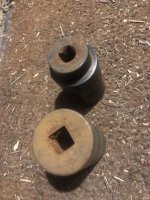
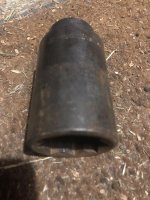
I have a 1/2” drive 8pt 1 3/8 snap on and a Cornwell 1/2” drive 6 pt 1 3/8
 

Attachments

  • image.jpg
    image.jpg
    139.9 KB · Views: 11
  • 6F0A438B-C50F-45B1-A1AB-9E6E769920D9.jpg
    6F0A438B-C50F-45B1-A1AB-9E6E769920D9.jpg
    102.3 KB · Views: 13
  • 7E0A6348-08DF-44A9-8855-1895646602D8.jpg
    7E0A6348-08DF-44A9-8855-1895646602D8.jpg
    154 KB · Views: 11

JulianMorrow

Banned
Joined
Jan 18, 2019
Messages
287
Location
Oklahoma
Right. But isn't it the length of the handle the "machine" in this case? Not the anvil. An 8" ratchet in any drive size has the same amount of relative leverage.

A larger anvil (e.g., 1/2") is stronger and less likely to break/slip under high torque compared to a smaller anvil (e.g., 1/4"). Compare impact tools with their different torque ratings for different drive sizes--that underlines the point.

A mechanic once posted here that he prefers a 3/8" ratchet over a 1/2" ratchet, because he didn't like carrying around the extra weight of a 1/2" ratchet throughout the day. That ergonomic justification is the best argument for going to a smaller size, along with clearance issues.
 

orangeblood

Well-known member
Joined
Dec 7, 2016
Messages
297
Location
Texas
...... FWIW, I watched Don Garlits completely rebuild his top fuel dragster engine in a gravel pit stall using the aforementioned Craftsman 1/2" drive set with sockets from 1/4" to 1". Those were the only sockets he carried and in that little hip-roofed box.

^thanks for sharing that memory.....must have been a really neat thing to watch
 

stonesg

Well-known member
Joined
Jun 13, 2016
Messages
249
Location
SE Georgia
It's too large or small when the manufacturer doesn't make a socket in that drive/size...

Adapters will get you some slop either way but could you picture swinging a 3" socket with adapters and a 1/4 ratchet?

At some point it becomes impractical.
 

PelicanPines

ALLIANCE MEMBER
Joined
Apr 30, 2014
Messages
38,117
Location
New Jersey, USA, Earth, My own reality
It's too large or small when the manufacturer doesn't make a socket in that drive/size...

Adapters will get you some slop either way but could you picture swinging a 3" socket with adapters and a 1/4 ratchet?

At some point it becomes impractical.

So correct... it's why i use 1/4" & 1/2"... rare for me to pull out my 3/8" anything.
 

Samuel D

Well-known member
Joined
Apr 9, 2019
Messages
638
So correct... it's why i use 1/4" & 1/2"... rare for me to pull out my 3/8" anything.
Old school! And why not …

I was in Romania a few weeks ago and noticed that 3/8"-drive is still pretty rare there. Even car mechanics were using 1/4"-drive or 1/2"-drive and nothing in between.

Where does Plomb’s 9/16"-drive fit in?
 
To avoid these ads, REGISTER NOW!
Top Bottom