To avoid these ads, REGISTER NOW!

Sodium citrate for rust removal!

Beerhippie

Well-known member
Joined
Oct 13, 2023
Messages
9,733
Location
Far NE Oregon
After reading how some folks are mixing citric acid and baking soda to make a rust remover, I got to thinking. What you should get from that is one hell of a mess, lots of CO2 and sodium citrate.

So I just cut to the chase. After a little research, I found that sodium citrate is used in food prep, so I asked the cooks in the pub kitchen if they had any. They gave me this bag,

54130928090_ea0e7a3afd_b.jpg

about half-full, left over from a previous culinary experiment.

I picked up this neat little rabbet plane back in April, and put it away and forgot it. I ran across it again today and decided to give the citrate a try.

53650342385_2fa1ed278d_b.jpg

Sorry, the only "before" picture I have of it.

After an hour-and-a-half in a saturated citrate w/160F water and an industrial ultrasonic cleaner:

54130817154_5d4079d7a0_b.jpg

No elbow grease was used in this experiment.

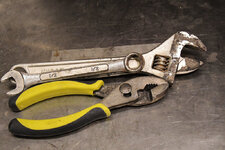
May as well see how much use I can get out of the now-near-black solution, so I grabbed these from the brewery tool box:

54130755118_1eda8f5368_b.jpg

They're in the ultrasonic right now. I'll report back when they've buzzed for an hour or so.
 
Last edited:
To avoid these ads, REGISTER NOW!
OP
B

Beerhippie

Well-known member
Joined
Oct 13, 2023
Messages
9,733
Location
Far NE Oregon
Yes, $8.80/lb vs. $9.50, but I don't really feel the need to have eight pound on hand. One nice thing is I'm getting a lot of use out of a single batch.

Just used the same batch to clean some more plane parts today:

54162253579_c4b932e655_b.jpg

Take my word for it, it was a lump of rust.

The SC seems to be easy on paint (that might be Japanning), which is sometimes desirable.
 
To avoid these ads, REGISTER NOW!

Dagny

Well-known member
Joined
Jul 25, 2014
Messages
2,985
Location
Northern Wi.
Wonder how it would work for rust stains on a fiberglass tub iron out is so nasty I hate using it
 
OP
B

Beerhippie

Well-known member
Joined
Oct 13, 2023
Messages
9,733
Location
Far NE Oregon
Well, my experiment with how long the solution will last and how many uses I can get out of it is at an end. :(

My mistake was simple: I needed a container, preferably wide-mouth with a good lid, for storing the solution. I went to the pub kitchen in search of such and was successful--in a way. The container was exactly what I was looking for--the cook simply consolidated the contents of two two-pound jugs of black pepper into one, and I was set to go.

Turns out, you can't clean the smell of black pepper out of a poly container. Worse, when the pepper gas combines with iron, the result is something now banned by the Geneva Convention.

When this awful substance is used on porous cast-iron, the result is a tool that forever stinks--and if you file, sand or grind on it, your hands and shop will too.

My half-gallon of SC solution will be going to the toxic waste facility at Arlington tomorrow. Let's hope they accept it. If not, we'll move it on to the chemical weapons disposal facility in nearby Umatilla.
 
OP
B

Beerhippie

Well-known member
Joined
Oct 13, 2023
Messages
9,733
Location
Far NE Oregon
Wonder how it would work for rust stains on a fiberglass tub iron out is so nasty I hate using it
I'd give it a try!

I'm using about five hundred grams per quart of hot water, plus a small shot of Dawn dish soap.

I believe that oxalic acid is the usual chemical used for rust stain removal, but oxalic acid is pretty toxic if consumed.
 
OP
B

Beerhippie

Well-known member
Joined
Oct 13, 2023
Messages
9,733
Location
Far NE Oregon
I called the Hazmat disposal line. The nice folks in white moon-suits tell me I might be able to leave my big plastic bubble in a day or so. The machinery they're rigging up outside the shop is a little concerning.
 

rlitman

Well-known member
Joined
Oct 18, 2010
Messages
24,596
Location
Long Island
Is this the stuff that gives you the runs if you eat it dissolved in a tea?
No. It has a lot of sodium though, as the name should make clear.
I think that is Magnesium Citrate. Works like a charm.
Correct. It's the magnesium that's the laxative.
Throw 1-2 tablespoons of that food grade stuff in a pan with some grated cheese and a little milk to make super creamy, not hardening cheese dip or sauce.
That's a lot. Sodium citrate is probably the best additive for making cheese super melty, but I find it off putting when used at the suggested 2-3% w/w. It turns the cheese too much into a velveeta goo, and I'm happiest at 1.5% w/w, though even as little as 1% helps prevent fondue curdling.
 
OP
B

Beerhippie

Well-known member
Joined
Oct 13, 2023
Messages
9,733
Location
Far NE Oregon
I'm back to singing the praises of this stuff!

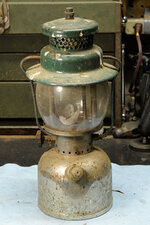
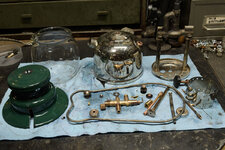
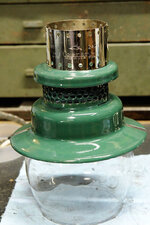
I'm restoring a 1950 Coleman lantern right now. I used a hot lye solution in the ultrasonic cleaner to remove dirt, pigeon **** and grime. My next step has always been phosphoric acid to remove rust and oxidation. Phos acid will ruin the porcelain enamel on a lantern ventilator (or any other porcelain, like the bathroom sink). It turns brass pink by removing some of the surface zinc from the alloy, requiring a fair amount of elbow grease to restore to brass-colored brass. So I tried a hot sodium citrate solution (1 lb/gal H2O) in the ultrasonic instead. I've been doing this to remove rust from steel for a while, but this was the first time trying it on nickel-plate, brass and glass.

Before:

54602981318_5041c9729e_o.jpg

54602769231_02912c633a_o.jpg

After, no elbow grease invested:

54603226814_244c5030e3_o.jpg


54603348085_7e89b14d5b_o.jpg


54604717140_24cec25fc0_o.jpg

The last pic is some parts that required absolutely no elbow grease and are ready for use. They got a rinse with denatured alcohol, as I've fount that eliminates spotting and streaking from our hard water. The brass parts are left bright brass.

I'm lovin' this stuff!
 
Last edited:
To avoid these ads, REGISTER NOW!
Top Bottom