To avoid these ads, REGISTER NOW!

Soil stabilization fabric under driveway

iagsxr

Well-known member
Joined
Jan 10, 2010
Messages
1,505
Location
Vinton, Iowa
What do I need to know about soil stabilization fabric?

I'm working on a big driveway area by an old storage building. I need to end up with a driveway that will support my pneumatic-tired forklift. Not sure what the machine weighs, it has a 6000lb. capacity so it's heavy.

For starters I'm going to do a 10' × 32' area where there had been a lean to on the building. There'll be foundation holding the rock in place on three sides. The shallowest I've measured is needing about 8" of rock, most of it is around a foot.

What I was planning to do is put down fabric, a layer of 4", then bring it to grade with road rock. I see there's woven and non-woven fabric. Apparently the non-woven drains quicker. I'm thinking not much water's going to pass through that thick of gravel and I just need to grade it to run off anyhow.

How's that all sound?
 
To avoid these ads, REGISTER NOW!

Streetbu

Well-known member
Joined
Jan 7, 2014
Messages
3,082
Location
Central NY
I've always seen crews use Typar. Didn't know there was different versions. Basically it just keeps the stone from sinking into the dirt and let's water thru. What you said sounds like it should work fine as long as it's compacted well.
 

pstnbly

Well-known member
Joined
Jul 20, 2010
Messages
766
Location
So. Vermont
Geotextile fabric. The woven variety is "road fabric" to support loads. the "spun" type is filter fabric to be used in subsurface drainage applications i.e. curtain drains, footing drains, and septic systems.
 

red61cj5

Well-known member
Joined
Mar 31, 2016
Messages
3,756
Location
West Virginia
I've always seen crews use Typar. Didn't know there was different versions. Basically it just keeps the stone from sinking into the dirt and let's water thru. What you said sounds like it should work fine as long as it's compacted well.

second for the typar, I've got it under about quarter mile of dirt road that was absolute **** before, deeep mud, but the typar then gravel firmed it up really well, going on ten years now, starting to show through in a few places.
 

SJR033

Well-known member
Joined
Jan 13, 2015
Messages
269
Location
Portage, Michigan
Where is a good place to get the typar?

Typar is a name brand just like Kleenex. Your best place to find stabilization fabric is you local underground pipe supplier. The one that sells pipe to contractors or municipalities. They are ones selling it to the road crews as well. Ferguson Waterworks is a national company that has locations close to you.

https://www.ferguson.com/branchResults?searchKey=21202&kob=WW&distance=50&_requestid=171184

That is where I would start.
 
To avoid these ads, REGISTER NOW!

ms fowler

Well-known member
Joined
Jun 27, 2012
Messages
450
Location
Littlestown, PA _ 6 miles south of Gettysburg
What is the material like under the proposed driveway? Is it solid, or is it mud? Does it get seasonally wet, or is it generally dry? Is the sub soil clay?, or silt, Sand or decomposed rock? Many people confuse Silt with Clay. There are several field tests to help distinguish between them-- 1) try to roll a thread of the soil between your fingers, adding water as necessarily If you can roll a thread, at some moisture content that is 1/8" or smaller--it is clay; if not, it is silt. make up a moist-to-wet patty and put it in the palm of your hand. With the soil patty and your palm facing up, smack the back of your hand several times, rapidly, look at the soil patty, then squeeze the patty, and look at it again. If the appearance changes from looking dry to looking wet, to looking dry again, then it leans to silt. What you are seeing is how easily water moves thru the soil. Water will not move quickly thru Clay, but it does thru silt. Finally, take that wet soil patty and make a cube--like a pair of dice size. Let it dry, thoroughly. Then try to crush it. If you can easily crush it, it is silt; if it is impossible to crush (like a brick) then its clay.
You need to do these tests and then post back what you find. You may not need geo textile at all, or you might want a geo-grid material. You do not want a non-woven textile for your application.
A geo-textile provides separation between the stone you will add and the water, or mud below it. If you have no water, or wet soils, you may not need any fabric.
An old sales question for people selling geo-textiles was " What do you get if you add 1 ton of good stone to 1 ton of mud? " You get 2 tons of mud. The geo-textile separates the mud from the stone. Geo-grid does the same thing, but the openings are larger, and you use a clean stone that "locks" up with the apertures and carries the load.
Post back some more details.
 

Rookie2

Well-known member
Joined
Feb 27, 2013
Messages
1,925
Location
Western Pa.
I've never seen a pneumatic-tired forklift work under load on gravel. IMO
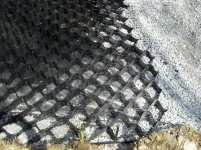
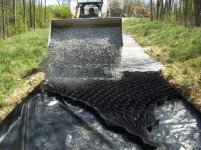
As an alternative consider this material (I'll find the name ,right now it escapes me) :

We ran a 6 axle crane, 6 loaded front discharge concrete trucks, and at least 15 triaxle trucks over two of these road repairs with very little damage or depressions.
 

Attachments

  • 2MB old scandisc 598.jpg
    2MB old scandisc 598.jpg
    152.6 KB · Views: 103
  • 2MB old scandisc 600.jpg
    2MB old scandisc 600.jpg
    156 KB · Views: 92
Last edited:
OP
I

iagsxr

Well-known member
Joined
Jan 10, 2010
Messages
1,505
Location
Vinton, Iowa
I've never seen a pneumatic-tired forklift work under load on gravel. IMO

At our old shop that forklift worked outside on the gravel all day every day. It's all about getting a base then topping it with something that compacts. I know what I want to end up with just not how to get A to B.

What is the material like under the proposed driveway? Is it solid, or is it mud? Does it get seasonally wet, or is it generally dry? Is the sub soil clay?, or silt, Sand or decomposed rock? Many people confuse Silt with Clay. There are several field tests to help distinguish between them-- 1) try to roll a thread of the soil between your fingers, adding water as necessarily If you can roll a thread, at some moisture content that is 1/8" or smaller--it is clay; if not, it is silt. make up a moist-to-wet patty and put it in the palm of your hand. With the soil patty and your palm facing up, smack the back of your hand several times, rapidly, look at the soil patty, then squeeze the patty, and look at it again. If the appearance changes from looking dry to looking wet, to looking dry again, then it leans to silt. What you are seeing is how easily water moves thru the soil. Water will not move quickly thru Clay, but it does thru silt. Finally, take that wet soil patty and make a cube--like a pair of dice size. Let it dry, thoroughly. Then try to crush it. If you can easily crush it, it is silt; if it is impossible to crush (like a brick) then its clay.
You need to do these tests and then post back what you find. You may not need geo textile at all, or you might want a geo-grid material. You do not want a non-woven textile for your application.
A geo-textile provides separation between the stone you will add and the water, or mud below it. If you have no water, or wet soils, you may not need any fabric.
An old sales question for people selling geo-textiles was " What do you get if you add 1 ton of good stone to 1 ton of mud? " You get 2 tons of mud. The geo-textile separates the mud from the stone. Geo-grid does the same thing, but the openings are larger, and you use a clean stone that "locks" up with the apertures and carries the load.
Post back some more details.

Thanks for all that, I'll try to do some of your tests later today.
 

ms fowler

Well-known member
Joined
Jun 27, 2012
Messages
450
Location
Littlestown, PA _ 6 miles south of Gettysburg
Geo textiles have come a long way. Did you know that during the Civil War, artillery men would trow blankets over soft mud and then throw dry dirt or stone on top? It helped them get canons to where they needed to be.
Same thing today--the geo textile separates mud from new fill.

First time I saw it in use I was stunned. We had to relocate an access road so that we could excavate and repair a 72" water line that ran under the road. Adjacent to the road was a wetlands/swamp. A team of laborers wearing hip waders rolled the fabric out in places that wouldn't support the weight of a laborer. Then a Cat dozer pushed out about a 1' to 1 1/2' lift of stone on top of the fabric, and it held!. That was 30 +/- years ago, and after the repair to the water line, they kept the "temporary " roadway. It is still in use today.
 
To avoid these ads, REGISTER NOW!
Top Bottom