To avoid these ads, REGISTER NOW!

Solar Battery understanding

TractorJeff

Well-known member
Joined
Dec 8, 2013
Messages
3,309
Location
Elkhorn, WI
We often stay at my brother's remote cabin.
Originally Generator powered, but now Solar powered by Renogy products rated at 800 watts capacity. Currently the battery bank consists of 7 Walmart Marine/Trolling 12 volt batteries rated at 105 amp/hours each. The batteries are parallel connected for 735 amp/hours. There was a 5 gallon Hot Water tank at 1500 watts which has been replaced by a 10 gallon Tank at 1650 watts. The Hot Water is only turned on in the morning for 2 showers, when the 2nd shower is done, it is turned off after a half hour of recovery (for Math sake, assume 2hrs).
My major questions are about the Lead Acid batteries!
Everything I have read so far states that the batteries can only be discharged down to 85%. I assume this is a Voltage related value?
BUT!
There is another value given as 50% usable capacity (or something like that?) This 50% number is the one that I can't seem to get a handle on?
Very often in the morning the Inverter shuts off on Low Voltage Alarm towards the end of the Hot Water recovery period.
Assuming 6 hours of high production sunlight, how many more Walmart batteries could be added while getting full recovery?
Nephew buys the batteries for his Dad, so DO NOT SAY CHANGE TO ANOTHER TYPE!
The system seemed to work last year with the 5 gallon Hot Water tank, but not this year with the 10 gallon tank.
Can anyone help?
 
To avoid these ads, REGISTER NOW!

mike93lx

ALLIANCE MEMBER
Joined
Dec 9, 2013
Messages
37,805
Location
Richmond, VA
My understanding is 50% of the rated amp hour capacity is all you want to use

The quantity of batteries won't change how much the solar array outputs. You could put 100 batteries in and fully recover every day if you array matches the demand
 
Last edited:

dogdog

Well-known member
Joined
Nov 15, 2011
Messages
12,711
85% is the battery voltage before the electronic cuts off battery to prevent the batteries from deep discharge, 10.5 or below is considered fully discharged for lead acid battery. So 10.5/12.5 is about 85%

Amp hour
, watt hour
Pretty sure you can do those math and keep in mind the inverter efficiency are different from those modified sine wave and pure sine wave inverters either case both will not be 100% efficient. Also battery life
 

ripperd

Well-known member
Joined
Jul 2, 2014
Messages
2,048
Location
Twin Cities, MN
You have roughly 8800watt hours of storage.

Assuming the heater is 120v and qfter overhead probably consumes 2000w. At 50% that can run the heater roughly 2 hours for about 4000wh draw.

To replace the 4000wh with 800w panels you need the full sun for 5+ hours which is probably very optimistic.

My guess is you need about double the solar to reliably get the batteries near full each day.
 
OP
T

TractorJeff

Well-known member
Joined
Dec 8, 2013
Messages
3,309
Location
Elkhorn, WI
Total System operation is Coffee Pot, LED Lights, Refrigerator and an On Demand Water Pump to provide water from the storage tank, Microwave as needed(rarely), a small window Fan in the evening for the bedroom and during the Winter a Circulation Fan on the Propane Heater.
As far as the Batteries, I do understand the sizing issue better now! Thanks!
Couple of more questions;
What about true Golf Cart Deep Cycle batteries? Would their Top Off Charge value be different? Would their discharge value be lower than the Marine batteries? Would there be any realistic Gain to swapping over to them?
Solar Array:
Yes, from what I have read so far, the Array would have to be doubled in size to accommodate the Sun's inefficiencies (Weather)
 

dave*99

Well-known member
Joined
May 5, 2009
Messages
4,274
Location
Coastal NJ
If your inverter cuts off @ 85%, that becomes the limiting factor.
Perhaps golf cart batteries can withstand a deeper discharge without damage - but if the inverter cuts of at 85% you won't see a benefit from the change.

Also -are your existing batteries getting charged to 100% from the solar array?
 

HoosierBuddy

Well-known member
Joined
May 9, 2006
Messages
2,931
Location
Southern Indiana
If I'm reading you right, you're kicking on a cold water heater in the early morning when your batteries are pulled down already and the sun has not had a chance to recharge.

I'd be very curious if this would work better by moving your showers later in the day.

May not be the solution you want, but if it was me I'd be looking at a small propane water heater. Maybe set up that, a cook top, an outdoor grill, and a bi-fuel generator off of propane. A couple of 100# cylinders and you're in business. Only run the generator if the batteries are getting low.
 

bluedog225

Well-known member
Joined
Jan 31, 2012
Messages
3,302
Location
Texas
Are you running a 12 volt system?

The whole conversation is easier if you convert everything to watts.

Heating water with batteries is not a great idea. Solar thermal water heat is really good. Propane is really good. Solar/electric/water is not good.

Mixing new batteries with the old is going to be a small disaster. Whether you change battery type or not, you will be needing new batteries at some point. Lead acid may be the best answer for a cold environment but other types deserve some looking into before spending the cash.

When you wear out or kill the batteries you have, I’d recommend moving up to a 48 volts system.
 

WisJim

Well-known member
Joined
Dec 20, 2010
Messages
2,292
Location
Menomonie, WI
I always figured using only 20% of the battery capacity except for emergencies. The 85% or 80% is the amount of battery capacity you don't use. Your 7 batteries at 105 amp hours times 12 volts is 8820 watt hours, as mentioned above, or 8.8 Kw-hrs of total capacity. The 20% you can safely use is 1.76 Kw-hrs (1760 watt hours) or about what the water heater would use in one hour--not considering inverter inefficiency. In other words, the water heater is probably using all of your usable battery capacity in an hour, and anything else at all is dropping the batteries even lower, which will shorten their life.
Based on my 40+ years of off grid battery experience (using wind and solar generated electricity) I would say that the water heater is not an acceptable load for the system you describe. Even a refrigerator might be too much load for the system to reliable and have a reasonable battery life (depending a lot on the refrigerator of course). You really need to figure out your actual energy usage, at least using the nameplate power requirements and the hours each item runs to get a ball park figure. And remember that most inverters (unless it is a good, meaning expensive, one) will be 80 to 90% efficient at the best and maybe less efficient.
Golf cart batteries would have more capacity and would probably last longer (in years of usable life), but actual solar deep cycle batteries like the L15 sized 6 volt batteries have been the minimum that I have recommended in the past for a system like the one you describe. I personally used either telephone company batteries (2 volt cell, 1680 amp hours) that I got used, or new fork lift style batteries 1500 amp hour 2 volt cells, The telephone company batteries were about 360 pounds each and the forklift style were over 200 pounds per cell--but I have gotten 20 years of use from one set. I haven't priced them lately.
 

dcg9381

Well-known member
Joined
Jun 20, 2018
Messages
11,864
Location
Austin, TX
How old are those batteries?

Yea, 12V "deep cycle" batteries are non-ideal if you've got to substantially discharge.
The next step up is 6V batteries in series.. Golf cart type. If you want to stick to lead acid. They handle this sort of thing better.

Want to really be able to discharge substantially, you've got to go lithium. The voltage drop is minimal - they discharge hard until about 80% or so.

In my (limited) experience with off grid applications, we really had to ramp up our battery capacity and charge capacity (solar panels) - it wasn't unusual to get 3-7 days that were overcast... So you have to plan for that.

The cheaper way to do it is to get a generator (even a small one) that can charge this system. 800 watts is not much solar for 8.8kw of battery storage. I'd definitely be adding more panels.

Other options: Small propane powered tankless water heaters are pretty inexpensive... That's what I have at the shop, connected to a 100lb "portable" propane tank. If it's the water draw that's killing you and you have room, consider adding a small one - say 3 gpm in-line. You can keep the existing water heater if you want, as any pre-heating of the water consumes less propane on the tankless.
 
OP
T

TractorJeff

Well-known member
Joined
Dec 8, 2013
Messages
3,309
Location
Elkhorn, WI
Yes, I (We/They) figured electric Hot Water was a bad idea.
BUT! You need to understand that the project started out on a Generator so Hot Water was no big deal! Switching to a Propane Water source is ideal in the real world sense of Solar! But I know my nephew and brother are not going to spring for that!
BEST Solution for this project would be a transfer switch to run the Cabin off from the Generator in the morning and plus a Battery Charger to "catch up" the Batteries because of the Sun Less days.
As far as Forklift Cells, neighbor had his sights on a like new set but the forklift got scrapped before he could get dibs on them!
 
Last edited:

dcg9381

Well-known member
Joined
Jun 20, 2018
Messages
11,864
Location
Austin, TX
Well, you're talking a few hundred bucks for a 3gpm propane water heater. If he's not going to spring for that, I'm probably not going to be much help.

I've also done passive solar hot water. Thermosyphon. These systems are used all over the world, they're just not common in the US. The system I used was from Rheem (it was a rebrand of something they bought) - but it could easily store enough hot water for 3 days without any sun... It's remarkable how much heat you can get into water from sunlight... Even black PVC mounted outside somewhere... Course, cold areas, this creates another thing to maintain in the winter. Commercial thermosyphon is not cheap though, I've seen some people roll their own....

I'm doing a project with lithium batteries for something else. They've got a 5000 watt "dumb charger" that I can use - it's designed for use with "dirty power" (from generators). You simply run that independently and the inverter takes care of the rest. You can kick the charger down on input amps, so just a little 2000 water inverter gen could get the job done.
 
To avoid these ads, REGISTER NOW!
OP
T

TractorJeff

Well-known member
Joined
Dec 8, 2013
Messages
3,309
Location
Elkhorn, WI
My Brother turned 70 today and is on limited Income. My nephew lives 1200 miles from where the cabin is at. We use it when we are out there (600 miles). So it is hard to show up and say "You need to do this or that" for us.
When we are out there the same time as my nephew, then we can broach the subject of propane hot water.
I think the focus should be an easy way to hook up the generator (transfer switch) and charger to top off the batteries. After all, the Honda Inverter Generator is just sitting there waiting.
 

nadogail

Well-known member
Joined
Jan 23, 2009
Messages
32,026
Location
Coronado, CA
Several years ago I read of a guy who used a water cooled engine to charge batteries and make his lights. The engine heat also heated his bath water and warmed his hydronic heating system.
He also used passive solar panels.
 

dcg9381

Well-known member
Joined
Jun 20, 2018
Messages
11,864
Location
Austin, TX
Double the batteries.
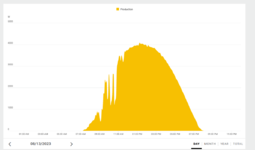
He's got 800 watts of solar panel(s). He has 8800 watts of storage. Assuming he's got fixed panels that are property targeted, his solar production is on a curve and he's likely only getting maybe 3-4 hours of full charge rate, assuming full sun. I'm "guessing" without seeing actual power usage/storage, but I think I've got a good guess. I'd start with enough panels to fully recharge those batteries on a "full sun" day before I chase storage capacity.

Here's a typical PV curve for us in the south, the little cuts in the graph are cloud cover, this is actually 6000 watts worth of panels that give up a bit to non-optimal tilt, but the output curve will still be the same.

In terms of storage, for "off grid" - I target a minimum of 3 days without any PV charge in for storage capacity... Even that won't get you by in the winter or in high cloud cover areas. But make sure you can fully charge your system - that's the bang for the buck right now.

1692132886266.png
 
OP
T

TractorJeff

Well-known member
Joined
Dec 8, 2013
Messages
3,309
Location
Elkhorn, WI
The panels are manually aligned every 3 to 4 weeks. They had discussed a mobile moving device for daily sun curve but decided against it. Its a cabin.
I'm still thinking of talking to my nephew about the generator and a transfer switch plus a battery charger for when the generator is running?
 

dcg9381

Well-known member
Joined
Jun 20, 2018
Messages
11,864
Location
Austin, TX
The panels are manually aligned every 3 to 4 weeks. They had discussed a mobile moving device for daily sun curve but decided against it. Its a cabin.
It's still not enough PV to charge those batteries on a sunny day, especially after they are being fully discharged (per the inverter). He needs more panels with current power draw. Then we can figure out if he needs more storage.

I'm still thinking of talking to my nephew about the generator and a transfer switch plus a battery charger for when the generator is running?
I think that's fine. Make sure the charger is compatible with possibly "dirty" generator power.

BTW, there are inverters that will do all of this for you. EG-4s are "bottom" of the market price $1-2k, but they have some decent parasitic draw.
 

American Locomotive

Well-known member
Joined
Jan 8, 2017
Messages
11,005
Location
Rhode Island
The batteries should have enough storage (in theory) to do what you want, but odds are they are not getting fully charged. You will likely need more solar panels to top the system up.

The truth is you're throwing away a lot of potential power. Solar panels are maybe 20% efficient. Lead Acid batteries are not particularly high charge/discharge efficiency, and your 12v > 120v inverter isn't going to be super efficient either. The best solution (IMO) would be to install a solar water heating panel on the roof and use that to heat your hot water directly.
 

dave*99

Well-known member
Joined
May 5, 2009
Messages
4,274
Location
Coastal NJ
The OP has asked for suggestions on a transfer switch to patch in a generator that is on site. He is well aware the solar array is undersized.

Here's is one example, I'm assuming the inverter is 120V, not 240V is that correct?


dcg9381

Well-known member
Joined
Jun 20, 2018
Messages
11,864
Location
Austin, TX
The OP has asked for suggestions on a transfer switch to patch in a generator that is on site. He is well aware the solar array is undersized.
That question wasn't entirely clear to me. To recommend a transfer switch, I'd need to know more about the entire setup. We also need to know if we want this to be automatic or manual. Frankly, he doesn't need a transfer switch if he's just going to charge batteries from a generator powered charger once in a while manually.

Seems like he's thinking about suggesting a transfer switch because the batteries are getting discharged to the point (probably by the hot water heater) that they need to pull power from something else. That might not be the case if he add just 2 more panels.

There may be better solutions. Many modern inverters ARE transfer switches. The EG-4 6500-48s (120V, but can be 240V if you buy 2) have switching and preference functions. They can be setup to "prefer solar", "prefer battery" and "prefer grid" (or generator). They are $1300 - basically the cheapest on the market, below what an generator (auto) transfer switch would cost.
 

dave*99

Well-known member
Joined
May 5, 2009
Messages
4,274
Location
Coastal NJ
Think low tech, inexpensive, cabin, not used often, it you show up and batteries are dead and its cloudy and you want coffee....a shower....

Generator, inverter already there.

Sure you could use extension cords etc, but he asked about a transfer switch.
 
OP
T

TractorJeff

Well-known member
Joined
Dec 8, 2013
Messages
3,309
Location
Elkhorn, WI
Quote: "Originally Generator powered, but now Solar powered by Renogy products rated at 800 watts capacity"
3000 watt Inverter is by Renogy also. Currently the 7000 watt Honda Inverter generator sits there waiting to be used.

Questions are: How do you disconnect "live" Panels and Controller from batteries? The sun is shining so the system is still making power. Will this damage the Controller? Does the Controller need to be disconnected while the batteries are being charged by another source? Can an "off the shelf" battery Charger be hooked up to the Battery Bank to charge via the Honda Inverter Generator? Can the Battery Charger be left connected all the time to the Batteries? (I think it can, but would like opinions)

My thought process is a 60 amp transfer switch with an outlet to plug the Battery Charger in.
Start the Generator, Flip whatever switches necessary, go back to cabin to wait for hot water, after a couple of hours in the morning, flip the switches back to let the Solar take over, shut off generator.
Enjoy the Day and Evening on a Full Charge!
 
To avoid these ads, REGISTER NOW!
Top Bottom