To avoid these ads, REGISTER NOW!

Solar expansion tank

varmint

Member
Joined
Aug 8, 2010
Messages
6
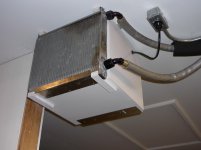
This may be a weird first post, but here goes: I am trying to find a small expansion tank for the solar heating system in my shop... two flat plate collectors (about 96 sq. feet total) on the shop roof, circulating a synthetic oil that heats via a NASCAR (used from Ebay) oil cooler with a computer rack fan to move the shop air. The oil is from the early 80's, a product called Brayco 888 that was made for solar systems. No longer available. My problem is this- every tank I can find, like Amtrol, etc., uses butyl rubber bladders, and the Brayco oil will attack butyl. Back in the day, Amtrol made special tanks with Hydrin bladders, but no more. The Brayco oil has lots of great properties, like good thermal transfer, high boiling point, non-toxic, non corrosive, but doesn't like butyl rubber. Glycol mixs won't work- the plates get too hot when they stagnate, and an acid compound forms.

I attached some fotos of the main componets- you can see the tank in the pump pic.

thanks, and I don't expect any miracles, but you never know!
 

Attachments

  • P1000291.jpg
    P1000291.jpg
    146.3 KB · Views: 38
  • P1000235.jpg
    P1000235.jpg
    151.6 KB · Views: 42
  • P1000220.jpg
    P1000220.jpg
    129.5 KB · Views: 38
To avoid these ads, REGISTER NOW!
OP
V

varmint

Member
Joined
Aug 8, 2010
Messages
6
I forgot to add, the pictures show the installation before it was finished, so no piping, insulation, details like that.
 

walrus

Well-known member
Joined
Nov 12, 2008
Messages
11,696
Location
Maine
Letting solar panels stagnate is bad, what about using glycol and then covering the panels in the summer.? I'm almost ready to fire up my solar system for my shop. I'm using glycol but my panels are vertical so summer time sun won't heat them up so much. I'm still planning on covering them
 
OP
V

varmint

Member
Joined
Aug 8, 2010
Messages
6
I should have added that I sold and installed systems like these in the late 70's- early 80's, before Jimmy Carter left office and his successor got rid of those silly and un-American ideas of using solar energy. Back then, we had some great tax incentives... Between the state of Indiana and the Feds, some 60% of a system's cost was written off. That said, panels like mine (I had actually installed them, back in 1984, but the then-new home required a new roof a couple of years ago, and a crane was needed to take them off so the owner decided to just leave them off. I saw an opportunity) can reach over 350 degrees when stagnate, and even in the fall and spring those high temps can be a problem if you don't want the heat. Originally, we heated water with most of the systems, and when storage max was achieved, the system had to shut down. Glycol just didn't work. I have heard that the Bray oil can be sold for upwards of $100/gal. out in Colo. where a lot of these systems were sold, back in the day. FWIW, they are Novan products, and Novan was based in Boulder, if I remember right.
 
To avoid these ads, REGISTER NOW!

jdieter

Well-known member
Joined
Nov 17, 2007
Messages
320
Location
Northern Indiana
It may not be practical in your system, but wouldn't a steel tank work as long as it was higher than anything else in the system. The industry I retired from used these for expansion tanks in a water/water heat exchanger, each tank had a sight glass so we could monitor the level to keep the tanks from getting waterlogged and an air supply to keep a small air charge on the water.
 

RPH

Well-known member
Joined
Dec 17, 2006
Messages
4,190
Location
Michigan Thumb
Expansion tanks have a bladder inside to allow pressure to be applied to the liquid seperating the fluid and air. This keeps air from mixing with the fluid causing other problems. Well water systems utilize an expansion tank to supply water pressure when the pump is off.
 

ixlr8

Well-known member
Joined
Sep 15, 2009
Messages
438
Location
Eastern Shore Virginia
I remember in the heating system in the house I grew up in the expansion tank was just a steel tank about 1' in diameter and 3' long laying on it's side between the joists in the basement. The inlet and outlet valves were on the bottom. The outlet valve had a special vent in the handle where you could let air in to backfill it to replenish the air cushion when you opened the valve to let some water out. You had to do that occasionally due to the air getting adsorbed into the water. Sounds like that could work for you.. if you could find/make one.
 

redsky49

Well-known member
Joined
Jan 21, 2009
Messages
582
Location
near the coast in eastern North Carolina
You can always select a standard compression tank. The only downside is that they become waterlogged over time and have to be recharged every year or two.

Bell & Gossett (B&G) make several versions. You can also order them with Airtrol or IRS air separators, floor or ceiling mounting, etc.

Follow proper engineering practices and standards while selecting and installing.

http://www.bellgossett.com/ProductPages/Parts-Compression-Tank.asp

As always, offered only as opinion
 
To avoid these ads, REGISTER NOW!
Top Bottom