To avoid these ads, REGISTER NOW!

Solar guru question about angle vs larger system

tinysparky

Well-known member
Joined
Oct 22, 2016
Messages
195
I will be installing my own solar system next month. I have two options


Ground mount at the perfect angle and alignment....for Washington state

Or 30 degrees off of that ...pointing south west....and a slightly lower angle....on my pole barn.


If I do it on my barn (which it was built for...)....I can get a system that is 20% larger then the ground array. Saving money on pipe, concrete, and rental.

Any solar guys here?

Sent from my Pixel 2 XL using Tapatalk
 
To avoid these ads, REGISTER NOW!

02vito

Active member
Joined
Aug 30, 2017
Messages
40
Location
Colorado
If you will entertain a response from a non-expert [yet] on solar, there is in my opinion no perfect angle for the panels, as the declination of the sun changes with the seasons. With a fixed-angle mount, the angle has to be a compromise. The compromise can be such that the performance is maximized during the season when you need the most power.

My investigation so far has me leaning towards pole-mount units with a manual angle adjustment.

It is easy to do the arithmetic and determine how much performance you lose by a fixed-angle mount and compare that with the performance of variable-angle pole mounts and their increased cost. One installer I consulted with suggested that a roof-mount, fixed angle system can be built somewhat larger than can a pole-mount system of the same cost, so that the performance disadvantage is countered by the larger size.
 
OP
T

tinysparky

Well-known member
Joined
Oct 22, 2016
Messages
195
If you will entertain a response from a non-expert [yet] on solar, there is in my opinion no perfect angle for the panels, as the declination of the sun changes with the seasons. With a fixed-angle mount, the angle has to be a compromise. The compromise can be such that the performance is maximized during the season when you need the most power.

My investigation so far has me leaning towards pole-mount units with a manual angle adjustment.

It is easy to do the arithmetic and determine how much performance you lose by a fixed-angle mount and compare that with the performance of variable-angle pole mounts and their increased cost. One installer I consulted with suggested that a roof-mount, fixed angle system can be built somewhat larger than can a pole-mount system of the same cost, so that the performance disadvantage is countered by the larger size.
Found the answer that has been elusive for days....

At my latitude, facing south west results in a 12-13% drop in production. Facing east or west is a larger 18-22% drop.

For the few thousand difference...I will be going in the roof and won't be putting more posts in concrete.. they had been estimated at schedule 40, 3" pipe 24" wide holes by 52". 284' of pipe plus conduit.

Sent from my Pixel 2 XL using The Garage Journal mobile app
 
To avoid these ads, REGISTER NOW!

nsula_country

Well-known member
Joined
May 23, 2013
Messages
1,534
Location
Northwestern Louisiana
For the record, I do not have solar. Maybe one day...

But, I know people with solar and have learned things from them...

When solar is mounted on a roof, care must be taken to preserve the integrity of the roof and not leak. When roofing becomes compromised, like a hail storm the solar system must be removed from the roof. Then roofing material removed and replaced. Then the solar system reinstalled. The labor for the solar removal and reinstallation is not covered by homeowners insurance. It is all expense, and expensive. This crossed roof top installation off my list.

IF you have the real estate, ground mount with positioners is the way that I would go. At least I we ever do it, we will go ground mount. Round-Up will be our friend.

I don't know where your design for the ground frame came from, but 3" Sch 40 is massive pipe! 11ga 2x2 square or 1x2 rectangular tubing would be easier to work with. But I don't know what size system you are planning.

My $0.03

CT
 

Git

Well-known member
Joined
May 18, 2008
Messages
6,894
Location
S Cal
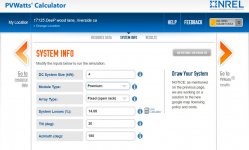
Go to PVWatts - It's a government website so you won't have to worry about receiving junk mail, phone calls etc

https://pvwatts.nrel.gov/

Enter your actual address because it is going to pull up the weather history for your area to use in it's calculations

When you get to the System Info page - you can play around with the settings to see what works best for you. For now, don't worry about system loss. You are primarily concerned with the Azimuth (what is the actual direction the panels will be facing) and the tilt. Use 'premium' panels and whatever size system you are looking at. If you are thinking about a system that will cover multiple roofs (South and West for example). Run the calculator for one roof with the size of the system on that roof and then go back and change the azimuth and roof tilt (if any), run it again and add the results together

For system size, take the number of panels and multiply it by the output rating of the panel, and then divide by 1,000 (18 x 320 = 5,760 divided by 1,000 - 5.76 DC)

Lastly, it usually pays to use higher producing panels so that you can cram them all on the South most facing roof. My system uses two roofs, my South roof has 18 panels and my West roof has 21 panels and the output from both roofs is about the same

attachment.php
 

Attachments

  • 183.jpg
    183.jpg
    83.5 KB · Views: 69
Last edited:

tyme2par4

Well-known member
Joined
May 16, 2016
Messages
571
Location
NH
^This exactly. PVWatts is a great tool to estimate the production of a system.

As for ideal angle, if you are looking at total annual production, the ideal angle is roughly equal to the degree of latitude at which you are located. Higher tilt will provide more in the winter, while lower tilt will provide more output in the summer. If you have basic net metering, total annual production is what you want to maximize.

As you have seen, ground mounts tend to cost a bit more due to extra materials. They do however give you the option to optimize angle and direction, which you can't do on a roof. You can also avoid potential shade areas if you have open space.

Plug in the info you have on system size, direction and angle into PVWatts and see what you get for a difference in output. I would guess since you can go 20% larger on the roof, you will probably still end up with more output.
 
To avoid these ads, REGISTER NOW!
Top Bottom