To avoid these ads, REGISTER NOW!

Solar power grab

aggie113

Well-known member
Joined
Jul 22, 2015
Messages
475
Location
San Antonio, TX
Was hoping to wait a few more years for the tech to get a bit better, but my hand was forced. Putting a 21+kWh array up. Most will go on my south facing garage roof and the rest on the south facing house roof section that has no intrusions. Two good sized inverters each hooked up to it's own 14.x kWh battery and I hope to take care of 95% of my needs. Of course as I say that I'm contemplating adding another mini split to the garage to help it cool down in these hot summers :)
If anyone cares, panels are q.tron m-g2+ 440w series, inverters are EG4 Flexboss 18s along with an EG4 Gridboss, batteries are EG4 indoor 280Ah lithium.
 
Last edited:
To avoid these ads, REGISTER NOW!
OP
A

aggie113

Well-known member
Joined
Jul 22, 2015
Messages
475
Location
San Antonio, TX
How was your hand forced?

Whats the payback on this system vs investing the money?
Payback is a bit longer for me with the battery system. 9-10 years to break even with my current electric use and current rates. However, I do expect rates to continue going up over the years. And the battery part was me trying to keep off grid even at night or during slight outages.
No idea how well that would do against investing the money, but I'm good with savings right now, of course all my market accounts are just pretend money until I actually pull it out.
 

mm08822

Well-known member
Joined
Jan 13, 2012
Messages
5,984
Location
NJ
What is the energy buy-back structure when generating excess solar derived energy for Texas?
 

mike93lx

ALLIANCE MEMBER
Joined
Dec 9, 2013
Messages
37,643
Location
Richmond, VA
Payback is a bit longer for me with the battery system. 9-10 years to break even with my current electric use and current rates. However, I do expect rates to continue going up over the years. And the battery part was me trying to keep off grid even at night or during slight outages.
No idea how well that would do against investing the money, but I'm good with savings right now, of course all my market accounts are just pretend money until I actually pull it out.
9-10 years? How high are your rates?
 

mm08822

Well-known member
Joined
Jan 13, 2012
Messages
5,984
Location
NJ
Payback is a bit longer for me with the battery system. 9-10 years to break even with my current electric use and current rates. However, I do expect rates to continue going up over the years. And the battery part was me trying to keep off grid even at night or during slight outages.
No idea how well that would do against investing the money, but I'm good with savings right now, of course all my market accounts are just pretend money until I actually pull it out.
You should also compare a battery-based storage system against one without. Your POCO's buy-back plan is needed to properly assess.

Is there a limit on the generation size in Tx? A common requirement is that system size = annual consumption amount.
 
OP
A

aggie113

Well-known member
Joined
Jul 22, 2015
Messages
475
Location
San Antonio, TX
Rates are pretty low. Last month was about .13 per kWh. I used about 3160 for the month. Average is around 2415 for the past year. San Antonio means CPS for power, they do a net metering, credit banked against power used. I do not know when it resets. Beyond that I believe they will buy back at .02 per kWh.
I looked at prices with and without batteries. Most installers recommend no battery setups as it does hurt the ROI, but I want the advantages of a whole house battery backup setup. Don't know of a size limit on the install in Texas, but my system is sized to just over my current consumption.
In the future I may add more batteries in the coming years, but I'll see how it goes.
 
OP
A

aggie113

Well-known member
Joined
Jul 22, 2015
Messages
475
Location
San Antonio, TX
Can you share your calc on roi? I am struggling to see a 9-10 year payback with such cheap electric rates
Yeah, pure ROI calculators are giving me 10-11 for payback. Also with the solar loan to pay for the system paid off in 4-5 years like I plan I would technically have to include the 5-6k interest in that. So maybe 12 years ROI. System cost to me will be ~46k including that loan interest. But I think rates will be going up, so may creep down in my favor.
 

ericm

Well-known member
Joined
Apr 17, 2016
Messages
1,963
Location
Southern Oregon
Google's ROI calculator assumes price increases of 2% a year. In both California and Oregon it's been between 10 and 22% every year for the last few years. Our new place in Oregon will be getting a 15kw array and a battery. Last summer they had a lot of power outages.

Oregon has 1:1 net metering, unlike California. That really helps. The array can be set up to optimize annual production rather than winter production. Mostly that's just the angle of the south facing panels. The solar company say they like 20 degrees for total production vs the usual 40 for best winter production. The house roof is 2:12 so it's even less than 20.
 

mm08822

Well-known member
Joined
Jan 13, 2012
Messages
5,984
Location
NJ
In the simplest of calcs (w/o rate hikes, system efficiency losses over time, cost of money, maintenance):
2,415kwh x $.13/kwh x 12 m/yr = $3,767/yr for current electricity usage from POCO.
 
OP
A

aggie113

Well-known member
Joined
Jul 22, 2015
Messages
475
Location
San Antonio, TX
In the simplest of calcs (w/o rate hikes, system efficiency losses over time, cost of money, maintenance):
2,415kwh x $.13/kwh x 12 m/yr = $3,767/yr for current electricity usage from POCO.
That deal is done, so not sure why the arguments. Trying to slow down the solar industry? :p In reality, my electric costs are 4.5-5k a year.
 

mm08822

Well-known member
Joined
Jan 13, 2012
Messages
5,984
Location
NJ
That deal is done, so not sure why the arguments. Trying to slow down the solar industry? In reality, my electric costs are 4.5-5k a year.
Who's arguing? The curiosity was around payback. Based on your previous information in post #9, I presented a simplistic calculation of what you spend per year on electricity. Now you indicate it's $4.5 - 5K/yr.

So $46K/$5/yr = 9+ yrs. Enjoy it.
 

walta

Well-known member
Joined
Jan 13, 2017
Messages
2,312
Location
Dutzow Missouri
From a dollars and cents point of view if grid power is available buying batteries is foolish. Installing batteries for back up power is almost futile the number of kWh your battery can store is likely to be tiny compared to the huge loads you must have to burn than many kWh.

Before you buy a huge system consider making investment in efficiency and use fewer kWh.

I think if you can’t make it ROI in under 7 years you should pass.

Walta
 
OP
A

aggie113

Well-known member
Joined
Jul 22, 2015
Messages
475
Location
San Antonio, TX
From a dollars and cents point of view if grid power is available buying batteries is foolish. Installing batteries for back up power is almost futile the number of kWh your battery can store is likely to be tiny compared to the huge loads you must have to burn than many kWh.

Before you buy a huge system consider making investment in efficiency and use fewer kWh.

I think if you can’t make it ROI in under 7 years you should pass.

Walta
Thanks, but I'm getting the batteries for me. I'm ok with a longer ROI.
 

mm08822

Well-known member
Joined
Jan 13, 2012
Messages
5,984
Location
NJ
When I hear the "return on investment" argument about solar, I ask "What's your return on investment of your TV, you fancy car, etc.?"
There's a lot more to the solar decision than return on investment.
It is speculative anyway. Stuff happens that isn't planned for.
 
To avoid these ads, REGISTER NOW!

jmdirk

Well-known member
Joined
May 4, 2015
Messages
707
When I hear the "return on investment" argument about solar, I ask "What's your return on investment of your TV, you fancy car, etc.?"
There's a lot more to the solar decision than return on investment.

Agreed. Solar is almost never an 'investment' at the residential scale. In most cases, from a purely financial point of view, you're better off taking that capital and investing it in a more traditional instrument.

Solar if often something one does out of environmental concern (recognizing that not everyone believe solar is all that environmentally friendly) or out of self sufficiency. OP has already acknowledged that the battery hurts his payback calculation. But he wants it for the self sufficiency it brings
 

dcg9381

Well-known member
Joined
Jun 20, 2018
Messages
11,778
Location
Austin, TX
What is the energy buy-back structure when generating excess solar derived energy for Texas?
It depends on your provider. TX is "deregulated".
Payback is a bit longer for me with the battery system. 9-10 years to break even with my current electric use and current rates. However, I do expect rates to continue going up over the years. And the battery part was me trying to keep off grid even at night or during slight outages.
Isn't "expected" battery life in the 9-10 year range? These are relatively new so no one has had them for 10 years. I'm surprised that you can get "payback" on this in 10 year with a commercial install, but as you've got "per kW" net metering, that's ideal for PV and I get it.

I'd take that 30% while you can get it also....

You've got 14kWh. I assume 48V batteries? What are the battery details? Takes lots of DC amps to get you up to 240V AC, curious how much power your can invert.
 

aquinob

Well-known member
Joined
Oct 7, 2014
Messages
238
Location
Portsmouth, VA
Just an aside, in my little neighborhood there are two houses that have had new roofs put on and a whole bunch of trees taken down. Wonder why that is?
 

WisJim

Well-known member
Joined
Dec 20, 2010
Messages
2,286
Location
Menomonie, WI
My last batteries in an off grid system were lead acid, similar to forklift batteries, and lasted over 20 years. I monitored them very carefully and took very good care of them. I think that lithium chemistries have been in use for long enough to take a chance on them lasting their estimated life.
 

Old Man Roger

Well-known member
Joined
Apr 6, 2017
Messages
17,670
Location
Palm Coast Florida
Too bad you couldn’t sell electricity to your neighbors.

I already run the AC where I like it in the summer, I’d probably turn the heat on a little sooner in the winter, I would definitely cool the garage and attic in the summer. I’d probably have more lights all around, and probably leave them on more.

Cant think of anything else I would do differently.
 

ericm

Well-known member
Joined
Apr 17, 2016
Messages
1,963
Location
Southern Oregon
From a dollars and cents point of view if grid power is available buying batteries is foolish.

It depends on how much you get back when sending power to the grid. If you have NEM 3.0 or some other similar metering where you get paid a pittance on power that you send to the grid, you need batteries to make the solar pay. Either the batteries are used to time shift loads so you're mostly using power at the cheapest time, or they're used to store solar energy and feed it back to the house at night. Or some combination as needed to suit the install and the metering.

Installing batteries for back up power is almost futile the number of kWh your battery can store is likely to be tiny compared to the huge loads you must have to burn than many kWh.

Actually batteries and solar can work pretty well for backup. My neighbors in CA put in a solar and battery setup for our frequent and long power outages. It's partly due to their experience that we're doing a solar and battery setup in our new house.

Before you buy a huge system consider making investment in efficiency and use fewer kWh.
For sure.

I think if you can’t make it ROI in under 7 years you should pass.

Everyone's calculation is different. Heck, there's a lot of ways to calculate ROI. No one can predict power company rate increases, except that they're going to happen. And of course there are other factors to putting in solar than pure ROI.

I like the idea of making my own power. I also like that it's clean power.

My wife says we have power outage PTSD. Our home in California is in steep unstable mountains where it's expected that power will go out often and for long periods of time. Being captive to the worst utility in the country makes that worse. We've made it 28 years with a gas generator and we're tired of it. The new place will have solar, batteries, and a generator input so I can charge the batteries if needed. A whole house generator would have cost somewhat less but then I'd have to deal with propane, and I'm done with that.
 

mattthemuppet

Well-known member
Joined
Dec 9, 2023
Messages
241
Location
San Antonio TX/ Spartanburg SC
Another point to consider are the storms in central Texas and the fragility of the standalone Texas power grid. I would have loved some back up power during the Snowpocalypse a few years ago, instead of freezing my *** off with my kids for four days. Obviously a whole house generator could do that, but that’s another big chunk of money and it doesn’t do anything when it’s not being used
 

rpcraft

Well-known member
Joined
Aug 14, 2014
Messages
1,057
Location
Waco
Payback is a bit longer for me with the battery system. 9-10 years to break even with my current electric use and current rates. However, I do expect rates to continue going up over the years. And the battery part was me trying to keep off grid even at night or during slight outages.
No idea how well that would do against investing the money, but I'm good with savings right now, of course all my market accounts are just pretend money until I actually pull it out.
Battery is the way to go. I have a non battery system right now and I more than break even but would like to put that surplus back where I can use it. I just need to invest the time and $ to see if I can walk it back to a battery system now
 
OP
A

aggie113

Well-known member
Joined
Jul 22, 2015
Messages
475
Location
San Antonio, TX
The warranty on the batteries is 10 years. The ROI is for the WHOLE system. So the batteries can still be doing 80% after 10 years and they will be "good". It really depends on my discharge/recharge count at that point. Getting two 14.3kWh batteries, they will each go to an inverter, total output from the inverters is ~105A, batteries can do 140A max. CPS is the local power co, and that isn't going to change in San Antonio, but the current net metering could change in the future.

Battery is the way to go. I have a non battery system right now and I more than break even but would like to put that surplus back where I can use it. I just need to invest the time and $ to see if I can walk it back to a battery system now
You could upgrade your grid tie in device to something that can take what I'm guessing is solar AC via micro-inverters and plug it into a setup that allows that AC to go back to the panel/house or go into the inverter and batteries:
 

dcg9381

Well-known member
Joined
Jun 20, 2018
Messages
11,778
Location
Austin, TX
Too bad you couldn’t sell electricity to your neighbors.
He is providing electricity to the neighbors via net metering. It decreases the demand on the POCO. But it's POCO infrastructure. With net metering, they're crediting him $1 and selling that power for $1.

POCOs can change policy in TX, it's unregulated. That's what they did to me. I now get partial wholesale credit for power generated and they sell it to the neighbors at retail. It's a risk.

The warranty on the batteries is 10 years. The ROI is for the WHOLE system. So the batteries can still be doing 80% after 10 years and they will be "good". It really depends on my discharge/recharge count at that point. Getting two 14.3kWh batteries, they will each go to an inverter, total output from the inverters is ~105A, batteries can do 140A max. CPS is the local power co, and that isn't going to change in San Antonio, but the current net metering could change in the future.
If I were you (and I've installed 5+ PV systems), don't count on the long term warranty at all. The chances of your installer still being in business after 10 years is sketchy.

No one really knows how long these batteries will last, they haven't been around 10 years. It may depend on "cycles" (they are usually rated for X cycles). If you really want to take care of them, consider setting their peak charge conservatively (80%).

I'm all for these types of power backups. The usually switch so fast you wont even notice the power being out. That being said, 28kW @ 100A max continuous (being conservative), assuming they are 48V batteries: 100A * 48V * 2 batteries = 9600 watts peak output.. That's going to get you about 3 hours give or take.

9600 watts / 240V (AC) = 40A available (240V panel power)

Consider load shed devices or circuit priority. A power backup where you overload the inverters and they shut down is going to annoy you. You CAN always manually drop the loads (switch off breakers) and restart the system if power is down.

This system will work great (with managed loads) on temporary outages - which is most of what I get in TX. Won't do much for extended outages.

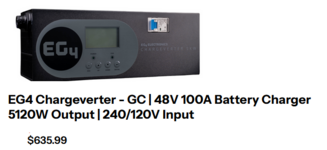
What I'd do is add a "manual charger" that can assist solar (via portable generator) direct to the batteries.... That's your multi-day power outage solution at lowest dollar. EG4 makes a charger than can be run by a generator, direct connect to batteries.. It's a few hundred bucks.
 

rlitman

Well-known member
Joined
Oct 18, 2010
Messages
24,624
Location
Long Island
The warranty on the batteries is 10 years.
And you believe you could make a warranty claim 10 years from today from a company that's been in business for 5 years? The solar, micro-inverter and lithium battery markets have made the smart phone markets look static, and LiFePO4 batteries generally have an optimistically stated lifespan of 5-10 years (sure, you'll get anecdotes of 10+ years, but memory fades and people take pride in the payouts from risky decisions and all that, so I take these with a grain of salt). Hopefully they have some magic sauce and a near zero failure rate for 10 years, because anything short of that, and they'll either go bankrupt paying out claims, or get a reputation for fraudulently denying claims. There's a reason that reputable battery warranties generally get pro-rated out to 3 years.
 

bwringer

Well-known member
Joined
Jan 1, 2013
Messages
10,303
Location
Indianapolis
...Solar if often something one does out of environmental concern (recognizing that not everyone believe solar is all that environmentally friendly) or out of self sufficiency. OP has already acknowledged that the battery hurts his payback calculation. But he wants it for the self sufficiency it brings

Another point to consider are the storms in central Texas and the fragility of the standalone Texas power grid. I would have loved some back up power during the Snowpocalypse a few years ago, instead of freezing my *** off with my kids for four days. Obviously a whole house generator could do that, but that’s another big chunk of money and it doesn’t do anything when it’s not being used
Yup. The math nerds are missing the point entirely.

Look at OP's location, then think back over the news from TX over the last five or so years.

It seems obvious that the OP is buying peace of mind given the well-known and entirely un-addressed deficiencies of the power grid in TX. The only thing certain about the future is uncertainty. If the needed infrastructure upgrades ever happen (not flippin' likely), steep price increases will be needed to fund them.

The most likely outcome is that the pocos continue with an assortment of ineffective temporary band-aids for the foreseeable future, which are even more expensive in the long term, and reliability and resiliency will continue to decline.

To put this another way, any payback is pretty much gravy.

If you can scare up the capital, and you plan to stay in the same home in TX for at least the next five or ten years or so, it would almost be silly to NOT invest in insulating yourself from these issues, whatever form that takes.
 

rlitman

Well-known member
Joined
Oct 18, 2010
Messages
24,624
Location
Long Island
...If you can scare up the capital, and you plan to stay in the same home in TX for at least the next five or ten years or so, it would almost be silly to NOT invest in insulating yourself from these issues, whatever form that takes.
I guess someone has got to be a trailblazer. More power and the best of luck to them.
 

dcg9381

Well-known member
Joined
Jun 20, 2018
Messages
11,778
Location
Austin, TX
Look at OP's location, then think back over the news from TX over the last five or so years.
It seems obvious that the OP is buying peace of mind given the well-known and entirely un-addressed deficiencies of the power grid in TX. The only thing certain about the future is uncertainty. If the needed infrastructure upgrades ever happen (not flippin' likely), steep price increases will be needed to fund them.
I'm in TX. For those that don't know, we sustained a power outage than ranged from 1 day to over a week in Texas due to a "100 year freeze". Our homes are not designed for freezing, the resulting pipes that burst, inability for most consumers to turn off the water, etc, caused billions in damages.

This system will do little to help in that situation.

The other thing that the OP needs to consider is that when the grid fails, he's got 40A available for about 3 hours. Power will need to be managed (perhaps manually if nothing else is included in this bid). This is going to be fine in a "heating" situation if he's got gas heat, but electrical heat and AC timelines will have to be managed and will be short lived (hours, not days).

This system will work great for short term power loss, assuming his house is drawing less than 40A.

To put this another way, any payback is pretty much gravy.
The historical trend is prices have gone up 33% in 10 years for TX.

OP, I would definitely add one of these and keep a 5000-6000 watt generator on hand for longer outages, you'll still be limited to 40A, but this would make a long outage something that is manageable:
1754057077101.png

Not going to argue on the math. He gets kW per kW net meter, that's IDEAL for PV solar.
 

ArcReactorKC

Well-known member
Joined
Jun 1, 2019
Messages
2,237
Location
Out in the county NE of KCMO
As someone who is in the microgrid industry deploying and monitoring commercial solar all over the continental US I'll say this.

Installing residential solar very rarely makes fiscal sense if that is the only driving motivator. If one thinks that this will negate their electric bill or even put money in their pocket in the near future they do not understand the forces at play, or they have a very rare set of circumstances.

Now on the other hand the electrical grid is starting be less reliable and outages are starting to be more common even if they are a shorter duration than they were historically. As modern humans rely more and more on electricity to perform daily tasks (looking at you EV's, electric stoves, electric water heaters, heat pumps, etc.) knowing you have ** amount of time at full load during an outage is pretty nice.

Our home is on a very reliable line just off of the main transition where two utilities meet and grid tie. This means outages are super rare. EXCEPT when the weather is inclement i.e. very hot or very cold and the terribly unmaintained Evergy grid in KC starts forcing rolling blackouts the local CO-OP up here opens the ties so they do not have to participate and force these blackouts on their customers. When that happens voltage fluctuations hit our local sub pretty wild and I can watch the autotransformers working their *** off to maintain proper voltage setpoint. Watching the incoming utility roll from 215vac to 250vac and back on 30-45 second oscillations. The bulk of most peoples devices and appliances can handle this just fine but my server racks really dislike it and EV chargers often refuse to charge until the oscillations smooth out or stop entirely which can be minutes or hours depending on what is happening across the utility.

Just having the solar inverters between the utility and my devices themselves keeps things online that would've normally shut down. Then add in the battery back up for when we do have an outage and it's a no brainer.
However on the other end if I didn't run businesses out of my house and I wasn't such a crybaby about air comfort in the house we could live without it.

Buy it if you want it, do not buy it as an "investment"
 

Mikes61

Well-known member
Joined
Dec 25, 2023
Messages
234
I’m in CA, in a 3000 sq ft house with a pool. We had a 27 panel, 12,000 kw per year system installed under NEM2, a couple years ago. We didn’t get any batteries. It’s the best thing we’ve ever done.

The price per kw is 75c during peak hours and 36c off peak.
Our SCE bills used to be $250ish in the winter and $500-$600 in the summer months. I was always shutting off the lights and worrying about power consumption to keep the bill down.

We paid $48,000 for the system, with a $15,000 tax credit. The loan is $255 a month for 25 years at 3 1/4% interest.

Where I live is now entering our hot couple of months and I’ve already got a $396 credit from the past 10 months with SCE. I don’t worry about turning off the lights or worry about the SCE bill like my friends without solar do. We sleep with the A/C set to 71*.

We’re not effected by rate increases either.

Again, it’s the best thing we’ve ever done, and I don’t care how much interest I’m paying over the life of the loan. My monthly bills are WAY less than they were before I got solar.
 

American Locomotive

Well-known member
Joined
Jan 8, 2017
Messages
10,977
Location
Rhode Island
Wow, that's an incredible amount of power usage! Almost 6x what we use. I would say solar is definitely worthwhile for you.

It's a shame solar is still so backwards in the U.S. in terms of installation costs. We're one of the most expensive places to get solar installed for some reason. Australia and Europe is 1/2 - 1/3 our cost per watt installed, it's crazy.

And you believe you could make a warranty claim 10 years from today from a company that's been in business for 5 years? The solar, micro-inverter and lithium battery markets have made the smart phone markets look static, and LiFePO4 batteries generally have an optimistically stated lifespan of 5-10 years (sure, you'll get anecdotes of 10+ years, but memory fades and people take pride in the payouts from risky decisions and all that, so I take these with a grain of salt). Hopefully they have some magic sauce and a near zero failure rate for 10 years, because anything short of that, and they'll either go bankrupt paying out claims, or get a reputation for fraudulently denying claims. There's a reason that reputable battery warranties generally get pro-rated out to 3 years.
I feel there's a big difference between storage batteries, and active "device" batteries. Things like phones, power tools, etc... beat on their batteries hard. They try to squeeze as much capacity as they can out of the smallest batteries, while trying to charge them as quickly as possible AND trying to make them as cheaply as possible. Household storage batteries do not have all those same limitations or qualifiers.

A quick peruse on Google seems to indicate that most solar storage battery solutions have 10 year warranties. Lithium batteries can last a very long time if they're maintained at a 70-80% SoC and aren't getting a full draw-down every day. Don't forget, EV car batteries have a mandatory 8 year warranty, so there's been a big push to get battery reliability up.
 
Last edited:

dcg9381

Well-known member
Joined
Jun 20, 2018
Messages
11,778
Location
Austin, TX
I feel there's a big difference between storage batteries, and active "device" batteries. Things like phones, power tools, etc... beat on their batteries hard. They try to squeeze as much capacity as they can out of the smallest batteries, while trying to charge them as quickly as possible AND trying to make them as cheaply as possible. Household storage batteries do not have all those same limitations or qualifiers.
They are also cycled frequently. Often several times per day.
A quick peruse on Google seems to indicate that most solar storage battery solutions have 10 year warranties. Lithium batteries can last a very long time if they're maintained at a 70-80% SoC and aren't getting a full draw-down every day.
Those "warranty" solutions are only as good as the company installing them - solar companies come and go. Good luck going directly to EG-4 (they're actually a China company selling under several brands). Just importing them alone (direct) is a huge pain in the *** and they're not going to cover the costs to ship them over on a boat or the associated tariff.

Tesla: is 10-years: Powerwall will retain at least 70% of its initial energy capacity after those 10 years. Hopefully Tesla will be around.. This is likely a better bet, but it's a high premium over "off the boat" battery systems.

Almost all of these batteries for home use will be set to 100% SOC. Even Tesla recommends that we use 80% as max charge on our model-Y unless we need the additional range. If I was self-installing residential that doesn't discharge frequently (like the OP), I'd use 80% SOC.
 

jmdirk

Well-known member
Joined
May 4, 2015
Messages
707
From a dollars and cents point of view if grid power is available buying batteries is foolish. Installing batteries for back up power is almost futile the number of kWh your battery can store is likely to be tiny compared to the huge loads you must have to burn than many kWh.

Before you buy a huge system consider making investment in efficiency and use fewer kWh.

I think if you can’t make it ROI in under 7 years you should pass.

Walta

On my system I can theoretically add up to 3 x 10 kWh batteries. At full charge I would get about 10 hours of heating/cooling - not counting anything else. I have a 6kW gas generator that can pretty much power the whole house (connected via a collar on the meter) and I can go several days on a couple full gas cans. Way cheaper than dropping the cash on batteries.

Where it could make sense is I have kW based net metering and Time of Use pricing. Which means I can charge the batteries in off peak times (or via clipped energy from the inverter as it's a DC coupled system) and discharge them during peak times and maximize the payback that way.
 
To avoid these ads, REGISTER NOW!
Top Bottom