To avoid these ads, REGISTER NOW!

Solar power

rwilly

Well-known member
Joined
Jan 26, 2009
Messages
113
Location
maple valley wa
Does anyone use solar power for their garage?
I’m wondering if solar would be a good source just for the lighting in my 1800sf shop?
I have no idea the cost or performance of solar.

I am thinking with the latest LED lights that draw little power, a few solar panels would be enough to run just the lighting.

located in cloudy Seattle.
 
To avoid these ads, REGISTER NOW!

kd3pc

Well-known member
Joined
Aug 10, 2013
Messages
3,630
Location
Northern Neck
cloudy seattle will likely require a decent size battery bank to provide storage. Enough panels and LEDs will work.
 

rebelranger

Well-known member
Joined
Sep 18, 2012
Messages
188
Solar install diy is easy and cheap. Batteries are not cheap. If you want solar and power for leds look at the newer battery generators. Basically they are energy storage and you can plug a 1200w solar array into them. If you wait just lights this is the bees knees.

I diy installed a 7kwh solar system on my shop with zero solar experience and it's worked great and held up to tornado winds. I have under 3500 in the system from panels to electric wire.
 

jmiller_2308

Well-known member
Joined
Nov 16, 2013
Messages
551
Location
Shakopee, MN
If you want to do the solar to be green or because running wire might be difficult or impossible then as my scientist friend used to always say, "do the math".

What will it cost and what is the payback. You should be able to find solar generation numbers relative to your area. You should also be able to look at the energy consumption of the leds and then determine how much you need to invest in the solar panels. If you plan to work when solar isn't generating then factor in enough battery usage. What is that number and what do you pay the utility?

In my situation, even with govt kick backs, after paying for the equipment the system didn't pay for itself for well over 14 years and after 20 years the stuff is dated and likely needs to be replaced. Could you use that early investment in the solar to generate enough money to easily cover what you would save in years 14 through 20?

I like solar but every time I do the math it becomes a financially bad decision. If you are motivated to be green or other reasons than you may well be motivated to discount the costs.
 

WisJim

Well-known member
Joined
Dec 20, 2010
Messages
2,268
Location
Menomonie, WI
Solar should "pay for itself" in about 7 years or less, in value of energy produced, less time if you shop around for components and do the work or at least most of the installation, yourself. My oldest panels are almost 40 years old and still work fine and should work for another 40 years unless they get damaged. Batteries are expensive and have a limited life. I've been able to get 20 years of use from a set of expensive top quality lead acid batteries but a more typical life is 7 to 10 years or less, depending on the battery type and quality and more importantly, the care that they are given.
 

vrinner

Well-known member
Joined
Aug 29, 2006
Messages
1,078
Location
Placentia, CA
I put a pretty big system on my garage and although I pay between $10 and $20 per month in "nonbypassable charges", I do get most of that back at the end of the year true up. If I could not have hooked up my system to the house/grid, I would not have put solar in (at least something that big). But if you have no other options to get power then I dont see why not.
 

dcg9381

Well-known member
Joined
Jun 20, 2018
Messages
11,660
Location
Austin, TX
I have 6000 watts of solar on the shop and have done several residential installs.
If you're installing non-grid-tie solar to do lighting in your shop, it's really not "practical" in a financial sense. You'll need to store that power and plan for 3-4 days (perhaps more) of no available solar power. You'll spend more replacing batteries over the years in what it would have cost you to run that lighting.

Solar becomes cost effective (eventually) when you grid tie it and allow it to reduce (or eliminate) your power bill. I say "eventually" as it will take 10-20 years to re-coop those costs even with the federal rebate (which I think gets reduced soon).

Grid tie solar will not provide power when the grid is down, BTW... With a few exceptions, there are a few inverters out there that have an outlet on them.
 

mike93lx

ALLIANCE MEMBER
Joined
Dec 9, 2013
Messages
37,445
Location
Richmond, VA
Solar should "pay for itself" in about 7 years or less, in value of energy produced, less time if you shop around for components and do the work or at least most of the installation, yourself. My oldest panels are almost 40 years old and still work fine and should work for another 40 years unless they get damaged. Batteries are expensive and have a limited life. I've been able to get 20 years of use from a set of expensive top quality lead acid batteries but a more typical life is 7 to 10 years or less, depending on the battery type and quality and more importantly, the care that they are given.
I would take a 7 year pay back in a heart beat. Even with the solar companies' fuzzy math on cost escalations, I am looking at 10 years for a system on my house with 12 cent electric.
 

kbeefy

Well-known member
Joined
Sep 14, 2013
Messages
3,446
Location
Harington, Eastern Washington
Solar is so cheap in Washington it doesn't make sense for saving money.
Not sure if it's different in Seattle... I used the calculator and it projected 20+ years to recoup the install price.

If it's just because there is no electrical service then I would look for some 12 or 24v lights and some golf cart batteries.
Depending upon useage you could probably get by with 300-600w of panels, and they are easy to add more if you need more.
 

Walkers

Well-known member
Joined
May 17, 2021
Messages
3,912
Location
Cave Creek Az
Solar hasn’t made sense for me, living in AZ, until recently because the price per watt has finally come down. For most turnkey systems you are just buying 20 years of power in advance. The company that sells and installs it though, they make some good money.

I have been reconsidering it recently, as I want to air condition my welding shop. I couldn’t afford to pay my electric bill to do that though.
 

theoldwizard1

Well-known member
Joined
Feb 22, 2011
Messages
43,114
Location
SE MI
There are basically 2 ways to do solar. Full off grid or grid tie.

Full off grid has no connection to the power grid and you are limited by the the amount of sun you get, the number of panels you have, the amount of battery storage you have and the size of your inverter (assuming you want some AC power).

Grid tie is basically a way to reduce your monthly bill. It "helps" the grid. You can start small (a couple of panels and micro inverters) and grow later.
 

dcg9381

Well-known member
Joined
Jun 20, 2018
Messages
11,660
Location
Austin, TX
I would take a 7 year pay back in a heart beat. Even with the solar companies' fuzzy math on cost escalations, I am looking at 10 years for a system on my house with 12 cent electric.

If you can get a 7-year pay back, do it all day long. Doing this stuff DIY with minimal "overhead" (interconnection) costs, realistic payback in my area is about 10 years on projects that I do for myself. It's not just the cost of the panels, the mounting setups are not inexpensive.

If I do it commercial (for hire) - the margins are pretty high (I'm cheaper than anyone else on the right project) but you're still looking at 15 years.

Although costs of solar have come down per watt, they've been impacted by increased tariffs and perhaps by the soon-to-reduce federal tax credit on solar. So if you're thinking about doing it, might take a look at the reduction on that credit.
 

dcg9381

Well-known member
Joined
Jun 20, 2018
Messages
11,660
Location
Austin, TX
I would take a 7 year pay back in a heart beat. Even with the solar companies' fuzzy math on cost escalations, I am looking at 10 years for a system on my house with 12 cent electric.

If you can get a 7-year pay back, do it all day long. Doing this stuff DIY with minimal "overhead" (interconnection) costs, realistic payback in my area is about 10 years on projects that I do for myself. It's not just the cost of the panels, the mounting setups are not inexpensive. Our electricity is "fairly cheap" - so the economics can vary substantially.

If I do it commercial (for hire) - the margins are pretty high (I'm cheaper than anyone else on the right project) but you're still looking at 15 years.

Although costs of solar have come down per watt, they've been impacted by increased tariffs and perhaps by the soon-to-reduce federal tax credit on solar. So if you're thinking about doing it, might take a look at the reduction on that credit.

Note, there are relatively new "hybrid" systems that use batteries and can do stand alone as well as grid-tie, but I have not done one yet.
 

mike93lx

ALLIANCE MEMBER
Joined
Dec 9, 2013
Messages
37,445
Location
Richmond, VA
I'm now thinking about DIY'ing a few panels to do stuff like landscape lighting, charging my OPE and tool batteries and maybe lighting for the small shop I will be building this fall.

If I hired someone for a system, I would easily eat up the entire federal credit this year, so a future reduction wouldnt be a problem
 

dcg9381

Well-known member
Joined
Jun 20, 2018
Messages
11,660
Location
Austin, TX
IF you're doing it that way as a fun project hobby, go for it. IF you're doing it that way for payback / long term gain, I'd pass.

The solar investment federal credit is direct drop off your tax bill. The only way it drops to zero (for the tax year) is if the value of your solar tax credit exceeds the amount of taxes you've paid on your taxable income. The credit is 26% of the cost of the system (and associated installation if you have it done for you). Biden extended it for 2022. Beyond that, it's future is unknown - but I'd wager that it'll be extended again.

Very rough math - if the value of your installed solar system equaled your annual taxable income, you wouldn't receive the full 26% credit for the tax year 2021 via income tax offset. It looks like any remaining credit would be "rolled forward" and claimed in the future tax year... But I'm not a CPA and don't know the limits of rolling credits forward.
 

theoldwizard1

Well-known member
Joined
Feb 22, 2011
Messages
43,114
Location
SE MI
I'm now thinking about DIY'ing a few panels to do stuff like landscape lighting, charging my OPE and tool batteries and maybe lighting for the small shop I will be building this fall.

If I hired someone for a system, I would easily eat up the entire federal credit this year, so a future reduction wouldnt be a problem
Look into micro-inverters. Very DIY. One panel, one inverter, PLUG INTO ANY OUTLET !
 
To avoid these ads, REGISTER NOW!

exranger06

Well-known member
Joined
Aug 9, 2015
Messages
1,686
Location
CT
No personal experience, but the micro-inverters shutdown when they sense no grid power.

Their plug is the disconnect.
It's still a code violation because you can overload a circuit. I drew a crude diagram showing how this can happen. In the scenario I pictured, the breaker will never trip because the current on the home run never goes above 14 amps. But combine that current with the current supplied from the panels, and you can easily overload a portion of the circuit wiring.
 

Attachments

  • solar panel.jpg
    solar panel.jpg
    81.3 KB · Views: 28

vavet

Well-known member
Joined
Mar 6, 2012
Messages
5,321
Location
Ashland, VA
It's still a code violation because you can overload a circuit. I drew a crude diagram showing how this can happen. In the scenario I pictured, the breaker will never trip because the current on the home run never goes above 14 amps. But combine that current with the current supplied from the panels, and you can easily overload a portion of the circuit wirin
What happens if you don't have either a grid connection or a battery/energy storage device? As the output from the panels decrease with a cloud or sunset, you could be consuming more than is being produced. Conversely, you could be producing more than you're consuming. Where does the extra go?

We took a vacation last week that included an Amish buggy ride in SE PA. The driver was an Amish gentlemen and he explained that many people around that area, including him, have solar panels with batteries and they even have an electric washing machine. That was a surprise to me. I knew they used some generators and power tools for work (furniture making and similar), but I was surprised about the washing machine and the solar panels. They are not connected to the power grid. I think that's the line they will not cross.

He also had a van in his driveway. He said the van belongs to his son who hires someone to drive it for him to farmer's markets.
 

exranger06

Well-known member
Joined
Aug 9, 2015
Messages
1,686
Location
CT
What happens if you don't have either a grid connection or a battery/energy storage device? As the output from the panels decrease with a cloud or sunset, you could be consuming more than is being produced. Conversely, you could be producing more than you're consuming. Where does the extra go?
The amount of power a panel produces depends on how much power is being demanded from it. In other words, it depends on the load connected to it. For example, a 100W panel can produce UP TO 100W. That doesn't mean that it IS producing 100W all of the time.
It's like a car battery: I can connect a 50W light bulb to it, and the battery is providing the 50W of power the bulb needs. I can disconnect that bulb and connect a 10W bulb instead, and the battery is providing 10W. Just because the battery is capable of providing 50W, it doesn't mean that it IS providing that much wattage all the time.
So if you have a 100W solar panel and you connect a 10W light bulb to it, the panel will provide the 10W of power and nothing else. If you connect a 50W bulb instead, you will have 5 times as much current flowing out of the panel. If you connect something that uses over 100W, the panel will put out as much as it can, but the rest will get pulled from another source, assuming it's connected to another source (grid-tie).
 

sjvicker

Well-known member
Joined
Aug 9, 2014
Messages
602
Location
SW Washington
If you're looking for lighting only and a fun project to learn about solar then here's what I would do.

1. buy 400w of renogy panels off amazon and wire in series/parallel
2. buy a PWM charge controller such as the renogy wanderer
3. wire your light circuit to a separate sub panel
4. feed sub panel with inverter of your choice. Something big enough that has + and - terminals on it for feeding the panel.
5. 2 12v AGM batteries with around 100AH each in parallel.
6. buy the battery terminal and solar MC4 connector crimper
7. verify correct wire sizes and everything I said up above will work appropriately. Follow all codes on the 120v side, blah blah blah.

This all is about $1200 bucks and gets you started. From your charge controller you can monitor battery voltage and if you find that you run them low you can add batteries or panels from there as needed. In my opinion its not worth it to buy LI batteries right now as there's so much R&D going on with electric vehicles that the prices will drop significantly over the next few years.

You may find that you need an extra couple of panels or batteries or just simply to shut off lights in areas your not working.
 

vavet

Well-known member
Joined
Mar 6, 2012
Messages
5,321
Location
Ashland, VA
The amount of power a panel produces depends on how much power is being demanded from it. In other words, it depends on the load connected to it. For example, a 100W panel can produce UP TO 100W. That doesn't mean that it IS producing 100W all of the time.
It's like a car battery: I can connect a 50W light bulb to it, and the battery is providing the 50W of power the bulb needs. I can disconnect that bulb and connect a 10W bulb instead, and the battery is providing 10W. Just because the battery is capable of providing 50W, it doesn't mean that it IS providing that much wattage all the time.
So if you have a 100W solar panel and you connect a 10W light bulb to it, the panel will provide the 10W of power and nothing else. If you connect a 50W bulb instead, you will have 5 times as much current flowing out of the panel. If you connect something that uses over 100W, the panel will put out as much as it can, but the rest will get pulled from another source, assuming it's connected to another source (grid-tie).
Thanks for the explanation. That makes perfect sense.
 

dcg9381

Well-known member
Joined
Jun 20, 2018
Messages
11,660
Location
Austin, TX
No personal experience, but the micro-inverters shutdown when they sense no grid power.

Their plug is the disconnect.
All inverters that I know about shut down when the grid is down. Given the microinverter is a little different because you don't have "live" DC wires into the residence.

Here, code requires that disconnects are readily accessible, labelled, and available on the outside of the structure. This is (perhaps) a regional requirement, but our local requirements are minimal. Other regional requirements I've seen are lightening strike protection and overload protection.

As mentioned above there is the "overload" case on downstream outlets - that's the "real" issue (to me). If you were going to do it, should do it on a dedicated outlet / circuit.
 

theoldwizard1

Well-known member
Joined
Feb 22, 2011
Messages
43,114
Location
SE MI
Here, code requires that disconnects are readily accessible, labelled, and available on the outside of the structure. This is (perhaps) a regional requirement, but our local requirements are minimal.
Outdoor outlet with label.

As mentioned above there is the "overload" case on downstream outlets - that's the "real" issue (to me). If you were going to do it, should do it on a dedicated outlet / circuit.
Good suggestion !
 

dcg9381

Well-known member
Joined
Jun 20, 2018
Messages
11,660
Location
Austin, TX
Outdoor outlet with label.
Have to ask one of the master sparkies and I agree with you that "unplugging" something is disconnecting it, but not 100% sure this would fly.

The last project I did (not micro-inverter) has a special box that was NEC approved "rapid shut down". I'm not sure if microcontrollers have this function (as viewed by the NEC) - but the rapid shut down does eliminate the need of a physical shut down. That being said, my jurisdiction would not recognize it as a replacement for physical shut down.
 

andyvh1959

Well-known member
Joined
Feb 15, 2020
Messages
2,590
Location
Green Bay WI
If you're looking for lighting only and a fun project to learn about solar then here's what I would do.

1. buy 400w of renogy panels off amazon and wire in series/parallel
2. buy a PWM charge controller such as the renogy wanderer
3. wire your light circuit to a separate sub panel
4. feed sub panel with inverter of your choice. Something big enough that has + and - terminals on it for feeding the panel.
5. 2 12v AGM batteries with around 100AH each in parallel.
6. buy the battery terminal and solar MC4 connector crimper
7. verify correct wire sizes and everything I said up above will work appropriately. Follow all codes on the 120v side, blah blah blah.

This all is about $1200 bucks and gets you started. From your charge controller you can monitor battery voltage and if you find that you run them low you can add batteries or panels from there as needed. In my opinion its not worth it to buy LI batteries right now as there's so much R&D going on with electric vehicles that the prices will drop significantly over the next few years.

You may find that you need an extra couple of panels or batteries or just simply to shut off lights in areas your not working.
Pretty much what I have planned and am installing in my 24x28 shop garage. I've always been curious about use of solar, and I also have a bunch of 12v wall outlets installed to plug in my collection of motorcycles to keep the batteries charged. But, it comes with a price, my system is totally off grid so I have some costs of product: (4) 220w panels at $160 each, charge controller $600, combiner box/junction box $125, two marine deep cycle batteries at $90 each (and two other batteries I already had), NEMA enclosure for wire pass through on the roof $65, cabling for the solar panels to the combiner box $50, the six overhead lights are 12 off-road LED lights bars (24" long) at $22 each. All the power outlets are 12v RV style wired into single gang boxes mounted in the garage walls. I used standard wiring boxes and 14/2 wire to distribute the power from the batteries. I used 14/2 Romex because it is easy to run and IF the solar really didn't work out I could wire it to a 110v in my sub panel, change out the outlets and lights and good to go.

I also have 12v LED light bars for over my workbench and cycle lift areas. So far the total amp load for all six LED light bars on at the same time is only 3.2 amps. I will add a few more 12v LED light bars overhead to get a more complete spread of light, but the light output is plenty good my work areas, just the more white light than a typical shop light.
 

rebelranger

Well-known member
Joined
Sep 18, 2012
Messages
188
Forum I caution you that unless you have experience with solar to take time and research it yourself. My system which I diy installed was quoted by the two local solar companies from 26k to 32k. my bill of materials is attached. I shopped around to get the cheapest price but here it's what I bought. Also solar tax credit goes down to 22% this year then phases out next year, if I recall correctly.

Wise friends the future is here, add solar my electric rate is .084 a kwh, some of cheapest in nation, and solar makes financial sense for me.

The SMA inverter does have a grid down outlet but it's rare situations to have sun power and a down grid. In hindsight I probably would do a different inverter today, something with better off grid potential but the SMA inverter is so proven and reliable.
20200714_183044.jpg
 

rebelranger

Well-known member
Joined
Sep 18, 2012
Messages
188
Here is my productionScreenshot_20210818-212510_Sunny Portal.jpg
 

Attachments

  • Screenshot_20210818-212510_Sunny Portal.jpg
    Screenshot_20210818-212510_Sunny Portal.jpg
    88.9 KB · Views: 11

mike93lx

ALLIANCE MEMBER
Joined
Dec 9, 2013
Messages
37,445
Location
Richmond, VA
Forum I caution you that unless you have experience with solar to take time and research it yourself. My system which I diy installed was quoted by the two local solar companies from 26k to 32k. my bill of materials is attached. I shopped around to get the cheapest price but here it's what I bought. Also solar tax credit goes down to 22% this year then phases out next year, if I recall correctly.

Wise friends the future is here, add solar my electric rate is .084 a kwh, some of cheapest in nation, and solar makes financial sense for me.

The SMA inverter does have a grid down outlet but it's rare situations to have sun power and a down grid. In hindsight I probably would do a different inverter today, something with better off grid potential but the SMA inverter is so proven and reliable.
20200714_183044.jpg
I would love to see the financial justification for solar when your power is 8.4 cents, seriously
 

rebelranger

Well-known member
Joined
Sep 18, 2012
Messages
188
Mike93lx - my electric bill for my 5800sqft house avg $75 in summer and $145 in winter. My house is all electric, no gas, 4ton trane zoned heat pump, heat pump water heater, electric heated floors, spray foam insulation, exterior rigid foam, insulated exterior cladding, ICF basement walls, all led lights, double pane argon windows, etc etc.

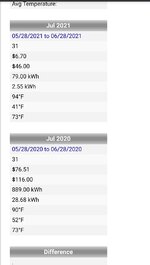
Regardless my system makes between $3 and $5 a daily. So $3x365 = $1,095 a year on lowest end. With my diy bill it's under 3 year ROI. On the high end $5x365 = $1825 it's under 2 year ROI. Everyone is different but this is the analysis YOU need to do.

Here is before and after as provided by my power company. Screenshot_20210818-214305_Chrome.jpg
 

walrus

Well-known member
Joined
Nov 12, 2008
Messages
11,675
Location
Maine
2023 is when the step down to 22% tax credit occurs, its still 26% thru 21 and 22
 

tyme2par4

Well-known member
Joined
May 16, 2016
Messages
571
Location
NH
Forum I caution you that unless you have experience with solar to take time and research it yourself. My system which I diy installed was quoted by the two local solar companies from 26k to 32k. my bill of materials is attached. I shopped around to get the cheapest price but here it's what I bought. Also solar tax credit goes down to 22% this year then phases out next year, if I recall correctly.

Wise friends the future is here, add solar my electric rate is .084 a kwh, some of cheapest in nation, and solar makes financial sense for me.

The SMA inverter does have a grid down outlet but it's rare situations to have sun power and a down grid. In hindsight I probably would do a different inverter today, something with better off grid potential but the SMA inverter is so proven and reliable.
I'm curious what your total installed cost and size of the system is.
I installed a 6kW system on my parents house a few years back for about $8k total before incentives. They got $1500 back from the state and then another 30% back on federal taxes.
With an electric price of $.16/kWh it paid for itself in about 3 years.
 

dcg9381

Well-known member
Joined
Jun 20, 2018
Messages
11,660
Location
Austin, TX
I'm curious what your total installed cost and size of the system is.
I installed a 6kW system on my parents house a few years back for about $8k total before incentives. They got $1500 back from the state and then another 30% back on federal taxes.
With an electric price of $.16/kWh it paid for itself in about 3 years.

I self installed a 6KW system in 2019. Our power cost here is $0.1168 per kWh. Cost for the system (panels, hardware, inverter, rails) - $9,006.87, which is $6665 after federal rebate. Add, I'd say, $500-$1000 for equipment rental (lift) and misc hardware, disconnects, etc.

My install is a bit "non-optimal" - it does face south, but has a tilt of about 1/12 as I have it mounted on the shed roof of the shop (I need a 14' eve mimimum). Production from yesterday is below. So it produced, $3.50 worth of solar power yesterday, which is reduced off my power bill 1:1, as my POC does a monthly net of energy consumption/production. If the cost of power stays the same, it'll pay for itself in between 7-10 years approximately.

1629473840863.png
 
Last edited:
To avoid these ads, REGISTER NOW!
Top Bottom