I've been debating installing a DIY solar system on my garage roof. (it would likely be with the aid of a Master Electrician Friend whom is also an electrical engineer) So far we've only lightly discussed and I'm trying to calculate my needs to determine cost to come up with a budget.
It's worth noting my garage and house are on separate meters currently. Plan is to eventually subfeed the house off the garage meter/panel, which is setup for this and conduit is run between the two. I just can't justify $1000 worth of cable to save a $20/mo meter charge. If I go solar, that changes things....
This past November my usage for house was 1320.75kWh and the garage 540.26kWh, so about 1860 between the two. In July I used 2285kWh total. The lightest months, since building garage were about 1300-1400. My garage has South facing roof on an 8/12 Pitch, I believe I can get about 30-35 panels on this roof and meet code for room to walk around. My hope would be to get the invertor, charge controller and all the wiring installed with maybe enough panels to power the garage and get things going, then slowly add to help power the house. Thinking maybe 1/3 then 1/3 then 1/3, that would also keep everything from aging out at once. Garage panel should be setup for this, not sure how the meter works, if that requires a change or not.
I just got off phone with a local solar provider, but they really cater to the full install. He did answer some questions, but left me with a few questions.
He says 30 panels provide about 11Kw of power, so with my roof slope and our area, I'd be getting about 1600kwh in July and about 1200 in Nov. He then said some people use micro invertors to keep cost low at first, but his take was an optimized starting invertor might be best for the long haul in my area. As I said, he isn't really wanting to sell a pieced out system and prefers to do turn key, so he sent me to unbound solar online. He mentioned a 10,000watt invertor if I go string.
I guess I need to know how large of invertor should I be looking at to power everything down the road. I'm guessing I don't need a charge controller unless I add battery backup? This would be grid tied. My understanding is solar is kind of plug-n-play once you get the basics installed, am I mistaken on that? Am I missing something?
It's worth noting my garage and house are on separate meters currently. Plan is to eventually subfeed the house off the garage meter/panel, which is setup for this and conduit is run between the two. I just can't justify $1000 worth of cable to save a $20/mo meter charge. If I go solar, that changes things....
This past November my usage for house was 1320.75kWh and the garage 540.26kWh, so about 1860 between the two. In July I used 2285kWh total. The lightest months, since building garage were about 1300-1400. My garage has South facing roof on an 8/12 Pitch, I believe I can get about 30-35 panels on this roof and meet code for room to walk around. My hope would be to get the invertor, charge controller and all the wiring installed with maybe enough panels to power the garage and get things going, then slowly add to help power the house. Thinking maybe 1/3 then 1/3 then 1/3, that would also keep everything from aging out at once. Garage panel should be setup for this, not sure how the meter works, if that requires a change or not.
I just got off phone with a local solar provider, but they really cater to the full install. He did answer some questions, but left me with a few questions.
He says 30 panels provide about 11Kw of power, so with my roof slope and our area, I'd be getting about 1600kwh in July and about 1200 in Nov. He then said some people use micro invertors to keep cost low at first, but his take was an optimized starting invertor might be best for the long haul in my area. As I said, he isn't really wanting to sell a pieced out system and prefers to do turn key, so he sent me to unbound solar online. He mentioned a 10,000watt invertor if I go string.
I guess I need to know how large of invertor should I be looking at to power everything down the road. I'm guessing I don't need a charge controller unless I add battery backup? This would be grid tied. My understanding is solar is kind of plug-n-play once you get the basics installed, am I mistaken on that? Am I missing something?
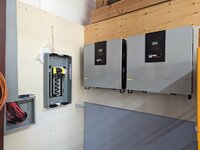
 I'm at the tail end of a DIY 16.4kw "Permitted" but "Off Grid" install on my toy shop with a plan to use generator model switch over instead of grid tie down the road. I'm in at $27k (19k after tax rebates) , none of this accounts for my time.