To avoid these ads, REGISTER NOW!

Solar

ToolsRCool

Well-known member
Joined
Dec 28, 2024
Messages
231
Location
Plymouth, MI
Just a brief post about rooftop solar, for anybody considering it. I did it myself, and love the result. There are really only 3 parts and 2 wires. If you have an un-obstructed South facing roof surface, there is a lot to be gained. West works too. In my case, it is like having a 5.8kW generator running anytime the sun is out. Has been 100% maintenance free since installation. Was a full city permit build and inspection per utility company requirements. There are solar farms now popping up, which will be a different config than here.

I did 21 Mitsubishi 280W panels, and used micro-inverters, one per, so the system pushes in parallel vs series (no bottle-necks). Internet connectivity is not required, only for monitoring of system performance. 2.5 year ROI, electric bills are only $9 a month now (line connection fee) no matter how much we run the A/C. Even though we're in MI, it covers about 10 of the 12 months of total usage. No battery because we are still grid tied. Utility comes out and re-flashes the digital smart meter to basically have 2 odometers, one in each direction, of which they are totaled each month. At least in MI, the utility never really pays you for excess generation, but instead credits are issued of which you use at night and in the winter months. Meter reads negative during any daylight hours.

Nothing to sell, just an advocate for rooftop solar if anybody has any DIY questions, I'd be happy to answer. Utility rates are only ever going to increase. In this instance, it felt great to cut ties with the man. Solar incentives and rules differ per state, so I really only know them for MI. Even those have changed a bit since I did this a few years ago. There is, or at least was, also a US Federal tax rebate pertaining to such. Used panels are even available now in the market for very low cost, which really drives the total cost even lower.

Siding is shot in the below pic. Garage getting a full tear down and rebuild this spring.
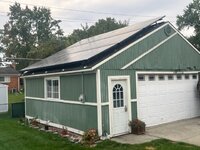
Garage.jpg
 
To avoid these ads, REGISTER NOW!

davejo

Well-known member
Joined
Oct 29, 2015
Messages
277
Location
(VA)
Good info, where did you buy your components and learn what to look for?
 
OP
T

ToolsRCool

Well-known member
Joined
Dec 28, 2024
Messages
231
Location
Plymouth, MI
Panels are Mitsubishi. I wanted a Japanese brand for their longevity quality. Enphase had the most descriptive information about inverters online and were the largest name at the time for micro-inverters. Then just generic Google searching for roof mount rack systems, wanted something generic I could piece together to make up the size needed. Ended up buying the inverters and racks from the same distributor, they gave a discount just by calling and asking them. Racks are anodized aluminum, all stainless bolts. Did not have to re-shingle to mount the pedestals to the rafter boards.

For code and permit related items, a lot was gathered off my utility providers website.

Honestly though, all said and done, it came down to really just being panels, racks, and the inverters. Then 2 wires connecting anywhere to your 240v. I already had a 240v subpanel in my garage. Code wanted a labeled disconnect located close to the utility meter for responders to de-energize the panel system if need be, easy.

I'm powering my entire house 10 of the 12 months of the year using just 1/4 of my total available roof structure, and these panels were had a pretty low output spec even when new as compared to others that were coming out at the time. All components have a 25 year warranty on them, even when self-installed. I did have one Enphase inverter fail pretty early on, Enphase knew of the failure due to the internet connectivity of my monitor module, and was already sending a replacement unit before I submitted the notice. Swapped that one out, all been fine since.

My system will actually not produce electricity during a power outage. My older inverters require utility line power to generate and match/sync the frequency phase. So with no reference, the inverters simply shut off. That was also a safety feature at the time to protect line workers. You can get inverters now which can put your house on its own "island" and continue to generate during utility loss, take a more costly control unit to do so (automated trasfer switch, etc...), but is possible. I could probably also do it with a small true sine wave inverter and a 12v battery, but honestly we don't lose power much on bright sunny days. For real outages, I have a small 8kW construction site light tower unit, trailer mounted liquid cooled Kuobta diesel, quite (1800rpm vs 3600rpm), super reliable, self contained with 30g integral fuel tank, and sips fuel @ 3g/24hrs lightly loaded.
 

larry4406

Well-known member
Joined
Jan 27, 2006
Messages
19,291
Location
Northern Virginia
Very nice.

I still kick my *** for not taking home an entire roof top solar set with racks and all from a house we demolished. Thought long and heard but I felt like with all the projects going on I did not need this one as well. :dunno:

If the grid goes down, can you via appropriate interlock, use a small generator to create a 60 hz power source for the inverters to then sink to?
 

lund

Well-known member
Joined
Nov 2, 2019
Messages
788
Location
Michigan
Nice job and info. I am in MI (central in my case) also.

I am tempted to do something like this after new roofing is due soon (few years). I presume tax credits will go away in the coming Trump admin and utility incentives may become less (big diff if they credit at consumer or wholesale rate ... which do you get?). But this kind of simple setup makes good sense. I become more queasy with those wanting to put large LI-I battery packs in their homes. Those are probably not a good idea from a safety standpoint. But I guess one can say similar about electric or hybrid cars in the garage. Yes gas can be dangerous too ... but likely not as much so as large battery packs. I would probably want any electric or plug in hybrid car charging outside most of the time.

One thing surprised me with your setup though. You did not want to put on a new roof *before* the panels? Those must not be simple to take off when you eventually need to re-roof. I suppose if the roof is new when put on that it would add to the life, if lucky, with much of the sun blocked. I am thinking of putting on a meal roof underneath to get good longevity.

Do you plan on charging an electric or plug in hybrid vehicle with your panels? That might make more use of the power and if they are crediting you at consumer rates for the generation that might work well even with the charging over night.

Also, does snow accumulation pose a problem? Do the panels shed reasonably well with the modest slope that you have? Where I am in central michigan our snow load is going way down now with the warming climate.
 

pembol

Well-known member
Joined
Feb 13, 2014
Messages
270
Very nice.

I still kick my *** for not taking home an entire roof top solar set with racks and all from a house we demolished. Thought long and heard but I felt like with all the projects going on I did not need this one as well. :dunno:

If the grid goes down, can you via appropriate interlock, use a small generator to create a 60 hz power source for the inverters to then sink to?

I think the solar inverters are very sensitive to the incoming waveform (as a safety measure) and so I am not sure a generator will be good enough to fool them into turning on. I also wonder if bad things may happen with both a highly variable load and source with no battery in the system to buffer things. But this is also something I have thought of as we are in the same situation.
 

WisJim

Well-known member
Joined
Dec 20, 2010
Messages
2,283
Location
Menomonie, WI
We had an off-grid PV system since 1982, moved the components in 1989, and added more over the years. The original part was 24 volt, ground mount panels, battery based with a 4kw Xantrex inverter, but when we added more panels and grid tied Enphase microinverters, I set things up so that the microinverters worked with the AC output from the big Xantrex inverter and it worked pretty well. I have since moved and now have rooftop solar with newer Enphase inverters. We put a standing seam steel roof on the house before installing rooftop solar so we will never (hopefully) have to worry about reroofing or roof leaks.
 

walrus

Well-known member
Joined
Nov 12, 2008
Messages
11,679
Location
Maine
You can fool grid tied inverters with batteries and an inverter, but back feed the grid and you will be in trouble.
 

reader2580

Well-known member
Joined
Dec 31, 2014
Messages
14,547
Location
Minneapolis, MN
I have around 11,000 watts of solar panels. They work great in the summer, and don’t produce much at all during the winter. We have had heavy overcast clouds for at least five days of the past seven. On these heavy overcast days I have been producing about 1% of the potential energy the array could produce at full production. I am not sure I am even producing enough to cover the base load of my house.

I have ground mounts at 35 degrees that are positioned just slightly to the west of solar south to get more production during the high use times in the summer months. (The positioning was more to keep the ground mounts parallel to my property line.)
 

ericm

Well-known member
Joined
Apr 17, 2016
Messages
1,963
Location
Southern Oregon
I have a contract to put solar and batteries on the new house we're building. It'll be 12kw of panels, 33kw of batteries and should be able to run the entire house at least during spring and summer. We might have to turn the A/C down some during outages. It will have the ability to take generator input as well, if the outage is in the winter and the panels are not enough. The house will be all electric so it's going to take a bit of power. 2/3 of the panels will be mounted facing SSW (that's all that will fit that roof pitch) and 1/3 facing NNE. Those will make good power in the summer but not much in the winter. The inverter/controller has the ability to deal with all of that.

Oregon has 1:1 net metering by law. In California now you get paid so little for the power you put back into the grid that the only way a system pays is to have batteries to run your house at night. Not so many people can afford that. I think a lot of utilities are pushing to copy it because discouraging solar makes more profit for them.

If I need more solar I can put panels on the shop and assign it's extra credits to the other meters.
 

wyliesdiesels

Well-known member
Joined
Aug 14, 2012
Messages
20,022
Location
Modesto, CA
Very nice.

I still kick my *** for not taking home an entire roof top solar set with racks and all from a house we demolished. Thought long and heard but I felt like with all the projects going on I did not need this one as well. :dunno:

If the grid goes down, can you via appropriate interlock, use a small generator to create a 60 hz power source for the inverters to then sink to?
would have to have 2 interlocks- 1 for solar 1 for generator and im not sure how you could install 2.
 
OP
T

ToolsRCool

Well-known member
Joined
Dec 28, 2024
Messages
231
Location
Plymouth, MI
Very nice.

I still kick my *** for not taking home an entire roof top solar set with racks and all from a house we demolished. Thought long and heard but I felt like with all the projects going on I did not need this one as well. :dunno:

If the grid goes down, can you via appropriate interlock, use a small generator to create a 60 hz power source for the inverters to then sink to?
Should have taken them. It makes your electric bill disappear. You don't care what is left on or not anymore after having them. Of course we are still sensitive to such, but just as an example.

I think you could self-produce a sine wave from an inverter and get your grid back up, but I don't want to be doing that with something cheap and risk zapping out all 21 of my micro-inverters. I just shut my main off, shut the solar off, then fire up my Kubota diesel genset.
 

theoldwizard1

Well-known member
Joined
Feb 22, 2011
Messages
43,184
Location
SE MI
I live less than 10 miles from you !

Was a full city permit build and inspection per utility company requirements.
This what is scaring me off ! From what I have read, the permitting and inspection process by the power company is quite daunting !

Did you hire someone to inspect your plans and prepare the permit ?

2.5 year ROI, electric bills are only $9 a month now (line connection fee) no matter how much we run the A/C. Even though we're in MI, it covers about 10 of the 12 months of total usage.
.
.
.
At least in MI, the utility never really pays you for excess generation, but instead credits are issued of which you use at night and in the winter months.
When "grid tie" solar first came out, Detroit Edison would let you run your non-digital meter backwards, effectively buying your excess power at the same "retail" price that they sold it to you. That changed a few years ago. Now they "buy back" your excess power at "wholesale" rates. This typically make ROI very long !
 
OP
T

ToolsRCool

Well-known member
Joined
Dec 28, 2024
Messages
231
Location
Plymouth, MI
Nice job and info. I am in MI (central in my case) also.

I am tempted to do something like this after new roofing is due soon (few years). I presume tax credits will go away in the coming Trump admin and utility incentives may become less (big diff if they credit at consumer or wholesale rate ... which do you get?). But this kind of simple setup makes good sense. I become more queasy with those wanting to put large LI-I battery packs in their homes. Those are probably not a good idea from a safety standpoint. But I guess one can say similar about electric or hybrid cars in the garage. Yes gas can be dangerous too ... but likely not as much so as large battery packs. I would probably want any electric or plug in hybrid car charging outside most of the time.

One thing surprised me with your setup though. You did not want to put on a new roof *before* the panels? Those must not be simple to take off when you eventually need to re-roof. I suppose if the roof is new when put on that it would add to the life, if lucky, with much of the sun blocked. I am thinking of putting on a meal roof underneath to get good longevity.

Do you plan on charging an electric or plug in hybrid vehicle with your panels? That might make more use of the power and if they are crediting you at consumer rates for the generation that might work well even with the charging over night.

Also, does snow accumulation pose a problem? Do the panels shed reasonably well with the modest slope that you have? Where I am in central michigan our snow load is going way down now with the warming climate.
Great questions, happy to answer:

Battery packs don't make too much sense (to me) if you are able to be grid tied. I work with batteries daily, and absolutely hate them. They are little mini bombs, they leak, they go dead, their internal resistance increases and they eat themselves, they are large and heavy, expensive, they blow up or catch fire. Really suggest to do a system without a battery if you have grid nearby.

Check the current US Federal tax incentive, it was reducing on a schedule per year, but they may have extended it. I don't think Trump touched it before, that's when I put mine up. It may have even been extended, I have not looked recently. Was almost 40% when I did mine. There are no MI state level incentives, MI is very much in bed with the utility companies I learned through this. Other states are WAY more consumer solar friendly. There was a bill in place to restore Net Metering, I don't think it went through, or at least not yet.

I got in on the tail end of Net Metering as it was closing, therefore I was grandfathered in for an additional 10 years. I have not yet studied the retail-wholesale relationship they are now doing. Hopefully with that, they are letting you install more panels to offset the difference? Array size was limited to your annual consumption when I did it. They wanted to make sure they would not owe you in the end.

Did not redo my shingles, good observation. It was in OK shape when I did the install, and realized that once the array was up, the shingles would never see sunlight again because they are fully covered. From that, they may even last nearly forever? Not sure, but the panels and racks are removed super easily if shingle service is ever needed. Cordless ratchet and one socket is all that is needed. All of the micro-inverters have plug connectors on them. I have each micro-inverter bolted to the frame of each panel, so they come off as a modular unit per, with just the 2 connectors on each inverter.

No plans for an EV. Because our system was sized without the draw of an EV, the utility makes you size it according to your last years total kWh usage. But again, I don't know about how the new and latest rules work for such. Hopefully they are more accommodating?

Winter solar output in MI is very low for 4 reasons combined: 1. Daylight hours are significantly less, the angle of the sun is way lower, the panels can be snow covered, and winter has tons of overcast days. The output is not zero, it does make some power, and luckily we are not running the A/C in the winter, so the solar is still helping, but this is why we pay about 2 months work of partial electric bills per year.
 
OP
T

ToolsRCool

Well-known member
Joined
Dec 28, 2024
Messages
231
Location
Plymouth, MI
I think the solar inverters are very sensitive to the incoming waveform (as a safety measure) and so I am not sure a generator will be good enough to fool them into turning on. I also wonder if bad things may happen with both a highly variable load and source with no battery in the system to buffer things. But this is also something I have thought of as we are in the same situation.
I don't know. I am not sure, and did not want to find out, so I don't try it, and instead I shut off the breaker for the solar when I do connect and run my generator.
 
OP
T

ToolsRCool

Well-known member
Joined
Dec 28, 2024
Messages
231
Location
Plymouth, MI
I live less than 10 miles from you !


This what is scaring me off ! From what I have read, the permitting and inspection process by the power company is quite daunting !

Did you hire someone to inspect your plans and prepare the permit ?


When "grid tie" solar first came out, Detroit Edison would let you run your non-digital meter backwards, effectively buying your excess power at the same "retail" price that they sold it to you. That changed a few years ago. Now they "buy back" your excess power at "wholesale" rates. This typically make ROI very long !
Way cool on the location, we should meet for lunch one day.

So, the permit process was way easier than imagined. DTE just wants your city to approve your wiring. That can be done yourself, as long as it meets code. All of that is very simple to do. My city inspector was at my house for 3 minutes, had zero questions, and really just kept asking if he could borrow my 4x4 scissor lift to build a pole barn at his place. Once I had the signed tag, I just submitted a pic of that to DTE, they sent a field tech out, that guy re-flashed my smart meter with his laptop, then took off and said I'm all set. That was it. Like, another 3 min visit. I'm Net Metering on a digital smart meter. It reads negative anytime the sun is out, even right now on this overcast day it is showing -1.4kWh.

I did not hire anybody for any of it. City wanted a permit for electrical and building. Paid those, the each came out and said great, signed, and left. I submitted hand drawings, done with a ruler to scale. When I submitted for them, I was all nervous, thinking I'd need all sorts of official stuff. When they heard 2 different things, they immediately dropped any concerns on their side. When I said I am doing it myself, and when I said it is going onto a detached garage. With both of those, they literally said "Oh, so if it burns down, nobody gets injured, then we don't care what you do.". It was awesome. Of course I still did the job with decency, but a neighbor did his on his attached roof at the same time, with even less submittals than I did, and his passed with flying colors as well.

Yes, they ended Net Metering. But, DIY solar still makes amazing sense. You can buy used panels, and nearly eliminate most of your electric bill, for very low cost. Net Metering may be restored in the future as well. It was just so easy to do, anybody can do it.
 
OP
T

ToolsRCool

Well-known member
Joined
Dec 28, 2024
Messages
231
Location
Plymouth, MI
We had an off-grid PV system since 1982, moved the components in 1989, and added more over the years. The original part was 24 volt, ground mount panels, battery based with a 4kw Xantrex inverter, but when we added more panels and grid tied Enphase microinverters, I set things up so that the microinverters worked with the AC output from the big Xantrex inverter and it worked pretty well. I have since moved and now have rooftop solar with newer Enphase inverters. We put a standing seam steel roof on the house before installing rooftop solar so we will never (hopefully) have to worry about reroofing or roof leaks.
Standing seam and panels is an awesome looking combo.
 
OP
T

ToolsRCool

Well-known member
Joined
Dec 28, 2024
Messages
231
Location
Plymouth, MI
You can fool grid tied inverters with batteries and an inverter, but back feed the grid and you will be in trouble.
Maybe, I decided I am not going to try it and find out by zapping dead all 21 of my micro-inverters. I just dump the main and solar breakers, and fire up my generator. Pretty rare that the power fails on a bright sunny day anyway. Usually storm caused from trees.
 
To avoid these ads, REGISTER NOW!
OP
T

ToolsRCool

Well-known member
Joined
Dec 28, 2024
Messages
231
Location
Plymouth, MI
I have around 11,000 watts of solar panels. They work great in the summer, and don’t produce much at all during the winter. We have had heavy overcast clouds for at least five days of the past seven. On these heavy overcast days I have been producing about 1% of the potential energy the array could produce at full production. I am not sure I am even producing enough to cover the base load of my house.

I have ground mounts at 35 degrees that are positioned just slightly to the west of solar south to get more production during the high use times in the summer months. (The positioning was more to keep the ground mounts parallel to my property line.)
11kW is a healthy system! I have always wondered about West-facing. I was going to add one panel in that direction for 24hrs and then do a comparision on total gathered energy to one of my South-facing array panels. I hope to add more panels once my Net Metering expires, and those new ones would all be West-facing since I fully occupied my South-facing garage roof.
 
OP
T

ToolsRCool

Well-known member
Joined
Dec 28, 2024
Messages
231
Location
Plymouth, MI
I have a contract to put solar and batteries on the new house we're building. It'll be 12kw of panels, 33kw of batteries and should be able to run the entire house at least during spring and summer. We might have to turn the A/C down some during outages. It will have the ability to take generator input as well, if the outage is in the winter and the panels are not enough. The house will be all electric so it's going to take a bit of power. 2/3 of the panels will be mounted facing SSW (that's all that will fit that roof pitch) and 1/3 facing NNE. Those will make good power in the summer but not much in the winter. The inverter/controller has the ability to deal with all of that.

Oregon has 1:1 net metering by law. In California now you get paid so little for the power you put back into the grid that the only way a system pays is to have batteries to run your house at night. Not so many people can afford that. I think a lot of utilities are pushing to copy it because discouraging solar makes more profit for them.

If I need more solar I can put panels on the shop and assign it's extra credits to the other meters.Absolutely, local utilitites are very against

I have a contract to put solar and batteries on the new house we're building. It'll be 12kw of panels, 33kw of batteries and should be able to run the entire house at least during spring and summer. We might have to turn the A/C down some during outages. It will have the ability to take generator input as well, if the outage is in the winter and the panels are not enough. The house will be all electric so it's going to take a bit of power. 2/3 of the panels will be mounted facing SSW (that's all that will fit that roof pitch) and 1/3 facing NNE. Those will make good power in the summer but not much in the winter. The inverter/controller has the ability to deal with all of that.

Oregon has 1:1 net metering by law. In California now you get paid so little for the power you put back into the grid that the only way a system pays is to have batteries to run your house at night. Not so many people can afford that. I think a lot of utilities are pushing to copy it because discouraging solar makes more profit for them.

If I need more solar I can put panels on the shop and assign it's extra credits to the other meters.
Nice! Yep, local utilities are VERY against consumer owned solar arrays. They work that well, it is a threat to them. They want to own the solar and sell it to you, they do not want you owning and making your own power.
 
OP
T

ToolsRCool

Well-known member
Joined
Dec 28, 2024
Messages
231
Location
Plymouth, MI
Huge proponent of DIY solar - I hope it becomes more common place. Especially with the criminal prices solar installers are charging these days.
So that is exactly what has me pushing this here. Those solar companies really are trying to retire off 2-3 jobs. To DIY this is very easy, only 3 parts and 2 wires. But, if somebody is uncomfortable doing so, they can still do it a low cost way. Just hire a roofer to install the racks and panels, and then an electrician to wire it up. Even @ $150/hr or whatever, it is not going to be $25,000 for an installed system. You buy the parts, then just pay for install of the 2 categories.
 

American Locomotive

Well-known member
Joined
Jan 8, 2017
Messages
10,965
Location
Rhode Island
So that is exactly what has me pushing this here. Those solar companies really are trying to retire off 2-3 jobs. To DIY this is very easy, only 3 parts and 2 wires. But, if somebody is uncomfortable doing so, they can still do it a low cost way. Just hire a roofer to install the racks and panels, and then an electrician to wire it up. Even @ $150/hr or whatever, it is not going to be $25,000 for an installed system. You buy the parts, then just pay for install of the 2 categories.
What was your total investment?
 
OP
T

ToolsRCool

Well-known member
Joined
Dec 28, 2024
Messages
231
Location
Plymouth, MI
More details on how your genset is wired in.
Genset is just a temporary mobile emergency unit. I use a construction site light tower I bought and cut the light tower off of. It is a very compact and quiet liquid cooled 8kW Kubota diesel, spins 1800rpm (not 3600rpm). Integrated 40g fuel tank, weatherproof cover, mobile on trailer. Paid $1,000 for it off eBay. Burns 3g/24hrs lightly loaded. I plug it into my 240v garage welding outlet after shutting off my main breaker and solar panel breaker. I have mini-split A/C, so it is strong enough to even power that during an outage. That Kubota is silent and will run forever. Starts instantly, no matter the temp.
 
OP
T

ToolsRCool

Well-known member
Joined
Dec 28, 2024
Messages
231
Location
Plymouth, MI
What was your total investment?
A pinch under $6k total outlay before receiving the US Federal tax incentive back at the beginning of the following year. I think that incentive was nearly 40% at the time, somewhere in the 36%-40% range. Way less than the $25k solar companies were quoting, and I was able to use higher quality components.
 

sjvicker

Well-known member
Joined
Aug 9, 2014
Messages
602
Location
SW Washington
So that is exactly what has me pushing this here. Those solar companies really are trying to retire off 2-3 jobs. To DIY this is very easy, only 3 parts and 2 wires. But, if somebody is uncomfortable doing so, they can still do it a low cost way. Just hire a roofer to install the racks and panels, and then an electrician to wire it up. Even @ $150/hr or whatever, it is not going to be $25,000 for an installed system. You buy the parts, then just pay for install of the 2 categories.

I think you really hit on something here. I'm in the process of setting up my off-grid system and some of the costs I've seen that people pay for installed systems just dont add up, and there's issues with long term support of the inverters.

You did it right. You did the research and found a simple solution that gets you a quick ROI.

To anyone considering getting into solar, check out Will Prowse on youtube. He does a good job outlining the types of systems and giving templates to follow to create your own system. For less than 10k you can DIY your own solar system without batteries that reduces your need for grid power.
 
OP
T

ToolsRCool

Well-known member
Joined
Dec 28, 2024
Messages
231
Location
Plymouth, MI
Some states are very pro-solar. Not only Net Metering, but then issue credits or certificates that have monetary value you can cash in on. You can not only eliminate your electric bill, but then also profit from it. All for something that just sits on your roof, is silent, extends your shingle life, lowers your roof temps, and requires zero maintenance.

Encourage more questions if anybody has. I can take and post any detailed pics as well if anybody has areas of specific interest.

The electrical part is super boring. Just 2 wires into a 240v breaker in my panel.
 

davejo

Well-known member
Joined
Oct 29, 2015
Messages
277
Location
(VA)
quotes from a couple companies this fall:

after government subsidy was about $35K for 16kw worth of panels and microinverters installed on a steep standing seam roof
 

ipgenie

Well-known member
Joined
Jan 29, 2020
Messages
562
Location
Idaho
I designed and installed my 25kW system 5 years ago on my pole barn. I bought used panels from a solar farm and string inverters due to the lower cost. After tax incentives, I paid just under $18k out of pocket. Three solar instalation quotes were all around $90K

I sized it for my current electric use plus switching to electric heat, an EV and a plug in hybrid. It took a few years before we got both cars I bought one tank of gas this year and propane savings have been over $1K per year. I'll break even in 2025. Our utility credits our account for the retail value of the export. That credit doesn't expire and we over produced a lot the first few years. Currently there is a balance of about $5K.

We got in at the end of net metering and are grandfathered in for 20 more years. I have a separate DIY battery system for essential loads during an outage, but we don't need it much. In 5 years we've had two outages over an hour, most are only a few minutes.
One thing I've learned is that solar is not a good fit for everyone, but in our situation, even with low utility rates, it's been a good fit.
 

reader2580

Well-known member
Joined
Dec 31, 2014
Messages
14,547
Location
Minneapolis, MN
11kW is a healthy system! I have always wondered about West-facing. I was going to add one panel in that direction for 24hrs and then do a comparision on total gathered energy to one of my South-facing array panels. I hope to add more panels once my Net Metering expires, and those new ones would all be West-facing since I fully occupied my South-facing garage roof.
South is 180 degrees. My panels are probably 190 degrees so just barely to the west.

It is not uncommon to place panels facing southwest or west to pick up sunlight when electric rates tend to be high, and usage is also high due to A/C usage.
 

ipgenie

Well-known member
Joined
Jan 29, 2020
Messages
562
Location
Idaho
If I were building a shop to mount solar on, I'd build with a gambrel roof sized for the solar panels. Top pitch would be 30 degrees and bottom would be 45 degrees so half of the panels would be at our ideal angle for summer and the others for winter.

Mine has a shallower pitch and a wing. I extended the shop for solar but still ended up with some panels on the north side. They average about 80% of the south facing panels in the summer, worse in the winter, partly due to how slowly the snow melts off and partly because the sun is so low. I wouldn't need as large of an array if the angles were better but 25 years ago when I built the first half of the shop, solar wasn't even a thought.

I've got a few south facing panels on my mower shed. They charge my electric mower and yard tools. I don't have any production data on those but I may add a little meter to log that data. It would be nice to measure the production of the three different directions.
 

lund

Well-known member
Joined
Nov 2, 2019
Messages
788
Location
Michigan
Great questions, happy to answer:

Battery packs don't make too much sense (to me) if you are able to be grid tied. I work with batteries daily, and absolutely hate them. They are little mini bombs, they leak, they go dead, their internal resistance increases and they eat themselves, they are large and heavy, expensive, they blow up or catch fire. Really suggest to do a system without a battery if you have grid nearby.

Check the current US Federal tax incentive, it was reducing on a schedule per year, but they may have extended it. I don't think Trump touched it before, that's when I put mine up. It may have even been extended, I have not looked recently. Was almost 40% when I did mine. There are no MI state level incentives, MI is very much in bed with the utility companies I learned through this. Other states are WAY more consumer solar friendly. There was a bill in place to restore Net Metering, I don't think it went through, or at least not yet.

I got in on the tail end of Net Metering as it was closing, therefore I was grandfathered in for an additional 10 years. I have not yet studied the retail-wholesale relationship they are now doing. Hopefully with that, they are letting you install more panels to offset the difference? Array size was limited to your annual consumption when I did it. They wanted to make sure they would not owe you in the end.

Did not redo my shingles, good observation. It was in OK shape when I did the install, and realized that once the array was up, the shingles would never see sunlight again because they are fully covered. From that, they may even last nearly forever? Not sure, but the panels and racks are removed super easily if shingle service is ever needed. Cordless ratchet and one socket is all that is needed. All of the micro-inverters have plug connectors on them. I have each micro-inverter bolted to the frame of each panel, so they come off as a modular unit per, with just the 2 connectors on each inverter.

No plans for an EV. Because our system was sized without the draw of an EV, the utility makes you size it according to your last years total kWh usage. But again, I don't know about how the new and latest rules work for such. Hopefully they are more accommodating?

Winter solar output in MI is very low for 4 reasons combined: 1. Daylight hours are significantly less, the angle of the sun is way lower, the panels can be snow covered, and winter has tons of overcast days. The output is not zero, it does make some power, and luckily we are not running the A/C in the winter, so the solar is still helping, but this is why we pay about 2 months work of partial electric bills per year.
Thanks for the info.

I agree with you absolutely on batteries. I really wonder what Cali is going to have happen if every house ends up with large battery packs to address overloaded grid issues.

You being in on net metering is a big deal. Unfortunately, for those that are not, it is likely a big difference to be getting credited at wholesale vs consumer rates. If the country really wants high uptake of solar, net metering while remaining on the grid will make a lot of sense. Hopefully legislation will do this. If it were more uniform, it would really help to get higher uptake of solar and drop fossil fuel use (thereby extending supplies and lowering prices there too while lessening environmental impact).

One issue on the shingles is that around edges you will still have a lot of exposure. Plus extra runoff will be diverted to the ends where it may enhance washing on top of still receiving the full solar load. So I am not sure if the panels will help that much on roof lifetime. I think most places recommend an updated roof with a lot of life left before install.

MI is definitely not the most solar friendly place since we have limited sun in the winter as you point out and I think we are in a zone sufficiently cold where winter electric heat via heat pumps will not work well. Snow and ice will also largely block solar unless you regularly clean the panels.

If you are also grandfathered in via net metering with a larger load you could try electric hot water heating and a plug in hybrid (not a lot of recharge infrastructure in Michigan now) to take more advantage if you want to upsize your system. That might make good economic sense ... particularly if you have local enough commuting.
 
OP
T

ToolsRCool

Well-known member
Joined
Dec 28, 2024
Messages
231
Location
Plymouth, MI
Agree on all.

I'm in a fixed position on my array size, only because I'm grandfathered on net metering. Sizing of my system to the max the utility will allow was based off the prior years annual image. So, it would be great to simply add more panels and the switch more appliances to electric, but I can't. At first when I inquired about this they said they would let me. The a few months later they have it out in print on their website that such is not allowed.

So, with that said, natural gas is still the lowest cost form of purchased energy available. Home is high efficiency NG furnace, and putting a second in my spring garage rebuild.

I have not looked deeply into MI's current rules for the new inflow/outflow meeting. I'm hoping they will simply allow you to add enough panels to offset the difference, but I'm guessing no way, they want $ from you monthly no matter what. I'm not sure why they just don't bring customers on at retail in / wholesale out with no limits? Have others be partial generators, they still make their profit, and we could even have the potential to make a small amount. But that could be baby steps toward putting them out of business, at least on the residential scale.

Still worth it.
 

dcg9381

Well-known member
Joined
Jun 20, 2018
Messages
11,767
Location
Austin, TX
So that is exactly what has me pushing this here. Those solar companies really are trying to retire off 2-3 jobs.
At the local municipality, last time I checked you needed 1M in liability insurance to connect a grid tie inverter. They also require that you pull a permit and will want to see your electricians license. Between the two of those things, it tends to thin the market quite a bit and drive up costs.

To DIY this is very easy, only 3 parts and 2 wires. But, if somebody is uncomfortable doing so, they can still do it a low cost way. Just hire a roofer to install the racks and panels, and then an electrician to wire it up. Even @ $150/hr or whatever, it is not going to be $25,000 for an installed system. You buy the parts, then just pay for install of the 2 categories.
Electricians here won't touch solar. Probably because they're too busy with standard electrical problems.
It IS possible to install in some of the smaller municipalities, but even those require a permit, a line drawing, and they have various additional disconnects required (even with a rapid-shutdown system).

For $6k before federal rebate on 6kw of Solar, that's a great price.

Great that you got net meter for 10 years. When they cut net metering and when to "wholesale" payback here, it added about 200% to "payback time".
 

reader2580

Well-known member
Joined
Dec 31, 2014
Messages
14,547
Location
Minneapolis, MN
Solar companies charge a lot for solar systems because people are paying it. The solar companies present a $30,000 to $50,000 quote to a homeowner, but then they say the federal government will pay for 30% of it, and in some cases there are other incentives too. A lot of people think solar prices will come down a lot if/when the tax credit goes away.

What often happens is solar companies inflate the quotes so that the 30% tax credit mostly benefits the solar company in the form of extra profit and sales commissions. I have heard that solar salespeople make some pretty large commissions on a sale. I also know that at least one national solar installer (now bankrupt) was pushing install crews to rush through jobs. The install crews would get several hundred dollars each if they installed a certain number of jobs per week.

There is a large residential solar installer here in the Minneapolis area that has to be spending tens of thousands per month on marketing and advertising. I see their ads all over the place.
 

Innovate1

Well-known member
Joined
Jul 28, 2014
Messages
4,289
Location
Illinois near St. Louis, Missouri
Interesting that you were able to do it all yourself. The big utilities are required to do net metering in Illinois but I am on a coop and they don't. I would have to upgrade my meter for grid intertie - as I understand it two meters. I could probably do that myself as I was able to do the original meter base install and all the other electrical. But also wanting some capability for power if the utility is out. Thinking about running solar panels with battery and inverter with the only connection to utility being a charger. Looks like some systems out there that can do that. Even saw something about a system that monitors weather and if an outage is likely it will charge the battery rather than optimizing for solar input. Not too far into the details yet... Some years ago I thought some of the incentives required professional installation but it seems that is no longer the case - think that might have been an Illinois incentive that no longer exists.
 

My Old Tools

Well-known member
Joined
Jun 4, 2014
Messages
5,439
Location
Hamrick Lake, TX
Very nice.

I still kick my *** for not taking home an entire roof top solar set with racks and all from a house we demolished. Thought long and heard but I felt like with all the projects going on I did not need this one as well. :dunno:

If the grid goes down, can you via appropriate interlock, use a small generator to create a 60 hz power source for the inverters to then sink to?
If the solar array puts out too much power, it will cook the generator.
 

lund

Well-known member
Joined
Nov 2, 2019
Messages
788
Location
Michigan
Agree on all.

I'm in a fixed position on my array size, only because I'm grandfathered on net metering. Sizing of my system to the max the utility will allow was based off the prior years annual image. So, it would be great to simply add more panels and the switch more appliances to electric, but I can't. At first when I inquired about this they said they would let me. The a few months later they have it out in print on their website that such is not allowed.

So, with that said, natural gas is still the lowest cost form of purchased energy available. Home is high efficiency NG furnace, and putting a second in my spring garage rebuild.

I have not looked deeply into MI's current rules for the new inflow/outflow meeting. I'm hoping they will simply allow you to add enough panels to offset the difference, but I'm guessing no way, they want $ from you monthly no matter what. I'm not sure why they just don't bring customers on at retail in / wholesale out with no limits? Have others be partial generators, they still make their profit, and we could even have the potential to make a small amount. But that could be baby steps toward putting them out of business, at least on the residential scale.

Still worth it.
Thanks.

I can see the power companies are trying to maximally restrict the interpretation with what you describe on your grandfathered situation with net metering. That is unfortunate. Any new solar installations will be much more unfriendly for homeowners without net metering.

It might be more realistically fair if they allowed consumers to deduct what they put back into the grid at the rates they are charged AND pay a fixed monthly fee for the grid service. But I guess that would be too logical and businesses want maximum $ and they want more use for their generator capacity. This is supposed to be where good governance steps in. But, unfortunately, with political contributions and our 2 party warfare (where eco friendly, unfortunately, may have became synonymous with liberal?) have resulted in good long-term approaches for all being dropped. MI may be ripe for such issues with the political divide roughly split and accentuated. But I also have a home in CA and I noticed they also did away with net metering on the premise that "who will pay for the grid" rather than finding a proper long term solution.
 

lund

Well-known member
Joined
Nov 2, 2019
Messages
788
Location
Michigan
At the local municipality, last time I checked you needed 1M in liability insurance to connect a grid tie inverter. They also require that you pull a permit and will want to see your electricians license. Between the two of those things, it tends to thin the market quite a bit and drive up costs.


Electricians here won't touch solar. Probably because they're too busy with standard electrical problems.
It IS possible to install in some of the smaller municipalities, but even those require a permit, a line drawing, and they have various additional disconnects required (even with a rapid-shutdown system).

For $6k before federal rebate on 6kw of Solar, that's a great price.

Great that you got net meter for 10 years. When they cut net metering and when to "wholesale" payback here, it added about 200% to "payback time".
The anti-DYI stuff on solar etc is perplexing. I can understand why they want things inspected etc. But they act like a small solar setup with 240V AC line to line will energize the whole neighborhood and electrocute their line crews. It is beyond ridiculous.

When I lived in Cali we regularly had trees down on our power lines (few times a month) and a sewer pump (house was below the sewer line, so no electricity meant no water/sewer use). So I made a parallel in-house circuit for direct connection to a generator for a few key things (sewer pump, furnace blower, fridge, and an outlet each floor) where I would manually plug in during extended outages. The simple system worked fine, but yikes was that a mistake. Line crews would pound on my door at 3 am asking if I was back feeding. They just hear a generator and go nutso. Several looked legitimately concerned yelling about it even (I guess company propaganda got some of them too). I put a sign on the door saying "No generator backfeed." It did not help. After a few rounds of early morning wake ups, I gave up and decided to do without.

Unfortunately I am starting to lose faith in our ability in the USA to do much of anything without excess complication. Solar needs to be better addressed so it does not end up discouraged.
 
To avoid these ads, REGISTER NOW!
Top Bottom