wyliesdiesels
Well-known member
I have never seen a transfer switch switch the GECs. did you mean neutral? only some transfer switch switch the neutral. usually they dont.Shouldn't the ground switching be handled by the transfer switch?

I have never seen a transfer switch switch the GECs. did you mean neutral? only some transfer switch switch the neutral. usually they dont.Shouldn't the ground switching be handled by the transfer switch?
you are not supposed to bond the neutral anywhere except the main service panel regardless of whether there is a GFCI.There's no transfer switch on an RV....
The problem w/ tying the neutral and ground together in an RV is that when you plug the RV into a GFCI, both the neutral and the ground share the current... but the GFCI sees less current on the neutral than it sees on the hot line, and immediately trips.
Yes, I meant neutral. I think the transfer switches setup for generator power usually did that switch for you. Obviously you don't want to bond the RV if connecting to shore power.I have never seen a transfer switch switch the GECs. did you mean neutral? only some transfer switch switch the neutral. usually they dont.
not true. ive seen many transfer switches that do not switch the neutral. its totally optional....Yes, I meant neutral. I think the transfer switches setup for generator power usually did that switch for you. Obviously you don't want to bond the RV if connecting to shore power.
The ******** "inverter" space in RV-land seems to be bleeding edge and problems with GFCI because of how they're doing these things seem to be common.
and where is the transfer switch located? just after the meter or after the first means of disconnect on the service?We've gotten way off the original topic, but I will explain how my motorhome is set up for ground/neutral bonding.
I have a diesel generator, shore power, and an inverter. The generator has the neutral and ground bonded inside of the generator. The generator is isolated from shore power by an automatic transfer switch when the generator is not running. The inverter has a ground bond relay in it that is open when shore power or generator power is available, and is closed when the inverter is creating AC power.
It is an RV so you don’t really have either of those. My transfer switch is located before the main load center. It is an RV specific transfer switch that transfers both hot and neutral.and where is the transfer switch located? just after the meter or after the first means of disconnect on the service?
There's the Darwin tax a lot of STEM people minimize when going the DIY way. That is, people having paid w/their lives/injury by chance or error spurring countermeasure revisions...which may not make sense to STEM types until explained. I read a quote on tradition and while I don't 100% agree with it rings true none the less and applies here IMO:I also think I am also in a demographic that is apt to make this sort of mistake - I have degrees in EE and physics and have a tendency to suffer from what we call 'physicist syndrome', which is the idea that you can figure anything out from first principles, and don't really need practical experience or training.
Generally I can figure out how things are supposed to work, but don't have the practical experience to know and plan for all the ways that it could, and at some point will, go wrong. Which is where the electrical codes and inspectors come into play, they are based on decades of experience of things going wrong, and take the wild card of human nature into account - I don't always know why the code is the way it is, but it is usually for a good reason that I haven't thought of.
If it is before the main service panel, then it is the main service panel.It is an RV so you don’t really have either of those. My transfer switch is located before the main load center. It is an RV specific transfer switch that transfers both hot and neutral.
Anyone's that done this try their luck w/decommissioned panels that are cents to the dollar on ebay? AFAIK they test good but are pulled from farms due to life cycle/efficiency/other reasons.
Not from EBay, but I purchased 22 used solar panels from Sun Electronics back in 2017 or 2018. They are still working just fine. I also bought four used panels locally in 2020 that are still working fine.Anyone's that done this try their luck w/decommissioned panels that are cents to the dollar on ebay? AFAIK they test good but are pulled from farms due to life cycle/efficiency/other reasons.
$720 per kW capacity. That's exactly how much igenie's came out to, also.A pinch under $6k total outlay before receiving the US Federal tax incentive back at the beginning of the following year. I think that incentive was nearly 40% at the time, somewhere in the 36%-40% range. Way less than the $25k solar companies were quoting, and I was able to use higher quality components.
Just a brief post about rooftop solar, for anybody considering it. I did it myself, and love the result. There are really only 3 parts and 2 wires. If you have an un-obstructed South facing roof surface, there is a lot to be gained. West works too. In my case, it is like having a 5.8kW generator running anytime the sun is out. Has been 100% maintenance free since installation. Was a full city permit build and inspection per utility company requirements. There are solar farms now popping up, which will be a different config than here.
I did 21 Mitsubishi 280W panels, and used micro-inverters, one per, so the system pushes in parallel vs series (no bottle-necks). Internet connectivity is not required, only for monitoring of system performance. 2.5 year ROI, electric bills are only $9 a month now (line connection fee) no matter how much we run the A/C. Even though we're in MI, it covers about 10 of the 12 months of total usage. No battery because we are still grid tied. Utility comes out and re-flashes the digital smart meter to basically have 2 odometers, one in each direction, of which they are totaled each month. At least in MI, the utility never really pays you for excess generation, but instead credits are issued of which you use at night and in the winter months. Meter reads negative during any daylight hours.
Nothing to sell, just an advocate for rooftop solar if anybody has any DIY questions, I'd be happy to answer. Utility rates are only ever going to increase. In this instance, it felt great to cut ties with the man. Solar incentives and rules differ per state, so I really only know them for MI. Even those have changed a bit since I did this a few years ago. There is, or at least was, also a US Federal tax rebate pertaining to such. Used panels are even available now in the market for very low cost, which really drives the total cost even lower.
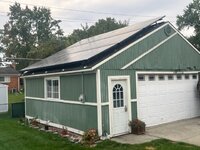
Siding is shot in the below pic. Garage getting a full tear down and rebuild this spring.
That's amazing!Just a brief post about rooftop solar, for anybody considering it. I did it myself, and love the result. There are really only 3 parts and 2 wires. If you have an un-obstructed South facing roof surface, there is a lot to be gained. West works too. In my case, it is like having a 5.8kW generator running anytime the sun is out. Has been 100% maintenance free since installation. Was a full city permit build and inspection per utility company requirements. There are solar farms now popping up, which will be a different config than here.
I did 21 Mitsubishi 280W panels, and used micro-inverters, one per, so the system pushes in parallel vs series (no bottle-necks). Internet connectivity is not required, only for monitoring of system performance. 2.5 year ROI, electric bills are only $9 a month now (line connection fee) no matter how much we run the A/C. Even though we're in MI, it covers about 10 of the 12 months of total usage. No battery because we are still grid tied. Utility comes out and re-flashes the digital smart meter to basically have 2 odometers, one in each direction, of which they are totaled each month. At least in MI, the utility never really pays you for excess generation, but instead credits are issued of which you use at night and in the winter months. Meter reads negative during any daylight hours.
Nothing to sell, just an advocate for rooftop solar if anybody has any DIY questions, I'd be happy to answer. Utility rates are only ever going to increase. In this instance, it felt great to cut ties with the man. Solar incentives and rules differ per state, so I really only know them for MI. Even those have changed a bit since I did this a few years ago. There is, or at least was, also a US Federal tax rebate pertaining to such. Used panels are even available now in the market for very low cost, which really drives the total cost even lower.
Siding is shot in the below pic. Garage getting a full tear down and rebuild this spring.
 www.thermomart.com
I'm knee deep in learning about this stuff now. rabbit holeYou should totally do it, especially if you have any South facing roof surface. It can be done for even less now since you can get used panels for cheap.
I'd love to see the design. I've done two "thermosyphon" systems, which worked absolutely great, but you don't often see them in the USA.That's amazing!
I'm setting up my own solar panel for water heater. I'm using a differential thermostat (model DIN-S from ThermoMart) that solved my pump problem.