To avoid these ads, REGISTER NOW!

Solder or flex for water heater?

bw77

Well-known member
Joined
Jul 10, 2009
Messages
1,317
Location
Upstate NY
Our current water heater is 18 years old and is connected to the copper supply pipes with solder joints. When we replace it would stainless flex lines be the best way to go, or are solder joints still being used?

Thanks.
 
To avoid these ads, REGISTER NOW!

brewchief

Well-known member
Joined
Sep 20, 2008
Messages
2,370
Location
Michigan
I've replaced hundreds of water heaters and never once used those flex lines. Look at it this way, the joints on your currant heater have probably been around longer then the flex lines have been made.
 

Frank The Plumber

Well-known member
Joined
Feb 19, 2011
Messages
2,644
Location
Chicago.
Water heater installed in a system that is rigid pipe or tube should be installed like wise.

Points to water heater installation include:

Check chimney or exhaust ducting for proper and unobstructed air discharge.

Install a modern gas valve if the old wedge type exists, valve must operate freely and be in a readily accessible area.

Inspect water shut off, if required replace with new full port valving.

Proper metallic drip tube as required.

New flue piping, not reuse the 20 year old acid worn stuff there..

Dielectric unions or brass isolation technique as required.

50 gallon BradFord White natural flue, $800 w/ haul off.

The above is not any ones particular code, this is our personal quality criteria that we enforce as operators. This is what you should expect as a standard. Card the installer for a license, If you pay good money for a heater the guy should be Licensed Bonded and insured for your safety.
 
OP
B

bw77

Well-known member
Joined
Jul 10, 2009
Messages
1,317
Location
Upstate NY
Frank, thanks for the tips.

Around here price for a Bradford-White 40 gal nat gas, nat vent is 995 at an authorized Bradford-White supplier, 895 elsewhere. Might be less in Chicago because you are closer to their factory.

Current installation appears to be thread to sweat adapter, then 1/2" copper pipe to shutoff valve on the cold side.
 

Attachments

  • IMG_1470.JPG
    IMG_1470.JPG
    33.5 KB · Views: 52
Last edited:

raspy

Well-known member
Joined
Dec 16, 2010
Messages
103
Location
Wellington, Nevada
bw,

Looks like you have a copper threaded adapter screwed directly to the tank.

Be sure the new setup has a brass union if you hard pipe it. Dielectric unions are a poor choice, but still better than directly screwing copper to steel.

Flex piping is certainly OK. I usually go rigid from the wall to a valve on both the hot and cold lines. Then either to the tank with rigid copper or a flex pipe.

Flex is easier and might make it through an earthquake better than rigid. Also, if you install an expansion tank, you can mount it remotely and connect it with a flex line. Lots of choices, either is fine. Then main thing is avoid dielectrics and go with brass unions, you should see how corroded and restrictive the dielectrics get.
 

MrMark

Well-known member
Joined
Jan 25, 2010
Messages
4,626
Location
Southern Cal.
I would do the flex. I think it is a better install for serviceability and it is required by code out here. Probably not where you live but I don't see any advantage to the hard line all the way. The new quality flex lines do not leak or break.
 

Norcal

Well-known member
Joined
Mar 16, 2008
Messages
13,754
Water flex connectors are the norm here, mine have been in place since 1994, ever since the water heater was relocated in a remodel, (WH* is about 30 years old). The flex connectors for water & gas (not for the T&P valve though) are required for seismic reasons, in addition to strapping the WH itself.

*it was one of the last insulated w/ fiberglass instead of foam like they are today.
 

nehog

Well-known member
Joined
Jan 2, 2010
Messages
7,935
Location
Jaffrey, NH
For years our water was too acidic and would destroy water heaters in a few years (thank goodness for warranties!)

I replaced so many that I put flex (I agree with Frank BTW on this) as it seemed each water heater was ever so slightly different in height!

Now our water is much better, and the heaters last much longer (make it past the warranty period) but I don't regret the flex connections.
 

wantedabiggergarage

Member Emeritus
Joined
Feb 25, 2006
Messages
3,897
Location
Independence, MO, USA.
Isn't it location dependent (check codes)?

I thought Earthquake area's, required flex on both the gas and water lines, as well as a safety wire?

(in other words, his local people would be the ones to ask)
 

HVAC Phil

Well-known member
Joined
May 3, 2011
Messages
221
Location
Akron, Ohio
Frank, thanks for the tips.

Around here price for a Bradford-White 40 gal nat gas, nat vent is 995 at an authorized Bradford-White supplier, 895 elsewhere. Might be less in Chicago because you are closer to their factory.

Current installation appears to be thread to sweat adapter, then 1/2" copper pipe to shutoff valve on the cold side.
Wow that's the price for you to buy the tank?? Frank quoted a price installed. If that's what they charge for you to buy it, you are better off getting it installed by a pro for less. I usually charge $650 for a Bradford White 40 gal installed.
 

HVAC Phil

Well-known member
Joined
May 3, 2011
Messages
221
Location
Akron, Ohio
Flex lines are for people that can't solder. He lives in NY, shouldn't have too many earthquakes there. Hell i see flex lines on the gas lines to around here. They are illegal here to use a flex gas line on a stationary appliance.
 
OP
B

bw77

Well-known member
Joined
Jul 10, 2009
Messages
1,317
Location
Upstate NY
Wow that's the price for you to buy the tank?? Frank quoted a price installed. If that's what they charge for you to buy it, you are better off getting it installed by a pro for less. I usually charge $650 for a Bradford White 40 gal installed.

No, that's the total price, installed, with removal of old tank.
 

Kevin54

MEMBER EMERITUS
Joined
Jan 12, 2005
Messages
29,341
Location
Urbana, Ohio
I used the reinforced flex lines. Way quicker to hook up insted of buying multiple fittings and soldering together.
 

Frank The Plumber

Well-known member
Joined
Feb 19, 2011
Messages
2,644
Location
Chicago.
I can see using the Stainless jacketed flex lines in earth quake prone areas. The one problem that can occur on the flex lines would be a burst. This would happen because the flex line aged or had a flaw. This can happen due to guys reusing the flex lines instead of supplying new ones, cheapies, I'm talking contractors too, not homeowners.

If you look at the ****** on the top of a heater you will notice that this ****** has a ring or groove on it, this designates it as a dielectric ******. This further protects the heater from electrolysis. You should still use a dielectric union on it.
When going from copper to galvanized I use a brass ****** and a brass coupling as bridge fittings to lessen the ionic transfer between the copper and zinc. This for me has worked well as compared to dielectric unions, which tend to wear the rubber seal.

Phil, not sure when you did your last install on a 40 Bradford but the price went up quite a bit on these in April, about $60 with the 10% tax. All in I'm at about $525 for parts including the flue pipe valves dielectrics and all other materials. I usually end up with 4 solid hours on one between pickup install and haul away. You are not leaving much meat on the bone. May want to check the numbers. A 40 here is only $30 cheaper than a 50. With the cold lake water I install mostly 50's.
 

HVAC Phil

Well-known member
Joined
May 3, 2011
Messages
221
Location
Akron, Ohio
I can see using the Stainless jacketed flex lines in earth quake prone areas. The one problem that can occur on the flex lines would be a burst. This would happen because the flex line aged or had a flaw. This can happen due to guys reusing the flex lines instead of supplying new ones, cheapies, I'm talking contractors too, not homeowners.

If you look at the ****** on the top of a heater you will notice that this ****** has a ring or groove on it, this designates it as a dielectric ******. This further protects the heater from electrolysis. You should still use a dielectric union on it.
When going from copper to galvanized I use a brass ****** and a brass coupling as bridge fittings to lessen the ionic transfer between the copper and zinc. This for me has worked well as compared to dielectric unions, which tend to wear the rubber seal.

Phil, not sure when you did your last install on a 40 Bradford but the price went up quite a bit on these in April, about $60 with the 10% tax. All in I'm at about $525 for parts including the flue pipe valves dielectrics and all other materials. I usually end up with 4 solid hours on one between pickup install and haul away. You are not leaving much meat on the bone. May want to check the numbers. A 40 here is only $30 cheaper than a 50. With the cold lake water I install mostly 50's.

Just did an install last week along with furnace and a/c, chimney liner, humidifier. My cost was about $200 less than what you had in tank install. Must be the area you are in. The tanks did go up from last time for me, bout $25. Tank installs take me about 1.5hrs. I usually have all my stuff delivered, since it's free.
 

theoldwizard1

Well-known member
Joined
Feb 22, 2011
Messages
43,138
Location
SE MI
Be sure the new setup has a brass union if you hard pipe it. Dielectric unions are a poor choice, but still better than directly screwing copper to steel.

Excuse my ignorance, but how will a brass union stop electrolysis from eating the pipes ?


Frank - $800 for a 50 gal installed ! I wished you lived in my neighborhood !!

My home has flex, but I have heard they don't meet "code"

Did my son's a couple of months ago. Steel *******, to dielectric union, to threaded brass PEX adapter, to PEX. We saved a buck, by not changing the gas valve. Need to do that before the inspector comes.
 
Last edited:

raspy

Well-known member
Joined
Dec 16, 2010
Messages
103
Location
Wellington, Nevada
Installing a brass union between copper pipe and the galvanized ****** on the water heater is the best way to stop galvanic corrosion. This method is also used to connect copper piping to old galvanized piping during re-models. In that case you go from copper to a female adapter to a brass ****** to a galvanized coupling or 90 on the old pipe and you're good to go.

I've removed brass unions on 40 year old water heaters that looked just fine as did the galvanized ******* they were attached to. Dielectric union, on the other hand, have only a thin electroplated layer of zing on the steel part of the union that is exposed to fresh water. They corrode severely and clog the pipe over time. They are designed for this type of installation, and they do work, but they are a poor choice.

Copper flex lines have a brass coupling nut that screws onto the iron pipe and a dielectric washer system to disconnect the two metals. These are fine too.

The bottom line is that connecting copper to steel in a fresh water system requires the use of either a dielectric union or brass fittings between the two to prevent electrolysis. Dielectrics meet code, brass is better.
 
To avoid these ads, REGISTER NOW!

Frank The Plumber

Well-known member
Joined
Feb 19, 2011
Messages
2,644
Location
Chicago.
i remember when dielectrics actually worked a lot better, when a guy named John made them in Ohio. Now I try to use brass anywhere I can.
 

MrMark

Well-known member
Joined
Jan 25, 2010
Messages
4,626
Location
Southern Cal.
Frank,

I am running 50 feet of copper pipe (3/4 L) for garage air distribution to get the water out of my air and I wonder if the same concerns are present with the steel to copper transition where with compressed air? It obviously has some water vapor in it, at least in the beginning. I am having a hydraulic hose made with the JIC flare fittings (to avoid a union in the beginning of the run) for the connection between the compressor tank and the metal piping system. The hydraulic hose will have steel fittings. Do I need a brass connector between the tank and this hose? and between the other end of the hose and the FIP copper adaptor that starts the copper run?

http://www.mcmaster.com/#catalog/117/162/=cxly0n

What are the best hangers (it will be exposed) for this system? I would like a bit of standoff.

Do you hit your joints with a dry rag while still in the pasty state for the finished look?

Have you seen the price of copper and brass *******? $28 for a 10 foot 3/4 L pipe at Home Depot. Brass ******* are at unbelievable prices right now.

What is your preferred solder - I have some Lennox stirling left.

Is it going to be a problem to adapt with copper down to 1/2 FIP at the beginning of the run or is that kind of stupid? I was going to just get the 1/2 hydraulic hose (maybe two feet) to get from the tank to the run but I could go full 3/4 if that makes more sense.

Any other tips feel free.


Thanks.


Questions:
 
Last edited:

MrMark

Well-known member
Joined
Jan 25, 2010
Messages
4,626
Location
Southern Cal.
One more question: why don't I see any PEX pipe in local construction? I see CA allows PEX pipe as of 2009 and yet I've never seen it used for potable water distribution in construction in my area. Why not at the price of copper? I personally wouldn't use it but I would think penny pinching contractors would use it if they could. What do you know about this?
 

MrMark

Well-known member
Joined
Jan 25, 2010
Messages
4,626
Location
Southern Cal.
One more: shartbite cap in the wall put in by a plumber because the capped off pipe (slab leak) is right up against an ABS drain. No way to easily move the drain and hence no way to solder safely. If that pipe gets melted we are toast. Although it might be able to be cut out and replaced with repair couplings it goes through concrete and there might not be enough at the bottom to couple to. Would you trust that Sharkbite cap in a concealed location?

(Why do we use ABS rather than PVC for drains in CA?)
 
Last edited:

csp

Well-known member
Joined
Mar 23, 2010
Messages
5,719
Location
Franktown, CO
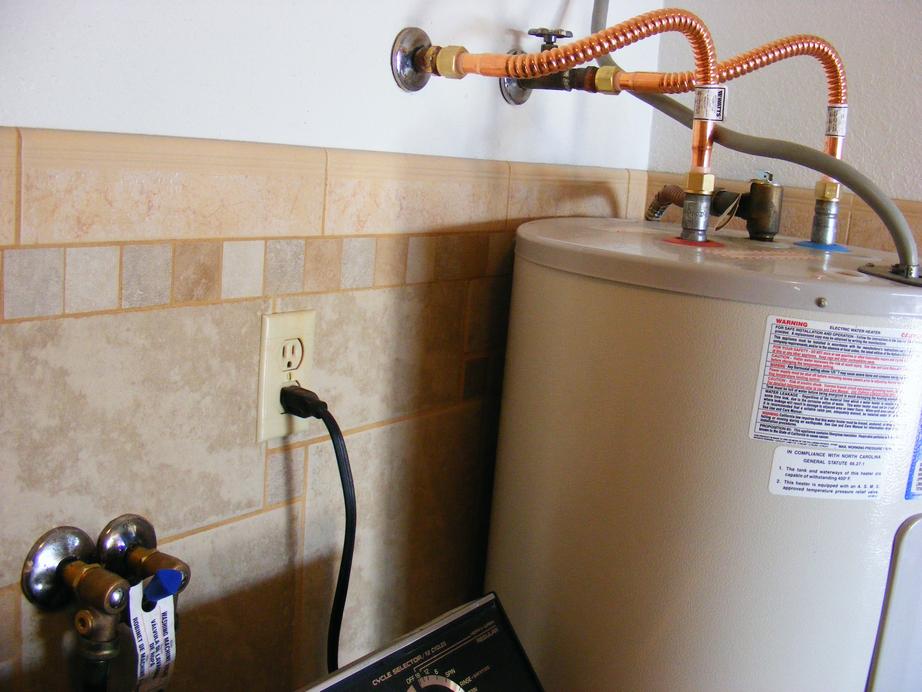
Flex lines are for people that can't solder.

Not necessarily. The ones I used are like those in the picture (found it via google images), but the connection to the rigid copper is a sweated joint. We are required to use these by code, and not because of earthquakes either. The soils on Colorado's front range can shrink/swell and because of crappy soil testing done in the '80s and builders who will build on crappy soil, everything sitting on a slab has to be isolated from the rest of the building.

Our ductwork has flexible boots in it, our basement framing is required to float separate from the slab, etc.

new_utility_room_plumbing.jpg
 

mrb

Well-known member
Joined
Dec 31, 2008
Messages
3,734
One more question: why don't I see any PEX pipe in local construction? I see CA allows PEX pipe as of 2009 and yet I've never seen it used for potable water distribution in construction in my area. Why not at the price of copper? I personally wouldn't use it but I would think penny pinching contractors would use it if they could. What do you know about this?

I believe some municipalities dont allow pex. For newport I cant find it, but I did come across some people getting administrative exceptions pertaining to PEX, so there is something out there i just couldnt find it in the amount of time i was willing to spend.
 

Frank The Plumber

Well-known member
Joined
Feb 19, 2011
Messages
2,644
Location
Chicago.
We find that water has different hardness issues in different places. Different municipalities treat their water in different ways. So no two waters are alike and no material is universal.

Those copper jointers have problems with embrittlement, the corrugations temper or anneal and are prone to cracking in earth quake prone areas. If you do use them do not reuse them and if you are in a motion area I might pass on them.

I would treat an air line in copper the same as a water line. A lot of times the fact that the water has the electrical ground connected to it may or may not increase reactions between the metals. Since we can not say for certain that we would have no current of any type in the airline, we should use dielectric procedures.

Many times just the air flow motion can cause a static current, I've heard many stories of air ducting for wood vacuum systems in which they needed to be grounded in a certain way or a spark could cause an explosion from the wood dusting.

3/4 slip pipe x 1/2" male and or female copper pressure sweat fittings are available.

Copper has a few real key advantages to pex biologically. Copper is bacteriostatic, it inhibits the growth of life, like the root destroyer or a copper nail in a tree. Copper tube has an ability to inhibit bacteria, some micro bacterium and spores. It's not magic, but it is nice to not have a pipe that fosters growth of organics.
If you opened up a PVC water line you may notice that the line has an internal black film within it. This film in some cases can foster growth of organics. I would venture to say that if you have no or low chlorine levels in your water that there could be a potential for unchecked organic growth. This could possibly limit the installation of this material in some places.
It's possible that you may be able to get a variance if you have in home treatment.

I like Brigit and Canfields. Lennox works nice too. If it's in the budget use a nice strut clamp with an isolation bushing

I never touch a fluid joint to cool it, I may wipe the drip so as not to leave a sharp point but never spray or wipe with a wet rag until down to around 200 or so. Then I spray a bit ofNature works organic cleaner at it and wipe it with a scotchbrite sponge. Pretty.

For the solder joint next to the abs pipe I would use a section of tin sheet or a small sheet of temperature insulation or even a heat shield product to deflect the heat from the plastic joint. I would heat at a point away from the plastic if possible and let the heat sync towards the joint.

I personally would not use a shark bite fitting in a concealed location. As a pro I am expected to install a long term and reliable repair.
I would always work towards a properly caped, cut, sound mechanical joint over an o ring type joint. I guess I'm old school, but for me it's not that hard to give you a 40 year solution.
I would rather split and peel a tee or a cap out of a bad spot than hack it, bite it and run only to get a call back in 2 years to fix the same troubles.
 
Last edited:

MrMark

Well-known member
Joined
Jan 25, 2010
Messages
4,626
Location
Southern Cal.
Thanks for all the tips Frank!

Is the wipe with the scotchbrite better than the wipe with the dry rag?

Those are the copper jointers that we use here in CA. There are stainless braided ones too but they are not so good.
 

MrMark

Well-known member
Joined
Jan 25, 2010
Messages
4,626
Location
Southern Cal.
Frank, on the 3/4 to 1/2 adaptor question I was asking more of a fluid dynamics question. If necking down for the flex hose matters much. I suspect not but see what you say. The bung on the compressor is probably 1/2 so it probably doesn't matter. The main benefit of 3/4 run over 1/2 run will be extra storage and more surface area for heat removal I would guess.

Is this what you are talking about? The strut system would have to run parallel to the piping for my install for the nice look.

http://www.flexstrut.com/687.htm

I've used Brigid before. I think it has some nickle in it for strenght. It might be best for this application. I'm almost out of Sterling, so I'll get some Brigit.
 

csp

Well-known member
Joined
Mar 23, 2010
Messages
5,719
Location
Franktown, CO
Is the wipe with the scotchbrite better than the wipe with the dry rag?

Obviously I'm not Frank but I"m pretty sure that the wipe with the scotchbride sponge is in addition to the dry rag, but only after the joint is cool. It's just to pretty up the joint and remove any oxidation/discoloring.

Wiping with a dry rag is just to remove any excess solder/drips.
 

MrMark

Well-known member
Joined
Jan 25, 2010
Messages
4,626
Location
Southern Cal.
I always clean after cooling with water to remove the flux. If you see fittings with green on them this is a sign of not cleaning the flux. I think Frank was using the scotchbrite (the scotchbrite side?) for the dry wipe while the solder is still pasty to get rid of the excess hanging on the fitting. He probably comes back with a wet rag after cooling.

I'm wondering how Frank solders vertical couplers and avoids the candlestick effect. I have a trick but I'll see what Frank says.

Edit: you may be right. Frank may be using the scotchbrite for the cool cleaning that I was referring to above. Dry wipe for him may just be a gloved finger to flick off the drip.
 
Last edited:

hydramatic

Well-known member
Joined
Jun 26, 2009
Messages
510
Location
Alabama
go with frank the plummer...it only costs a nickel more to go first class...my daddy said that, and I`m stickin too it.
 

Frank The Plumber

Well-known member
Joined
Feb 19, 2011
Messages
2,644
Location
Chicago.
To avoid solder drop out you can heat the fitting at the top of the top cup, control your heat well and balanced, put a slight working curl on the solder so you can write with it fully around the joint. Then carefully add just enough solder to the bottom joint to fill it by slightly going all the way around the bottom perimeter and controlled feeding in your solder. Then you quickly transfer your solder feed into the top cup. You should always wear a nice clean pair of cotton gloves so that if it does run or form a sharp you can gently wipe the offending slobber spot.

I use Nokorode which leaves a mild wax feel, so I tend to use a scotch brite to polish up the cooled joint. If I'm doing a full repipe I'll use a rag to wipe it while it's still warm to get the wax off.

Soldering is a lot like pinstripping, you get a feel and it just happens, after practicing and developing your technique.

A neat trick is to unroll about 10 inches of solder, put a curl on about 4 " of that, hold the roll in your palm and feed out the working curl so you are feeding it with your pointer finger. You will be holding the solder roll in the holes, sort of with your thumb and pinky. By feeling the feed with your finger you can feel any debris, dirt or souring of the joint, it feels gritty, like sand while a good flow slides nice and unrestricted. And you should always circle the entire joint with the solder so as to cap it.

On such small diameter air, relatively low pressure, I don't really think that a lot of physics will factor in. Air tends not to react the same as water and deteriorate pipe surfaces in restriction spaces at lower pressures like we would use so intermitently in a shop. Not to say that it can not, just not in a home shop or small system as you are describing.

I have set up a few aquarium shops in which a Gast centrifugal blower is used or an oil less rotary blower, very high flow rate low pressure system, the whole system may push out 20 PSI sustainable, yet operate as many as 1000 air outlets or more each exiting under a water column of 18 to 24". If we added the combined pressure needed to aerate the system by total load the numbers would be astronomical as to the pressure required but since we are high air flow we actually use the weight of the air in motion as a force to overcome the pressure needed.
By doing this we keep down heat and power needed to operate the unit. This unit typically requires a 5 amp power source. Even under such a high flow requirement as this you get no residual deterioration of components nor any real pressure loss due to bends, even hard ones.
The pump basically forces a flow that feels much like a very high performance vacuum discharge, but it has the capability to step up it's capacity as it is taxed. It's like a little turbo.

The bad thing about the copper jointers is, they should only be used once and then discarded, same as the gas appliance connectors. When guys reuse them and buy beer with parts money bad stuff happens.
 
Last edited:

MrMark

Well-known member
Joined
Jan 25, 2010
Messages
4,626
Location
Southern Cal.
always solder your bottom joint first because the heat rises, right Frank? I do the same as you described - I think the trick is to judiciously apply the solder to the joint so as to just fill but no more. The other thing I do is not over flux, a thin flux is all that is needed and wipe the flux off that runs down the pipe when you start heating. The solder follows the flux and by not having the flux run down the pipe the solder tends to not run after the flux.

Thanks for all the help. What about that flexstrut I linked? Do you like that?
 

nate379

Banned
Joined
Feb 2, 2009
Messages
7,279
Location
Palmer, AK
I am thinking of replacing my hard piped setup for the water heater with flex line. The stainless braided kind.

I'm not sure what happened, but I went in the garage a few weeks ago and it was leaking. I replaced the rubber washers in the dielectric fittings and it stopped, but I noticed that the pipes aren't lined up all that great anymore and are using the union to pull the straight. Earthquake, floor settling?
 

Frank The Plumber

Well-known member
Joined
Feb 19, 2011
Messages
2,644
Location
Chicago.
Yes, if space allows. This way you could also share some other piping on the same runs later. It's inevitable that you will pipe something else. It is here anyways.
 
To avoid these ads, REGISTER NOW!
Top Bottom