To avoid these ads, REGISTER NOW!

Solid (Laminated?) 2x4 Loft/Mezzanine Floor

CA_Tallguy

Well-known member
Joined
Sep 4, 2014
Messages
120
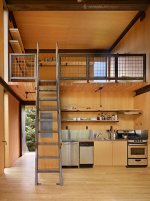
While searching for ideas on how to build a thin framed/floored mezzanine over the living room of my man cave, I came across this picture which appears to show a solid 2x4 floor in the loft area. It looks pretty cool and I've been intrigued by the idea ever since I came across this.
laminated-2x4-loft.jpg

Is this what it appears? Solid 2x4's on their side, sistered together continuously or laminated together? I can't find any other examples of this kind of construction except for people tediously laminating 2x4's together to make workbench tops.

Could a solid 2x4 floor like this span 8 to 10 feet without a problem and additional framing? (Supported just at the ends?) My idea would be to support one side against the back wall, and then the front side by building a beefy steel truss and supporting the floor from the bottom chord. The truss would also serve as a railing.

I'm trying to make the mezzanine floor take up as little vertical height as possible as I'm 6'8" and need every inch of space I can get both underneath and while up on top. This will likely hold up a sleeping area and office. I'd just like to be able to move around up there without being hunched over everywhere.
 
To avoid these ads, REGISTER NOW!

Kevin_b_c

Well-known member
Joined
Oct 25, 2012
Messages
91
Location
Langley, BC
Last edited:

bczygan

Well-known member
Joined
Nov 4, 2009
Messages
22,002
Location
DETROIT! Arsenal of Scrappers
The thinner the structure, the stiffer the materials need to be.

At some point, the weight of the materials themselves become a limiting factor.

When working with wood, selecting species that are stronger and stiffer increases the span and load capabilities. Engineering special wood structures is possible.

When wood is inadequate, metal takes over.

First determine your live load, typically 50#PSF for living areas.

Then determine how stiff a structure you want. For a space like this, with no finished ceiling below, you could use a deflection of 1/240th of span. Although it will feel better at 1/360th.

Then you just need materials to support themselves and your LL for the span. Let's use 10'.

More to come...

So let's imagine using a solid mass of 2x4's on edge. Figure 10#PSF for the weight of the 2x4's. That's the dead load. Total load is 60#PSF (Per square foot). Total load for a 10' span times 1' wide would be 600#.
If you are using solid 2x4's, each foot of width will have 8 of them. Let's choose a material. Cheap 2x4's are hem/fir with a Fb of 1100.

This span chart doesn't have 2x4's for the 10' span, so let's look at the 4x4's. It would take approximately 3 and a half to fill the space solid. Looking at the chart, each one will support a 524# uniformly supported load. You could certainly support these loads at this span. Add a thin plywood subfloor and carpet even.

http://www.awc.org/pdf/wsdd/c2b.pdf

I would be tempted to use construction adhesive between each 2x.

Consideration for support at the ends of this continuous floor need to be made.


Bill
 
Last edited:

Bib Overalls

Well-known member
Joined
Dec 4, 2006
Messages
3,318
Location
Jonesboro, Arkansas
Douglas Fir would be my choice. A "real lumber yard" can order it for you in lengths up to 20" and longer.When you do your math be sure you take about 3/15" off the top surface for planeing and sanding. Dimensional lumber comes from the mill with relived or rounded edges that need to be cut away to form a smooth laminated surface.
 

Caman

Well-known member
Joined
Feb 1, 2015
Messages
486
Location
MN
And I thought building a butcher block table was a lot of work....


I suggest you do what that builder did and install threaded rod through the laminates. It will act like post-tensioned concrete and make it stronger.
 
OP
C

CA_Tallguy

Well-known member
Joined
Sep 4, 2014
Messages
120
Thanks guys! I'm glad you found the original project, Kevin. I found the image on google image search on some site where it had been reposted. Nice to know a those extra details and confirmation that it is indeed repurposed dimensional lumber. I wondered about reinforcing that provides confirmation!

As far as what I have to work with, below is a rough sketchup of my building. The living area is in the front corner and the loft is the area behind the diagonal line. Width off the middle wall at the front of the building is about 6 to 7 feet, and on the wider end of the open area it goes to about 10 feet. The diagonal line is where I'm thinking of having a truss that doubles as a railing and the length of that would be 20 feet. Note that there is an extra post toward the middle of the loft and building - I put that in thinking it might help cantilever a support out towards the railing/truss from there.

For height, I have maybe 14'7" toward the peak from the unfinished concrete floor of the living area. The roof pitch is about 4/12. I'm hoping to be able to walk somewhat upright along the peak of the roof area (the middle wall). Feels like I should keep about 7.5 feet below the loft so I don't feel crowded walking around on the ground level. Whatever loft framing there might be would be open underneath so it could extend further down but I'd like to keep encroachment to a minimum so it feels more like the "ceiling" is really the bottom of the sub flooring.

floorplan.jpg
 
Last edited:
OP
C

CA_Tallguy

Well-known member
Joined
Sep 4, 2014
Messages
120
Thanks for the feedback everyone! Keep it coming!! :) Great stuff.

For wood, I would like to try to use Southern Yellow Pine considering it is local -- very local. I'm in a National Forest in the Piney Woods of East Texas. I know it is heavier but it is also stronger and I'm guessing that it the extra strength should carry more than the extra weight of the lumber?

Those calculations are much appreciated bczygan! I was looking at the SYP span tables and they also don't have 2x4's listed, nor do they have 4x4 (at least in floor joist span tables) http://www.southernpine.com/app/uploads/SPtable3_060113.pdf

As for support on the "open" side, I was thinking about using an H beam for the bottom chord of a truss. At first I was thinking about laying the 2x4's inside the bottom flange of the H beam but now I'm wondering about having the beam sit on TOP of the 2x4's and then have a plate underneath that is bolted up through the 2x4's into that bottom flange. That would leave the edge of the 2x4's exposed which would look pretty cool. Plus, it might better load the beam (rather than have the load sitting to one side of it) and provide more support for the 2x4's poking all the way underneath?
 
OP
C

CA_Tallguy

Well-known member
Joined
Sep 4, 2014
Messages
120
Consideration for support at the ends of this continuous floor need to be made.

I'm not that experienced at sizing metal but did find this load/span table for H (W) beams... this seems to suggest that 18ft is the max allowable span for the W8's? (I'm only going to 20'.) Seems like most W8's might be adequate for the needed load, however. Would a W10x12 be more appropriate? They don't have that one listed.

http://www.engineeringtoolbox.com/w-steel-beam-uniform-load-d_1722.html

So for the 20' span, using 10' uniform width to simplify even though it will only be 6' at one end, the beam would need to handle 6000# (50% of 600lbs per foot). Correct?

Seems like I could probably get by with a much smaller beam if it is just the bottom chord of a truss. That does complicate things. Also, as I noted previously, I would like to try to provide a little extra help in the center of the span with a cantilevered support coming out to the truss/beam out there.
 

bczygan

Well-known member
Joined
Nov 4, 2009
Messages
22,002
Location
DETROIT! Arsenal of Scrappers
No need for a truss.
Use the W8x10.
**** the 2x4 floor into the web of the beam. This will minimize the amount the beam drops below the ceiling. The amount that it sticks up above the finished floor creates a kick, to keep things from sliding off the mezzanine.

Not sure how to fasten. Want to connect to the web but if you bolt a ledger to the web, how do you connect the 2x4's? Can't use joist hangers.

Thinking you just slide the 2x's in and **** to the beam web and let the flange support them as you glue them together. Might drill the beam web and secure with lag bolts through the web every 8" or so, and into the ends of 2x's.

The other end of the deck needs to rest on a continuous ledger, sized and supported and fastened properly.

Bill
 
Last edited:
OP
C

CA_Tallguy

Well-known member
Joined
Sep 4, 2014
Messages
120
I'm getting a little excited about this idea! The look would be pretty cool both as a floor and a ceiling underneath. Plus, it would be hard to come up with another design that would take up such a small amount of vertical space.

Estimating the cost of SYP lumber -- comes out to under $500 to do the 20 feet of the main area of the mezzanine. I'd probably end up continuing the treatment back over the bathroom (into the sleeping area). The span is longer over there but still would be supported at least around the 10ft mark + at both ends.

Trying to think through supporting it on the closed side with 2x6 studs. Perhaps I could just lag bolt some heavy angle along there as a ledger? Or, I could split the currently very long studs and create a top plate for the 2x4's to sit on right within the wall, and then continue the framing on top of them. Using angle would probably be a lot easier since that tall wall is already nearly framed out.
 
Last edited:

mtwaterguy

Well-known member
Joined
Nov 16, 2007
Messages
3,518
In PDX, years back, built in the very early 1900's when wood was cheap in the PNW. Three stories and the floors/ceilings were made of 2X10 on end. Great floor to work on and easy to refinish.
 
To avoid these ads, REGISTER NOW!
OP
C

CA_Tallguy

Well-known member
Joined
Sep 4, 2014
Messages
120
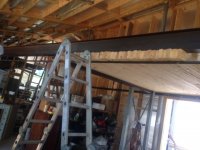
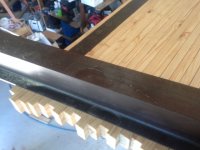
Thanks to everyone for all the great feedback in this thread. I'm getting close to the point in building construction to where I may move forward on this. My current thinking is to support 2x4's from the bottom of the w8x10 beam by clamping them from underneath using a long piece of thick flat bar stock. That would leave the edge exposed similar to the pic I posted in the first post. Would probably look pretty cool this way!

Wondering if you guys might provide more feedback and ideas around a few areas...

(1) top surface finishing -- would you guys run the boards through a surface planer before installing them? Or try to get them aligned and use some sort of heavy duty floor resurfacing equipment to plane/sand them down after they are all installed?

(2) some have talked about using glue/adhesive between the boards and all thread. I'd love to hear more of your thoughts about this. How much benefit do you think there will be in running all-thread or long bolts through the boards vs just slamming some nails in as I go with a nail gun? If I go with all-thread, should I just bolt together sections of 4 or 6 feet? Less? More?
 

OJ Bartley

Well-known member
Joined
May 18, 2009
Messages
605
Location
Toronto, ON
Wow, I just came across the thread today because it sounded like an interesting proposition, but I wasn't expecting it to actually come to fruition! Good for you Tallguy! It looks awesome, and is going to add some real character.

BTW, speaking as a 6'4" guy... you really are tall.
 

slickgt1

Well-known member
Joined
Oct 11, 2010
Messages
1,674
So what are your impressions? How did you end up attaching them? How did you plane it?
 
OP
C

CA_Tallguy

Well-known member
Joined
Sep 4, 2014
Messages
120
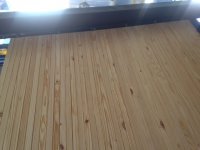
So far it looks pretty good. I planed the top surface of each board before installing it with a cheap harbor freight power plane to get it somewhat smooth and to square off the rounded edges just a bit. I didn't stress out too much on this as I'm going for a rustic look anyway so if it isn't perfectly "refined" that is OK. I am not entirely sure where I am going from here on this aspect to finish it. Been thinking about renting a floor sander to take it down further and then finishing it off with polyurethane. Will spray or brush poly on the bottom side to try to seal the boards up a bit from moisture and dirt/dust.

I've finished the 20ft length of the w8x10 beam so far but I am going to continue this flooring treatment over a regularly framed bathroom so that is next. The 2x4's will rest on the top of a bearing wall on one end for this. So we have 6 to 8 feet left to go.

The boards are sandwiched next to each other with construction or subfloor adhesive between and then we are just slamming 3-1/2 inch nails through to the last board with a nail gun. We try to keep the boards flush on top as we go to get out any crown. Once in awhile we'll use a long deck screw to pull them together if there is some bow or twist that is hard to get out.

The boards are supported on the wall side by a heavy piece of steel angle iron as a ledger. In addition, we run the 2x4's out long into the wall cavity when we come up next to a stud and then we use some heavy simpson lag type screws to fasten to the 2x6 studs -- on flooring board to each side of the stud. Sometimes we have to notch or shim the floor boards if they are not lining up perfectly.

It has been remaining fairly flat as we go although there have been a few times when it seems like it wants to start running uphill on the ledger side, where the boards are not wanting to lay flat on it. We've come up with various hacks to force it to run flat in those cases -- mostly we sandwiched a 2x4 or 2x6 between the studs on that side to force it more level. This isn't a problem on the beam side as the boards are strapped tightly to the bottom of the beam with a piece of steel pulling them up from below. I used grade 5 bolts every 14 inches or so. Worked out pretty well. You can kind of see the strap in the first pic on post #13 above.
 
OP
C

CA_Tallguy

Well-known member
Joined
Sep 4, 2014
Messages
120
Couple more thoughts -- it does take quite a while but we are able to knock out maybe 4 to 6 feet in a day. This would go faster if you had a few people handling things in an assembly line fashion.... someone on the plane and then feeding things to others installing the boards inside.

Selecting the boards takes a long time too! I've been sourcing the boards just at home depot, digging through the pile to find ones that have at least one good edge to show on the top side. If anyone tries this, I highly recommend that you make several trips to get lumber over a week or even a few weeks. I try to get 30 or 40 boards at a time if I can and then come back a few days later hoping that they will have a new bundle out for me to dig through. Sadly, I'm needing 12 foot boards right now and they have those up on a middle shelf rather than at ground level and that makes it VERY hard to dig through to find boards. So my hope is that people come in and take some of the culled boards so next time I have a chance of digging through fresh inventory. Board selection was a lot easier when I was getting 8 and 10 footers.

Of course I'm trying to find the best of #2 SYP at a big box store so you can guess how that is going. It might have been a lot easer to try to order some #1 or better grade lumber to use but then you are kind of stuck with what comes in with your order and you can't cull through it as easily.
 

slickgt1

Well-known member
Joined
Oct 11, 2010
Messages
1,674
Have you tried to bench glue a few pieces together, run that section through the planer, then install that. I am not sure if this would help much, especially since you will need longer screws to get the bigger sections together.

Have you tried staggering the crowns? Curious if this would help you get more lumber, with slight crown, as opposed to perfect pieces.

Even though I love PL Premium construction adhesive, I would probably have used wood glue. I have never seen a glued joint fail, at least those with enough compression. Would be cheaper too. I am sure you are going through gallons of the stuff. Keep the updates coming. This really interests me.
 
OP
C

CA_Tallguy

Well-known member
Joined
Sep 4, 2014
Messages
120
The main thing I have been looking for in selecting lumber is a good narrow edge to be facing upward for the floor surface. I have been taking more crowned lumber and even some with twists than I normally would have as we are able to get things pretty straight when installing the boards.

We did assemble the final few pieces going up to the front wall on the bench because we were running out of room to do it one by one. Fortunately I have 2x6 walls so there is a bit of a cavity to get in and while we couldn't nail them into place, we were able to screw them using those 3 inch simpson fasteners I previously mentioned.

Otherwise, I felt bench assembly would have taken more time than I was willing to invest. I'm pretty happy with how flat the boards are from just wrangling them into alignment and then nailing. If I go back with a rental floor sander, that should get them really really flat.

For some reason, in the original concept that gave me the idea, I think they used all thread to bolt the floor together. Seems like that would work OK. You could just drill some holes and thread it as you go. Not exactly sure on how this would work because seems like you'd either need to ****-thread individual sections of the all-thread together or somehow bolt things together in smaller sections as you were going.

I've used a couple different kinds of construction adhesive while assembling this. I tried some "subfloor adhesive" to start and that stuff almost seemed like white glue. It was pretty thin viscosity and very white. It was a bit too runny for my taste and I switched to regular construction adhesive as that stayed in place a bit better. I have no idea what the difference is in the formulation and which will work out better in the long run or if it matters. "Subfloor" adhesive seemed to be conceptually closer to what I needed it for so that is why I tried that at first.
 

slickgt1

Well-known member
Joined
Oct 11, 2010
Messages
1,674
The way I imagined them threading sections. As in they glue a bunch together. Threaded rods through it. Washer and nut to compress it. One side goes to a wall, no rod sticking out, the other end, the threaded rod sticking out to accept next section. Next section is the same way, with the threaded rod offset not to hit the rods from the previous sections. You bolt section 2, to the rods from section 1. Section 3 to rods from section 2 and so on. This theory ends when you get the last section. As I am not sure how one would slide a section in, or bolt it in. Unless the last section is done one stick at a time, and just screw attach.

I don't think you will have failure from the construction adhesive. I have seen some amazing things from using PL Premium. It is especially useful when your joints are not super tight.
 
To avoid these ads, REGISTER NOW!
Top Bottom