To avoid these ads, REGISTER NOW!

Some Lathe Stuff

OP
D

deere2210

Well-known member
Joined
Apr 3, 2008
Messages
232
Deere2210.......
His answer......A precision part is any part that you will be making, an ordinary part is what everyone else is making..


Kevin, thanks for the feedback!! I don't have a set of reamers and need to buy some. With all the other tooling I've bought getting everything up and running it was one of the lower priority items, but I've moved them up on the list. The dowel pins and fixturing you mention make perfect sense. I've read drilled holes aren't completely concentric and the only way to do it is to ream them.

When you drill the hole, do you underdrill it to the final size and then ream it? For example, if I am going to drill a .25 final dimension hole, should I use a .25 drill bit and .25 reamer? Also, are they fed the same feedrate as a drill and same drill cycles (deep, peck, etc..)? Thanks again for sharing experience on this!:thumbup:
 
To avoid these ads, REGISTER NOW!
OP
D

deere2210

Well-known member
Joined
Apr 3, 2008
Messages
232
Here's the Dorian tool post you asked about.. The tool holders have a through the holder coolant jacket.. These work really slick and let you aim the coolant directly at the tip.. Since my TL-2 doesn't have an enclosure it also helps alot with keeping the coolant inside and not on the floor, althought it still gets out..

tp1.jpg


tp2.jpg


tp3.jpg


tp4.jpg
 
OP
D

deere2210

Well-known member
Joined
Apr 3, 2008
Messages
232
Here's a couple more on the bike I am making.. It's a multi-year project that I work on as I get time.. This one is the backing plate for an air filter.. I have a little laser that I engrave stuff with (water bottles for kids school, tool box security labels, etc..) also that's not based on g-code but still is computer controlled.. Uneven bolt pattern's have always been a pain to measure and then machine. A little off and material is wasted.. Now cut out paper templates to scale with it first, and then plexiglass to verify fit before turning the mill/lathe on.. Has saved a bunch of time and material..

af1.jpg


af2.jpg


air0.jpg

You can see this one is still a little off on that one open hole..

air1.jpg

After re-doing the dimensions cut it out in something more rigid to make sure it isn't the paper flexing or pulling..

air2.jpg


air3.jpg


air4.jpg

If you notice in this picture, it fits good and flush, but it is touching against the carb so that won't work.. Will probably machine out a little spacer to offset it a little..
 
Last edited:

Kevin54

MEMBER EMERITUS
Joined
Jan 12, 2005
Messages
29,341
Location
Urbana, Ohio
Kevin, thanks for the feedback!! I don't have a set of reamers and need to buy some. With all the other tooling I've bought getting everything up and running it was one of the lower priority items, but I've moved them up on the list. The dowel pins and fixturing you mention make perfect sense. I've read drilled holes aren't completely concentric and the only way to do it is to ream them.

When you drill the hole, do you underdrill it to the final size and then ream it? For example, if I am going to drill a .25 final dimension hole, should I use a .25 drill bit and .25 reamer? Also, are they fed the same feedrate as a drill and same drill cycles (deep, peck, etc..)? Thanks again for sharing experience on this!:thumbup:

In the first link Occupant listed, it states that you should ream only .002-.003 of material. That's good practice but that's not always possible. I like to keep a drilled hole about .002-.005 smaller up to an 1/8" diameter hole. Above that I like to leave approximately .010 of material to ream. That is not always possible to do that either. For instance, in your standard drill sizes, the next size smaller than .250 is .234. That is a .016 difference. That's pushing the limit for material left for reaming. You would have to use a Letter Drill "D" which is .246. I have reamed .016 of material many times, but it was in aluminum. Then again, the depth of the hole, the type of material, whether your drill was dull or sharp all come into play. Once you get into the habit of reaming your holes on an everyday basis, you will find what works and what doesn't.

When you purchase reamers, you want to be sure to purchase a couple extras if money allows it. 3/16", 1/4", 5/16". Those three sizes I have found, are used quite extensively in various things you may be working on. As far as Metric sizes, which I have never had the opportunity to work on metric projects, I would imagine that there may be two or three metric sizes that are used more than the other metric sizes in a lot of applications. So a good set of Number Reamers and a set of Fractional Reamers should get you started. You won't need a set of Metric drills if you have a set of Metric reamers. Possibly later on you could pick up a set of Letter Reamers. I have found in my work and all of the different things I worked on over the years, Letter sizes didn't crop up to much.

If you ever have the opportunity to work on pulley's that have keyways, or you are going to make pulleys with keyways, try to remember that you should always ream a keyed pulley with a spiral flute reamer. This keeps the reamer straight in the bore. A straight flute reamer can catch a keyway and either snap your reamer or make the hole out of round.

Enough of that though. :lol: I like the idea of the coolant through the toolholder for the lathe. I don't think our machines at work have those. Usually everything was flooded with coolant. If we did have them, I never seen it. But I can't imagine that the sales reps wouldn't have mentioned it at some point in all the years they were coming in. Myself, I like the idea. :thumbup:
 
Last edited:

Kevin54

MEMBER EMERITUS
Joined
Jan 12, 2005
Messages
29,341
Location
Urbana, Ohio
air0.jpg


In looking at this, and your comment about uneven bolt patterns, do you have any transfer screws? If you do, then you could take a piece of scrap Lexan like you have, or a scrap piece of aluminum, square the sides up, then transfer the holes from the carb to the material. Then clamp the material to an angle plate, and using a height gage, pick up the points in "X" and "Y". It takes a tad longer, but you'll be right on or only off by a couple thousandth max.

I'm not sure how your design software works, but can you import a picture into your program, then scale it for dimensions? I use a program called DeltaCad. It's a 2D CAD program and it's something like $29. It's fantastic for making 2D drawings or you can take a picture of something, import it, scale a known dimension, then dimension everything from that. Quick and handy for a lot of things. It's online at www.deltacad.com and they have a free download to try. You can import IGES files to it or save your drawings in a couple of extensions including IGES. Just a suggestion. I'd like to have some type of software like you are using, but I'm gonna have to get a little more change in my pocket first. :lol:
 
OP
D

deere2210

Well-known member
Joined
Apr 3, 2008
Messages
232
On your plate that is touching the carb, can you mill a relief area in the back of the plate where it touches the carb, so no spacer is needed?

I'm going to look and see once I get the filter. I think it is a 6" OD filter but I want to dimension it again and confirm what it will look like. Good idea on milling out a small relief on the back.. Would be better than putting a spacer in.. I should have the filter be end of week, so this weekend will run through it again and see what it looks like.
 
OP
D

deere2210

Well-known member
Joined
Apr 3, 2008
Messages
232
air0.jpg


In looking at this, and your comment about uneven bolt patterns, do you have any transfer screws? If you do, then you could take a piece of scrap Lexan like you have, or a scrap piece of aluminum, square the sides up, then transfer the holes from the carb to the material. Then clamp the material to an angle plate, and using a height gage, pick up the points in "X" and "Y". It takes a tad longer, but you'll be right on or only off by a couple thousandth max.

I'm not sure how your design software works, but can you import a picture into your program, then scale it for dimensions? I use a program called DeltaCad. It's a 2D CAD program and it's something like $29. It's fantastic for making 2D drawings or you can take a picture of something, import it, scale a known dimension, then dimension everything from that. Quick and handy for a lot of things. It's online at www.deltacad.com and they have a free download to try. You can import IGES files to it or save your drawings in a couple of extensions including IGES. Just a suggestion. I'd like to have some type of software like you are using, but I'm gonna have to get a little more change in my pocket first. :lol:

I've never used the transfer screws/method you mentioned.. Not exactly following how to use the angle plate and height gauge to pick up x & y? I use Solidworks for design and on occasion take a picture with my camera and then trace the JPG out with splines which gets me pretty close. I have the camera scanner on the Tormach and it uses the controller with a cheap camera to zoom in and set reference points. Install a little USB camera in the spindle set it to the center of what you are meausuring, and then zero out the DRO. From there I transfer it over to Solidworks based on the dimensions. It also will scan the part, but it is a "kluge" in the way it works so I have skipped using it.. Has worked pretty good for parts hard to measure. Doing paper templates has been helpful as I make mistakes there first..
 

fergus

Well-known member
Joined
Oct 4, 2009
Messages
1,620
Location
Yolo County CA
Your work is real nice. I too want to learn machine work...you have obviously really come a long ways from being just a beginner. What were some of the books you read?
 

bimmer1980

Well-known member
Joined
Feb 5, 2009
Messages
2,103
Location
York, PA
Beautiful Work!!!! Can you post a picture of the laser that you have as well? I like the simple prototyping work you do before cutting metal.

Just curious, where did you purchase the machines and roughly how much do you have invested?

I've got a bridgeport and a turnmaster lathe, but would eventually like to have some CNC equipment.....

Keep on making Chips!!!!!!!!!!!!!

p.s. I like some of the hints and tips that are being shared in this thread!!!
 

Kevin54

MEMBER EMERITUS
Joined
Jan 12, 2005
Messages
29,341
Location
Urbana, Ohio
I've never used the transfer screws/method you mentioned.. Not exactly following how to use the angle plate and height gauge to pick up x & y? I use Solidworks for design and on occasion take a picture with my camera and then trace the JPG out with splines which gets me pretty close. I have the camera scanner on the Tormach and it uses the controller with a cheap camera to zoom in and set reference points. Install a little USB camera in the spindle set it to the center of what you are meausuring, and then zero out the DRO. From there I transfer it over to Solidworks based on the dimensions. It also will scan the part, but it is a "kluge" in the way it works so I have skipped using it.. Has worked pretty good for parts hard to measure. Doing paper templates has been helpful as I make mistakes there first..

Solidworks designs before the part. What you need to do is reverse engineer what you need. I'll try to explain it as I know how to do it, but you may or may not follow it. :lol: I will use generic dimensions to help explain.

What I would have done would be to measure the bore of the carb. For explanations sake, we'll say the bore is 1.875". And I will say the outer diameter of your part is 5.000" Then take a round piece of aluminum and chuck it up in the lathe. Turn a 1.875 diameter back far enough to catch the bore on the carb, but not back so far you hit the fuel inlet or the brass piece.
With Transfer Screws in the carb, you can now slide this plug in and give it a slight tap. You now have the bolt pattern on this plug. Now you can take this plug, clamp it to an angle plate, and pick up on center and zero out your height gage.Now you can start picking up the ***** points on the plug. Once you have those dimensions, you rotate the plug and angle plate over 90 degrees and pick up the points again. You now have the "X" / "Y" coordinates from center zero on the plug. Once you have those, then you can do your programming in Solidworks. Total time for doing something like that.....maybe 30 minutes to cut a plug, get your points, then get your dimensions. By laying it out this way, you can get your centerline dimensions no matter what the orientation of the part is. Once you lay it out in Solidworks, you can rotate your layout any way you want.

Hopefully you have an angle plate and a height gage. If not, look on CL and pick on up cheap. Also if you don't have a surface plate, you may want to check into one of those whether it be granite or steel. All valuable pieces of equipment in machining.
 

Attachments

  • plug.JPG
    plug.JPG
    112.3 KB · Views: 69

OccupantRJ

Well-known member
Joined
May 15, 2009
Messages
10,906
Location
Eastern North Carolina
I'm going to look and see once I get the filter. I think it is a 6" OD filter but I want to dimension it again and confirm what it will look like. Good idea on milling out a small relief on the back.. Would be better than putting a spacer in.. I should have the filter be end of week, so this weekend will run through it again and see what it looks like.

When designing items, I like to remove or at least not add items to an assembly if possible, as that's just something else to wrestle with while trying to get the bolts installed. This method also keeps things sleek and streamlined. Remember, machining is nothing but metal removal anyway. When making parts, just machine away anything that is not the part you are trying to make. :willy_nil
 

Kevin54

MEMBER EMERITUS
Joined
Jan 12, 2005
Messages
29,341
Location
Urbana, Ohio
So, a .25 drill bit wouldn't make a .25 hole?
reaming seems like a waste of time

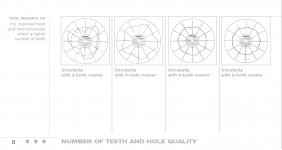
It will and it won't :lol: It won't give you a perfectly round hole. Most people that want a 1/4" hole in a piece of metal will automatically grab a 1/4" drill bit and start drilling. If all they did was hit the metal with a center punch, the tip of the drill will wobble when starting to drill. To the naked eye, it may not look like that. That is why a hole should always be center drilled first. But if the drill wobbles to begin with, it will then keep following that wobble, slightly decreasing as you go deeper. But by then you may have already lost exact center location along with the hole being circular. Here is a section out of the link that Occupant posted up. Notice the first reamed hole using a two flute reamer and how out of round it is. A drill is not nearly as precise as a reamer, so maybe double up the looks of the first hole if all you were using was a drill bit. With that, not all drill bits are even up to size. Some run around .002 undersize. A reamer will be right up to specs as far as size. Material thickness and the material composition also plays a big part in what a hole will look like. I have seen some sheet-metal parts that were "drilled only" that looked more like a square hole instead of a round hole. It was just a good thing the bolt head was large enough to cover it. :lol: So a good practice is to always Center Drill, drill, then ream. And when one uses a center drill, you want to use a center drill that it's size is either equal to or slightly larger than your finished hole and then control the diameter of your center drilled hole by adjusting how deep you go. For instance, and using a 1/4" hole for an example, you would want to use either a 1/4" dia. center drill or a 5/16" center drill. You then only want to take either one to the depth where the center drilled hole is 1/4" in diameter or just slightly under. Then using a smaller drill bit than the finish size of your hole, the lead in on your drill bit will contact the center drilled hole all around and not allow it to walk and make your hole out of round.

As far as the comment about reaming being a waste of time.....It all depends on what you are doing and what the application is. If you are just drilling some holes to fasten say a piece of angle iron to a metal bench. You may be fine with just a drilled hole because it is not a critical application. But if you are making parts that say, go on the Stealth Fighter, and the holes are pertinent for dowel pin location and clamping of the part, precise location is number one, and depending on the customer, aesthetics come into play. If you are putting holes into a $7500 part, you don't want it to look like some hack did it. :lol: Once a person gets into the habit of center drilling, drilling, then reaming, it becomes habit and you can do all three just as fast as just drilling a hole. It makes for good practice.

attachment.php
 

Attachments

  • hole.jpg
    hole.jpg
    145.2 KB · Views: 2,040

MBfreak

MEMBER EMERITUS
Joined
Dec 10, 2010
Messages
2,301
Location
Linkoping , Sweden
Kudos to Kevin who wrote this very well:
As far as the comment about reaming being a waste of time.....It all depends on what you are doing and what the application is. If you are just drilling some holes to fasten say a piece of angle iron to a metal bench. You may be fine with just a drilled hole because it is not a critical application. But if you are making parts that say, go on the Stealth Fighter, and the holes are pertinent for dowel pin location and clamping of the part, precise location is number one, and depending on the customer, aesthetics come into play. If you are putting holes into a $7500 part, you don't want it to look like some hack did it. Once a person gets into the habit of center drilling, drilling, then reaming, it becomes habit and you can do all three just as fast as just drilling a hole. It makes for good practice.

Wasting time is eating junk food, mowing the lawn, watching TV.
Being careful when manufacturing or repairing stuff can never be a waste of time!
Hooray for Kevin guys like him,

Ola
 

Kevin54

MEMBER EMERITUS
Joined
Jan 12, 2005
Messages
29,341
Location
Urbana, Ohio
Thanks for the Kudos for sure. :bowdown:

I love machining and always have. I had a job sitting behind a desk three times. All three times was as a Tool Designer. I never bid on the job, but got thrown into it because as a Tool & Die maker we designed on the fly. As soon as I had a chance to go back into toolmaking, I jumped on it and bid out of design.

There is a certain satisfaction of taking a large ugly piece of steel, aluminum, brass, or whatever material, and turning it into a work of art that is now flying a few thousand feet above on an airplane. BTW...I worked for one of the largest manufacturers of aircraft lighting. Interior lights, exterior lights, cockpit lighting, power supplies for planes, landing lights. Both on military and on commercial aircraft. My wife worked in the same factory I did and she was an assembler in a specialty department that assembled all the prototypes. That is how her and I met. She was the sole person that wired quite a few instrument lights for the Apollo project. One week I had the task of building some new cargo lights and the lights that light up the logo on the tail of the plane. These were for Margaret Thatcher of England. One project I had a couple of years ago was machining the housings for the refueling lights on the F-117 Stealth Fighter. No one in our plant knew how to machine them.

Just stuff like that makes machining cool. I worked with ones that just looked at it as a job, and their work showed it. I looked at it as a challenge to be able to make a work of art. Everyday was something different. Most people I was around looked at everything in a bundled way. It's a job. We do the same thing day in and day out, and all i want is a paycheck. I look at it as a challenge and never ever said "let someone else do it because I can't" or "I don't know how". Those same people could never figure out why they never received a very large raise at review time. Piss poor attitude filters down to piss poor work, filters down to piss poor reviews, which ultimately filters down to piss poor pay.

I'll have to find a few projects that are laying in my toolbox, snap a photo, and see if others can figure out how it was made. I think I may have a few cool reflectors in my box.

There are some really good machinist on here and I know that they would be more than willing to help anyone out that wants to learn how to start machining. I'm one that will help out and I'm also one that will ask the others how to do certain things. I could go into my job and run it with a blindfold on as I am that good. But that is in my job only and what I did on a daily basis for 31+years. It amazes me that in doing my job for that length of time, I can talk with someone like Occupant, Deere, A_Pmech, just to name a couple off the top of my head, maybe ask a simple question that I think I am right on, and find 6 new ways how to do something that I never even thought about. When it comes to machining, there is no end to learning you receive until they throw that first shovel of dirt over the casket. :thumbup:
 
OP
D

deere2210

Well-known member
Joined
Apr 3, 2008
Messages
232
Your work is real nice. I too want to learn machine work...you have obviously really come a long ways from being just a beginner. What were some of the books you read?

These are a couple good things that helped me get started..

1.) Smartflix -> they rent DVD's on how to use a lathe and the Bridgeport.. These were really good as I had no previous experience and it walked through the types of machines and basics to get started.

2.) Youtube -> I google constantly looking for machining video's, feed/speed training, etc.. Alot of good stuff out there.

3.) Machinist Bedside Reader -> Book available on Amazon

4.) CNC Programming Handbook -> Another book.. it can get pretty deep but it has a ton of good stuff in it.

5.) Machinist Handbook -> Another book

Once you get the basics down, I found out that the best way to learn is to chuck something up and just start making chips.. The other item is like this forum/thread. Being able to ask questions to guys that have been in the business with tons of experience is awesome! Like the discussion on reamers.. I had no clue in reference to reamers, but learned a ton of stuff in reading Kevin's post, and the files Occupant attached.. Hope this helps!
 
To avoid these ads, REGISTER NOW!

sanddan

Well-known member
Joined
Jul 7, 2005
Messages
708
Location
Oregon
Regarding the wheel spacer design a few thoughts.

The most important features in the part are the ID and OD as these are used to align the wheel to the hub. Both the size and concentricty should be held as tight as possible. The next most important feature is the thickness of the spacer but the assembly it mates to would determine how tight a tolerance would be needed. The third and least important feature to the function of the spacer would be the holes for the mounting bolts. The hole size should be larger than the bolt for ease of assembly and to allow for some location tolerance. As most bolted joints are designed with clamping as the main task and not for locating the part a reamed hole is not needed and would only add cost to the part.

I have designed products for 25 years but only recently started learning the art of machining so I try to do every operation as close to dead nuts on as I can. Lots to learn in that dept. If you are making a part for yourself, cost is not the issue so either method is good. Reaming the holes might be good practice but certainly not required.

Great job on all of the parts you have shared with us. Thanks and keep up the great work.:thumbup:

Dan
 
OP
D

deere2210

Well-known member
Joined
Apr 3, 2008
Messages
232
Beautiful Work!!!! Can you post a picture of the laser that you have as well? I like the simple prototyping work you do before cutting metal.

Just curious, where did you purchase the machines and roughly how much do you have invested?

I've got a bridgeport and a turnmaster lathe, but would eventually like to have some CNC equipment.....

Keep on making Chips!!!!!!!!!!!!!

p.s. I like some of the hints and tips that are being shared in this thread!!!

Thanks, I need to take a picture and will upload. It's a Trotec Speedy 300 75watts. It will cut up to .5 plexiglass or wood and can engrave pretty much anything except PVC. When you burn PVC it puts off toxic gas that can mess the laser up. Pretty much everything else works.. It has really come in handy for prototyping..

Equipment can be expensive.. I've got a fair chunk of change in them.. Sometimes I kick myself thinking I could do better having just invested the capital in stocks or CD's.. My goal is to try and make a small business out of it (custom billet parts, prototyping, and engraving). Just have this feeling someday my day job will get outsourced to India and need something to fall back on.. Plus, I sure like making those chips!!:beer:
 
OP
D

deere2210

Well-known member
Joined
Apr 3, 2008
Messages
232
Solidworks designs before the part. What you need to do is reverse engineer what you need. I'll try to explain it as I know how to do it, but you may or may not follow it. :lol: I will use generic dimensions to help explain.

What I would have done would be to measure the bore of the carb. For explanations sake, we'll say the bore is 1.875". And I will say the outer diameter of your part is 5.000" Then take a round piece of aluminum and chuck it up in the lathe. Turn a 1.875 diameter back far enough to catch the bore on the carb, but not back so far you hit the fuel inlet or the brass piece.
With Transfer Screws in the carb, you can now slide this plug in and give it a slight tap. You now have the bolt pattern on this plug. Now you can take this plug, clamp it to an angle plate, and pick up on center and zero out your height gage.Now you can start picking up the ***** points on the plug. Once you have those dimensions, you rotate the plug and angle plate over 90 degrees and pick up the points again. You now have the "X" / "Y" coordinates from center zero on the plug. Once you have those, then you can do your programming in Solidworks. Total time for doing something like that.....maybe 30 minutes to cut a plug, get your points, then get your dimensions. By laying it out this way, you can get your centerline dimensions no matter what the orientation of the part is. Once you lay it out in Solidworks, you can rotate your layout any way you want.

Hopefully you have an angle plate and a height gage. If not, look on CL and pick on up cheap. Also if you don't have a surface plate, you may want to check into one of those whether it be granite or steel. All valuable pieces of equipment in machining.

I got it! Thanks for explaining!! I'm going to give it a try! I have a small granite surface plate that I use for setting tools up. Don't have an angle plate will have to add that one to the future tools list!
 
OP
D

deere2210

Well-known member
Joined
Apr 3, 2008
Messages
232
In the first link Occupant listed, it states that you should ream only .002-.003 of material. That's good practice but that's not always possible. I like to keep a drilled hole about .002-.005 smaller up to an 1/8" diameter hole. Above that I like to leave approximately .010 of material to ream. That is not always possible to do that either. For instance, in your standard drill sizes, the next size smaller than .250 is .234. That is a .016 difference. That's pushing the limit for material left for reaming. You would have to use a Letter Drill "D" which is .246. I have reamed .016 of material many times, but it was in aluminum. Then again, the depth of the hole, the type of material, whether your drill was dull or sharp all come into play. Once you get into the habit of reaming your holes on an everyday basis, you will find what works and what doesn't.

When you purchase reamers, you want to be sure to purchase a couple extras if money allows it. 3/16", 1/4", 5/16". Those three sizes I have found, are used quite extensively in various things you may be working on. As far as Metric sizes, which I have never had the opportunity to work on metric projects, I would imagine that there may be two or three metric sizes that are used more than the other metric sizes in a lot of applications. So a good set of Number Reamers and a set of Fractional Reamers should get you started. You won't need a set of Metric drills if you have a set of Metric reamers. Possibly later on you could pick up a set of Letter Reamers. I have found in my work and all of the different things I worked on over the years, Letter sizes didn't crop up to much.

If you ever have the opportunity to work on pulley's that have keyways, or you are going to make pulleys with keyways, try to remember that you should always ream a keyed pulley with a spiral flute reamer. This keeps the reamer straight in the bore. A straight flute reamer can catch a keyway and either snap your reamer or make the hole out of round.

Enough of that though. :lol: I like the idea of the coolant through the toolholder for the lathe. I don't think our machines at work have those. Usually everything was flooded with coolant. If we did have them, I never seen it. But I can't imagine that the sales reps wouldn't have mentioned it at some point in all the years they were coming in. Myself, I like the idea. :thumbup:

Great stuff! Thanks for the info!
 
OP
D

deere2210

Well-known member
Joined
Apr 3, 2008
Messages
232
Couple more pics.. This one is the top engine mount.. Took some cold roll and countersunk a couple holes in the lathe and bent another piece across and then up to bolt to the frame.

coil1.jpg


coil2.jpg


coil3.jpg


coil4.jpg


coil6.jpg


coil5.jpg
 
OP
D

deere2210

Well-known member
Joined
Apr 3, 2008
Messages
232
One more set.. Decided to relocate the choke bracket. I saw some pics of other bikes that had this same setup and liked it so went ahead made one..

choke.jpg


choke1.jpg


choke2.jpg


choke3.jpg


choke4.jpg
 

OccupantRJ

Well-known member
Joined
May 15, 2009
Messages
10,906
Location
Eastern North Carolina
Deere, technically, the countersinks you referenced are really counterbores. That is something I have seen a lot of people confuse through the years. The transfer screws Kevin mentioned before are really handy for transferring a bolt pattern when needed. There is a set available for each thread size. Here's a link.

http://www.victornet.com/subdepartments/Transfer-Screws-and-Transfer-Punches/2601.html

And here is a link to some machining training videos I posted previously in one of my threads. It shows the use of several tools aspiring machinists will be interested in.

http://www.garagejournal.com/forum/showthread.php?t=52695
 
Last edited:

Kevin54

MEMBER EMERITUS
Joined
Jan 12, 2005
Messages
29,341
Location
Urbana, Ohio
Deere, technically, the countersinks you referenced are really counterbores. That is something I have seen a lot of people confuse through the years. The transfer screws Kevin mentioned before are really handy for transferring a bolt pattern when needed. There is a set available for each thread size. Here's a link.

http://www.victornet.com/subdepartments/Transfer-Screws-and-Transfer-Punches/2601.html

And here is a link to some machining training videos I posted previously in one of my threads. It shows the use of several tools aspiring machinists will be interested in.

http://www.garagejournal.com/forum/showthread.php?t=52695

Heimann transfer screws are made right here in Urbana, Ohio. I know the brothers of the one that owns it. They don't sell to the public though :(

Deere.....In regards to the transfer screws, you could make your own only of a little different style. The standard transfer screw would be difficult to make because it has a small hex at the point that the transfer holder is also a socket used to run the screw down. You can make the other two types relatively easy though by using a piece of hex stock. Ill put the pic up. The first one is your standard transfer screw. The second pic is one that you could make out of hex stock. The third pic is for use in a non threaded hole. The sets of these normally run in your nominal sizes. 1/8, 3/16, 1/4, and so on. The blind hole punch can also be used in a threaded hole but most use the threaded transfer screws for a threaded hole and the smooth ones for blind holes that are not threaded.

Making a few sets would make for a nice lathe and mill project. Make yourself up an aluminum box with a slide lid, and inside have some holes to set all the transfer screws in. To buy a set of transfer screws can be expensive. For just one thread size, you are looking at roughly $15. So for 10 thread sized, you're looking at approx. $150+. Transfer screws are an item that will sit in a toolbox for months without use, but when that one project comes around, they are invaluable.

TSS-K10_Photo1.jpg


NS-1_Photo1.jpg


BHS-1_Photo1.jpg


Here is what the set screw sets consist of and you can see how the holder is also the socket to run then in. You have one holder per thread size. The pic is a little deceiving. A transfer screw set of one size normally consist of approx. 6 transfer screws that fit in the holder, one holder, and one threaded cap that keeps the screws contained inside the holder.

When you use a transfer screw, you run it into your threaded hole far enough that just the point is sticking above the surface.

2258.gif
 
Last edited:

mrbreezeet1

Banned
Joined
Dec 6, 2010
Messages
3,694
Location
Moundsville, WV, 15 miles South Of Wheeling WV
Let me ask a question here, I am making up a tension rod for a bandsaw, and got a 3/8" acme nut,(Brass) and a piece of Plain Steel acme threaded rod coming from McMaster Carr, the plain steel rod is said to meet "ASTM A108 and have a Rockwell hardness of B 70, and not rated for tensile strength.
This is a 14" delta Bandsaw, wood cutting, this is the rod that applies the tension.
Do you think this rod is strong enough?
 

mrbreezeet1

Banned
Joined
Dec 6, 2010
Messages
3,694
Location
Moundsville, WV, 15 miles South Of Wheeling WV
Let me ask a question here, I am making up a tension rod for a bandsaw, and got a 3/8" acme nut,(Brass) and a piece of Plain Steel acme threaded rod coming from McMaster Carr, the plain steel rod is said to meet "ASTM A108 and have a Rockwell hardness of B 70, and not rated for tensile strength.
This is a 14" delta Bandsaw, wood cutting, this is the rod that applies the tension.
Do you think this rod is strong enough?

just got the e mail back from Mc Master Carr on the shipping, asked if it was cheaper to ship to a business?

"Shipping would be about $5. It’s the same price whether we ship to a residential or business address. "


Well, I went ahead and ordered the Brass nuts, and the "Plain Steel Acme Rod" was reading at a bandsaw mill group where the fellow stated that plain steel would be plenty strong enough. So we shall find out. Now to dig up or fashion some sort of hand-wheel.
Funny thing about the site McMaster Carr, it never did show the shipping after the order was placed. Just said applicable shipping will be added. Hope it's only around $5.00 as quoted.
 
OP
D

deere2210

Well-known member
Joined
Apr 3, 2008
Messages
232
Heimann transfer screws are made right here in Urbana, Ohio. I know the brothers of the one that owns it. They don't sell to the public though :(

Deere.....In regards to the transfer screws, you could make your own only of a little different style. The standard transfer screw would be difficult to make because it has a small hex at the point that the transfer holder is also a socket used to run the screw down. You can make the other two types relatively easy though by using a piece of hex stock. Ill put the pic up. The first one is your standard transfer screw. The second pic is one that you could make out of hex stock. The third pic is for use in a non threaded hole. The sets of these normally run in your nominal sizes. 1/8, 3/16, 1/4, and so on. The blind hole punch can also be used in a threaded hole but most use the threaded transfer screws for a threaded hole and the smooth ones for blind holes that are not threaded.

Making a few sets would make for a nice lathe and mill project. Make yourself up an aluminum box with a slide lid, and inside have some holes to set all the transfer screws in. To buy a set of transfer screws can be expensive. For just one thread size, you are looking at roughly $15. So for 10 thread sized, you're looking at approx. $150+. Transfer screws are an item that will sit in a toolbox for months without use, but when that one project comes around, they are invaluable.

TSS-K10_Photo1.jpg


NS-1_Photo1.jpg


BHS-1_Photo1.jpg


Here is what the set screw sets consist of and you can see how the holder is also the socket to run then in. You have one holder per thread size. The pic is a little deceiving. A transfer screw set of one size normally consist of approx. 6 transfer screws that fit in the holder, one holder, and one threaded cap that keeps the screws contained inside the holder.

When you use a transfer screw, you run it into your threaded hole far enough that just the point is sticking above the surface.

2258.gif

I need to pick up some hex stock and will give it a try making a couple. I understand how they work now. Thanks for all the pictures and detail on how to use them. Will make locating holes easier. I have been using a usb camera in my spindle to measure stuff which has been pretty good. The Mach3 controll software has a built in scope and scan plugin built in. I need to take some pics of the process and post up.
 

mrbreezeet1

Banned
Joined
Dec 6, 2010
Messages
3,694
Location
Moundsville, WV, 15 miles South Of Wheeling WV
So do you guys agree with the bandsaw mill post that the plain steel acme rod would be strong enough for my application?

just got the e mail back from Mc Master Carr on the shipping, asked if it was cheaper to ship to a business?

"Shipping would be about $5. It’s the same price whether we ship to a residential or business address. "


Well, I went ahead and ordered the Brass nuts, and the "Plain Steel Acme Rod" was reading at a bandsaw mill group where the fellow stated that plain steel would be plenty strong enough. So we shall find out. Now to dig up or fashion some sort of hand-wheel.
Funny thing about the site McMaster Carr, it never did show the shipping after the order was placed. Just said applicable shipping will be added. Hope it's only around $5.00 as quoted.
 

NASTYZEN

Well-known member
Joined
Jun 11, 2010
Messages
2,823
Location
St-Colomban,Que. Canada
Some nice projects there deere2210. I love bikes, but seldom get to work on them.
I'm sure you can make yourself your own transfer screws easily, judging from all your varied projects posted here. Not to mention the equipment.
 

mrbreezeet1

Banned
Joined
Dec 6, 2010
Messages
3,694
Location
Moundsville, WV, 15 miles South Of Wheeling WV
So do you guys agree with the bandsaw mill post that the plain steel acme rod would be strong enough for my application?

Boy, that McMaster Carr is Awesome. Ordered Friday night, but they said it wouldn't ship till Monday, got home today, was here already!
Shipping was only $4.84 too.
Those Brass Acme nuts are nice. Had to file down the OD just a bit to fit the Bandsaw, but they are nice and beefy too. Probably about 3/8" thick.
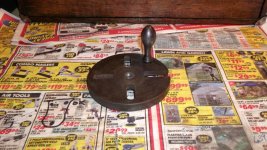
I got the acme rod cut to length, and am working on a hand wheel.I cobbled up the hand wheel from this faceplate I had laying around from a 109.21270 craftsman lathe. I have a 1/2" X 20 tpi plug threaded up into the faceplate and bored out, and am waiting for the acme thread in the freezer to shrink.
I had a handle that I press fit into a hole I drilled in towards the outside of the faceplate.
Here is what it looks like.

EDIT
Here is is done, Came out pretty good I think.
 

Attachments

  • Wheel 1.jpg
    Wheel 1.jpg
    161.4 KB · Views: 112
  • Wheel 2.jpg
    Wheel 2.jpg
    159 KB · Views: 110
  • Off Saw 1.jpg
    Off Saw 1.jpg
    161.4 KB · Views: 119
  • On Saw 1.jpg
    On Saw 1.jpg
    129.7 KB · Views: 119
Last edited:

stioc

Well-known member
Joined
May 2, 2005
Messages
1,317
Location
SoCal
Wow impressive work OP. I too am in the IT industry but love to tinker with tools, cars, motorcycles etc. I bought a HF mini-lathe 3 years ago tried to learn it in my spare time but pretty much gave up for multiple reasons- I didn't have all the cool tooling which made it difficult to use the lathe for anything useful, didn't know how to make my own cutting tools, didn't have the right stock to make something when there was a need, found pre-made stuff much cheaper and faster than to make my own, realized without a mill a lathe is not that much of a value etc. So the last 3 years it's been sitting in the garage. Having seen this thread it makes me want to start it back up but as much as I like the idea of being able to make my own stuff (simple car/bikes parts) like you are I don't think a mini lathe alone will ever be enough and from there it's a slippery slope...a mill, a plasma cutter, a tig-welder, a CNC, 4 axis etc etc. So for now I'll live vicariously through your awesome projects, pictures, hints and tips hoping one day I just may try again and have better success.
 
OP
D

deere2210

Well-known member
Joined
Apr 3, 2008
Messages
232
Finished up the air cleaner.. Came out great, really happy with it.. Still need to powdercoat or chrome it.. Not sure which yet.. Once I mounted the carb bracket up behind the backplate it provided enough clearance so didn't need to mill the back out at all.. Next up, need to build some forward controls..

airf0.jpg


airf1.jpg


airf2.jpg


airf3.jpg
 
OP
D

deere2210

Well-known member
Joined
Apr 3, 2008
Messages
232
Wow impressive work OP. I too am in the IT industry but love to tinker with tools, cars, motorcycles etc. I bought a HF mini-lathe 3 years ago tried to learn it in my spare time but pretty much gave up for multiple reasons- I didn't have all the cool tooling which made it difficult to use the lathe for anything useful, didn't know how to make my own cutting tools, didn't have the right stock to make something when there was a need, found pre-made stuff much cheaper and faster than to make my own, realized without a mill a lathe is not that much of a value etc. So the last 3 years it's been sitting in the garage. Having seen this thread it makes me want to start it back up but as much as I like the idea of being able to make my own stuff (simple car/bikes parts) like you are I don't think a mini lathe alone will ever be enough and from there it's a slippery slope...a mill, a plasma cutter, a tig-welder, a CNC, 4 axis etc etc. So for now I'll live vicariously through your awesome projects, pictures, hints and tips hoping one day I just may try again and have better success.


Thanks for the comments.. Definitely is a good feeling to take an idea and turn it into a part.. It does get a little crazy, because there is always one more tool / machine that seems needed to do something.. One thing I learned about getting stock is to find a metal supplier in your local area.. Most of them sell "drops" from left over pieces that are too small for the big buyers.. I've picked up a bunch of aluminum any where up to 10' in length and paid by the pound.. Same for some stainless (304). Build a good relationship with the guys running the saws who write up the weight tickets.. They will usually let you know of some other stuff that might be better, or bundle a deal together for you..
 
To avoid these ads, REGISTER NOW!
Top Bottom