To avoid these ads, REGISTER NOW!

Some long overdue framing reconstruction

andyvh1959

Well-known member
Joined
Feb 15, 2020
Messages
2,594
Location
Green Bay WI
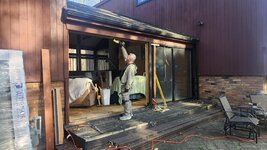
Took advantage of some unusual Wisconsin warm November weather recently to finally rebuild the living room south wall of my 1973 built architect designed contemporary home. The south wall was a 17' span of doubled 2x12s, two 8' patio doors with one 6" wooden post with NO anti-rot/flashing/coatings applied when first built. 52 years of Wisconsin weather caused considerable rot and the roof had sagged onto the patio doors which became part of the supporting structure.

With my hired constractor friend Jake (thats him in the picture) got my 10ton bottle jack to lift the load off the rotted post, and the repairs. replacement of rotted wood, and new framing started. What was once a single plain wood post with NO moisture abatement is now three tripled 2x4 pressure treated posts on a new pressure treated sill. with coatings and flashings applied. The prehung door is fully installed and the windows positioned. I used 2" styrofoam sheet to enclose it for the night and keep out critters. Now I can finish the install with proper sheeting, flashing, etc.

It just baffles me that the architect, contractors/builders did nothing at all to plan for future moisture issues. Granted, it was built in 1973, but no application of any common flashing and sealers just shows disregard for proper design and work. Especially since the design of the house has much less than 12" overhangs, and the back of the house is constantly exposed to the prevailing west winds, rain, snow, ice etc common to Wisconsin weather. The door and windows are top end Windsor products (much like Marvin top line but not as expensive), fully aluminum clad with no seal dependent protection of the inner wood structure. Finally better.


20250318_185114.jpg20251118_193822.jpg
 

Attachments

  • 20251116_082639.jpg
    20251116_082639.jpg
    432.9 KB · Views: 134
  • 20251114_120320.jpg
    20251114_120320.jpg
    691.2 KB · Views: 136
Last edited:
To avoid these ads, REGISTER NOW!

CraigStu

Well-known member
Joined
May 22, 2014
Messages
4,026
Location
Blacksburg, Va
Yes it is baffling. I guess people figure if it lasts X years it's OK. I had a 22 yr old sliding door where the frame piece on one side had rotted at the bottom. Typical pre-assembled door w/ an aluminum sill plate over wood and verticals sitting on the aluminum. Everything put together w/ large staples. As the rot continued the vertical got effectively shorter so the top was sagging on that end and the door ran out of adjustment and was binding as it closed. My replacing the bottom 18" or so of the vertical was nowhere near as complex as your situation but still frustrating.
 

reader2580

Well-known member
Joined
Dec 31, 2014
Messages
14,516
Location
Minneapolis, MN
Something built in 1973 was probably designed before the 1970s energy crisis. Older houses had a lot more air leakage that helped dry things out so they were not always as concerned with moisture control. My house and detached garage had vinyl siding installed at some point. The garage had the vinyl siding installed directly on the sheathing with no housewrap. I had to replace a bunch of the sheathing due to rot. I replaced the vinyl siding on house and garage with Smartside as the vinyl was in bad shape.

I do volunteer construction work at a Boy Scout summer camp. Many of the buildings were built in the 40s and 50s. They didn't do a good job at controlling moisture compared to today. Many buildings have no flashings over doors and windows. A lot of time is spent these days repairing rot from lack of proper moisture control. It is not unusual to start on a minor repair that should take a few hours only to find rot that means two days of reconstruction.
 

The Metric System

Well-known member
Joined
Apr 28, 2025
Messages
268
My experience with architects is that they are very often more focused on the cosmetic aspects of their "vision" than whether they are designing a structure that will be buildable, durable, and suitable for habitation/use by actual humans.
 

bluedog225

Well-known member
Joined
Jan 31, 2012
Messages
3,276
Location
Texas
My contractor complained there were too many holes in the Simpson connectors specified by the engineer. It would take too long to fill them. Instead, he wanted a toenail in the boards and move on.

I get it, he needs to finish the job get paid and move on. If it lasts five years without rotting, he’s in the clear.
 
OP
A

andyvh1959

Well-known member
Joined
Feb 15, 2020
Messages
2,594
Location
Green Bay WI
My experience with architects is that they are very often more focused on the cosmetic aspects of their "vision" than whether they are designing a structure that will be buildable, durable, and suitable for habitation/use by actual humans.
Don't get me started on so many idiot architect design flaws in this house. Poor traffic flow planning, odd window placements, no design plans practically. The kitchen is at the end of the house opposite the garage on the main level (trilevel). Everything in and out of the kitchen has to go through the living room. Same for laundry. My ex wanted this house and now it's mine to make best of it. I had a residential design drafting class in high school. Our main project was to design a house, graded on style, flow, practicality, functionality, etc. I aced that class.
 

firebirdparts

Well-known member
Joined
Jun 8, 2016
Messages
10,601
Location
Kingsport, TN
Good job. The worst structural error I ever saw in my life was made on a house an architect built for himself. Lucky nobody was killed by it, and the house didn't fall. Really fancy house, though.
 

reader2580

Well-known member
Joined
Dec 31, 2014
Messages
14,516
Location
Minneapolis, MN
Good job. The worst structural error I ever saw in my life was made on a house an architect built for himself. Lucky nobody was killed by it, and the house didn't fall. Really fancy house, though.
Architects are not structural engineers. There are independent structural engineers that can often review a plan for maybe $1,000 depending on the local market.

My brother built a very large house with a sport court and large attached garage. His engineering costs were around $3,000 because it was very complex. He had to use a lot of very expensive LSLs and LVLs once the engineer did his work. I saw his house after it was framed, and the amount of lumber used was insane. I could have framed three houses like mine with the lumber used.
 

Hank11

Well-known member
Joined
Aug 19, 2019
Messages
1,148
Location
Tennessee
Of course it’s an oversimplification, but sometimes it’s handy to think about it like this —“ architects make it pretty engineers keep it from falling down”.
 
To avoid these ads, REGISTER NOW!

Stuart in MN

Well-known member
Joined
Sep 8, 2005
Messages
23,084
Location
Minneapolis
I wouldn't slam the entire profession - like any job, there are good architects and bad architects. I'm a retired engineer, and worked with many of them over my career. Most of them include engineers as sub consultants where necessary.
 

LopezBart

Well-known member
Joined
Oct 13, 2023
Messages
2,538
Location
Lopez Island, WA
Architects have to use structural engineers when their designs don't align w/ prescriptive code requirements - e.g. when their designs are unanticipated by the building codes. Of course, the increased emphasis on seismic and storm safety has greatly increased the role of engineers in residential building design since the 1970s.
Keep in mind that the materials and technologies available for waterproofing have burgeoned since the OP's house was built. Flashing tape, house wrap (not just tar paper), expanding foam, etc - all post 70s iirc.
 
OP
A

andyvh1959

Well-known member
Joined
Feb 15, 2020
Messages
2,594
Location
Green Bay WI
Of course it’s an oversimplification, but sometimes it’s handy to think about it like this —“ architects make it pretty engineers keep it from falling down”.
And qualified skilled quality contractors make it all happen, or not. And yes, much has changed materials wise since 1973, but like I posted initially, there was nothing applied to mitigate moisture/rot erc. I too am a retired mechanical engineer, and given the age of this house and the construction constraints of the architect design they should have used a wood encased steel post to serve as the main support versus a plain wood tripled 2/4. They could have coated the bottom third of the wood with roofing asphalt, and then applied copper flashing, then coat the outside of that and then apply finish trim on the outside. Just common sense.

And yes, I don't mean to group all architects into one clueless group. Same for engineers I have worked with. One of the best in my career was "only" an associate degreed designer who simply had intrinsic understanding and applied realsitic solutions. That same engineer later reported to an PHD engineer who was largely clueless. I've met some engineers who I swear could not determine the control end of a hammer.
 

The Bean

Well-known member
Joined
Dec 24, 2021
Messages
1,811
Location
Delaware Valley (SE PA)
As an architect, i might be expected to take offense, but I'll tell you, Frank Lloyd Wright didn't bother worrying about leaks when he designed Falling Water in western Pennsylvania.
Okay, he was a womanizer, didn't provide enough headroom for his tall client because he himself was of short stature, and left his family to take up with another woman.
We're not all perfect. Lol.
 
Last edited:

jimkinney

Well-known member
Joined
Jan 3, 2009
Messages
299
Location
Florida's Space Coast
Nice repair.
Had a similar what were they thinking moment after a few years in this which I bought new. 8'x4' sliding glass doors on extruded aluminum tracks. Door weighs 50+ pounds and the 1/8" wide guide rail looked like corrugated roofing from the uneven wear.
Cut a slot out the track and put in a piece of 3/4 stainless steel angle screwed into the sill. Still rolling effortlessly today.
 
OP
A

andyvh1959

Well-known member
Joined
Feb 15, 2020
Messages
2,594
Location
Green Bay WI
I'm not dissing on all architects, but the one that designed this house clearly missed the mark in many regards. And sure, design review in retrospec is easy, and easy to be critical in many ways. Perhaps the people that commissioned the architect are as much at fault if they had too much influence on the design. I was told by contacts within a local highly renowed architectural firm that the architect for my house was actually a commercial building architect, so that may explain a lot of the lack of sensibility in this house design.

I have been to Taliesen, toured the buildings. Been to Falling Waters, toured the house. Been through the Johnson & Johnson building, I even had a almost complete sales portfolio of Frank Llyod Whright homes and buildings. His designs are thought provoking, stunning, but function and practicality were certainly secondary.
 

Ak Jim

Well-known member
Joined
Jan 5, 2012
Messages
532
Location
Interior AK
Don't get me started on so many idiot architect design flaws in this house. Poor traffic flow planning, odd window placements, no design plans practically. The kitchen is at the end of the house opposite the garage on the main level (trilevel). Everything in and out of the kitchen has to go through the living room. Same for laundry. My ex wanted this house and now it's mine to make best of it. I had a residential design drafting class in high school. Our main project was to design a house, graded on style, flow, practicality, functionality, etc. I aced that class.
Why not move to a better house?
 
OP
A

andyvh1959

Well-known member
Joined
Feb 15, 2020
Messages
2,594
Location
Green Bay WI
That's the plan. But as the pics show this is a contemporary style tri-level in a conservative housing market. I bought it back in 2002 as it was the house my ex-wife wanted just after we married, and it had never been updated since built in 1973. I should have stood my ground at the time wiht the concersn I saw in the house design and issues, but she wanted it and I caved. I had a really nice, solid, older farm house on a new foundation with a huge garage/shop I had built, sold that to buy this house (still kick my *** for that dumb choice).

By 2007 we headed into divorce. So now I've been updating this house to make it much more market pallitable. This project was to get rid of the rot and structural issue and get rid of those damned patio doors. Another design flaw regarding the living room patio doors is there was no way to not have weather issue, debris, snow, ice collect directly on the lower tracks for the slider doors, especially since the design of the eaves did not offer any overhang protection. With these issues I could not feel good about selling it as is. Now that many issues are addressed I'm getting closer to getting out of this house, thats the goal.
 

reader2580

Well-known member
Joined
Dec 31, 2014
Messages
14,516
Location
Minneapolis, MN
My house has a pretty bad floor plan too, but I wanted an inexpensive starter home with a detached garage. The whole garage thing has to do with city zoning code. At least I have a front door going directly into the kitchen. The primary garage can be up to 3,000 square feet and 45 feet tall. A 2nd garage is much more restrictive on height and square footage. An attached garage is considered the primary, and would need to be converted to living space to no longer count as the primary garage.

My house is 1,300 square feet with three bathrooms, one story, and four bedrooms (one in basement). I could not imagine a family of five living in this house for long. The vast majority of the main floor is bedrooms and bathrooms. The kitchen is a tiny eat in kitchen, and there is a tiny living room. Great for a single guy, but a family of five would be on top of each other. The basement is clean and dry, but chopped up into a bunch of rooms due to a load bearing wall running down the center.
 

reader2580

Well-known member
Joined
Dec 31, 2014
Messages
14,516
Location
Minneapolis, MN
Architects have to use structural engineers when their designs don't align w/ prescriptive code requirements - e.g. when their designs are unanticipated by the building codes. Of course, the increased emphasis on seismic and storm safety has greatly increased the role of engineers in residential building design since the 1970s.
The current IRC has various tables showing what spans and heights can be built without engineering in most cases. Minnesota took the IRC and amended it with some additional tables that allow 34 feet of width with 16 foot tall walls. I wanted to go 40 feet wide with 30 feet of garage door on the gable end. The city building guy said I needed engineering because 40 feet was not in the building code. I spent $700 with an engineer who produced a plan that would have cost an additional $10,000 to $15,000 that I didn't have. The city said if I cut back to 34 feet, or less, I would not need any engineering. I ended up at only 24 feet wide in the end due to finances.

I know that many building departments approve garages/accessory structures all the time that exceed the spans in the tables.
 
To avoid these ads, REGISTER NOW!
Top Bottom