To avoid these ads, REGISTER NOW!

soow vs. romex (240v outlet)

To avoid these ads, REGISTER NOW!

alfredeneuman

Well-known member
Joined
Mar 3, 2011
Messages
4,596
Location
Fullerton, CA

Walkers

Well-known member
Joined
May 17, 2021
Messages
3,912
Location
Cave Creek Az
write a note for yourself, 'Next time Start with pictures'. It would have saved you buying the wrong stuff twice. I wouldn't have any issue hard wiring a piece of equipment that big. It is not likely to be moved around at all once settled.
 

Cruzan80

Well-known member
Joined
Jul 22, 2015
Messages
4,486
Location
Denver, CO
The reason people suggest hardwiring is that receptacles cost a lot:
https://www.zoro.com/hubbell-wiring...ceptacle-30a-5-hp-blue-hbls330r6w/i/G2481337/
....and you must have the matching plug
Personal shop or not you should wire it to Code.
I am well aware of how much they cost. Hence why I was asking about what made something "portable" and requiring a plug vs the direct wire "stationary". I understand direct-wiring is much easier, since it doesn't require such expensive plugs. What I wasn't aware or unsure of is when something could change from one to the other, since this is heavier than most of the compressors people seem to continually suggest direct-wiring. Would using/accepting MC cable be a better alternative to SOOW?

Regarding wiring it to code... the motor has a separate starter, so when "off", it is only powering a low-voltage transformer. And the plug is a locking plug in the ceiling, so highly doubtful I would pull the plug when on. If needed, the breaker box is only about 10-15ft away to kill power to the entire circuit. The receptacle/plug/wiring is rated above the motor amperage, just not the HP. From my understanding, the reason for HP ratings is due to disconnection while under a heavy load, and the risks associated with that, correct?

The former owners (cabinet shop) had it built-in to a long bench, so does that change it from "portable" to "stationary"? :)
 
OP
J

jengland

Member
Joined
Jul 30, 2018
Messages
14
Location
Side of the house
Actually a little impressed you got that cord through the 90. You could have just put the receptacle next to the panel and used all that as an extension cord.
i did think about doing that...but i didn't want a long, snake-of-an-extension cord all over the garage floor. i thought it might be something to trip over while working so i decided that a neatly installed outlet on the wall would be more organized and then a shorter extension cord if i needed it. thanks.
 

SlappyWhite

Well-known member
Joined
Oct 3, 2012
Messages
1,819
Location
Upper Canada
Extremely hack, an outlet just under the panel using the proper wire would have solved everything and would have been dirt cheap. Lots of ways to tuck the extension cord along that wall without doing it entirely wrong afterwards.

It looks almost like someone went out of their way to do it entirely wrong with all the wrong materials! Please go back and do it correctly.
 
To avoid these ads, REGISTER NOW!

SlappyWhite

Well-known member
Joined
Oct 3, 2012
Messages
1,819
Location
Upper Canada
Obviously should have used J hooks.

Also make should it's sloped 1/4" per foot so the electricity drains when you're done using it. Would make for a nasty shock if it doesn't drain.

How many farads do you think a set-up like that has?
 

mark-NJ

Well-known member
Joined
Apr 1, 2019
Messages
775
Location
new jersey
I did use the extra SOOW wiring I had left over to make a 240v extension cord.

EXTENSION CORD.jpg


Not to muddy the waters further, but that is a code violation. Boxes with knockouts cannot be used on rubber cord in this fashion. NEC article 314.23 details how these boxes are to be (permanently, rigidly) mounted only.
 

mark-NJ

Well-known member
Joined
Apr 1, 2019
Messages
775
Location
new jersey
Having been on the receiving end of several different AHJ's interpretation more than once, I think you and I are going to have to agree to disagree on that.

I've had jobsites shut down because of "1900-box (and the like) extension cords". These metal boxes are intended by their UL file for "permanent installation" and any use other than that usually doesn't pass muster with AHJs.

Now it may have been a "urination contest" between the local IBEW and the Chicago AHJs, but I once worked a tradeshow at McCormick, and the AHJ's refused to let the exhibitors use any of the McCormick-supplied "extension cords" (thousands & thousands of 1900-boxs + SO cord). Same issue: they're for permanent installation only. Yes, at the time there was an underlying tension between the AHJs & McCormick & the IBEW, but still: the AHJ was "looking for something", and this was low-hanging fruit.

Are these boxes used this way all the time? Sure. Do >95% of AHJs care? no. Do they look the other way? Often. But is it "allowed" based on the UL file? Nope.
 

pattenp

Well-known member
Joined
Jun 4, 2008
Messages
10,175
Location
Virginia - USA
Mark, your point is well taken. Under NEC 240.5(4) the listed components is the catch. So technically the made up cord pictured above is not NEC compliant. Live and learn.
I understand in a public use area such as a trade show or job site that all safety requirements are enforced.
 

mark-NJ

Well-known member
Joined
Apr 1, 2019
Messages
775
Location
new jersey
To me, 110.3(b) is the overriding catch-all: "Listed or labeled equipment shall be installed and used in accordance with any instructions included in the listing or labeling". The implications of that simple phrase is the cornerstone of NFPA70 and oversees the whole enchilada...

Here's the other thing: OSHA doesn't dig it, either. While I can't cite the code, the 4 biggest takeaways are 1.) the knockouts get kicked in which puts them close to live components, 2.) the knockouts get knocked out, exposing live components, and 3.) anecdoctally, it's found that most people run the grounding conductor (green) to the outlet's yoke, but don't bond the box. Relying on the yoke isn't code. and 4.), coupled with #3, being unsupported, to plug something in, you typically have to hold the box in one hand while plugging the device in with the other, greatly increasing the chances for electric shock.

(I read that on line somewhere in a publication by an OSHA engineer....can't remember where though)
 
Last edited:

wyliesdiesels

Well-known member
Joined
Aug 14, 2012
Messages
20,251
Location
Modesto, CA
To me, 110.3(b) is the overriding catch-all: "Listed or labeled equipment shall be installed and used in accordance with any instructions included in the listing or labeling". The implications of that simple phrase is the cornerstone of NFPA70 and oversees the whole enchilada...

Here's the other thing: OSHA doesn't dig it, either. While I can't cite the code, the 4 biggest takeaways are 1.) the knockouts get kicked in which puts them close to live components, 2.) the knockouts get knocked out, exposing live components, and 3.) anecdoctally, it's found that most people run the grounding conductor (green) to the outlet's yoke, but don't bond the box. Relying on the yoke isn't code. and 4.), coupled with #3, being unsupported, to plug something in, you typically have to hold the box in one hand while plugging the device in with the other, greatly increasing the chances for electric shock.

(I read that on line somewhere in a publication by an OSHA engineer....can't remember where though)
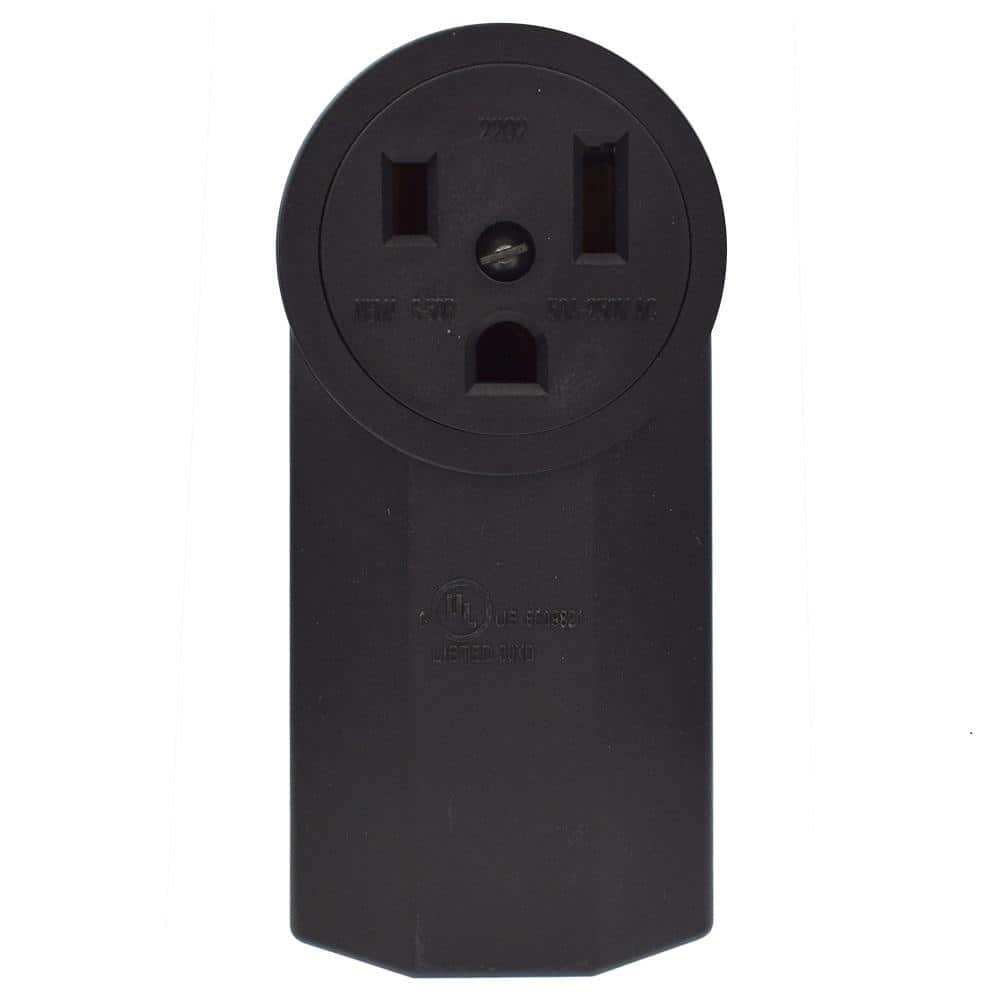
yeah so a better solution is a receptacle in its own housing which are sold at the big box stores. though some may flag even that since these are used as surface mount receptacles...

(side note- home depot's description of it being a range and dryer outlet is incorrect. dryers don't use 50a circuits and stoves need either a 10-50 or 14-50...)

 
To avoid these ads, REGISTER NOW!
Top Bottom