To avoid these ads, REGISTER NOW!

SORRY, but yet another barrel stove thread

knied1

Active member
Joined
Feb 3, 2015
Messages
41
Hi all,

I know to a point this subject has been beaten to death, but I have tried to research installing a barrel stove in a pole barn and after sifting thru I`m still in the same place I began.

* YES I know the insurance company will not insure the barrel stove.
* YES ive read all the replies where people heard of one burning the place down, or heard of a guy who had this issue or that issue.
* YES ive read about needing to keep an eye on the barrel to make sure it doesn't rust out.

In my opinion all of the negatives about barrel stoves can easily be fixed with common sense.

where I've had trouble finding decent answers is simply the installation on them. I have a 30'x40' pole barn, wood post and perlin construction with metal siding, and concrete floors. I have 2 pieces 16Ga x 3' x 8' long pieces of siding that I want to use as a heat shield for between the barn wall and the stove.

Does any one have experience with using a heat shield and if so what distance you keep the stove from the heat shield?

I am thinking that I can screw the siding to the face of my posts creating a little more than 4" gap between the heat shield and the wood perlin framing. then I can set the stove 18" from the heat shield. this will also allow me to have the stove pipe 36" from framing until I poke thru the wall.

One other thing I am installing a double barrel kit in the barn.

Any input from you guys with experience will be GREATLY appreciated.
 
To avoid these ads, REGISTER NOW!

xxaler

Well-known member
Joined
Nov 16, 2014
Messages
239
Location
Sutton Ontario
When I installed my stove I didn't insulate that end of the shop so just put it 14" from the wall. It was fine, wall didn't get hot.

Framed/insulated that wall later on and when running the chipboard read 61 Celsius with the stove at full blast. Laid a piece of 8x3 18 guage steel against the stack, wall doesn't even get above 12 Celsius now.
 

930dreamer

Super Moderator
Staff member
Joined
Oct 7, 2009
Messages
22,958
Location
Amarillo,TX and Stinnett,TX
The clearance to combustibles is probably 36". For my wood stove install I moved it 36" from my wall insulation, and install durarock in the corner. I can tell you the durarock gets hot so I have a box fan blowing over the durarock. The next step I need to do is add steel sheets over the rock with a one inch spacer between and off the floor.

The added steel sheets will absorb the heat and radiate it back into the shop and allow the air to flow behind it with the spacers/floor gap.

With the above all complete I could in the theory move the stove closer to the walls, but I would probably need to install all the way to the ceiling as the stove pipe is smoking hot also. Just my .02.:D
 

Attachments

  • 100_1280.jpg
    100_1280.jpg
    74.4 KB · Views: 150
  • 100_1308.jpg
    100_1308.jpg
    97.4 KB · Views: 134
Last edited:
OP
K

knied1

Active member
Joined
Feb 3, 2015
Messages
41
With the above all complete I could in the theory move the stove closer to the walls, but I would probably need to install all the way to the ceiling as the stove pipe is smoking hot also. Just my .02.:D[/QUOTE]

your stove pipe looks to be single wall, (I very well could be wrong)
I am planning to put an elbow immediately out of the top barrel, and use double wall pipe until I exit the building. Also with the style layout im looking to do with the pipe, I should be able to keep 36" between the pipe and wood framing.

Do you feel my situation would have the same issues you are having with heat in the pipe?
 

930dreamer

Super Moderator
Staff member
Joined
Oct 7, 2009
Messages
22,958
Location
Amarillo,TX and Stinnett,TX
With the above all complete I could in the theory move the stove closer to the walls, but I would probably need to install all the way to the ceiling as the stove pipe is smoking hot also. Just my .02.:D

your stove pipe looks to be single wall, (I very well could be wrong)
I am planning to put an elbow immediately out of the top barrel, and use double wall pipe until I exit the building. Also with the style layout im looking to do with the pipe, I should be able to keep 36" between the pipe and wood framing.

Do you feel my situation would have the same issues you are having with heat in the pipe?[/QUOTE]

Correct, single wall until it reaches the ceiling support box and then triple wall out, not sure what if you will have any draft issues going straight through the wall? Are you planning on the pipe going above your roof ridge line?
 
OP
K

knied1

Active member
Joined
Feb 3, 2015
Messages
41
QUOTE]

Correct, single wall until it reaches the ceiling support box and then triple wall out, not sure what if you will have any draft issues going straight through the wall? Are you planning on the pipe going above your roof ridge line?[/QUOTE]

Actually code in my area says to go 4 feet above a 10 foot radius (I know confusing I had to ask too)

what that means is if I draw a straight horizontal line from the stove pipe to the roof line, I need to have the pipe 4 feet above that. OR 2 feet above the peak of the building what ever happens first.

I`ve read about needing to establish a "draft" burn in order to get a good draft going especially when using a horizontal run, but I figured it was better than poking hole in my roof that could leak later.....just an opinion of mine nothing real founded I just like to avoid penetrations in the roof if possible.
 

Bondo

Well-known member
Joined
Dec 22, 2007
Messages
2,549
Location
Greenfield, Maine
Hi all,

I know to a point this subject has been beaten to death, but I have tried to research installing a barrel stove in a pole barn and after sifting thru I`m still in the same place I began.

* YES I know the insurance company will not insure the barrel stove.
* YES ive read all the replies where people heard of one burning the place down, or heard of a guy who had this issue or that issue.
* YES ive read about needing to keep an eye on the barrel to make sure it doesn't rust out.

In my opinion all of the negatives about barrel stoves can easily be fixed with common sense.

where I've had trouble finding decent answers is simply the installation on them. I have a 30'x40' pole barn, wood post and perlin construction with metal siding, and concrete floors. I have 2 pieces 16Ga x 3' x 8' long pieces of siding that I want to use as a heat shield for between the barn wall and the stove.

Does any one have experience with using a heat shield and if so what distance you keep the stove from the heat shield?

I am thinking that I can screw the siding to the face of my posts creating a little more than 4" gap between the heat shield and the wood perlin framing. then I can set the stove 18" from the heat shield. this will also allow me to have the stove pipe 36" from framing until I poke thru the wall.


One other thing I am installing a double barrel kit in the barn.

Any input from you guys with experience will be GREATLY appreciated.
Ayuh,.... I've built a few,.....

I'd suggest you mount yer sheets of tin, a few inches up, off the floor, 'n space it an inch or so off the purlin's,...
That'll allow the natural convection air currents to pull away the heat build up,...
On both the hot side, 'n the shielded side of yer panels,...

For the smoke pipe, I'd run single wall pipe, til ya get nearer the wall yer passin' through,....
The single wall pipe, will continue to loose heat into the air, as long as possible,.....

Back when I biult a double barrel stove, I put the door on the front of the bottom barrel, 'n the smoke pipe adapter on the back, up into the top barrel, 'n the smoke pipe out of the front of the top barrel, to get the Most heat exchange, Possible,....
 
OP
K

knied1

Active member
Joined
Feb 3, 2015
Messages
41
Great info guys thanks ALOT.

Another question that popped into my head is the upper barrel.
I can not remember seeing one with a door to clean out creosote.
How do you guys keep them from building up creosote without having access to the upper barrel? or does the upper barrel get that hot it burns itself clean?
 

gungatim

Well-known member
Joined
Jan 8, 2013
Messages
8,101
Location
west mich
my experience in using a barrell stove, then a franklin stove, and now a wood burning fireplace insert very similar to 930dreamer's pics: never had an issue with heat against the wall. I just have a couple 4x4 pieces of leftover steel siding screwed in the corner. single wall pipe up 5', then horizontal out through the side wall. I have a little oven thermometer that sits on it, when it gets to about 400 deg. I turn on a 16" desk fan runnng through a HF router speed control, when it gets to 600, it goes on full speed. I imagine if there were no fan and it sat all day burning that hot, maybe there'd be an issue, but I've not ever had one. the barrell stove I used was same but I didn't need the fan as the top barrell radiated quite well.

I use single wall pipe, radiates better and is cheap.

I have never done anything more than whacking the stove pipe once or twice a year with a wood stick to knock down the creosote into the stove to burn up...
 

s_ontario

Well-known member
Joined
Jan 5, 2006
Messages
552
Location
canada
I have had barrel stoves and double barrel stoves they burn out fast and old wood stoves in shops before if you have the wood and your going to put up a proper smoke pipe. just bite the bullet and get a hotblast furnace

clearances and 12" sides 18" stove pipe 30 rear 40 front has blower and firebrick, cast grate my shop is 80 degrees today and its ******** cold out

http://www.garagejournal.com/forum/attachment.php?attachmentid=416376&stc=1&d=1424111947
 

Attachments

  • DSC00011.jpg
    DSC00011.jpg
    139.1 KB · Views: 143

PugetDude

ALLIANCE MEMBER
Joined
Mar 13, 2013
Messages
22,409
Location
Superstition Mountains, AZ
Had a barrel stove years ago. Here's a few tips...

1. Line the bottom half of the lower barrel with firebrick and the barrel will probably last your lifetime...

2. Single wall pipe will radiate a significant amount of heat that is lost with double or triple wall pipe- use single wall inside the building until you get to your ceiling/roof penetration- switch to insulated pipe there, per code....

3. 1/2" pipe standoffs for the heat shield, long lag bolts with 3" long pipe spacers. Make a couple of L-brackets for feet.

4. I set mine on a brick hearth, raised it up off the floor a bit. Made it easier to load the lower barrel and clean up the chips and dust around it.

Post pics of the finished installation.
 
OP
K

knied1

Active member
Joined
Feb 3, 2015
Messages
41
Had a barrel stove years ago. Here's a few tips...

1. Line the bottom half of the lower barrel with firebrick and the barrel will probably last your lifetime...

2. Single wall pipe will radiate a significant amount of heat that is lost with double or triple wall pipe- use single wall inside the building until you get to your ceiling/roof penetration- switch to insulated pipe there, per code....

3. 1/2" pipe standoffs for the heat shield, long lag bolts with 3" long pipe spacers. Make a couple of L-brackets for feet.

4. I set mine on a brick hearth, raised it up off the floor a bit. Made it easier to load the lower barrel and clean up the chips and dust around it.

Post pics of the finished installation.

Thanks for the info, a little more info on my setup.

1, Yep already have the fire brick, was also planning to put a bag or two of play sand in the bottom as well.

2, Yea...guess the best thing is to go thru the roof...TOO many people are saying the same thing for me to go my own way on this one.

3, what do you mean by L brackets for feet? not sure of your talking about feet on the heat shield?

4, I am planning to put it on cinder blocks to save on the back.


Again, thanks to all you guys who are answering my questions.
 
OP
K

knied1

Active member
Joined
Feb 3, 2015
Messages
41
Yes- if the cooler air neat the floor can get under it, it will create a convective current that draws the heat up and away from the wall.


OK I got ya.....based on the answers I received I was thinking of holding the heat shield up off the floor approx. three inches, and using standoffs and long screws attaching it to the perlins, and not resting on the floor at all.

But if im understating you, your recommending that I put feet on it also......YEP your right....guess it would keep it from sagging over time
 

Bondo

Well-known member
Joined
Dec 22, 2007
Messages
2,549
Location
Greenfield, Maine
OK I got ya.....based on the answers I received I was thinking of holding the heat shield up off the floor approx. three inches, and using standoffs and long screws attaching it to the perlins, and not resting on the floor at all.

But if im understating you, your recommending that I put feet on it also......YEP your right....guess it would keep it from sagging over time

Ayuh,.... I'd go twice that,....

Easier to sweep under,..... ;)
 

6768rogues

Banned
Joined
Nov 28, 2007
Messages
4,524
Location
Western NY
One of my buildings is built similarly but with the inside finished with engineered wood subflooring up 4 feet and the remainder with metal barn siding. I put a wood burning furnace with the chimney pipe exiting the furnace on the back of the furnace, between the wall and the furnace. For a heat shield I used a spare piece of metal siding with some 2 (maybe 2 1/2) inch bronze bushings I happened to have. I screwed through the metal shield, through the center holes in the bushings and into the wall. That spaced my heat shield away from the wall. The furnace is about 2 feet from the shield and the pipe elbows up and is about 16 inches from the shield. With a big fire going, the heat shield gets warm and by sticking my hand behind it I can feel that the wall is cold.
My chimney pipe exits the furnace, elbows up and at about 8 feet off the floor it elbows, transitions to triple wall and exits through the wall and up the outside of the building.
 
Last edited:
To avoid these ads, REGISTER NOW!

TractorJeff

Well-known member
Joined
Dec 8, 2013
Messages
3,309
Location
Elkhorn, WI
My UL listed woodstove has its own heat shield 3 inches off its back. Its certified for 18 inch wall clearance. The wall is plywood sheet will brick façade 1 inch from the house wall. House wall never gets hot. the single stack goes straight up with a thermometer 24 inches above the stove, we strive for 400 degrees right there.
A buddy of mine had a barrel type stove 2 feet from the wall. Studs were 24 inches on center. He cut the wood out and installed a sheet of 16 gauge, then poked the single wall pipe out through that. He burned pallets in it which made quick hot intense fires. The wooden walls never got hot. Sometimes that pipe would be glowing.
Me personally, I would buy that furnace like the other guy posted about. Burns slower, makes more heat which equates to less wood burned which means less work in Spring and Summer cutting wood plus means hauling in less wood to burn in winter!
Your time is valuable!
 
OP
K

knied1

Active member
Joined
Feb 3, 2015
Messages
41
Hi guys.....Great input thanks a lot....as far as wood consumption for me it isn't an issue....I actually always end up with more wood than I need for heating my house...Long story short between my neighbor and my father I`m usually all set....also I most likely will only be using the heater 4 or 5 days per winter when I need to work on a snowmobile or car for some reason.

Really THANKS for all the information
 

cattoon

Active member
Joined
Jan 12, 2006
Messages
34
Location
N.W. Alabama
I have used a single barrel heater in my shop for 3 years, it is moderately insulated. It was 40F in there sunday morning and after a couple of hours was about 55. The highest I saw was about 70f which was very comfortable to work in.
 

Clik

Well-known member
Joined
Jan 1, 2011
Messages
430
Location
Highest Mountain in Western, MD
I kept my barrel stoves up off the floor not only so I sweep under them but in case of any spill of gasoline. Fumes lay low and are dense near the floor.

From my experience barrels don't burn through. They rust through in the off season as moisture mixes with creasote and ash which makes a corrosive mix.

Pipe is insulated to keep cold outside air from condensing smoke on the inside of the pipe.

We live on top of a mountain with high winds/cold temps and just last week had the dome clog and catch fire, filling the house with smoke. This is on a double wall stainless pipe serving our home stove which is all code soapstone two year old woodstove. Of course domes are just single wall.

I used the skid plate off a Jeep for a heat shield on my last barrel stove. Used "L" brackets for feet. The skid had a slight bend on each side which made it wrap slightly and was just the right size.

Where the pipe exited the wall of my pole barn, I covered the stringers with a section of single wall stove pipe. Just leave the split open and slip over the 2X4 stringer and screw in place. Leaves a nice air gap between the metal and wood.

I have never built a double barrel stove but if I do, I think I'll try connecting them end to end so I land slide longer logs in and let the draft work the length better.
 
OP
K

knied1

Active member
Joined
Feb 3, 2015
Messages
41
I know this thread has been dead for a wile, but for several reasons, I have not been able to install my barrel stove.
finally I now have the time to put it in, and have just one last thing I need a suggestion on.

First off I know there were different options given earlier in the thread, so...here is the way im planning to install it.

* Double barrel with pipe going straight thru the roof (yes I will have double wall pipe from about 2 feet inside the roof line, up and thru the roof, total of 9 feet)

* Entire stove assembly will be on a stand lifting it an additional 12" off the floor.

* Steel roofing on 1 1/2" stand offs screwed to the purlins to act as a heat shield

* Heat shield will have 4" air gap at bottom.

* pole barn has wood post, and wood purling style framing


MY last question,

Since I am putting up a head shield, how much room do I need between the stove and the heat shield.....for obvious reasons I am trying to minimize the amount od floor space the barrel stove will take up.


Thanks to all
 

theoldwizard1

Well-known member
Joined
Feb 22, 2011
Messages
43,196
Location
SE MI
Since I am putting up a head shield, how much room do I need between the stove and the heat shield.....for obvious reasons I am trying to minimize the amount od floor space the barrel stove will take up.
How thick is the heat shield ? Thicker is better.

How high does the heat shield go ? It should go up to where you transition to double wall.

These are just my SWAGs. Not to any "code"

I would want at least 12" from the stove to the heat shield. Also, you want about 4" BEHIND the heat shield ! Plus the wall behind the heat shield should be non-combustible. (concrete backer board or 2 layers of 1/2" drywall).
 

gungatim

Well-known member
Joined
Jan 8, 2013
Messages
8,101
Location
west mich
why lifting off the floor?

for heat shield, I just use some leftover polebarn siding screwed to the wall...nothing fancy. never gets very hot anyway, the heat rises....just put a fan on the wall above it and turn it on if you think it gets too hot (easy to do)...

barrel stoves are not rocket science...
 

nadogail

Well-known member
Joined
Jan 23, 2009
Messages
31,965
Location
Coronado, CA
I recall, from 60 years ago, a five barrel stove in the Sod Roofed Scout Cabin on the Eklutna flats near Anchorage Alaska. It had three barrels on the bottom and two on the top.

It could burn long lengths of slab wood from a nearby sawmill.

It could keep the large two room cabin comfortable during winter weekend outings.

The cabin was destroyed in the early '70s.
 
OP
K

knied1

Active member
Joined
Feb 3, 2015
Messages
41
why lifting off the floor?

for heat shield, I just use some leftover polebarn siding screwed to the wall...nothing fancy. never gets very hot anyway, the heat rises....just put a fan on the wall above it and turn it on if you think it gets too hot (easy to do)...

barrel stoves are not rocket science...

Lifting it off the floor mainly for easier to clean up under it, sweeping etc.


I know some people feel that it also allows for a fume gap incase something flammable gets spilled, so I guess im also covering that base as well.


I have 4 sections of sheeting used to protect the pole barn siding for delivery that I am planning to use for the heat shield.
The contractor who built my barn was going to throw them out, and I kept them.....same material as the siding, but galvanized instead of painted like the siding.

Thanks everyone for the input
 
OP
K

knied1

Active member
Joined
Feb 3, 2015
Messages
41
NO NO NO !

It is critical that air flows BEHIND the shield. If you screw it to the wall, it just passes heat to the wall !!

I understand what your saying, and the heat shield I am going to have about 3 or 4 inches off the floor, and on stand off`s from the wooden purlins,

I believe he was asking why I was lifting the stove off the floor, but I may be wrong.
 
Last edited:

gungatim

Well-known member
Joined
Jan 8, 2013
Messages
8,101
Location
west mich
NO NO NO !

It is critical that air flows BEHIND the shield. If you screw it to the wall, it just passes heat to the wall !!

the sheeting I used is leftover from my polebarn, it is the "W" type corrugated, there is plenty of airflow behind it and barely gets warm. for fun I've used my infrared thermometer, while the top of the stove can hit 450 degrees (rarely, usually around 350, then I switch on the fan), the sides and bottom are only around 150. the shield on the wall? I clocked 85 degrees max at the top, 60 at the bottom...

not worried about it passing heat to the wall (since it's a polebarn, there is just a couple horizontal 2x4's, nothing else combustible...)
 
OP
K

knied1

Active member
Joined
Feb 3, 2015
Messages
41
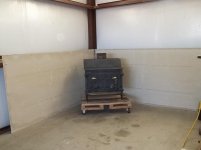
I got the Stove installed over the weekend, and used it last night.
I did not have a roaring fire going in it, but a nice steady medium one.

Just a quick explanation on how I set it up......

* Spare roofing material on the wall with 3" standoffs, and approximately 8" off the floor as a heat shield.

* lifted the barrel stove an additional 8" as well for easier cleanup under it, and easier to feed the stove with wood.

* Chimney pipe is run straight thru the roof, single wall up to about 18" from the roof, and double wall the rest of the way.

* Stove is set 12" from the heat shield.

* Instead of purchasing the flashing boot, I was able to cut the hole thru the roof tight to the chimney pipe, and high temp silicone seal between the pipe and metal roofing.

After starting a fire I kept checking how hot the heat shield was getting....no I didn't have a thermometer, but the stove was hot enough that I could not hold my hand on it, the heat shield got a little more than warm, but not so hot that I couldn't hold my hand on it....and never hot enough to make me concerned ..... My opinion if I can hold my hand on it for how ever long I wanted to, the air gap behind it was defiantly a lot cooler than the surface of the heat shield.....Then I decided to put a box fan blowing on the stove, and had it in a location that also got air moving behind the stove.....I did this more to help move the heat around the pole barn, but it also dropped the temperature of the heat shield by at least half.....remember that without the fan the heat shield didn't get very hot at all, so I have little worry having a hotter fire in the stove, ill just put a fan there to move air. Even though the heat shield NEVER got hot enough to give me concern, I do not think setting the stove any closer than 12" to the heat shield is a good idea at all.

I understand that all of you who replied to my add already know this stuff...I just figured I would type out my setup for the next guy to reference.....And for the next guy....I am not at all saying that setting your stove up less than the minimum recommended clearances is safe, but if you do it you must have common sense !!!!!!!!
 

Dragfluid

ALLIANCE MEMBER
Joined
Sep 15, 2013
Messages
17,565
Location
Pillager, MN
"* YES I know the insurance company will not insure the barrel stove."

Just to clarify, you realize that even if you have a fire that is not the fault of the homemade barrel stove, there will still be no coverage,,,, PERIOD.

Please be careful!
 

RustnGrease

Well-known member
Joined
Jun 26, 2014
Messages
397
Location
Schuylkill County, PA
Did you actually check with your insurance co? I spoke to my agent about adding a seconday heat source and they said wood stoves are ok, but they need to inspect the installation. Then again a barrel stove would probably be considered homemade. I'd probably be going coal anyway but wanted to check on wood regardless.
 
OP
K

knied1

Active member
Joined
Feb 3, 2015
Messages
41
"* YES I know the insurance company will not insure the barrel stove."

Just to clarify, you realize that even if you have a fire that is not the fault of the homemade barrel stove, there will still be no coverage,,,, PERIOD.

Please be careful!

COMPLETELY NOT TRUE !!!!!!
I did my homework,
For the rest of the message below I am specifically describing a flame driven heating source…..for example….. Barrel stoves, PURCHASED and Manufactured fire places, Pellet Stoves, Purchased Radiant Heater, Purchased Forced air heaters, Purchased Flame heated boilers…….and SOME electric radiant heating sources.
Unfortunately last year when I first thought about putting the barrel stove in I believed that exact statement, and decided not to put it in……. I decided to buy a torpedo heater and used that last winter.
About 3 weeks ago my insurance agent stopped at the house to review my insurance coverage ….. I keep atv`s, jetski`s snowmobiles, tools etc in the barn
She saw the barrel stove in the corner and asked when I was planning to hook it up.
I explained that I decided not to so that my insurance wouldn’t be void, and am using a torpedo heater this is where it get interesting…… If you put heat into any detached NON commercial use, NOT living space dwelling, and it causes property damage or loss, the insurance will not cover the loss.
She also explained that there are FAR more fires caused by torpedo heaters than barrel stoves… and they are NOT covered…. I then said that I will probable purchase a radiant heater from Northern Tool, or Grainger….NOPE STILL NOT COVERED …… NON Commercial, Detached NON Living space dwelling will NOT be coverers for loss if you are using a heat source for personal comfort.
If someone strikes the light pole and causes and electrical fire….YES COVERED
If my neighbor is burning leaves and starts the building on fire …..YES COVERED.
If the fire place in my house has an ember out of the chimney and started the building on fire …..YES COVERED.

If I am using ANY TYPE HEATING SOURCS as described above in the barn and I have a fire …….It is NOT COVERED…she explained it like this…..I could have a $5,000 heater put in by a professional with all receipts in hand….. I can be in the barn welding, and a welding spark hit a gas can and start a fire……..if they deem that the heating source is in use at that time …… there will be NO coverage PERIOID!!!
I also called my insurance provider…..and they said that the agent was absolutely correct…..Out of curiosity I called a different insurance provider and the exact same thing, so it is not just my insurance provider that will not cover ANY flame driven heating source in a “ NON COMMERCIAL, NON LIvING SPACE DETACHED DWELLING”
 
Last edited:
OP
K

knied1

Active member
Joined
Feb 3, 2015
Messages
41
I should have added that if I wanted "FULL COVERAGE"
I could not have it on my home owner`s insurance I would need a separate policy and it would be crazy expensive.......They also said that the fact I do welding in the barn can be reason for them to not cover loss either......basically, home owner`s insurance policies expect any out building to be used for storage only, and that is the reason they put the " Non commercial, non living space" tag on them
 
To avoid these ads, REGISTER NOW!
Top Bottom