To avoid these ads, REGISTER NOW!

Sound dampening enclosure for an air compressor?

Beerhippie

Well-known member
Joined
Oct 13, 2023
Messages
10,041
Location
Far NE Oregon
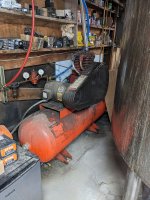
We're moving this compressor:

55127535486_9fec976361_o.jpg

From the shop, where it's shoe-horned in behind a bunch of **** and makes working in the shop almost impossible when running.

That'll be fun. A couple of floor jacks should get it out to where I can get to it with the forklift.

Here's where it's going:

55127724278_11b7f0d129_o.jpg

The comp is about 6' long, just over 2' deep, plumbing included, and 4' tall. The bay is 8' long, 4' deep and 5 1/2' high. The comp is driven by a 7 1/2 hp motor. Here's the data plate from the comp:

55127755573_5d8cf22cec_o.jpg

What would you use for sound dampening? How much ventilation will I need? The bay is on an outside wall, where noise matters less than the other walls. I can cut in a couple of louvered vents on that wall.

I'll use heat tape to prevent any wet parts from freezing in the uninsulated, unheated warehouse.

Outside of the opposite side of the warehouse is outdoor seating for the warmer seasons. We'd like customers seated there to be able to carry on a conversation with the comp running.

The compressor will only run occasionally when we're canning beer.
 
To avoid these ads, REGISTER NOW!

OccupantRJ

Well-known member
Joined
May 15, 2009
Messages
11,278
Location
Eastern North Carolina
I have a true 5hp compressor in an 8x20 insulated room. The room gets hot enough that I installed a thermostat controlled 6” through the wall vent fan to pull heat from the room after it hits 90f. The compressor is relatively quiet in the main shop, but it produces a hell of a lot of heat.
 

PCustoms

Well-known member
Joined
Jul 23, 2011
Messages
23,579
Location
VT
@Beerhippie a little off topic, but don't compressors used in commercial settings require periodic inspection or replacement at a specified interval?

I.e. a newer, quieter, more efficient unit might be better.
 
OP
B

Beerhippie

Well-known member
Joined
Oct 13, 2023
Messages
10,041
Location
Far NE Oregon
@Beerhippie a little off topic, but don't compressors used in commercial settings require periodic inspection or replacement at a specified interval?

I.e. a newer, quieter, more efficient unit might be better.
While that may be true, I've never been informed of it.

Our budget right now doesn't really allow for a new comp. That was my first choice!

The tank is certified and is inspected when the boiler and other pressure vessels are. One of my thoughts was to replace just the pump of the compressor, using our motor and reservoir.
 

PCustoms

Well-known member
Joined
Jul 23, 2011
Messages
23,579
Location
VT
The tank is certified and is inspected when the boiler and other pressure vessels are.

Should be all set then.

How much heat does it out out?

You could do a double 2x6 wall with Rockwool all around it, but heat will probably be an issue. Realistically anything you do to trap sound will also trap heat, so be prepared
 
To avoid these ads, REGISTER NOW!
OP
B

Beerhippie

Well-known member
Joined
Oct 13, 2023
Messages
10,041
Location
Far NE Oregon
Should be all set then.

How much heat does it out out?

You could do a double 2x6 wall with Rockwool all around it, but heat will probably be an issue. Realistically anything you do to trap sound will also trap heat, so be prepared
As I mentioned, one wall is an outside wall with nothing but one 16 ga. thickness of sheet metal between the inside and out. I can cut in a couple of louvered vents on that wall. Noise is also far less of a concern there, as it faces far away from our public areas--and is far enough from the shop and brewery. It's just the noise inside of the warehouse that's a problem, as the opposite wall of the warehouse--also just one thickness of 16 ga steel--is adjacent to a seating area.
 

GeoBruin

Well-known member
Joined
May 5, 2018
Messages
3,754
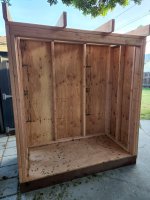
I kicked my compressor out of the shop but wanted to spare my neighbors the noise, so I built an acoustically insulated shed. I ended up building a trap door to separate the compressor compartment from the rest of the shed. The interior walls and ceiling were covered with acoustic foam panels. The front door and trap door were covered in a fibrous mat used to install behind drywall for acoustic insulation.

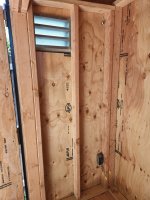
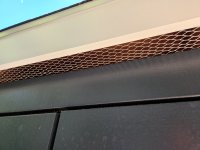
I installed a vent near the flywheel for air to come in and a solar vent at the top to pull air out. There's also a soffit vent.
 

Attachments

  • 20250501_082348.jpg
    20250501_082348.jpg
    433.2 KB · Views: 23
  • 20220828_141448.jpg
    20220828_141448.jpg
    1.7 MB · Views: 22
  • 20220828_143209.jpg
    20220828_143209.jpg
    1.1 MB · Views: 23
  • 20220815_153437.jpg
    20220815_153437.jpg
    982.6 KB · Views: 23
  • 20220813_155056.jpg
    20220813_155056.jpg
    851.7 KB · Views: 23
  • 20220813_120027.jpg
    20220813_120027.jpg
    939.8 KB · Views: 22
  • 20220806_134800.jpg
    20220806_134800.jpg
    754.6 KB · Views: 23
  • 20220801_184838.jpg
    20220801_184838.jpg
    746.2 KB · Views: 23
  • 20220826_183656.jpg
    20220826_183656.jpg
    494.5 KB · Views: 20
  • 20220813_160318.jpg
    20220813_160318.jpg
    484.8 KB · Views: 21

dr_clyde

Well-known member
Joined
Jan 7, 2009
Messages
6,466
Location
Holland, MI
We built a sound deadening enclosure for a generator a few years back. Very enlightening as to how sound dampening actually works.

First thing to remember. Sound is energy. When it hits a surface, it is either absorbed, reflected or both. If the energy is strong enough, it will travel through the surface and re-broadcast at a lower level.

Your first priority is to create an environment that will absorb energy instead of transmitting it. This usually means soft, spongy surfaces. Acoustic foam is designed for this, but it isn't the only thing that will work. Drywall is a surprisingly good sound deadener, but it needs to be isolated from the surrounding structure by an insulator. There exists products like Green Glue which is specifically designed to acoustically isolate drywall from the support structure.

What I would recommend you do is to make a box within a box. Isolate the compressor itself onto a skid of some kind that has some isolation from the floor. Rubber works great for this. Then make a box around the machine that is mounted only to that skid. This will be insulated with a sound deadener like Dynamat. Make it removable so you can service the compressor. Then you will build a "room" inside that pallet rack that has a very well enclosed wall/door structure that has minimal air gaps. This is lined with acoustic foam or even packing blankets from HF. They work surprisingly well at dampening noise.

You will need to vent heat and supply air. This is done through a fan fed duct that is lined with Dynamat or wrapped in drywall/green glue. Put lots of angles in this. Every time the sound has to turn a corner, it loses energy. Straight ducts transmit sound very well. But angled ducts bounce the sound a few times and it's energy fades very fast.

You will not be making an airtight structure, so the compressor shouldn't starve for air. But venting the heat will need to be a priority.

So, in a nutshell. Any vents need to be angled and insulated. You need to vent air in and out. Use a fan to force air over the motor and compressor head, then push that air out through another angled vent. Isolate as much as you can from the space and the building. Any physical contact will transmit noise.

Most industrial places have just a concrete block room with vents and a few doors to isolate their compressors. If you can get away with building a block wall room they work very well for this.
 
OP
B

Beerhippie

Well-known member
Joined
Oct 13, 2023
Messages
10,041
Location
Far NE Oregon
@dr_clyde : That's a great plan for making a sound-proof enclosure!

I'm making a sound attenuating enclosure. I'll be making some "walls" from 1/4" ply, a door from 1/2", with 1X4 studs and insulating with unfaced fiberglass batts. I'll cover the batts with fire-resistant burlap to keep the glass dust contained.

We have an outdoor bandstand in the pub yard--again, built by a coworker and finished by yours truly. The roof was an open-rafter shed roof, topped with steel roofing. The back is a slat fence and the front and sides open. The fist time we had music out there, it was the worst acoustics you've ever heard! With the tinny reflections from the roof, it was impossible to actually hear the music, much less understand lyrics.

I filled the rafter bays with unfaced glass batts and covered them with the same burlap. I won't say it's concert-hall perfect, but it's certainly 100% better and plenty good enough for us to lure in traveling bands, sometimes nationally-known bands.

If it's good enough for music, it should be good enough for a thirty-five-year-old compressor.

I'm going to try using two 2' square passive louvered and screened vents, one high and one low (same setup as we use for our boiler room) for the heat. If those don't do the job, I can add a fan for forced ventilation. Intake air is already set up to draw from outside via a snorkel--also handy if we flood the warehouse. We're not too concerned with noise from the outside wall--it faces away from the public areas--but I'll also insulate between and around the vents.
 
To avoid these ads, REGISTER NOW!
Top Bottom