To avoid these ads, REGISTER NOW!

Sound shield for air compressor?

Hobby_Man22

Well-known member
Joined
Nov 16, 2020
Messages
3,581
Location
tx
I have plenty of extra pieces of r11 open face insulation from my shop being built. Instead of just tossing it away i want to make a sound shield using two sheets of plywood placed in the corner of the shop. The insulation will be attached to the plywood. Its mainly just to keep the noise down when the doors are open to keep from disturbing the neighbors. The top of the sound shield will also be open so things dont get too hot inside. That being said, will it still be a substantial decrease in noise by not having a top? Also the insulation will be sandwiched inside by wooden studs as spacing and an additional piece of plywood to cover the other side so no insulation will be exposed. Basically a studded insulated wall to block the noise.

 
To avoid these ads, REGISTER NOW!
OP
H

Hobby_Man22

Well-known member
Joined
Nov 16, 2020
Messages
3,581
Location
tx
By lining the interior with plywood, you've pretty much defeated the sound absorption capability of the insulation. The ply makes it an audio reflector.
Good point. Well, I guess I could cut the 2x4's into strips and then screw them to the plywood basically holding the insulation in place. I kept it in my bathroom at my other shop and it had plywood on both sides with insulation in the middle, but in that particular case it was a totally enclosed room and you could have a normal conversation standing outside, but i think like you said its just going to bounce off and go out the opening up top
 
Last edited:

maverick302

Well-known member
Joined
Nov 20, 2014
Messages
145
Location
SE PA
For the top, you could use a piece of insulation on the ceiling as a cloud. A diffuser of some sort would also serve to cut down on noise escaping the top. Check out GIK acoustics for some ideas.
 

Stuart in MN

Well-known member
Joined
Sep 8, 2005
Messages
23,039
Location
Minneapolis
Putting the insulation on the inside should do the trick. My son had a roll of some kind of rubberized insulation about 1/4" thick - he simply hung it from the ceiling in a tube shape around the compressor leaving a space at the bottom and open at the top - it made a HUGE difference!
That's pretty clever. A rigid surface like plywood is going to vibrate, so it will act in a similar fashion as a loudspeaker. A soft surface will do a lot more to dampen the sound.
 

Steve W.

Well-known member
Joined
Mar 27, 2019
Messages
1,244
Location
Southwest oHIo
Another option would be to see if there is a muffler available for the compressor's intake.

Much of the noise related to a compressor is the intense **** when the intake valve opens.
I have seen great improvements by simply adding a muffler.

.
 

niget2002

Well-known member
Joined
Oct 2, 2012
Messages
11,123
Location
Josephine, TX
Every time a sound bounces off of an object, it gets quieter (unless there's resonance, but we won't go there). Pointing the sound at the ground and ceiling will make quite a difference. Putting sound absorption material on the ceiling directly above it will also help. Think 'foam spikes'.

Make a small false wall on legs with the insulation on the inside. Make it a foot off the ground and have it extend a foot or so above the height of the compressor. Don't let it touch the compressor, or the wood would just turn into a large speaker driven by the vibrations of the compressor.

Another option would be to see if there is a muffler available for the compressor's intake.

Much of the noise related to a compressor is the intense **** when the intake valve opens.
I have seen great improvements by simply adding a muffler.

.

This also helps. I modified an air filter for a lawn mower onto an old compressor of mine. It helped some.
 
To avoid these ads, REGISTER NOW!

908Jim

Well-known member
Joined
Aug 1, 2013
Messages
555
To quieten our 25 hp Quincy recip compressor, I hung a half dozen sections of **** carpet remnants, in a staggered pattern around the open 3 sides of it. The hung from about 2' from the floor to about 8' and made a heck of difference in the warehouse we were working in.

That thing sounds like a beast!
 

johnre

Well-known member
Joined
Dec 1, 2016
Messages
1,045
Location
Portland, OR
The best way to cut noise is to eliminate it at the source - so if you haven't purchased the compressor yet, consider one that has a cast iron pump, as they are generally much quieter than aluminum pumps.
 

Citation

Well-known member
Joined
Jan 20, 2016
Messages
3,212
Location
Indy
Two suggestions. First, if you partly enclosed the compressor for noise reasons, make sure it has enough air flow to prevent over heating.
Second, a lot of compressor noise comes from the air intake. Look at creating an intake muffler. I did a simple one on my small, cast iron pump. It's one of those round air filter housings that look kind of like an old carburetor mounted air cleaner with a round snout off to one side. I slipped a length of rubber hose onto that snout. Sucking the air in through the hose seems to make a big difference. My theory is the walls of the hose can flex and dampen the sonic pressure waves coming from the intake of the pump. I copied this idea from my California Air Tools compressor. It includes what looks like a stupid like bit of fish aquarium bubbler tube but it really works.
 

FTG-05

Well-known member
Joined
Oct 11, 2012
Messages
1,524
Location
TN
Two suggestions. First, if you partly enclosed the compressor for noise reasons, make sure it has enough air flow to prevent over heating.
Second, a lot of compressor noise comes from the air intake. Look at creating an intake muffler. I did a simple one on my small, cast iron pump. It's one of those round air filter housings that look kind of like an old carburetor mounted air cleaner with a round snout off to one side. I slipped a length of rubber hose onto that snout. Sucking the air in through the hose seems to make a big difference. My theory is the walls of the hose can flex and dampen the sonic pressure waves coming from the intake of the pump. I copied this idea from my California Air Tools compressor. It includes what looks like a stupid like bit of fish aquarium bubbler tube but it really works.
Pics of this would really help. (y)
 

johnre

Well-known member
Joined
Dec 1, 2016
Messages
1,045
Location
Portland, OR
Two suggestions. First, if you partly enclosed the compressor for noise reasons, make sure it has enough air flow to prevent over heating.
Second, a lot of compressor noise comes from the air intake. Look at creating an intake muffler. I did a simple one on my small, cast iron pump. It's one of those round air filter housings that look kind of like an old carburetor mounted air cleaner with a round snout off to one side. I slipped a length of rubber hose onto that snout. Sucking the air in through the hose seems to make a big difference. My theory is the walls of the hose can flex and dampen the sonic pressure waves coming from the intake of the pump. I copied this idea from my California Air Tools compressor. It includes what looks like a stupid like bit of fish aquarium bubbler tube but it really works.
Just make sure the tubing walls are thick enough that it doesn't collapse and restrict or close off the air intake - that would likely finish off the compressor pump.

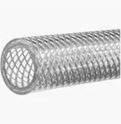
CAT's fish aquarium bubbler tube doesn't seem very substantial to me, especially at elevated temperatures, unless it's polyester reinforced like this stuff:
1750087390298.png
I'd go with automotive reinforced rubber tubing myself, as I know it will hold up under temperature.
 

Citation

Well-known member
Joined
Jan 20, 2016
Messages
3,212
Location
Indy
Just make sure the tubing walls are thick enough that it doesn't collapse and restrict or close off the air intake - that would likely finish off the compressor pump.

CAT's fish aquarium bubbler tube doesn't seem very substantial to me, especially at elevated temperatures, unless it's polyester reinforced like this stuff:
1750087390298.png
I'd go with automotive reinforced rubber tubing myself, as I know it will hold up under temperature.
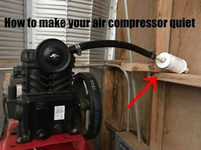
I used a simple, clear vinyl tube. This picture is from a YT video with a similar setup. I have just the round, black filter housing and the rubber hose. I don't have (and am not convinced of the value of) the PVC thing on the end. (Indicated by red arrow from the video)
1750091840475.png
 

Citation

Well-known member
Joined
Jan 20, 2016
Messages
3,212
Location
Indy
The tubing I used is about 1/2” ID. No issue with collapsing under pressure but it's relatively thick wall and not that flexible. Remember, we are only dealing with, at max, -14.7 psi.
 
OP
H

Hobby_Man22

Well-known member
Joined
Nov 16, 2020
Messages
3,581
Location
tx
The best way to cut noise is to eliminate it at the source - so if you haven't purchased the compressor yet, consider one that has a cast iron pump, as they are generally much quieter than aluminum pumps.
Saw a youtube video of an 80 gallon quincy qt-5 pro. It spins at a lower rpm like the old ones. Its like $3500 though, but i bet it will last 30 years
 
To avoid these ads, REGISTER NOW!
Top Bottom