To avoid these ads, REGISTER NOW!

Source for unistrut C purlin beam clamps

Justintime2

Well-known member
Joined
Jul 26, 2019
Messages
97
Location
PNW
Need to mount some unistrut to the underside of my mezzanine C purlins to support an electric hoist. Anyone know of a reasonably priced source for buying 4 of them and not a case? Can't be lighter duty then these due to the weight it will need to support.
Purlin beam clamp
Thanks
 

Attachments

  • 5F02DB2B-07C4-48F9-9F56-91B99E3EC5B2.png
    5F02DB2B-07C4-48F9-9F56-91B99E3EC5B2.png
    23.4 KB · Views: 197
To avoid these ads, REGISTER NOW!

nmk_61802

Well-known member
Joined
Mar 6, 2008
Messages
965
Location
Central IL
Looks like these are priced as ea. Pricey little things @ $3100/ case. No idea if they will deliver, but they did let me add them to my cart.


Oops, just realized that you did not give enough information. Those are for the -2 strut size, but you never listed what size you actually need.

Also found this which is small case Qty:

 
Last edited:
OP
J

Justintime2

Well-known member
Joined
Jul 26, 2019
Messages
97
Location
PNW
Goal is 4 clamps that secure 2 18" sections of unistrut between 16" on center C purlins 24" apart. Then 1 26" section spanning the 2 16" sections and bolted together should give me well over the 1320lb rating of the hoist.
 
OP
J

Justintime2

Well-known member
Joined
Jul 26, 2019
Messages
97
Location
PNW
And a photo for reference
 

Attachments

  • C7C1CD25-E1EC-4E3A-94E7-4325930CFEEB.jpeg
    C7C1CD25-E1EC-4E3A-94E7-4325930CFEEB.jpeg
    263.4 KB · Views: 199
OP
J

Justintime2

Well-known member
Joined
Jul 26, 2019
Messages
97
Location
PNW
Not available at Grainger or on eBay
looks like the Gordon's link is it so far.

Other option is I ditch the 4 with cross beam plan and just go with 1 pair and one 18" strut section with the hoist mounted directly to it. That would lower the total weight rating to 1200 which should still be ok as it's just for engine hoisting.
 
Last edited:

readhead

Well-known member
Joined
Dec 8, 2012
Messages
6,187
Location
Durango, Co.
Look at your plans for the building if you have them and notice that nothing is to be attached to the bottom flange of the purlins.
Is there enough collateral load designed into the roof structure to support what you want to do?
Don’t get excited. If you have enough structure you can attach the brackets to the web of the purlins.
 
OP
J

Justintime2

Well-known member
Joined
Jul 26, 2019
Messages
97
Location
PNW
Good point. The mezzanine was built to hold a car on top of it and has double steel columns at the end of each span, it should be plenty I'd presume. Also building is all steel.
 

readhead

Well-known member
Joined
Dec 8, 2012
Messages
6,187
Location
Durango, Co.
Was the floor designed for any collateral load? You still have to attach to the web of the joists not the bottom flange.
Just because it’s steel doesn’t mean it will hold up anything you want to attach.
I have been in the metal building business for over twenty years and have fixed my share of collapsed buildings. All caused by added loads. Please proceed with caution.
 
OP
J

Justintime2

Well-known member
Joined
Jul 26, 2019
Messages
97
Location
PNW
Was the floor designed for any collateral load? You still have to attach to the web of the joists not the bottom flange.
Just because it’s steel doesn’t mean it will hold up anything you want to attach.
I have been in the metal building business for over twenty years and have fixed my share of collapsed buildings. All caused by added loads. Please proceed with caution.
Thanks for the info/guidance, I have no idea if the floor was designed for a collateral load. Can you clarify attaching to the web of the joist and not the bottom flange? Those brackets are specifically designed to attach to the bottom flange and support 1200lbs of which I'd likely never exceed 600-700. The mezzanine isn't a structural part of the building and sits independent of the structure by two saddled steel columns on each end of the support. The mezzanine is thought of and built for it ahead of time but added after as this one was.
 

readhead

Well-known member
Joined
Dec 8, 2012
Messages
6,187
Location
Durango, Co.
There are a lot of clips and clamps for attaching to C’s and Z’s but there is a conflict in the use of these items. In preenginerred metal buildings the purlins are designed for a specific load requirement and every building I have been involved with states on the plans that the bottom flange is not to be attached to. The reason for this is any extra load can cause the bottom flange to bend down and reduce the strength of the purlin causing it to roll over and deflect. That being said a building can be designed with heavier materials and shorter spans to make the use of the clips possible. Your run of the mill building will not have those options. Your building appears to have average materials and in my opinion those clips are not appropriate.
Generally the only trades that are allowed to attach to the bottom flange are electricians installing light weight conduit. The most offending installations are drywall, unit heaters, infrared heaters, plumbers, sprinkler fitters and duct work. Without a collateral load designed into the structure those installations can cause serious damage.
Again, proceed with caution. Maybe consult a structural engineer. I am sure there is a way to do what you want. You just have to have a safe solution.
 
OP
J

Justintime2

Well-known member
Joined
Jul 26, 2019
Messages
97
Location
PNW
Thanks for the info, that makes sense to me (rolling of the bottom flange which would compromise its strength, I'll look into it further.

My thinking is with the clamps design of pinching itself up against the flat inside web of the purlin essentially transmitting that energy down into the crease of the flange bottom and web itself instead of near the outside edge which could roll it, and it spanning two purlins which would further eliminate any rolling effect that it would perform as intended. I'll try to get confirmation of that however and see if there is a different way I need to do it.
 

Bluearmflames

Well-known member
Joined
Apr 1, 2013
Messages
104
Location
Hamburg, PA
Not to contradict redhead, because he knows metal buildings and the ins and outs. Almost every facility I have worked at bolts through the bottom on the purling. We never point load any one purling. We span multiple purlings with angle or strut and use square washers top and bottom to spread the load across a greater surface area of the bottom. Of course our loads are relatively static, but upwards of 400#. If there is some concern over deforming the lower flange, why not use a beam clamp drilled and installed into the side of the web of the purling. Then use all thread for your drop to the strut. Also as a point of note, 1 5/8” strut is not very rigid when spanned more than a few feet. We usually use deep strut for spanned applications with any weight. It keeps the deflection down.
 

chad215

Well-known member
Joined
Sep 30, 2019
Messages
128
Location
Caldwell,tx
I'm going to agree with readhead. I've been designing and selling metal buildings for over 20 years as well, and we add a very specific note to all of our packages that say to never connect to the flange of a purlin/joist. Always bolted to the web. That bottom flange will roll.
Also, that hoist isn't a static load.
That being said, there are ways to do what you want to do safely, but I don't think the way you are currently going is one of those ways. Not trying to dog pile here, I'd just hate to see you compromise your mezzanine, and I'd really hate to hear someone got hurt. Find a way to get the loads to the columns vs the joist.
 
To avoid these ads, REGISTER NOW!

readhead

Well-known member
Joined
Dec 8, 2012
Messages
6,187
Location
Durango, Co.
Items get attached to the bottom flange of purlins every day. Mostly because of uninformed superintendents, foremen and trades people. I have written lots of letters with photos to GC’s informing them of similar situations to let them know that the warranty on the building is void if items are not corrected. I have worked on three collapsed buildings and in every case the cause was attachments to the bottom of purlins. In each case the insurance company brought to attention the note on the plans that no attachment was to be made to the bottom of the purlin. In one case my letter was used to show that the contractor was informed of the problem and didn’t react. In all three cases the insurance claim was denied.
Of course there are buildings that have loads attached to the bottom flange of structural members that have been standing for twenty, thirty years or more. Everything works until it doesn’t. Why take a chance?
 

rustyjames

Well-known member
Joined
Dec 28, 2008
Messages
1,077
Location
central nj
I agree with those that chimed in on loading the bottom flanges of the floor joists. You could beef up those joists by screwing another to the joist web, back to back, if you will, creating a beam.
 
OP
J

Justintime2

Well-known member
Joined
Jul 26, 2019
Messages
97
Location
PNW
I think my plan will work but I am not ignoring the advice here, looking into it further and will abandon or adjust if needed.

Does anyone have an example of a bracket that would attach to the web of the Purlin as described above?
 

rustyjames

Well-known member
Joined
Dec 28, 2008
Messages
1,077
Location
central nj
There's brackets available that you can bolt to the webs and drop a piece of threaded rod to attach the strut. I'm pretty sure Simpson has them.
 
OP
J

Justintime2

Well-known member
Joined
Jul 26, 2019
Messages
97
Location
PNW
Not to contradict redhead, because he knows metal buildings and the ins and outs. Almost every facility I have worked at bolts through the bottom on the purling. We never point load any one purling. We span multiple purlings with angle or strut and use square washers top and bottom to spread the load across a greater surface area of the bottom. Of course our loads are relatively static, but upwards of 400#. If there is some concern over deforming the lower flange, why not use a beam clamp drilled and installed into the side of the web of the purling. Then use all thread for your drop to the strut. Also as a point of note, 1 5/8” strut is not very rigid when spanned more than a few feet. We usually use deep strut for spanned applications with any weight. It keeps the deflection down.
On your point that the unistrut is not very rigid when spanning more then a few feet and using deep strut that is correct. But this is a 24" span the hoist would be attached to and using their load specs of an 85% multiplier since it's slotted unistrut still puts it above the hoists rating and well above its intended use since it's such a short span.
 
OP
J

Justintime2

Well-known member
Joined
Jul 26, 2019
Messages
97
Location
PNW
the unistrut 24" span supports more than the hoists rating and well above my intended use for it (pulling vehicle motors), the Purlin beam clamps posted are rated above the hoists rating @1200lbs per pair and I'd be using 4 not 2, so the weight would be spread out to 2 separate purlins with 4 different points of contact in a box formation with brackets that are designed to connect to the purlins but somehow the bottom flange will roll and fail?

Still looking into that but I guess I'm struggling with the concept of how that will roll the flange when it's tied to several different purlins preventing "rolling" and with a connector rated and designed for it.
 
OP
J

Justintime2

Well-known member
Joined
Jul 26, 2019
Messages
97
Location
PNW
Almost impossible to get a direct answer on what will work outside of the standard hang nothing but conduit or similar.

That said I agree with the thoughts posted here on it possibly being a point of failure to use the purlin clamps linked and the possibility it could roll and deflect, even if unlikely.

I base this off a simple test of hanging my weight off the flange in the worst way possible and in an exaggerated way the hoist lift mounting setup wouldn't present and seeing enough deflection I wouldn't be comfortable proceeding.

Problem is I can't find any sort of threaded rod mount that would allow me to bolt them to the webbing, hang the rod down to hang Unistrut off of and then bridge mount the hoist.

If anyone can find a source/link for such a thing please post!
 
OP
J

Justintime2

Well-known member
Joined
Jul 26, 2019
Messages
97
Location
PNW
How about these EHMP10Z, any thoughts? Thinking 6 of these bolted through the center of the purlins web (weight distributed across 3 separate 16" on center purlins with 6 points of contact), threaded rod down to secure 2 36" sections of Unistrut up against the bottom of the purlins with a 24" section of Unistrut between them the hoist would be on.

Unistrut P1000T has a working beam load of 1437-lbs for a 24" span which is more then double my needs. The bracket hangers are 1437-lbs each with 6 of them spreading the weight across 3 separate purlins. The 6 threaded drop rods from those brackets would secure 2 36" sections of Unistrut at 16" centers and 24" apart up against the bottom of the purlins where The 24" section of Unistrut would saddle the two and hang the hoist from.

thoughts?
 

Attachments

  • CA2FCF30-0144-4297-9D92-F264A9C9525B.jpeg
    CA2FCF30-0144-4297-9D92-F264A9C9525B.jpeg
    42.3 KB · Views: 108
OP
J

Justintime2

Well-known member
Joined
Jul 26, 2019
Messages
97
Location
PNW
Wanted to follow up on this and post a few pics of what I ended up doing.

Used right angle brackets through bolted into the middle of the C purlin's vertical webbing which supports the unistrut frame assembly below with 6 threaded rod hangers, washers and loctite'd double nuts on each end. So 6 points of contact spread across 3 purlins.

The second right angle bracket just below those at the 4 corners has the hanger rod only passing through it to control any possible lateral movement of the unistrut frame. Nothing is bolted to, hung from nor were any holes drilled into the bottom Purlin flange/channel.

Hoist will hang from the bolted in center unistrut cross bar. Other 2 unistrut cross bars are also bolted to the beams to form a nice, rigid square frame.

Also bent up some conduit and extended the existing under mezzanine outlet to the Unistrut frame so the hoists short power cord can plug right in.

Hoist hasn't been mounted yet as I needed to change the control cables short 5ft to 14, ordered some 16agw 4c cable and will replace that on the bench before it gets mounted up.

Hung my 200lb frame from it and bounced up and down, didn't even budge.
 

Attachments

  • F39AF987-1BD7-49F3-8AD8-1E4E6DED0117.jpeg
    F39AF987-1BD7-49F3-8AD8-1E4E6DED0117.jpeg
    563.2 KB · Views: 89
  • 89C7368B-6428-4CFB-9E0A-0A137ABD925C.jpeg
    89C7368B-6428-4CFB-9E0A-0A137ABD925C.jpeg
    609.1 KB · Views: 89
  • E01A1990-34AA-4F7C-9D44-D5F45F42EA86.jpeg
    E01A1990-34AA-4F7C-9D44-D5F45F42EA86.jpeg
    585.4 KB · Views: 77
  • 3E6AE713-54F3-43B2-ACA4-76D5C39BD907.jpeg
    3E6AE713-54F3-43B2-ACA4-76D5C39BD907.jpeg
    485 KB · Views: 74
  • 593F657A-115E-43F9-A5F9-C0FD0EB1785C.jpeg
    593F657A-115E-43F9-A5F9-C0FD0EB1785C.jpeg
    724.8 KB · Views: 71
  • 11E32517-3626-4A23-A129-97FD85D03890.jpeg
    11E32517-3626-4A23-A129-97FD85D03890.jpeg
    602.3 KB · Views: 83
Last edited:
OP
J

Justintime2

Well-known member
Joined
Jul 26, 2019
Messages
97
Location
PNW
First couple of pics show the frame just supported by the threaded rod and not in contact with the bottom of the purlin. It was lightly snugged up to it to prevent rattling and unintentional movement but not cracked down possibly distorting the purlin.
 
Last edited:
OP
J

Justintime2

Well-known member
Joined
Jul 26, 2019
Messages
97
Location
PNW
Another followup. Lifted the 383 big block out of my Road Runner with this setup and it worked like a champ. Ran a tape measure from the bottom of the Purlin to the shop floor and through my research on the specs for these purlins and this span I decided if it showed anymore then 1/2" of deflection I'd stop lifting, go a different direction and relegate this setup to lighter stuff. It maxed out at 1/4" and worked flawlessly!IMG_8513.jpegIMG_8517.jpeg
 

readhead

Well-known member
Joined
Dec 8, 2012
Messages
6,187
Location
Durango, Co.
Now you can see the concern in action. If for some reason the engine got bumped and moved front to back or side to side it could have deformed the bottom flanges and compromised the strength of the joists. Perhaps the first time you don’t notice anything out of place. The second time it bends a little bit but it looks okay. The third time it deforms some more and it all comes down. By attaching the load to the strongest part of the joists you should have no concern.
 
OP
J

Justintime2

Well-known member
Joined
Jul 26, 2019
Messages
97
Location
PNW
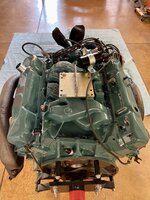
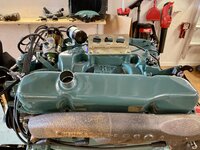
Thank you all for the advice given in this thread, it's why I started it to calibrate my expectations and stress test my ideas. And for anyone curious there are a couple of reasons the motor is out. First to replace a few seals to make her as liquid tight as possible. The other is to return the engine to its original color which is Turquoise Blue ( a greenish blue for this early production 68' model)

it was popular back in the day to paint these big blocks HEMI Orange as most could not afford the 30+% 426 HEMI option and a lot of the HP big blocks later wore a similar color anyway. Found an east coast guy who still mixes up that color and returned it to original.

IMG_8711.jpegIMG_8712.jpegIMG_8716.jpegIMG_8717.jpeg
 
To avoid these ads, REGISTER NOW!
Top Bottom