To avoid these ads, REGISTER NOW!

Sparky safety - Arc Flash but not voltage rated?

rslaback

Well-known member
Joined
Jul 24, 2010
Messages
4,102
Location
Westcentral Wisconsin
In my industrial maintenance environment we are having a discussion on the Bob Dale Gloves FR Arctek gloves. They are rated to a category 2 arc flash ppe but do not specifically call out a voltage limit. Because of this our ESH says we have to wear the old school rubbers and liners that everyone loves so much.

Per NFPA 70E 130.7 the category 2 criteria is panelboards up to 600V. Does this mean that the glove is electrically rated to at least 600V by default? If not, what is the point of an arc flash rated glove that you can't wear in a live electrical environment? That is the part I can't wrap my head around. Why have a NFPA 70E category rating if you can't wear them around live power anyway?
 
To avoid these ads, REGISTER NOW!
OP
R

rslaback

Well-known member
Joined
Jul 24, 2010
Messages
4,102
Location
Westcentral Wisconsin
Protecting from arc flash (burns and molten material) is different from electrical insulation and protecting you from getting electrocuted.

Your FR clothing is not an insulator.
Understood. But in what circumstances would a wearer have an arc flash hazard without an electrocution hazard?
 

PCustoms

Well-known member
Joined
Jul 23, 2011
Messages
23,684
Location
VT
Understood. But in what circumstances would a wearer have an arc flash hazard without an electrocution hazard?
It's been a few years since I've done this so I can't recall.

Check with your EHS rep, they should have an answer.
 

fitter30

Well-known member
Joined
Jun 23, 2019
Messages
3,027
Location
Peace Valley,mo
Since I've never seen 600 vac only 480 and 4160 wouldn't use ppe not rated for less than rated. Only have worked on chillers starters on 4160.
 

PCustoms

Well-known member
Joined
Jul 23, 2011
Messages
23,684
Location
VT
Understood. But in what circumstances would a wearer have an arc flash hazard without an electrocution hazard?
What are you working on, and are you licensed/trained or just working internally?
 

BrandonV

Well-known member
Joined
Jun 9, 2023
Messages
4,030
Location
Arizona
Understood. But in what circumstances would a wearer have an arc flash hazard without an electrocution hazard?

I work in facilities with high voltage substation equipment all the time doing LV work.

The clothing is required in the event I assume something goes kaboom while I'm in there.
 
OP
R

rslaback

Well-known member
Joined
Jul 24, 2010
Messages
4,102
Location
Westcentral Wisconsin
merely opening a panel cover presents an arc flash hazard before one could even touch something energized inside.
So I should wear the Arctek gloves long enough to open the panel but not to actually touch anything inside? Are there a lot of people who open live panels but don't actually do any work inside?
What are you working on, and are you licensed/trained or just working internally?
Injection molding machines and industrial automation mainly. Internal training and application.
 

bronc076

Well-known member
Joined
Jul 17, 2023
Messages
190
Location
Ozarks
I'm a cybersecurity guy for the Corps of Engineers and I've been doing a lot of work in government operated hydropower facilities the past few years. Before they let me in a facility I had to take arc flash training, lockout tag out awareness training, and some other safety training. We are encouraged to wear fireproof clothing, safety shoes are mandatory. Sometimes I'm in PLC cabinets but usually in an operations area or small server room. The guys that work there tell stories about events in the past, equipment can go molten rather quickly. One should not question safety gear, wear the clothes, follow the rules, go home alive at the end of the day.
 

Boogerman

Well-known member
Joined
Jan 28, 2021
Messages
837
Location
aspen cove hill
According to the manufacturer info, those gloves are not rated for work with tools. They are rated only for incidental exposure to arc flash. Their primary protection appears to be thermal. So, I have no idea what the intended user is. Maybe an inspector or engineer or troubleshooter that needs to open panels to view components, but not actually touch or manipulate any of the components?

I certainly would not in any way touch or work on energized components with those gloves as my only protection.

As you say, arc flash has an electrocution potential component to it, in addition to the heat. But, arc flash injuries can occur outside of the electrically charged current path. The plasma, although it is conductive, may not be in the conductive path carrying current, and still injure someone. I have been burned by molten metal globules expelled by an arc, without ever being in the current path.
 

toplessHO

Well-known member
Joined
Oct 20, 2014
Messages
14,147
Location
central florida
merely opening a panel cover presents an arc flash hazard before one could even touch something energized inside.
neighbor had that happen
Didnt even get the cover off before it flashed him.
Some buttlick that thought they was an electrician (I bet he cant even spell it)
did a shotty job of training wires,making sure the cover screws find a wire or 2.
But I also have a beef with manufacturers that stamp the panelboard enclosures
with screws on inside of enclosure vs outside.
 
To avoid these ads, REGISTER NOW!

toplessHO

Well-known member
Joined
Oct 20, 2014
Messages
14,147
Location
central florida
Ive seen enclosures that stamp the screw retainer tab on the outside
so there is not a chance of contact between the cover screw and the conductors inside panelboard.
So many times the proper cover screws are lost and sheetmetal screws with a nice pointy end and sharp threads are used.
 
OP
R

rslaback

Well-known member
Joined
Jul 24, 2010
Messages
4,102
Location
Westcentral Wisconsin
According to the manufacturer info, those gloves are not rated for work with tools. They are rated only for incidental exposure to arc flash. Their primary protection appears to be thermal. So, I have no idea what the intended user is. Maybe an inspector or engineer or troubleshooter that needs to open panels to view components, but not actually touch or manipulate any of the components?

My working theory at this point is that they are a thermal designed glove and the materials just happen to meet the Arc flash category 2 requirements so they market them as such. Kind of like how most regular weight denim jeans are good enough for AF PPE category 4.
 

Boogerman

Well-known member
Joined
Jan 28, 2021
Messages
837
Location
aspen cove hill
I learned what electrical I know back before arc flash became a code and OSHA item. One of the first informal "lessons" I was given by the journeyman I was working with was working in a way to protect yourself from both shocks and arcs. Using only Klein screwdrivers (he hated that I had a Snap-on black handle phillips in my belt). You KNOW Klein is designing their handles with voltage resistance in mind, who knows what Snap-on is thinking. Working with only one hand in the enclosure to avoid current through your heart. And, he always stressed wearing gloves. He wore smooth tight deerskin. I chose pigskin, mostly because it was hard to find deerskin big enough for my hands. He had been a lineman, and was a lot more aware of the dangers of arcing versus electrocution. He talked about guys that had lived through an electrical exposure, but lost their fingers to the arc. His thoughts were that leather gloves were good for arc flash in any single phase panel, and probably would protect against electrocution if you weren't standing in water or grounding your belly or legs to a panel or conduit. Along with safety glasses to protect your eyes.
 

Earp69

Well-known member
Joined
Sep 20, 2016
Messages
859
I learned what electrical I know back before arc flash became a code and OSHA item. One of the first informal "lessons" I was given by the journeyman I was working with was working in a way to protect yourself from both shocks and arcs. Using only Klein screwdrivers (he hated that I had a Snap-on black handle phillips in my belt). You KNOW Klein is designing their handles with voltage resistance in mind, who knows what Snap-on is thinking. Working with only one hand in the enclosure to avoid current through your heart. And, he always stressed wearing gloves. He wore smooth tight deerskin. I chose pigskin, mostly because it was hard to find deerskin big enough for my hands. He had been a lineman, and was a lot more aware of the dangers of arcing versus electrocution. He talked about guys that had lived through an electrical exposure, but lost their fingers to the arc. His thoughts were that leather gloves were good for arc flash in any single phase panel, and probably would protect against electrocution if you weren't standing in water or grounding your belly or legs to a panel or conduit. Along with safety glasses to protect your eyes.
All good stuff right here.
 

BreeStephany

ALLIANCE MEMBER
Joined
May 19, 2012
Messages
870
Location
Oregon
As others have said the purpose of arc flash gear is to protect against arc flash, not electrocution.

Destructive and even lethal arc flashes can occur even when all energized parts are not readily exposed.

A prime example would be energizing or de-energizing a main disconnect that has faulted internally, removing or installing a MCC can that has damaged clamping jaws unknown to the operator, etc.

An example that hits home for me is when removing MCC (motor control center) cans... if a user goes to pull an MCC can that they have unclamped the jaws from the center bus, the can itself is no longer energized and no voltage is present within the can, but voltage is still present on the bus behind, below, above the can. They go to remove the OLD good and baked can and one of the jaws breaks loose on the back of the can, falls within the internals of the center and strikes an arc between 2 phases of bussing or between phase and the case of the can and creates an arc flash...

No electrocution hazard is present when removing the can as it is de-energized and disconnect from the bus, but the potential hazard for arc flash is definitely present!

Another example. Let's say an operator needs to de-energize an OLD 5000A 480V main disconnect breaker that hasn't been cycled since new... the integrity of the internals of the breaker are unknown... if you throw the switch and it breaks internally and faults on the line side... you've got a BIG boom...

Arc flash gear ***** in that it's heavy, it's hot and it's cumbersome, but it sure is nice to know that if a fault DOES occur, you are likely heading home at the end of the day to your family with maybe some ringing in your ears, likely some bruises, possibly minor burns and a good scare, but at least you aren't heading out in a body bag or getting life-flighted to the nearest burn unit.

Just my two cents.
 

RPH

Well-known member
Joined
Dec 17, 2006
Messages
4,190
Location
Michigan Thumb
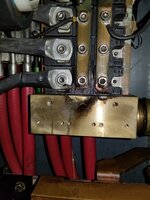
Rectifier module.jpeg
Condensation from running cooling water too cold. 3 phase bridge rectifier, Dcv bus links melted at around 675 vdc. I’m sure that one was heard in the area when it went.
 

PCustoms

Well-known member
Joined
Jul 23, 2011
Messages
23,684
Location
VT
Rectifier module.jpeg
Condensation from running cooling water too cold. 3 phase bridge rectifier, Dcv bus links melted at around 675 vdc. I’m sure that one was heard in the area when it went.
That looks a lot like a failure I was involved in.....

The oversized washers are a nice touch. Surprised there's no lock/star washer on there
 

RPH

Well-known member
Joined
Dec 17, 2006
Messages
4,190
Location
Michigan Thumb
The 6 points dcv connection do have spring washers on them. The acv side is tighter than it looks. It’s the current path that concerns the designers of the circuit. If I recall that was a 200 kW for steering rack hardener and tempering operation with 4 active spindles running at the same time.
 
To avoid these ads, REGISTER NOW!
Top Bottom