

You are using an out of date browser. It may not display this or other websites correctly.
You should upgrade or use an alternative browser.
You should upgrade or use an alternative browser.
Speedaire compressor
- Thread starter WTXTundra
- Start date
check with soapy water where it's leaking. I have had pressure switches that leak and they just need tightening where the housing & switch assy connect. often 4 torx tamper resist screws
micromind
Well-known member
So a dumb question. I changed the oil on the compressor and ran it for a couple of minutes. It didn’t turn off and it looks like a have a leak under where the pressure switch is located.
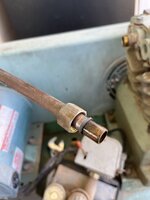
I went to touch the discharge copper tube from the compressor to the tank and it was extremely hot. Is this normal? Should the tank be warm to the touch also while air is being compressed?
Completely normal. The discharge tube should be too hot to touch and the tank will be noticeably warm.
12vx2
Well-known member
I have an old 1970's Sears SpeedAire beater that was designed for 90psi. The tank is old, thin, probably has at least some rust and corrosion and designed for 90psi. Lots of people will tell you adjusting it to 125psi(over 30% increase). won't hurt anything. Don't let the temptation to increase the pressure win out. In my career I was involved with pressure vessel U.T. and visual inspections, failure investigations. Nothing is worth having a failure.Yes sir. Thats why I want to replace it. The spring is tight but it’s hard to pull. I’ll try it out again.
I really want to replace the regulator. Any suggestions? What is the pressure rating of the tank? I’ve read some only pressure up to 90. I thought 120 was common with a releif valve at 125psig.
Thanks for your input. Yea this is interesting cause and I definitely don’t want to ruin a good unit. I reached out to Grainger and they said that the tanks are usually pressure tested to 200psig from the factory. The tank I have doesn’t look at all damaged but it is aged.I have an old 1970's Sears SpeedAire beater that was designed for 90psi. The tank is old, thin, probably has at least some rust and corrosion and designed for 90psi. Lots of people will tell you adjusting it to 125psi(over 30% increase). won't hurt anything. Don't let the temptation to increase the pressure win out. In my career I was involved with pressure vessel U.T. and visual inspections, failure investigations. Nothing is worth having a failure.
I might just install another 80/100 pressure switch now that I installed a new 115 psig relief valve.
PWC Repair
Well-known member
Campbell VT series pump. They last FOREVER if you keep the oil changed. I ran one for many years. Mine was the "Industrial" rated version with the extra valve plate. They came in 2 different bore sizes and a single cylinder version as well. You can get a whole rebuild kit with reed valves, seals, gaskets. and rings for less than $100.
They are good to have, my air compressor that had a Westinghouse magnetic starter had a habit of of sticking contacts, always knew what happened when the valve popped off causing me to run over & shut off the power to the compressor, changed the contacts & the problem continued, changed the starter & have had years of trouble free use from the starter since. It not functioning is enough to cause nightmares.Yes sir. Thats why I want to replace it. The spring is tight but it’s hard to pull. I’ll try it out again.
I really want to replace the regulator. Any suggestions? What is the pressure rating of the tank? I’ve read some only pressure up to 90. I thought 120 was common with a releif valve at 125psig.

Sears sold one just like it. I think the pumps are built by Smith maybe.Speedair is a ww Grainger house brand, they have an OK reputation. May you enjoy it in Good Health.
HORSEHEAVEN
Member
Amazon has several sellers offering replacement felt media for this type of compressor. Search: "26517 filter"So his looks like mine did. There was a wad of **** in there that was sucked in and no filter. I bought some fibrous filter material and made one for that intake channel.
I looked everywhere for an actual filter to fit in there, never found one. Either cut some material to fit or figure out how to mill something to attach and aftermarket canister filter to the intake area…my .02.
An upgraded element kit is described (and sold) at https://mastertoolrepair.com/air-filtery-assby-w-element-0e360c/
In the 1980s, Grainger sold an intake that bolted onto the head in place of the sheet metal plate. It provided a runner directly from the round paper element housing to the head. I have an old Craftsman (licensed from Dayton-Speedaire) with that adapter installed, and it's great. Of course, there's no sign in the Grainger catalog or on the web that it ever existed. I'd include a photo, but that compressor is out on loan at a shop across town.
I would be interested in a pic of that for mine. thanks.Amazon has several sellers offering replacement felt media for this type of compressor. Search: "26517 filter"
An upgraded element kit is described (and sold) at https://mastertoolrepair.com/air-filtery-assby-w-element-0e360c/
In the 1980s, Grainger sold an intake that bolted onto the head in place of the sheet metal plate. It provided a runner directly from the round paper element housing to the head. I have an old Craftsman (licensed from Dayton-Speedaire) with that adapter installed, and it's great. Of course, there's no sign in the Grainger catalog or on the web that it ever existed. I'd include a photo, but that compressor is out on loan at a shop across town.
metalmagpie
Well-known member
In addition to the previous recommended maintenance steps, I recommend pulling the head and looking at the valves. Air compressor valves are inexpensive and often super easy to change, and it can lead to greatly improved performance. All it will cost you is a little time and a head gasket. And you can make the head gasket if you have to.
While you're at it, I would locate your check valve and consider replacing it. Those are also consumable items on that class of compressor. Yours may have 20 years left on it and it might have a week left on it, but when you put in a new one you know what you have.
metalmagpie
While you're at it, I would locate your check valve and consider replacing it. Those are also consumable items on that class of compressor. Yours may have 20 years left on it and it might have a week left on it, but when you put in a new one you know what you have.
metalmagpie