I'm not so comfortable with your interpretation of your diagram.
As I see it, the wedge, pulls from the far side of the concrete like a carriage bolt would, whereas the epoxy pulls over the whole length of the hole like an ordinary screw. If tension is all you care about, the former is stronger. And epoxy isn't all it's cracked up to be:
https://en.wikipedia.org/wiki/Big_Dig_ceiling_collapse
My sketch and reply here is really taking the anchoring topic to the extreme, but I have too much time on my hands now while being retired. So I find these topics fun now.

Any time a load is being supported entirely from the structure ABOVE it like in a parking structure, those anchoring devices have to be approved by an engineer/or the architects .
So somewhere in the linked WIKI article "fail" stating there was a epoxy anchoring system failure, IMO either the engineer/architect or structural inspector dropped the ball.
No anchoring system can be ever be fool proof IF, it is being used to support a load weight or load movement, that it was NOT designed to be able to do.
And there is always, the possibility of the improper installations of an anchoring device by the workers doing it, even WHEN all the engineering/inspection criteria HAS been met.
I am a bit confused here to the blue text in your reply above with the mention of a carriage bolt resemblance, to a wedge anchor in regards to holding power ?
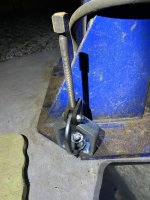
My comparison drawn in my sketch shows the vertical lift movement on the anchor bolt like from a car lift frame. (the OP for this topic)
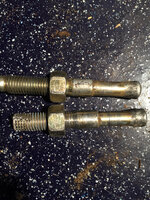
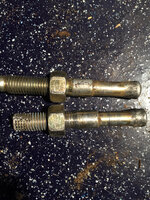
On the left in my sketch, I see the wedge anchor expansion cone SLOWLY over a long period of time while staying centered in the hole, as being pulled VERY SLOWLY upward by the lift frames vibrations. This action will SLOWLY degrade the side walls of the drilled hole where the wedge anchors expansion cone is spread against them.
Then over time, as the expansion cone is SLOWLY pulled upward, it will then bite in to undamaged, fresh sidewall concrete while locking the anchor bolt securely again in the hole .
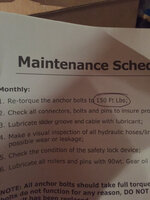
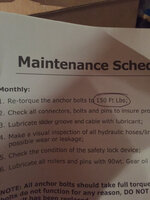
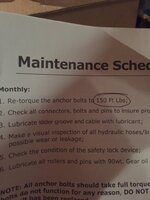
Which then requires re-torqueing the anchoring nut/washer down, to keep the load secured down tightly. Not a bad thing to do if needed. It just may have to be done randomly over time, as the wedge anchor bolt slowly protrudes higher and higher out of the concrete, as it is pulled upwards over time. The amount the bolt pulls upwards, depends on how much movement the frame gets. Maybe none.
The epoxied all thread rod in comparison, has the same upward lifting force on it, that the wedge anchor bolt has on it. But the load being secured by the epoxied bolt, will have to overcome the TOTAL resistance of ALL the epoxy that is bonded in to the bolts threads and against the holes side walls, for the full height of the hole, and for the total circumference of the hole.
So if one takes the TOTAL "holding" capability of the wedge anchor bolt/expansion cone that is only about .500 in. tall, and compare it to the epoxied all thread rod....where the epoxy has much more actual surface to surface contact of resistance to movement, than the .500 in. tall wedge anchor with its thin expanding metal cone does.
I see it happening this way IMO, maybe it does not though. With loads that can move around over time, I like epoxied all thread rod being installed
properly and per all instructions...in lieu of wedge anchors.
At least if the epoxy fails and the bolt starts pulling out, the same size hole can be drilled in the floor again, then a wedge/sleeve anchor used. But if the wedge anchor fails, a larger hole will have to be drilled to accommodate a larger bolt diameter wedge/sleeve anchor. Which will then mean, the steel anchoring plate holes will have to be enlarged also for the new anchor bolt to fit through. I agree, too much thinking going on here. Cheers...

JMO though.