To avoid these ads, REGISTER NOW!

Splicing round stock techniques?

davejo

Well-known member
Joined
Oct 29, 2015
Messages
277
Location
(VA)
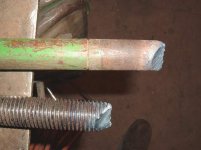
This is the latest issue on my metal building reconstruction. These are the 3/8 steel rod cross braces used to stiffen up the metal frames. they are threaded at the ends with hillside washers and are tightened to keep things square.

They were just cut in the middle when the building was taken down. Now I want to weld them back together and reuse them. Looks don't matter.

I assume that plain **** joints would be hard to get perfect and strong.

Sleeves with plug welds? Overlap and weld the two rods side by side?
 
To avoid these ads, REGISTER NOW!

matt_i

Well-known member
Joined
Mar 14, 2008
Messages
10,722
Location
SE Michigan
I would first chamfer the ends and weld them as a **** joint.

Then I'd get some type of reinforcement, could be other pieces of 3/8" rod, 3/8" square, or a small flat bar, 1/4" x 1/2" as one of many possibilities.

Now weld 2 pieces of that stock, lets just say 1" each side past the ****, place them on opposite sides of the original rod, and weld all of this up. The goal would be not to undercut at the far ends of the strong-backs.

But now this part isn't the weakest link any more.
 

Millwrong

Well-known member
Joined
Feb 4, 2018
Messages
369
Location
Canada
Just use an 8" or so 3/4 or 1" angle iron, clamp the round bars inside and run 4 stringers. It'll keep them straight and maintain most if not all or your tensile strength.
 

matt_i

Well-known member
Joined
Mar 14, 2008
Messages
10,722
Location
SE Michigan
I'd source the Grade 5 rod coupling nuts from McMaster instead of the el cheapo Grade 2 versions....since its keeping a building from racking...:)
 
To avoid these ads, REGISTER NOW!

ddawg16

Well-known member
Joined
Jul 11, 2008
Messages
21,005
Location
S. California
Some really good ideas....I learned something.....

So....the options are....

1. Sleeve - Slide both ends into it...weld

2. Angle - Clamp both ends into the angle...weld

3. Threaded Coupler - Thread both ends....screw into threaded coupler.

#3 is the most work....but requires no welding and allows for adjustments.

1 is a bit cleaner looking

2 is the easiest of the 3.

If it's going to be hidden and your confident you will never have to adjust....#2 or #1
 

sberry

Banned
Joined
Jun 18, 2005
Messages
35,747
Location
Brethren, Michigan
For guys that do this kind of thing for a living it would get a simple lap and weld if there was enough thread to do it, if not another chunk of rod as a splice and welder from one side would be sufficient. While there is some strength added after the fact these are pretty small and would be more important on a bigger building. The sheet will provide most of the strength and these little rods are mostly used to square this bay in conctruction.
Bigger use larger rods and they are also bigger in the roof when standing seam is used vs screwed roofing.
 
Last edited:

sberry

Banned
Joined
Jun 18, 2005
Messages
35,747
Location
Brethren, Michigan
Sure, thousands of grade 2 rods have been spliced that way for decades. Even 5 would come pretty close to the same as being one piece.
I have spliced rod straight dozens of times over they years.
 

Attachments

  • splice 1.JPG
    splice 1.JPG
    46.4 KB · Views: 24

matt_i

Well-known member
Joined
Mar 14, 2008
Messages
10,722
Location
SE Michigan
The only issue about the lap is that if the rod was cut out of 'Building X' and has to go back into 'Building X' in the same location, there might not be enough extra material to form the single lap. Obviously dependent on the amount of extra threads on each end, it would be up to the O.P. to verify length first.
 

Lwel9226

Well-known member
Joined
Jun 7, 2014
Messages
764
Location
So Oregon
For guys that do this kind of thing for a living it would get a simple lap and weld if there was enough thread to do it, if not another chunk of rod as a splice and welded from one side would be sufficient.

This is about the simplest way, but I would weld both sides, if you want to do a little more work, that would also look a little better, use the threaded coupler idea.........

LW
 

MoonRise

Well-known member
Joined
Nov 5, 2010
Messages
4,028
Location
NJ
3/8" steel rod?

Bevel the ends a bit and just weld it up. Done.

OK, more details. Bevel the ends a bit to ensure that you get complete joint penetration, tack weld it, check the alignment and positioning, weld it up. Take care to actually get complete joint penetration, meaning have 'proper' technique and welding parameters when you do the welding. Don't trap slag or other crud in the weld. Dress the final weld as desired (grind it to make it look all nice and smooth). Done.

Done right, you wouldn't even know that there was a weld joint there.

Done right, you will end up as strong or stronger then the original mild steel material.

Done wrong, and it will fail.

Or, lay the two rods side-by-side and weld the joint between them . Do both sides, make the weld complete joint penetration again, and it will pretty much be as strong as the original material. Ever so slight decrease in total rod 'strength', because you have the two rod pieces offset ever so slightly and thus change the applied load from pretty much pure tensile into a mostly tensile with a slight bending load at the joint.

Or thread both ends and join with a coupling nut.

Or get a sleeve and insert both ends of the rods into it and weld the sleeve to the rods.
 
To avoid these ads, REGISTER NOW!
Top Bottom