
cagey
Member
I'm evaluating ideas for replacing the two 23 year old 4 ton 12 SEER R22 package heat pumps sitting on my roof. They're still working okay, but will need to be replaced eventually. When that happens, I would rather not replace them with rooftop package units (mainly because of maintenance access issues, impeding roof replacement, but also because commodity replacement RTUs (e.g. Goodman GPH16 below) don't seem to offer substantial performance improvement), so I've been seeking to understand what alternatives might be available.
A new-to-me class of solution I've just stumbled across is exemplified by the MRCOOL Universal Series of split systems, which offer a mini-split-like (variable-speed) outdoor condenser coupled with precharged "no vacuum" DIY lineset to a single-speed indoor air handler, offered at 2-5 Ton capacity points w/18-20 SEER performance, at what I consider appealing prices). The heating specs of these units are particularly impressive, offering 100% of rated heat capacity down to 17F (vs my existing units providing 47%, and a current-market 16 SEER Goodman GPH16 providing 52%, at the same temp) which would remove the need to deploy efficiency-killing heat strips (our location might hit 17F one or two days per year). These units have been available for 3+ years, and reviews seem to confirm the mfgr performance specs and good reliability.
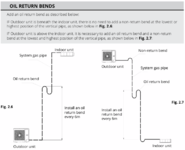
To my question: my house is a 1-story ranch (garage is a separate building, so not involved). I would prefer not to locate the air handlers in the attic (not much headspace, difficulty in moving the new air handlers up there (due to both size and weight), future maintenance access difficulty, more challenging duct rework). I was thinking an alternative way to retrofit a system like this for long-term maintainability while reusing most of the existing ductwork would be to create (per system/RTU) a new "air handler room" in the house (first floor) itself, in which the air handler would be deployed in vertical-upflow orientation. However, the new air handler room(s) would be located in the middle of the house (beneath where the existing RTUs tie into the duct system) away from exterior walls, resulting in the need for the lineset to rise 9 ft from the condenser up the exterior wall into the attic, run 20+ ft horizontally across the attic and down 6 ft to the air handler, creating an "up, across, down" (inverted U) lineset topo. I've studied the MRCOOL Universal (and look-alike Gree Flexx) installation manuals, and they have surprisingly little to say about lineset routing constraints/rules of thumb: their diagrams show both condenser below air handler, and air handler below condenser configurations, but with the lineset running steadily upward/downward between the two endpoints:
Can anyone confirm/refute whether the "inverted U" lineset topo I described in boldface above would would result in a reliable and fully performing system?
Thanks in advance!
A new-to-me class of solution I've just stumbled across is exemplified by the MRCOOL Universal Series of split systems, which offer a mini-split-like (variable-speed) outdoor condenser coupled with precharged "no vacuum" DIY lineset to a single-speed indoor air handler, offered at 2-5 Ton capacity points w/18-20 SEER performance, at what I consider appealing prices). The heating specs of these units are particularly impressive, offering 100% of rated heat capacity down to 17F (vs my existing units providing 47%, and a current-market 16 SEER Goodman GPH16 providing 52%, at the same temp) which would remove the need to deploy efficiency-killing heat strips (our location might hit 17F one or two days per year). These units have been available for 3+ years, and reviews seem to confirm the mfgr performance specs and good reliability.
To my question: my house is a 1-story ranch (garage is a separate building, so not involved). I would prefer not to locate the air handlers in the attic (not much headspace, difficulty in moving the new air handlers up there (due to both size and weight), future maintenance access difficulty, more challenging duct rework). I was thinking an alternative way to retrofit a system like this for long-term maintainability while reusing most of the existing ductwork would be to create (per system/RTU) a new "air handler room" in the house (first floor) itself, in which the air handler would be deployed in vertical-upflow orientation. However, the new air handler room(s) would be located in the middle of the house (beneath where the existing RTUs tie into the duct system) away from exterior walls, resulting in the need for the lineset to rise 9 ft from the condenser up the exterior wall into the attic, run 20+ ft horizontally across the attic and down 6 ft to the air handler, creating an "up, across, down" (inverted U) lineset topo. I've studied the MRCOOL Universal (and look-alike Gree Flexx) installation manuals, and they have surprisingly little to say about lineset routing constraints/rules of thumb: their diagrams show both condenser below air handler, and air handler below condenser configurations, but with the lineset running steadily upward/downward between the two endpoints:
Can anyone confirm/refute whether the "inverted U" lineset topo I described in boldface above would would result in a reliable and fully performing system?
Thanks in advance!

