To avoid these ads, REGISTER NOW!

Spot welding with mig

red61cj5

Well-known member
Joined
Mar 31, 2016
Messages
3,741
Location
West Virginia
I will be replacing a few floor panels (like the whole floor) in my willys jeep over this winter. Most of the panels were originally spot welded in place and I plan to do the same for the less visible areas. Has anyone used their mig to spot weld? Any extra equipment I need? I've seen the stand off nozzles made for it. Also, can I use flux wire or should I use gas? I'm using a Hobart 140, if that matters.
 
To avoid these ads, REGISTER NOW!

Spareparts

Well-known member
Joined
Mar 12, 2010
Messages
2,042
Location
Lansing Ks.
It is called Plug Welding do it all the time, I have a Roper Whitney punch, just punch holes line it up and plug weld it up, on the bottom side use some seam sealer to seal the overlap or it will rust in that seam, or **** weld it with no overlap.
 

ddawg16

Well-known member
Joined
Jul 11, 2008
Messages
21,005
Location
S. California
Good questions.....I've spot welded before...like when I'm getting pieces in place before I run the full bead. So, I seen no reason you couldn't use either method.....though I'm inclined to say gas. I'd only use flux for hard to get to locations and when vertical.
 

bri_man57

Well-known member
Joined
Mar 6, 2013
Messages
189
Location
Windsor Colorado
Yep, like others are saying, punch or drill holes and just weld those holes up to the base material.

Sent from my SM-N920T using Tapatalk
 

DTE

Well-known member
Joined
Jul 13, 2013
Messages
996
Location
North Carolina
If I am overlapping I just drill the top piece, here is a floor in a truck I am working on , where the panels are butted they are on top of square tubing. I use 030 wire and I always use gas.
 

Attachments

  • studebaker build 011.jpg
    studebaker build 011.jpg
    107 KB · Views: 271
  • STUDEBAKER BUILD 005.jpg
    STUDEBAKER BUILD 005.jpg
    148.4 KB · Views: 254
  • studebaker build 001.jpg
    studebaker build 001.jpg
    113.8 KB · Views: 254

Tinker2

Member
Joined
Oct 11, 2019
Messages
8
Location
Pacific NW
Plug welding [rosette welding in the aviation/airframe world]-


Not to be confused with tack welding a **** seam or spot welding using a spot welder. Tip: use weld through primer on the mating surfaces prior to welding.
 
Last edited:

DTE

Well-known member
Joined
Jul 13, 2013
Messages
996
Location
North Carolina
Also you will need a way to clamp the panels tight together or use some # 10/12 machine screws and bolt the pieces together if a clamp won't fit and then go back and weld those holes up.
 

MoonRise

Well-known member
Joined
Nov 5, 2010
Messages
4,028
Location
NJ
Rosette weld.

Go read the thread from MP&C and look at his write up all about car body work and repair and such.

Come back in about a week after reading through his nice and LONG thread. :D

Oh, and use GMAW aka MIG. Solid wire, usually 0.025, and C25 shielding gas.
 
To avoid these ads, REGISTER NOW!

brandonsmash

Well-known member
Joined
Sep 8, 2016
Messages
214
Easy peasy. Plug welding can be done with no additional tools other than a drill or punch for the top piece.
 

abachman

Well-known member
Joined
May 20, 2013
Messages
214
Location
Illinois
If you are drilling through both layers, you may want to use a piece of heavy copper as a backing. The weld will not stick to the copper. It just keeps the weld from building too much on the bottom side.
 
OP
R

red61cj5

Well-known member
Joined
Mar 31, 2016
Messages
3,741
Location
West Virginia
I'm reviving this thread for another stupid question. Gas settings? I went and got a tank of 75/25, but have no idea of how much to flow, anyone have a starting point for me?
 

king nero

Well-known member
Joined
Dec 27, 2010
Messages
1,469
Location
Belgium
For thin sheet metal work, a mixed gas with lower % CO2 works better. 90/10 or similar.
Flow rate for low energy welding is 10 - 12 liters/min or 21 - 25 cf/hour
For these low flow rates, make sure there is no draught in your shop, as the shielding gas can easily be blown away.
 

shawhite

Well-known member
Joined
May 28, 2014
Messages
1,519
I'm reviving this thread for another stupid question. Gas settings? I went and got a tank of 75/25, but have no idea of how much to flow, anyone have a starting point for me?

Usually the inside of the door of your welder will give you a range for the wire size you are using. Most of the time that is a good starting point but you may find you need to increase it depending on your environment (inside, outside, drafty etc)
 

WoodsTruck

Well-known member
Joined
Jan 12, 2013
Messages
1,020
I have plug welded panels using my pneumatic hole punch. When I ordered it, I had the option of two hole sizes and I went with the smaller hole. I wish I remembered where I bought it as the large hole would have worked better. The smaller hole has a tendency to bridge the weld bead over and though it looks like a nice button there is minimal penetration through to the bottom piece. With a larger hole, it would force a small internal bead to be developed onto the bottom piece before filling in the center. If I'm concerned this will be an issue I will double punch a hole so it is almost double width which gives the bottom piece time to melt and bond.
 

bri_man57

Well-known member
Joined
Mar 6, 2013
Messages
189
Location
Windsor Colorado
I used c25 mix, I'm not sure I would get a special bottle of gas only for sheet metal unless that's all I was doing. I run my regulator somewhere around 12 to 15.

d9119b5aa7e20f3c74389f7d95682471.jpg

Sent from my SM-N920T using Tapatalk
 

Attachments

  • d9119b5aa7e20f3c74389f7d95682471.jpg
    d9119b5aa7e20f3c74389f7d95682471.jpg
    179.3 KB · Views: 2

no704

Well-known member
Joined
Apr 27, 2016
Messages
5,209
Not welding related, but a hand full of clecos make sheat metal mock up much easier!
 

MoonRise

Well-known member
Joined
Nov 5, 2010
Messages
4,028
Location
NJ
I'm reviving this thread for another stupid question. Gas settings? I went and got a tank of 75/25, but have no idea of how much to flow, anyone have a starting point for me?

RTFM for your welder. :pimpflash

The usual shielding gas flow rate for 'small' MIG machines is around 20 cfh, give or take. For pretty much any weld. **** weld, or lap weld, or fillet weld, or plug/rosette weld.

Same with any new weld procedure, practice on some scrap first.
 

astroracer

Well-known member
Joined
Jun 22, 2005
Messages
3,001
Location
Mid_Michigan
I am running a 75/25 mix, .032 wire diameter, no special nozzle and absolutely no "weld-thru primer".... I have a hand held punch I built a bench mount for and one of the HF crimper/punch tools. The hand held is more versatile but the air powered one is a great arm saver when doing long runs like a floor pan.
I have done hundreds of plug welds building my Astro Van and rebuilding my '56 wagon. The MiG does an excellent job doing these but it will take a little bit to get the settings correct. Once you get them figured out pretty welds are the norm.
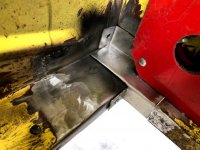
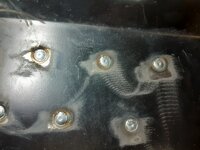
Here are a few pics of some of the welds my machine can do. Your results may vary. :)
These are the floors in my wagon.
2v2HbSdqdx9EDKg.jpg
2v2HbSd8Fx9EDKg.jpg
2v2HbSdjqx9EDKg.jpg
I also rebuilt both inner and outer cowls in this car and all of the patch panels were installed with plug welds.
Mark
 
To avoid these ads, REGISTER NOW!
Top Bottom