To avoid these ads, REGISTER NOW!

Spray Booth Ventilation Sizing

climb.on

Well-known member
Joined
Apr 13, 2015
Messages
501
Location
Minnesota
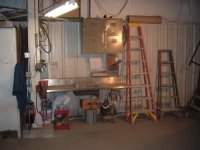
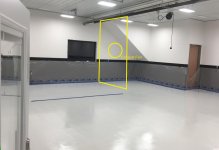
Any suggestions on going about sizing a exhaust fan for a spray room area? I think I will do some sort of temp wall or tensioned curtain on the left side of the area. This will be for a variety spray operations but mostly for woodworking finishes like spraying laquer with my Devilbiss HVLP spray gun. Some paint work as well. But no automotive finishes in the foreseeable future.

What about make up air? I am still under construction and a little worried my inspector is going to require some crazy **** if I put in an exhaust fan. However as far as the inspector is concerned, this is a "detached garage" and he is inspecting it as such. Just not sure what that means for make up air.

**PICTURES OF THE NEW SETUP IN POST 29**
 

Attachments
  • IMG_6409.jpg
    IMG_6409.jpg
    129.1 KB · Views: 161
Last edited:
To avoid these ads, REGISTER NOW!
OP
C

climb.on

Well-known member
Joined
Apr 13, 2015
Messages
501
Location
Minnesota
I wouldn't have a paint booth inspected....you'll spend $20k before you're finished....

Yah it won't be a booth. I will have a a temp wall/curtain on one side that will be easily removed and put away the majority of the time. I'll just pull it out when needed. Let's just call it a ventilation fan and "hypothetically" if it were a booth, how do I go about sizing it?
 

Slednut

Well-known member
Joined
Dec 20, 2012
Messages
2,550
Location
Washington state
I'm planning on building a temp booth and am also wondering how much air should be moving. I am also going to design it so the fan motor will be outside the enclosed area. Most fans these days are brush-less but I'd rather be safe than sorry.
 

Nivekdodge

Well-known member
Joined
Dec 7, 2017
Messages
99
Location
Pittsburgh PA
Think in the term of how long you would want the Garage to clear out. Actual booths get around 4400 CFM, which is tons. Especially trying to heat the incoming air. But be careful; with the inspections. I have yet to see a homemade booth pass. They usually get torn out and replaced.
 

Redraptor

Well-known member
Joined
Dec 15, 2016
Messages
100
Location
Greenville, PA
I used an attic fan and ducted it from the ceiling to the outside wall. I close off the area with huge pocket doors. Doesn't move a ton of air but enough I can use couple spray cans. No automotive jobs here either.
 

Warrenator

Well-known member
Joined
May 31, 2008
Messages
781
Location
Newberg, OR
The spray booths I have used professionally (this was way before CARB or EPA) had doors with filters at one end, so the incoming air was dust free and flowed linearly through the booth, and a big wall of filters at the other end with ductwork leading up, I would say at least 3 hp of motor driving two very large squirrel cage fans which sucked the air through the booth. This was for a car spray booth.

If I were to try to reproduce that at home with a plastic wall or something, I think the plastic would billow, dust would be sucked off the floor, etc. A better alternative I think would be to push filtered air through the booth, let the exhaust air go out through an open window or vent. Also that method would keep paint laden and possibly flammable fumes out of the fan.

In terms of how much air, one of those carpet dryer blowers moves about 3000 cfm. I think you can visualize that amount, we've all seen a carpet dryer running....... seems like it would be about right. Maybe two of them running during spray operations, one running during drying and curing. Those blowers are around 1/3 hp.

If the blowers were set up outside and just pushed air into the sealed room, no makeup air required. You would never be able to keep that huge volume of air cooled or heated if you pulled it from shop.

Just my two cents. I'm trying to figure out my spray booth situation myself. I want to make mine a multi purpose dusty room, welding smoky room, and paint room. Obviously some sweeping and mopping between sanding and painting!
 

EOC_Jason

Well-known member
Joined
Jun 25, 2012
Messages
11,388
Location
Bentonville, AR
If it's just going to be a curtain you will need to weight the bottom to the floor.

Look into the rolls of filter media, it has like an oily / sticky residue on it to trap the paint particles.

Any fan you make that exhausts to the outside like you said you will have to make up that air which basically unless you have a fresh air vent it is going to seep in from any cracks around doors, floors, roof, etc, etc... Depending on run time you might also end up running into condensation issues.
 

ckucia

Well-known member
Joined
Sep 23, 2008
Messages
370
Location
West Virginia
I've thought along similar lines and agree with Warrenator. Push air in through filters and exhaust it out elsewhere. That way you are in control of the air and any stray contaminants will be pushed out.

If you exhaust with the fan, then you will potentially create a low pressure zone and any dust, dirt, or dandelion floaters will get sucked out of any crack and crevice. Also, if your plastic wall let's go, it could get pulled into what you're spraying.
 

gnpenning

Well-known member
Joined
Jan 25, 2015
Messages
2,754
Location
I have more questions than answers.
There's reason most pro booths are down draft. Sberry had some good information in a thread about this, which would provide you with some good information. Sorry no link.

I would get my final inspection and then proceed.
 

sberry

Banned
Joined
Jun 18, 2005
Messages
35,747
Location
Brethren, Michigan
You can't push air thru a booth, it would go out everywhere not only out the place you wanted to. This is not a clean room but a spray booth, draft which means it is sucked out. Negative pressure.
 

sberry

Banned
Joined
Jun 18, 2005
Messages
35,747
Location
Brethren, Michigan
I've thought along similar lines and agree with Warrenator. Push air in through filters and exhaust it out elsewhere. That way you are in control of the air and any stray contaminants will be pushed out.

If you exhaust with the fan, then you will potentially create a low pressure zone and any dust, dirt, or dandelion floaters will get sucked out of any crack and crevice. Also, if your plastic wall let's go, it could get pulled into what you're spraying.

You must create low pressure, this is what makes air flow in the direction you want it to go. If it is pressurized it goes out everywhere evenly like a balloon pumped up. Fumes would be blown out every crack. The fan 'in a booth is in the exhaust side drawing it out.
I don't have a link on my phone for design.
 

matt_i

Well-known member
Joined
Mar 14, 2008
Messages
10,719
Location
SE Michigan
Couple of ideas, I am no expert by any stretch.

I can think of three reasons for ventilating, 1 is potential for building up the "fuel" part of an air:fuel mixture of air+VOCs to the point it could get bad if there was to be a spark. 2 is the person working in there also likes to breathe fresh air (despite PPE) and 3 the overspray can get everywhere if its not directed.

I think the downdraft preference is just that it makes it easier to harness overspray particles due to gravity. That plus you're not attempting them to pull them up past the operator's face.

The point about "pulling" air with the fan and having filtered makeup air is completely valid. The fan however sits right in the potentially combustible airstream...so that's where its important to have a setup that involves something like a TEFC (totally enclosed fan cooled) motor or a parallel shaft setup where the motor is outside the ductwork and only a shaft or V-belt goes into the airstream. In other words you don't want a motor with any potential for creating the spark mentioned above.

Those "explosion-proof" setups in lighting, venting, and the combustion-sensing and fire suppression are what are causes paint booths to be megabux if inspected. And the issues of freezing or roasting the operator because of the incoming air temp are imporant too.

So were I going to design my own shop booth I'd try to put the fan low. Waist height or lower. And setup the filter bank so an opened window would provide the makeup air. Id use something around 1/3 to 1/4hp fan.
 
Last edited:

ilovevocs

Well-known member
Joined
Jun 26, 2009
Messages
1,966
Location
Toledo, Ohio
Downdraft booths pull air over the vehicle in the shortest path.

In a downdraft booth you spray top to bottom, Eliminating overspray from fresh paint.

What ever you do, when you paint, you want to start at the intake side when spraying and work to the fan / exhaust fan.

I have painted more vehicles than I can count in a booth that used fluorescent lighting, an attic fan, and the cheap in wall filters that fit between studs.

I have never been concerned about combustibility. Had a friend that was a painter for over 30 years and he would spray clear while smoking a cigarette.

Not a smart idea, but if he didn’t blow up I don’t think I ever will and haven’t yet.

I prefer a positive pressure hood in lie of the filtered Marlboro, or even a respirator. If your only turning out a few completes a year the respirator will work ok.


I used to leave a window open for intake air and when I was done. Spraying I would crack a garage door for a minute or two, just enough to eliminate any remain haze in the air.

The one thing about working out of a make shift booth is that your ability to de-nib, cut, and rub will be honed quickly.


In a “dirty” booth I will hang / mount everything so the large surfaces are as perpendicular as possible to keep things tidy. For example if I’m doing a compete I will clear the hood hung from the hinge mints overhead. Keeps dust from settling on the large surfaces while the part is still curing.


You also want to talk to your auto body jobber and find a clear designed for use in said environment.
 
Last edited:

ngonerogwu

Well-known member
Joined
Jul 24, 2012
Messages
71
Location
Evansville, IN
I picked this up off craigslist. It's a col-met booth, can't remember the model number... in searching for a manual, it looks like a few of the big name booth companies make this same booth and put their name on it.

I use it for powder coating, so it has dry powder filters in it currently. You could just put wet filters in for actual paint, they aren't particularly expensive. You'd want to do a pre-filter setup as well.

38612888714_338e8b0826_c.jpg


This is a little older pic, i've since finished out the ceiling above the fan.

It's a 2hp 3ph tube axial fan, moves something like 12k CFM on full blast.

38503300994_1f6fcd379d_c.jpg


I run it on a VFD, and adjust the speed to what keeps the shop free of overspray as the filters get dirty. Have to worry bout about pulling media through the filters, as well as enough suction to get the media to them in the first place.

Previously I used a homemade booth, which can work just fine, but the key is the fan. Finding a huge fan like that makes a massive difference. The walls and whatever of the booth are easy. You could just use the commercial steel studs and sheet metal.
 
To avoid these ads, REGISTER NOW!

Dragfluid

ALLIANCE MEMBER
Joined
Sep 15, 2013
Messages
17,462
Location
Pillager, MN
Not sure where you're going to be "exhausting"? Just into the shop, or outside?
To throw off the inspector, just rough out a window where you want the fan, and after all the smoke clears, just pull the window and put in your fan. Like others have said, crack a door some.
 

kwb

Well-known member
Joined
May 1, 2009
Messages
1,769
Location
PNW
For an enclosed booth air is supposed to move at an average of 100 FPM - take that across the volume of the booth and you will see to do it right you need a really big fan.
 

sberry

Banned
Joined
Jun 18, 2005
Messages
35,747
Location
Brethren, Michigan
I use 1hp. I should have cut my fan down earlier. I wasted some beat along the way but it really clears well and can pull the corners together and air comes in from the ceiling for downdraft. It works so well i really dont even need to sweep the floor.
I am going to walk to my office and find a link and couple pics. Some experimenting with a bedroom where the door can be adjusted, a small rubber band is about right and one of those twin box fans in a window, crack a door to the house to let air in, then note how adjusting the door to the room effects flow. .
A pressure booth isn't really a pressure booth but a pressure may be used to "balance" the draw.
 

Dragfluid

ALLIANCE MEMBER
Joined
Sep 15, 2013
Messages
17,462
Location
Pillager, MN
Strawberry, the "roll up" device is simply just a rope tied to the ceiling on one end, correct? And the poly follows it with no problem?

Glad you posted that, as I asked you about it before, but you didn't have any pics handy. Thank you!
 
OP
C

climb.on

Well-known member
Joined
Apr 13, 2015
Messages
501
Location
Minnesota
sberry, your roll-up walls are exactly what I was thinking for mine. Thanks for the pictures. I hadn't considered pulling makeup air from the ceiling inside the booth. Does the cold in the winter effect your paint at all?

I have read, and someone mentioned 100cfm per sq/ft of the opening of the booth is the number to shoot for. So if the opening in my booth is 8x12 I need an 9600cfm fan. These fans get quite expensive, especially the explosion proof designs, which I am not going to worry about. I guess I've just sprayed in non code, non ideal situations, for so long, it's just not something I'm worried about. Not sure how this will end up, but I'm basically looking for the biggest fan I can find at the moment.

Make up air is critical, of course, but I'm not pre-filtering anything. I've sprayed so much stuff over the years in the dirtiest crapiest conditions with acceptable results, it's just not something I am going to deal with.
 
Last edited:

Lelandwelds

Well-known member
Joined
Sep 6, 2017
Messages
2,443
Location
Central Texas
Any suggestions on going about sizing a exhaust fan for a spray room area? I think I will do some sort of temp wall or tensioned curtain on the left side of the area. This will be for a variety spray operations but mostly for woodworking finishes like spraying laquer with my Devilbiss HVLP spray gun. Some paint work as well. But no automotive finishes in the foreseeable future.

What about make up air? I am still under construction and a little worried my inspector is going to require some crazy **** if I put in an exhaust fan. However as far as the inspector is concerned, this is a "detached garage" and he is inspecting it as such. Just not sure what that means for make up air.


Nice new shop.

That is a great idea for a permanent temporary paint booth. Paint booths , like shop lighting, is one of those things I have always done incorrectly. I am glad I read GJ.

It is pretty common for body shops in Austin to spend $50k or $100k above the booths construction cost to comply with the regulatory mess. Then, after construction, the guy wants to keep poking around regularly for hazardous waste.

I think I would not have anything paint related until after the approvals are in place.
 
Last edited:

sberry

Banned
Joined
Jun 18, 2005
Messages
35,747
Location
Brethren, Michigan
I used a 5 inch aluminum irrigation pipe 40 ft long. Yes, the sheet it duct taped to a gift in the ceiling and then to the pipe at the bottom and as said, rope tied to the ceiling, undullyer the roll and back to the ceiling thru a pulley. I used 3 ropes, 3/16 down to a boat winch.
The endwall used 2 and I pull them by hand. I thought I would have to replace this at some point, never did.
I post the link. It's an easy read and after one understands can get a "feel" for ventilation. How to tune a room or building, separation is good, can be making heat in the non paint side.
 

Attachments

  • paint curtain winch.JPG
    paint curtain winch.JPG
    33.5 KB · Views: 73
Last edited:

Dragfluid

ALLIANCE MEMBER
Joined
Sep 15, 2013
Messages
17,462
Location
Pillager, MN
I used a 5 inch aluminum irrigation pipe 40 ft long. Yes, the sheet it duct taped to a gift in the ceiling and then to the pipe at the bottom and as said, rope tied to the ceiling, undullyer the roll and back to the ceiling thru a pulley. I used 3 ropes, 3/16 down to a boat winch.
The endwall used 2 and I pull them by hand. I thought I would have to replace this at some point, never did.
I post the link. It's an easy read and after one understands can get a "feel" for ventilation. How to tune a room or building, separation is good, can be making heat in the non paint side.

What mil thickness is the poly, sir?
 

Falcon67

Well-known member
Joined
Jun 11, 2009
Messages
18,371
Location
Merkel, TX
I painted two cars in my old 20x24 using plastic sheeting, tape, box fans and filters. As opposed to what sberry said, I used the box fans to blow air in and it worked perfectly fine. Left the big shop door open during the spray work and closed it between coats. No problem. After the first car I learned to cover the floor with plastic and give it a shot from the water hose to keep it down. I designed the new shop same way, with the big door in front of the bay I'd use to paint and a window behind for incoming air. It'll work well enough IMHO, I don't shoot cars for a living.
 

sberry

Banned
Joined
Jun 18, 2005
Messages
35,747
Location
Brethren, Michigan
Not saying you cant spray a car that way but its not how a spray booth works. I copied the text below, it is a hook to the booth introduction I do in the post above. It is well worth the read word for word. Read it a couple times.
 
Last edited:

sberry

Banned
Joined
Jun 18, 2005
Messages
35,747
Location
Brethren, Michigan
Paint Spray Booth Basics
How and what makes a spray booth work? This is quite simple, there are basically only three (3) things to consider;
1. AIR -- a booth needs air and a lot of it to work properly.
2. FILTERS -- a vital and critical part that is usually slighted.
3. EXHAUST -- the method of removing contaminated air is vital.
Notice that lighting is not listed and for a good reason, it is not critical to a spray booth's operation. It IS critical to the painter and his or her performance in the booth. The amount or number of light fixtures for any given booth is basically up to the booth manufacturer and/or the booth customer. Only the method of construction (as it applies to spray painting) of the light fixture is subject to approval.
HOW SPRAY BOOTHS WORK
All of the following will be based on the recommendations of the National Fire Protection Association -- Bulletin 33. NFPA 33 are the best written rules and guidelines for spray booths and are what most municipalities use for their own fire codes. The only problem is that NFPA can only advise and has no means of enforcing its rules and regulations. OSHA will back up NFPA rulings but only if they (OSHA) are called in by an employee
AIR
Booths require air, a LOT of air in order to have a good air flow through the booth. NFPA-33 and OSHA ask for a minimum of 100 feet per minute (FPM) of air flow past the operator. For most booths this equates to needing a volume source of air of from 8,000 to 10,000 cubic feet per minute (CFM). This is a lot of air and usually more than a building can provide. Booths use air as water from a raging river. Only unlike a raging river that starts from a mild stream, the booth's need for a raging river of air must COME from a raging river of air. Again since most buildings can't provide this much air DON'T rule out an air replacement unit.
If the booth doesn't get the required air it needs then the air flow inside the booth is a lot less than the required 100 FPM. The paint over spray can't be whisked away and the painter is left standing in a cloud of over spray that eventually settles to the floor. This is why booths become dusty and dirty as well as leaving a lingering smell of paint and solvent.
FILTERS
Filters are probably THE most important part of ANY paint spray booth. There is a lot to know about filtration that the average person or even the average filter distributor doesn't know. First and foremost a filter must simply be able to do two (2) things in order to be effective. One is to be able to CAPTURE and the second is to be able to HOLD the over spray. If the filter now being used cannot do these two simple tasks then they are allowing the over spray to pass on into the exhaust chamber, fan, stack and into the outside air. This is THE leading reason that neighbors know when someone is painting. This is also how cars in the parking lot get "painted".
Cheap and junk filters that don't work can end up costing a lot of money. Good and effective filters that don't fit well into their frames or track allow contaminated air to "by-pass" them through the spaces left by poor fit. Either way the filters are NOT CAPTURING and HOLDING the over spray as required. This over spray that is allowed to pass on to the inside of the exhaust chamber, fan and stack will accumulate on these surfaces. Here is where fires start in spray booths and they have a habit of starting at night or on week ends when nobody is around. They are ignited by a phenomenon called composting.
EXHAUST
A good steel exhaust chamber with steel filter holding frames and an outlet for the stack are all required by NFPA-33. Keep this in mind if a home built booth is being considered. The exhaust fan is "sized" by the air required to provide a minimum of 100 FPM air flow in the booth. This size requirement for the exhaust fan is measured in CFM. This CFM dictates the size of fan required and the amount of air needed for a "balanced" operation. If the air the exhaust fan needs is provided to the booth then the fan doesn't have to draw it from all over the shop. The booth is happy and the shop is left "quiet".
Try mounting the fan high up in the steel exhaust stack and not against the exhaust chamber. This will allow the fan to operate quieter when one is inside the booth. Plus an axial fan operates with more efficiency when there is a few feet of exhaust stack on each end.
If the stack has a dampered stackhead at its termination it will keep the cold and wind out of the booth when the fan is off. It also will keep birds out of the booth.

No matter how complicated one’s booth my appear, it can be broken down into three (3) simple requirements for good and effective operation and they are;
1. AIR
2. FILTERS
3. EXHAUST
Failure to fully address these areas of concern will almost always result in a paint spray booth that is not very efficient and probably troublesome as well. However when these three (3) simple requirements are fully met the results are truly fantastic. Yet it is still true that in industry 95% of all troublesome booths are that way due to application or MISAPPLICATION. But of those that are NOT troublesome due to application the owners can't wait to show them off. And usually when they do, one will never hear how much it cost. Instead the owners are eager to tell everyone how valuable it is to them and their operation.
Problems may not be solved with a new booth, though the booth sales people will say that they will. As in many cases the problems lie outside of the booth, usually involving air or the lack of it. One may wish to talk to a spray booth consultant before any hasty decisions are made. The first step is always to "find out what is wrong". It's like going to the doctor to find out what is wrong. After some diagnosis the doctor tells us what the problem is and what the options are. Then the decision is up to us.
 
OP
C

climb.on

Well-known member
Joined
Apr 13, 2015
Messages
501
Location
Minnesota
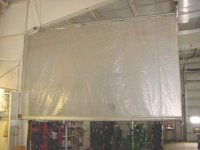
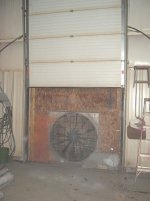
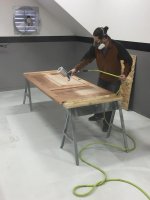
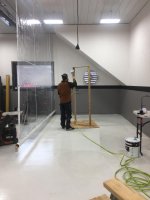
Just thought I would update this old post with my spray booth setup so far. I installed the 4300 CFM fan a while back. Bought it here For now my make up air is simply opening the man door. Before putting the curtain up, I did some painting in front of the fan and over spray seemed to find it's way everywhere. I was really surprised just how far overspray made it. No big deal, but it was just pretty interesting to see how far it went.

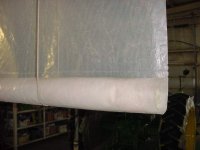
It was time to spray the interior doors for my house, so I needed to have the curtain up for a better containment. I'll be shooting upwards of 10 gallons of sealer and varnish, so I was really hoping this would do a decent job and I'm happy to report is works very well. The curtain I bought is a 12'x16' 24 MIL Clear Fire Retardant Tarp off eBay here.

The curtain's actual dimensions is about 12"-18" short in each direction, so that was a bummer, since it doesn't go all the way to the floor. I will extend it...someday...probably.

It rolls up and down very nicely, since it will stay in the up position 95% of the time. I used a 3"x20' section of PVC and cut it down to the length the tarp. Slicker than whale snot.
 

Attachments

  • IMG_8284.jpg
    IMG_8284.jpg
    81.4 KB · Views: 95
  • IMG_8280.jpg
    IMG_8280.jpg
    50.1 KB · Views: 95
  • IMG_8274.jpg
    IMG_8274.jpg
    65.3 KB · Views: 441
  • IMG_8215.jpg
    IMG_8215.jpg
    143.4 KB · Views: 267
  • IMG_8213.jpg
    IMG_8213.jpg
    102.3 KB · Views: 263
  • IMG_8212.jpg
    IMG_8212.jpg
    85.8 KB · Views: 262
Last edited:
OP
C

climb.on

Well-known member
Joined
Apr 13, 2015
Messages
501
Location
Minnesota
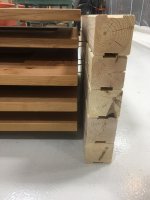
I also devised a system for stacking my interior doors for drying. 2 screws in the each end of each door and 4x4's (notched). Works quite well. I could safely stack 7 doors high. Hugh space saver. Meat hooks made it super easy to grab the screws to flip the doors over and to move them from the booth to the stacks.
 

Attachments

  • IMG_8265.jpg
    IMG_8265.jpg
    150 KB · Views: 43
  • IMG_8269.jpg
    IMG_8269.jpg
    77.1 KB · Views: 46
  • IMG_8271.jpg
    IMG_8271.jpg
    116.5 KB · Views: 45

sberry

Banned
Joined
Jun 18, 2005
Messages
35,747
Location
Brethren, Michigan
I've thought along similar lines and agree with Warrenator. Push air in through filters and exhaust it out elsewhere. That way you are in control of the air and any stray contaminants will be pushed out.

If you exhaust with the fan, then you will potentially create a low pressure zone and any dust, dirt, or dandelion floaters will get sucked out of any crack and crevice. Also, if your plastic wall let's go, it could get pulled into what you're spraying.

You described a clean room not a paint booth. A booth draws air thru creating negative pressure. A pressure room blows air everywhere, not just out the opening.
This is a good simple read for both design, once the basics are understood you can clear the dorm room of smoke or build makeshift booth pretty much anywhere.
http://finishingacademy.com/aerospace-finishing-training/paint-booth-pressure-levels/
They keep fukkin with these pages. let me see if I can find more complete.
http://finishingacademy.com/automotive-refinish-training/spray-booth-basics/
Click on right,,,, how paint booths work.
 
Last edited:

sberry

Banned
Joined
Jun 18, 2005
Messages
35,747
Location
Brethren, Michigan
I guess I missed some response to this thread before. One reason to divide the room is so heating equipment can run in the other part. I used common 8 mill poly off the shelf at the store. When I did it figured I would have to change it out on occasion,,,, been there 25 years and a hundred jobs.
 
To avoid these ads, REGISTER NOW!
Top Bottom