To avoid these ads, REGISTER NOW!

Spray Foaming the Roof Deck

cls89

Well-known member
Joined
Feb 13, 2020
Messages
138
Location
Southeast Michigan
I have 20x32 detached garage. I am in Southeast Michigan. The garage has a hip roof. I'm wanting to finish insulating the garage by spray foaming the roof deck.

Below are some questions and concerns about this method. Any help answering would be appreciated.

1. Is closed cell spray foam the best option for insulating the roof deck on a detached garage in a Southeast Michigan climate, or is open cell the better option?

2. Does my situation require ventilation? If yes what type of ventilation? Would something like these Rafter Vents work? Do I just attach the rafter vents to roof deck and then spray foam over it? Are there other ventilation options that make sense for my situation?

3. If I don’t ventilate the roof deck, would the spray foam making direct contact with the roof deck create a hot roof? If yes what are the concerns with having a hot roof? Can it cause pre-mature damage to the structure?

4. What about soffit vents? Do those get covered with foam? If not, how do I work around this?

5. What about ridge vents? Does it get covered, or is it sprayed around?

6. How thick should the spray foam be? Should it fill the entire 2x6 cavity?

7. If there is a roof leak how will this impact the substructure? I am assuming water will get trapped between the roof deck and foam which will eventually lead to wood rot and failure. Is this correct, or am I misunderstanding something?

8. How much can I expect this to cost if I do it myself using a DIY Kit? Any specific DIY kit recommendations?

9. My garage was built in the 1950’s, so the roof deck is constructed using solid lumber (see photo) and not OSB or Plywood Sheathing. Since solid wood expands and contracts are there any concerns with leaks / cracks in the spray foam after a couple of seasons?

10. Are there any additional details that I am overlooking for my situation? Whether it is related to ventilation, moisture, materials, climate considerations, etc.
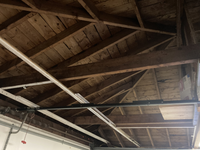
1677703761515.png
 
To avoid these ads, REGISTER NOW!

karoc

Well-known member
Joined
Dec 19, 2017
Messages
2,011
Location
Hemphill Tx
By no means am I qualified to answer your questions but I do have opinions. I’ve watch lot YouTubes on Spray foam. I know just enough to be dangerous so read at your own risk. I’m building a small home/shop in Texas which the Climate Zone is 2. You being where your at is Climate Zone 6(I think) Where your at dealing with long cold winters it’s suggested that in that area to use close cell spray foam 1”-2” which will also give you air seal for roof. But is your plans to make garage a condition space? Having cooling and heating year round. If so, then no venting at ridge nor soffit. From Youtubes people up north pulls cars or trucks or anything that may have snow on them which then you’re introducing humidity so humidifier will also be needed. There’s other benefits to close cell vs open cell which in my zone it’s open cell. But to get open cell to be air sealer I will need 6”. I do want condition attic because I believe it make world difference is living space and smaller utilities bills. But can I afford it, once get my roof on I’ll find out. Following your post. Watch YouTube and look up Spray Jones he’s in Canada
 
OP
C

cls89

Well-known member
Joined
Feb 13, 2020
Messages
138
Location
Southeast Michigan
By no means am I qualified to answer your questions but I do have opinions. I’ve watch lot YouTubes on Spray foam. I know just enough to be dangerous so read at your own risk. I’m building a small home/shop in Texas which the Climate Zone is 2. You being where your at is Climate Zone 6(I think) Where your at dealing with long cold winters it’s suggested that in that area to use close cell spray foam 1”-2” which will also give you air seal for roof. But is your plans to make garage a condition space? Having cooling and heating year round. If so, then no venting at ridge nor soffit. From Youtubes people up north pulls cars or trucks or anything that may have snow on them which then you’re introducing humidity so humidifier will also be needed. There’s other benefits to close cell vs open cell which in my zone it’s open cell. But to get open cell to be air sealer I will need 6”. I do want condition attic because I believe it make world difference is living space and smaller utilities bills. But can I afford it, once get my roof on I’ll find out. Following your post. Watch YouTube and look up Spray Jones he’s in Canada

My plan is to heat the garage using an electric heater in the wintertime. I don't plan on running any A/C in the summer. Venting needed? Just spray directly onto the roof deck?
 

dcg9381

Well-known member
Joined
Jun 20, 2018
Messages
11,778
Location
Austin, TX
Some answers, I've done 3 structures with foam:


Closed cell is the best product in terms of R value per inch. It's other advantage is that it won't pass water.. That second advantage being somewhat "moot" as even if it can't pass water, your roof deck will rot.

I usually do open cell as it's R value per dollar is better than closed cell.

Homes that are fully foam insulated are not usually vented. They're fully enclosed - no ridge vents, no soffit vents. In some climates (and MI may be one of them) moisture control / fresh air devices are required. IF you are doing the roof deck (only) you will not have an enclosed structure so it's TBD on the rest of it to me.

How thick? That's about desired R value and your budget. If you want a recommendation, look at recommended R values for your climate region (google). I prefer to cover the rafters.

Any roof leak is bad. Period. Doesn't depend on insulation type. Water wont go through open cell and will pass through open cell (perhaps making it easier to find the leak) - but water leaks are bad for roofs. You're understanding correctly that a water leak will lead to a roof deck failure. That's not unique to foam insulation.

In my experience, you cannot DIY this for less than having a professional do it (IE, Tigerfoam, etc). Costs in the south for foam have come down recently, but you will want more than one bid, then compare that bid to the cost of Tigerfoam, etc (DIY). DIY might be less for very small jobs (like doing a cargo trailer). Michigan costs are higher than here.
 
Last edited:

cretedog

ALLIANCE MEMBER
Joined
Mar 27, 2012
Messages
232
Location
North Dakota USA
I've had several shops and garages spray foamed. (Closed cell) Sprayed right on the deck, both wood and metal no problem. No venting. 3" the first one, 5" on the others and encapsulated the rafters, but our climate is much more severe than yours and the buildings are kept at comfortable temperature year around. Depending on your use, you could most likely do less. Also sprayed 1" on the walls to seal them up, then 6" of fiberglass- might want to consider doing your walls too if accessible... Definitely not a do it yourself thing using foam kits. Might also be well worth digging down and putting some styro around the perimeter of the slab. Good luck!
 
Last edited:

kj_mustang

Well-known member
Joined
Feb 9, 2011
Messages
1,213
Location
Harrisonburg, VA
I have 20x32 detached garage. I am in Southeast Michigan. The garage has a hip roof. I'm wanting to finish insulating the garage by spray foaming the roof deck.

Below are some questions and concerns about this method. Any help answering would be appreciated.

1. Is closed cell spray foam the best option for insulating the roof deck on a detached garage in a Southeast Michigan climate, or is open cell the better option?
Closed cell is an air and water vapor barrier if sprayed to enough thickness for your climate. Open cell foam will require a vapor barrier.
2. Does my situation require ventilation? If yes what type of ventilation? Would something like these Rafter Vents work? Do I just attach the rafter vents to roof deck and then spray foam over it? Are there other ventilation options that make sense for my situation?
I would expect that most installations are done direct to the roof underside or wall sheathing. You can have an attic space as vented or unvented. If you have an unvented building, you need to consider how your planned HVAC will affect the moisture levels inside the building. I have no expert knowledge but I would be concerned that raw spray foam chemicals sprayed on other foam may melt it.
3. If I don’t ventilate the roof deck, would the spray foam making direct contact with the roof deck create a hot roof? If yes what are the concerns with having a hot roof? Can it cause pre-mature damage to the structure?
Studies have shown that it does not.
4. What about soffit vents? Do those get covered with foam? If not, how do I work around this?
Existing soffit vents would need to be closed off if you want an unvented attic space. Usually the soffit area is blocked off before spraying.
5. What about ridge vents? Does it get covered, or is it sprayed around?
Depends on vented or unvented space.
6. How thick should the spray foam be? Should it fill the entire 2x6 cavity?
Depends on your budget and how much is needed for your climate. Closed cell about R-7 per inch. Open cell about R-3 to R-4 per inch deep.
7. If there is a roof leak how will this impact the substructure? I am assuming water will get trapped between the roof deck and foam which will eventually lead to wood rot and failure. Is this correct, or am I misunderstanding something?

8. How much can I expect this to cost if I do it myself using a DIY Kit? Any specific DIY kit recommendations?
I wouldn't attempt a large area install myself. You need to have consistent thickness of the foam over the whole area.
9. My garage was built in the 1950’s, so the roof deck is constructed using solid lumber (see photo) and not OSB or Plywood Sheathing. Since solid wood expands and contracts are there any concerns with leaks / cracks in the spray foam after a couple of seasons?

10. Are there any additional details that I am overlooking for my situation? Whether it is related to ventilation, moisture, materials, climate considerations, etc.
Here is an article for some basic info on spray foam.
https://www.jm.com/en/blog/2020/june/spray-foam--open-cell-vs--closed-cell/
 

Brad J.

Well-known member
Joined
Aug 6, 2015
Messages
70
I'm near Lansing and had a 32 by 48 done about 5 years ago. 5" in the ceiling and 3" walls. No venting. They block the soffits where they meet the walls and spray it. Closed cell and anything over 4" is a waste according to most charts. Only way I'll do it. Going to do the same to the house this year.
 

Chris705

Well-known member
Joined
Nov 1, 2012
Messages
834
Location
The Finger Lakes of NY
Check out ‘spray-Jones’ on YouTube. Confirm your learnings by asking your spray foam contractors their opinions on the same questions you posted. Some contractors will tell you what you want to hear to get the job, read between the lines to determine which contractor you feel most comfortable with. Spray foam is a topic with lots of opinions.
 

billconner

Well-known member
Joined
Jul 20, 2021
Messages
6,970
Location
Thousand Islands NYS
I interpret building code as not permitting the foam to be exposed. Drywall, intumescent coating, or other covering. I'd guess this may be ignored.
 

428PI

Well-known member
Joined
Jul 14, 2018
Messages
1,976
Location
Peabody, KS
I've had several shops and garages spray foamed. (Closed cell) Sprayed right on the deck, both wood and metal no problem. No venting. 3" the first one, 5" on the others and encapsulated the rafters, but our climate is much more severe than yours
I was talking to a cousin that still goes to my home church and he said that they are having problems with wood rotting with foam under wood and regular shingles. Probably is 12 years old.
 

karoc

Well-known member
Joined
Dec 19, 2017
Messages
2,011
Location
Hemphill Tx
428PI not speaking from personal experience but sounds like they having roof leaks before spray foam. But that’s one problems with closed cell foam, it repeals water and home owner wouldn’t know has leaks till wood rots away. Open cell will absorb water and will dry out. Either type foam I believe you need start with good roof. If I can swing it, I’m going to go with spray foam.
Good luck to your friend with problem, that’s bad problem to have
 
To avoid these ads, REGISTER NOW!

Denwood

Well-known member
Joined
Sep 22, 2014
Messages
4,192
Location
Thunder Bay, Ontario, Canada
Closed cell directly against the roof deck is the way to go for your climate zone. 3 1/2" to 4". I covered mine with drywall to address the fire/risk issue. Expansion/contraction of your timber sheathing will not be an issue.

All vents with this setup should be closed or foamed in. It is a zero vent approach. The roof won't be any hotter.

If you wanted to maintain a vented cavity, you would add 2" blocking, install baffles, and apply 3" spray foam against that. In that case, you'd extend that 2" cavity to the ridge vent and eaves. I don't see the point of doing this for a garage at all.

Don't bother DIY. Your foam installer will have preheated tanks and equipment etc. to ensure the foam is at correct temp/ratio which is very critical to correct installation. It will also likely cost out less than DIY, and they are in and out in a few hours.

The downside is that yes, leaks will not be obvious.
 
Last edited:

428PI

Well-known member
Joined
Jul 14, 2018
Messages
1,976
Location
Peabody, KS
The downside is that yes, leaks will not be obvious.
I seriously thought foam was the way to go (and actually having a foam man redo my front porch foundation for settling) but I recently had some roof panels replaced because there were skylights leaking and some rust on those panels beneath the skylights. The roof if 50 years old though but there's no way I would want to try and dig out roof panels that had foam attached. It would be a royal mess. Are they more efficient-absolutely. How long will the cheaper metal last on these Carolina carport buildings? I have 26 gauge corrugated galvanized metal.
 
OP
C

cls89

Well-known member
Joined
Feb 13, 2020
Messages
138
Location
Southeast Michigan
I appreciate all the comments. I'm primarily considering this option because the garage doesn't have a ceiling and the shape / slope of the hip roof makes it difficult to use standard fiberglass insulation batts in the roof deck cavities.

Not being able to detect a roof leak is a concern, but outside of that it is the least expensive option. I suppose I can be proactive with checking the roof shingles and replacing anything that looks damaged from exterior.
 
OP
C

cls89

Well-known member
Joined
Feb 13, 2020
Messages
138
Location
Southeast Michigan
I should also mention that the roof of the garage has a cupola type of vent. How does this get closed off? Shutters to close off in the winter? block off?
 
OP
C

cls89

Well-known member
Joined
Feb 13, 2020
Messages
138
Location
Southeast Michigan
Replying to this older thread. I’m getting closer to proceeding with spray foaming the roof deck in my detached garage.

One of the concerns I came across is the off-gassing that could occur if the spray foam isn’t properly installed. See video below.

If it’s not done correctly it can pretty much ruin the roof and would lead to a very expensive repair.

Is this a legitimate concern, or rare occurrence? Are there any other practical options for insulating a hip roof?

 
Last edited:

75gmck25

Well-known member
Joined
Jul 21, 2014
Messages
1,326
Location
Alexandria, VA
Like many products, the installer must follow the directions and understand the process. Hire someone with experience and references.

It seems like some contractors have gotten into the spray foam business because it seems like a good way to make a quick profit, but they may not have knowledgeable installers. We had our walls and roof deck done a couple years ago as part of a renovation and it was habitable (no off-gassing or odor) within a few hours.

Also make sure they will clean up all the mess created when they go back and trim the excess foam. They will always overspray a little, just to make sure there is good coverage.
 
OP
C

cls89

Well-known member
Joined
Feb 13, 2020
Messages
138
Location
Southeast Michigan
Like many products, the installer must follow the directions and understand the process. Hire someone with experience and references.

It seems like some contractors have gotten into the spray foam business because it seems like a good way to make a quick profit, but they may not have knowledgeable installers. We had our walls and roof deck done a couple years ago as part of a renovation and it was habitable (no off-gassing or odor) within a few hours.

Also make sure they will clean up all the mess created when they go back and trim the excess foam. They will always overspray a little, just to make sure there is good coverage.
Agreed. I would like to hire an experienced / reputable company to do this. By chance does anyone on this forum have any recommendations for a good spray foam company / service in Southeast Michigan / Metro Detroit area?
 

My Old Tools

Well-known member
Joined
Jun 4, 2014
Messages
5,441
Location
Hamrick Lake, TX
By no means am I qualified to answer your questions but I do have opinions. I’ve watch lot YouTubes on Spray foam. I know just enough to be dangerous so read at your own risk. I’m building a small home/shop in Texas which the Climate Zone is 2. You being where your at is Climate Zone 6(I think) Where your at dealing with long cold winters it’s suggested that in that area to use close cell spray foam 1”-2” which will also give you air seal for roof. But is your plans to make garage a condition space? Having cooling and heating year round. If so, then no venting at ridge nor soffit. From Youtubes people up north pulls cars or trucks or anything that may have snow on them which then you’re introducing humidity so humidifier will also be needed. There’s other benefits to close cell vs open cell which in my zone it’s open cell. But to get open cell to be air sealer I will need 6”. I do want condition attic because I believe it make world difference is living space and smaller utilities bills. But can I afford it, once get my roof on I’ll find out. Following your post. Watch YouTube and look up Spray Jones he’s in Canada
Texas is climate zone 7-8....
 
To avoid these ads, REGISTER NOW!
Top Bottom