Oldtuleguy
Well-known member
- Joined
- Nov 4, 2017
- Messages
- 10,467
I am going to have start checking those thrift stores!

Am I reading that right, that they snapped the metal handle of? I'd sure like to know how you break a handle like that without a hydraulic press, or liquid nitrogen.I have a parts ratchet if you are interested. It had the handle broken in shipment by the post office. The eBay seller had poorly packed the ratchet and of course the gorillas in the post office figured out how to break the handle. The red tint to this is just from reflections from my t-shirt I am wearing. PM me if interested with a address. All I want is shipment cost
I do not know ask the gorillas at the post office as they were the ones to break it.Am I reading that right, that they snapped the metal handle of? I'd sure like to know how you break a handle like that without a hydraulic press, or liquid nitrogen.
Who knows - perhaps the worker in question is married to a witchy woman named Bonney and he saw the tool and just lost it for a moment? lolI do not know ask the gorillas at the post office as they were the ones to break it.

Having never used "Evaporust", I suppose I'll have to dig into Lugnutz's "sticky" and figure it out.
I do wonder, however, considering the condition of these pieces, if it's even worth the effort.
These came out of a shed about 10 miles from the Pacific Ocean. The entire workshop is filled with stuff like this.
I remember loading a suitcase with my washed clothes still damp on a DC-8 flight years ago.If it is in the cargo compartment of a aircraft it is in a pressurized area of the aircraft and at the same temperatures as on the flight deck and the passenger compartment. Pets and live animals are often placed in the cargo compartments everyday. Freighter aircraft are also pressurized as everything from whales to horses are transported across the world in them. See a horse race on the tv likely a freighter transported that horsey from California to Kentucky as it is less stress for the horse then surface transport. The thing is it a good explanation of what might have happened of the two large items shifting but I still like the gorilla better


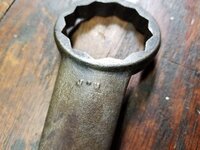
I figured the Checknut Wrench. Wondered if it qualified as one of their Semi-Finished Wrenches; "pleasing black enamel, and ends are polished."It's a Checknut wrench, made of carbon steel, originally black japanned, and after WWII. But probably not too long after. I don't think they show up in the early catalogs for some reason, only the SOE Checknut wrenches, which were 60X-61X.
It is NOT worth keeping - send it to me, instead.I am wondering if it is worth keeping, let alone the effort that would be required to make it functional again…
I do wonder, however, considering the condition of these pieces, if it's even worth the effort.
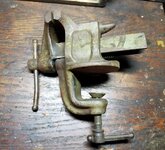
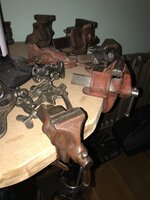 I have five models of the Champions, and am looking for the remaining thirteen. The model number is stamped on the flat of the anvil - numbers “112” to “130”. Unless it’s been filed or gouged off, you’ll see it when you clean it. They are not precision instruments, but they are old and cute.
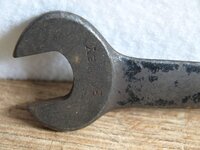
I do not see the forged-in date codes, but I suppose they are on it. The finish could be nickel, but it looks like cadmium to me. A Bonaloy DBE wrench with “MADE IN U.S.A.”would be 1938-1946, with a likely gap during the alloy restrictions."8ONALOY"
Thanks, LS! Have you ever seen that 8ONALOY before?I do not see the forged-in date codes, but I suppose they are on it. The finish could be nickel, but it looks like cadmium to me. A Bonaloy DBE wrench with “MADE IN U.S.A.”would be 1938-1946, with a likely gap during the alloy restrictions.
I've never seen that before. It's also not typical to have the size marking one on each side for Bonney wrenches. That's something the Cornwell did.Have you ever seen that 8ONALOY before?

Agreed.The finish could be nickel, but it looks like cadmium to me.
No gap. I have Bonaloy DBEs and combos with natty steel or cad finish and wartime date codes and MADE markings.A Bonaloy DBE wrench with “MADE IN U.S.A.”would be 1938-1946, with a likely gap during the alloy restrictions.
Not typical for Bonaloy. But note that Bonney did mark the sizes on opposite sides and ends for the -ZENEL- line as well for DBE's they made for others (Wright, NUBO, Gray Marine, and others).I've never seen that before. It's also not typical to have the size marking one on each side for Bonney wrenches.
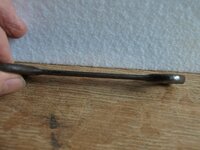
I love me some strange!EDIT: That is a very strange wrench, though.


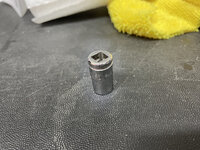
Mine is also 3/8”. It is a very early one.Most all of the refrigeration ratchets I’ve run across have been 1/4” drive but yesterday I came across this one which is 3/8” drive.
-Don


Yeah the roller bag needs a really good cleaning but that is easy just use some soap and water and it should clean up. It is a vinyl cloth style roller bag. The one I had before was a all vinyl roller and I cannot complain as it lasted well over twenty years of daily use.Nice acquisition, Mikeske!
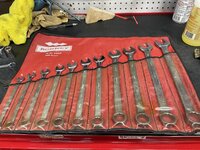
Now all you've got to do is find the accompanying metric set.....
odd little cv wrench
That’s from a brake servicing set.
Applicable for Chrysler cars.
Just FYI - 1933 Catalog (see IA/ITCL) page 33 shows all the brake wrenches and two different in-pouch sets.Thanks humber was curious about application. Just bought it cause it looked like a handy little wrench.