
You are using an out of date browser. It may not display this or other websites correctly.
You should upgrade or use an alternative browser.
You should upgrade or use an alternative browser.
Spreading the Bonney affliction!
- Thread starter bonneyman
- Start date
Private Lugnutz
Well-known member

You see that "picker upper" (holder, fishing tool, etc) between the oval sash brush and the trimmer's punch?
It's a BONNEY K8 Handy Holding Tool. Found today at the early bird.


twertsy
Well-known member
Nice! I found one of those this year too.
You see that "picker upper" (holder, fishing tool, etc) between the oval sash brush and the trimmer's punch?
It's a BONNEY K8 Handy Holding Tool. Found today at the early bird.
Sent from my VS990 using Tapatalk
dutchgray
Well-known member
View media item 61363View media item 61364Found this set of MEB wrenches on eBay, 6 to 19mm they were sensible money so I got them (Bonney is seriously uncommon to find here in England) as its a near complete set in decent condition, only missing the 8mm, anyone got a spare single? They just need a good clean and polish to get rid of the surface rust. Interesting that 17 & 18mm are the same blank
I found two Bonney screwdrivers Saturday. This one is a #08. Not sure of the year. It has ridges on each facet, unlike the ones that look like the Stanley 100+. The handle material is interesting - it softens in alcohol, which I discovered while removing some crud from it. Very shiny, now, and I'm lucky the lettering is stamped deep enough it didn't wipe away.
The other one is a wood-handled stubby SP2. I'll post it once I remember where I put my other two wood-handled ones.
The other one is a wood-handled stubby SP2. I'll post it once I remember where I put my other two wood-handled ones.
Attachments

Last edited:
Lug, that reminds me of my grandfather when I was a kid. He had several of those things, though I think they were the flexible type. Had one in the kitchen for getting stuff out from behind appliances, one by his chair in the living room (no idea why), and a few around his wood shop.
Sam'sAutoParts
Well-known member
Not many tools today at the flea market, but I did walk away with these two beauties. Both 1/2" drive.

Dennis Leigh Henry
Well-known member
Saw these at a flea market this past weekend.. I didn't ask what he wanted for them.. Any interest? PM me if so..
View media item 61397
View media item 61396
View media item 61397
View media item 61396
twertsy
Well-known member
Nice boards but a little too modern era for my taste. Now, if you see any that look older than 1940 I'll take 'em!!
Nice finds, gents!
Lugnutz, loving the brass pick-up tool.
Dutchgray, great score on the shorty combos. They appear Triangle era to me, with the Hex-Fit OE (intro'd in 1967) and Loc-Rite box ends. I'll check and see if I have an 8mm for you.
P.S. Just checked. I have two 9mm but no 8mm. Sorry.
Dennis, nice condition boards.
Sam, awesome find on the 1/2" drive sliding T handle. Very hard to find in such great condition.
Lugnutz, loving the brass pick-up tool.
Dutchgray, great score on the shorty combos. They appear Triangle era to me, with the Hex-Fit OE (intro'd in 1967) and Loc-Rite box ends. I'll check and see if I have an 8mm for you.
P.S. Just checked. I have two 9mm but no 8mm. Sorry.
Dennis, nice condition boards.
Sam, awesome find on the 1/2" drive sliding T handle. Very hard to find in such great condition.
Last edited:
dutchgray
Well-known member
Bonneyman
Thanks for looking for an 8mm
I'm sure I could buy one of ebay eventually but shipping will probably cost as much as the rest of the set.
8mm is too useful to not have.
Thanks for looking for an 8mm
I'm sure I could buy one of ebay eventually but shipping will probably cost as much as the rest of the set.
8mm is too useful to not have.
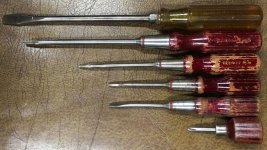
Updated wood-handled Bonney screwdrivers: WO6, WO4, WO3(x2), and SP2. The stubby phillips is printed very lightly, and with much smaller letters than on the slots. At top is a No.08 round shank with fluted amber handle.
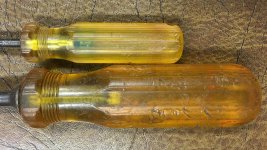
And, fueling the discussion comparing Stanley and Bonney screwdrivers, a No.06 (I think - the digits are effaced), posing with the earlier-style No.08 and...a little Stanley. Those handle patterns aren't just similar - they're identical.
And, fueling the discussion comparing Stanley and Bonney screwdrivers, a No.06 (I think - the digits are effaced), posing with the earlier-style No.08 and...a little Stanley. Those handle patterns aren't just similar - they're identical.
Attachments


Last edited:
Updated wood-handled Bonney screwdrivers. The phillips is printed very lightly, and with much smaller letters than on the slots.
Nice workmanship on those shanks there! They made such good stuff.
I'm getting upset again that Bonney went under!

twertsy
Well-known member
Nice workmanship on those shanks there! They made such good stuff.
I'm getting upset again that Bonney went under!
They were dunked!
Private Lugnutz
Well-known member
Okay, Bonney aficionados. Found a Bonney 4088 1/2-inch drive reversible ratchet at the early bird this morning...

What is it? I can't find it any catalog (1933, 1939, 1941, 1943, or 1947). Only the 4098. It has a very distinct "J Y" date code. That would be either 1933 or 1947. It's not chromed. Might be cad.
While I'm at it, why don't these style ratchets show up in the Bonney catalogs? All the figures of the reversible ratchets (1/4-inch V25, 3/8-inch T35, 1/2-inch 4098) in the catalogs are shown with solid tubular shanks leading out to the handle. I have a V25, a T35, and now this 1/2-inch drive 4088, which all have the wider shank with the concave panel.
What is it? I can't find it any catalog (1933, 1939, 1941, 1943, or 1947). Only the 4098. It has a very distinct "J Y" date code. That would be either 1933 or 1947. It's not chromed. Might be cad.
While I'm at it, why don't these style ratchets show up in the Bonney catalogs? All the figures of the reversible ratchets (1/4-inch V25, 3/8-inch T35, 1/2-inch 4098) in the catalogs are shown with solid tubular shanks leading out to the handle. I have a V25, a T35, and now this 1/2-inch drive 4088, which all have the wider shank with the concave panel.
Last edited:
Private Lugnutz
Well-known member
It is a 4098. Not even under a magnifying glass could I see a break. Only when I took a close-up.


I'd still like thoughts on why these wide, concave panel style rats don't show up in catalogs, though.
I'd still like thoughts on why these wide, concave panel style rats don't show up in catalogs, though.
twertsy
Well-known member
Sorry guys, I'll get to it I promise. Got roped into a golf tourney this weekend.
Sent from my VS990 using Tapatalk
Sent from my VS990 using Tapatalk
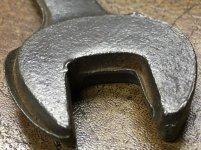
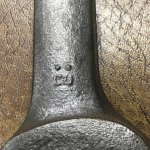
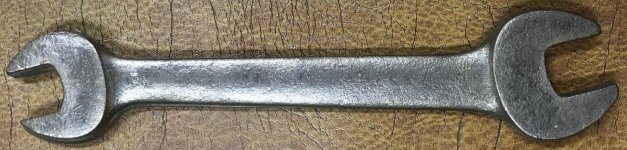
Here's a 10-½" Bonney CV DOE forged blank, gullet not ground, faces not polished, edges not trimmed, no stamping at all. Without the stamped "Bonney" logo, pretty tough to tell whether it's from 1929 or 1943, but based on shear production volumes, most likely 1943. There was a CV tappet wrench in the same bin, also unground and unstamped, but it was badly pitted, so I passed on it.
Attachments


Last edited:
Lug, I think that ratchet style must represent a very rapid transition from the tear-drop style handle to the cylindrical style handle. Bonney's not the only company that went through this phase. Someone in some company must have realized the steel was strong enough to have a shorter transition from the handle to the head, and lengthening the cylindrical part would eliminate extra manufacturing steps, or decrease milling errors. Your photo recapitulates the transition: Wiliams is the first step from a pure taper, then the Bonney, and finally the oxide one, with a handle turned full-length and an abrupt swell at the head.
Or maybe we're just not looking in the right catalogs.
Or maybe we're just not looking in the right catalogs.
Last edited:
superautobacs
Well-known member
It is a 4098. Not even under a magnifying glass could I see a break. Only when I took a close-up.
I'd still like thoughts on why these wide, concave panel style rats don't show up in catalogs, though.
I have a ratchet just like that in a 3/8 drive, only it's a Gray/Bonney stamp.
twertsy
Well-known member
Ok guys, haven't researched yet but here are mine. 3 1/2" drive 4098, and 1 A-704. 3 1/4" drive T-704 and 1 T-35.
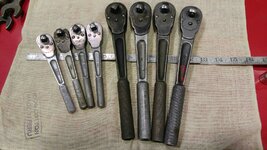
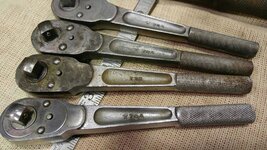

Also, a HUGE thank you to Bonneyman for completing my wrench set with the 9/16!
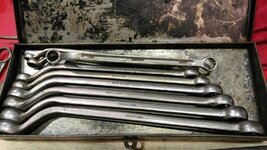
Sent from my VS990 using Tapatalk
Also, a HUGE thank you to Bonneyman for completing my wrench set with the 9/16!
Sent from my VS990 using Tapatalk
Private Lugnutz
Well-known member
Maybe. It would have to be very rapid to not show up in the 1941 or the 1943 catalogs. Unless it was a wartime thing they never bothered to document. They did re-use all the type-sets from the 1941 catalog in the 1943 catalog, because all the tools still show CV line markings, which was discontinued by 1943 due to alloy composition restrictions. So maybe that's the answer.Lug, I think that ratchet style must represent a very rapid transition from the tear-drop style handle to the cylindrical style handle.
Does anyone have any examples with 1939, 1941, or wartime date codes in the style that are shown in the 1939, 1941, and 1943 catalogs? With the solid, cylindrical shank?
twertsy
Well-known member
I only have one round handle, no date code though.Maybe. It would have to be very rapid to not show up in the 1941 or the 1943 catalogs. Unless it was a wartime thing they never bothered to document. They did re-use all the type-sets from the 1941 catalog in the 1943 catalog, because all the tools still show CV line markings, which was discontinued by 1943 due to alloy composition restrictions. So maybe that's the answer.
Does anyone have any examples with 1939, 1941, or wartime date codes in the style that are shown in the 1939, 1941, and 1943 catalogs? With the solid, cylindrical shank?


Sent from my VS990 using Tapatalk
Private Lugnutz
Well-known member
Thanks, twerts.
I hardly every collect outside my wartime niche, maybe a little to the left (pre-war) or right (post-war), and I usually pass right by primitive, antique tools, but I had to grab this "alligator" wrench at the flea market this morning…

…on the NBLB rule!
I hardly every collect outside my wartime niche, maybe a little to the left (pre-war) or right (post-war), and I usually pass right by primitive, antique tools, but I had to grab this "alligator" wrench at the flea market this morning…
…on the NBLB rule!
jakemac
Well-known member

twertsy
Well-known member
Nice snags Jake!
Sent from my VS990 using Tapatalk
Sent from my VS990 using Tapatalk
Sam'sAutoParts
Well-known member
Very nice! I may have some tool envy!
Sam'sAutoParts
Well-known member
Sockets from the flea market, was hoping to piece a set together, but I have a long way to go on the deeps. Shallows, are getting close. All 1/2 drive SAE. Most have a triangle but are prior to Off corner engagement. So 60s maybe 70s?

twertsy, looks like that 9/16ths I sent you is much happier with you than it was with me.
Sam, I surmise that Triangle had some significant non Loc-Rite inventory to sell off after their acquisition of Bonney in 1967, though Bonney got the LR patent in 1964. It probably took a few years to sell off that older stuff, plus that gave them time to get the LR forges and dies and pull-broaches made and on line. That might explain the triangle being present but no enhanced broaching. (This is all just speculation - I have no hard facts to back it up.)
In any event, your non-LR sockets do look to be in nice condition.
Sam, I surmise that Triangle had some significant non Loc-Rite inventory to sell off after their acquisition of Bonney in 1967, though Bonney got the LR patent in 1964. It probably took a few years to sell off that older stuff, plus that gave them time to get the LR forges and dies and pull-broaches made and on line. That might explain the triangle being present but no enhanced broaching. (This is all just speculation - I have no hard facts to back it up.)
In any event, your non-LR sockets do look to be in nice condition.
Sam'sAutoParts
Well-known member
twertsy, looks like that 9/16ths I sent you is much happier with you than it was with me.
Sam, I surmise that Triangle had some significant non Loc-Rite inventory to sell off after their acquisition of Bonney in 1967, though Bonney got the LR patent in 1964. It probably took a few years to sell off that older stuff, plus that gave them time to get the LR forges and dies and pull-broaches made and on line. That might explain the triangle being present but no enhanced broaching. (This is all just speculation - I have no hard facts to back it up.)
In any event, your non-LR sockets do look to be in nice condition.
Cool,that makes sense.
All but one of the bright chrome appear to be NOS. Couple of them have some oxidation from storage though, but in these parts it's to be expected.
BlueBomber
Well-known member
Three cool Bonneys-rwo Bonalloy DBEs and an old B-shield non-symmetric-profiled DBE. Anyone know about the bottom wrench?


twertsy
Well-known member
Three cool Bonneys-rwo Bonalloy DBEs and an old B-shield non-symmetric-profiled DBE. Anyone know about the bottom wrench?


3rd one is a battery terminal wrench. Later numbered 2875.
BlueBomber
Well-known member
Thanks, twertsy. They must have had some big-a battery terminals back in the day at those sizes.
Sam'sAutoParts
Well-known member
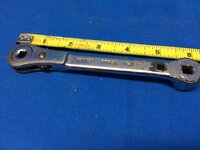
Bonney RF45A
Private Lugnutz
Well-known member
I picked up two Bonney DOE engineers wrenches this past weekend. A carbon ISN 29 and a chrome vanadium 33C.
Normally, any time I am pawing through a decrepit toolbox and I see a B-shield logo on a shank or the embedded-shield logo on a face (i.e., BON{\}NEY) I ignore it. Usually, due to their bulkiness (compared to sleeker wartime alloy composition styles), I don't even need to look that close. (Ditto for Vlchek V-shield, etc, etc...) And that's a habit that is hard to break after years of picking. But this past weekend I started making a concerted effort to help twertsy fill his Bonney Automotive Drop-Forged tool boards.
Unfortunately, while the 29 is the correct vintage and style (B-shield on shank, shield-embedded logo on face, no date code on shank), it's either not on his earliest board, or he already has it.
Continuing the misfortune, while he needs a 33C, the 1033-C CV line wrench I found is not early enough, bearing the BON{\}NEY logo on the face, but no B-shield on the shank, and it does have a date code: KR (1926).
(Believe me - I now have his ‘Needs List’ in my little pocket notebook.., so I don’t come home with any more wrenches I don’t need!)
Anyway, I didn’t buy these clunky-*** boat anchors for nothin'! So, I am sharing the friggin’ photos here anyway!
As a wartime collector, I am used to seeing wrenches with an ISN on the face opposite the brand on the top side, and milled opening sizes on the flip side. But the ISN 29 wrench (11/16 x 25/32 milled openings) has USS heavy bolt head sizes stamped on its flip side faces (3/8 x 7/16). The ISN 33C (model number 1033C) wrench is also interesting for its size markings (in this case, SAE), especially the larger face, which also has a six-sided symbol and a capital "C." (for ‘hex capscrew’) size stamping.
Nothing you guys haven’t seen before, I’m sure, but here they are…
The ISN 29:


And the ISN 33C (model number 1033C):


Normally, any time I am pawing through a decrepit toolbox and I see a B-shield logo on a shank or the embedded-shield logo on a face (i.e., BON{\}NEY) I ignore it. Usually, due to their bulkiness (compared to sleeker wartime alloy composition styles), I don't even need to look that close. (Ditto for Vlchek V-shield, etc, etc...) And that's a habit that is hard to break after years of picking. But this past weekend I started making a concerted effort to help twertsy fill his Bonney Automotive Drop-Forged tool boards.
Unfortunately, while the 29 is the correct vintage and style (B-shield on shank, shield-embedded logo on face, no date code on shank), it's either not on his earliest board, or he already has it.
Continuing the misfortune, while he needs a 33C, the 1033-C CV line wrench I found is not early enough, bearing the BON{\}NEY logo on the face, but no B-shield on the shank, and it does have a date code: KR (1926).
(Believe me - I now have his ‘Needs List’ in my little pocket notebook.., so I don’t come home with any more wrenches I don’t need!)
Anyway, I didn’t buy these clunky-*** boat anchors for nothin'!
So, I am sharing the friggin’ photos here anyway! As a wartime collector, I am used to seeing wrenches with an ISN on the face opposite the brand on the top side, and milled opening sizes on the flip side. But the ISN 29 wrench (11/16 x 25/32 milled openings) has USS heavy bolt head sizes stamped on its flip side faces (3/8 x 7/16). The ISN 33C (model number 1033C) wrench is also interesting for its size markings (in this case, SAE), especially the larger face, which also has a six-sided symbol and a capital "C." (for ‘hex capscrew’) size stamping.
Nothing you guys haven’t seen before, I’m sure, but here they are…
The ISN 29:
And the ISN 33C (model number 1033C):
twertsy
Well-known member
Very cool Lugz. I greatly appreciate you keeping an eye out. You're closer to Allentown than I so the odds are probably better for you. It's killing me to have that single open spot on that board! Next time you come by, hopefully you'll have more time to dig around my shop and find some stuff you need.I picked up two Bonney DOE engineers wrenches this past weekend. A carbon ISN 29 and a chrome vanadium 33C.
Normally, any time I am pawing through a decrepit toolbox and I see a B-shield logo on a shank or the embedded-shield logo on a face (i.e., BON{\}NEY) I ignore it. Usually, due to their bulkiness (compared to sleeker wartime alloy composition styles), I don't even need to look that close. (Ditto for Vlchek V-shield, etc, etc...) And that's a habit that is hard to break after years of picking. But this past weekend I started making a concerted effort to help twertsy fill his Bonney Automotive Drop-Forged tool boards.
Unfortunately, while the 29 is the correct vintage and style (B-shield on shank, shield-embedded logo on face, no date code on shank), it's either not on his earliest board, or he already has it.
Continuing the misfortune, while he needs a 33C, the 1033-C CV line wrench I found is not early enough, bearing the BON{\}NEY logo on the face, but no B-shield on the shank, and it does have a date code: KR (1926).
(Believe me - I now have his ‘Needs List’ in my little pocket notebook.., so I don’t come home with any more wrenches I don’t need!)
Anyway, I didn’t buy these clunky-*** boat anchors for nothin'!
As a wartime collector, I am used to seeing wrenches with an ISN on the face opposite the brand on the top side, and milled opening sizes on the flip side. But the ISN 29 wrench (11/16 x 25/32 milled openings) has USS heavy bolt head sizes stamped on its flip side faces (3/8 x 7/16). The ISN 33C (model number 1033C) wrench is also interesting for its size markings (in this case, SAE), especially the larger face, which also has a six-sided symbol and a capital "C." (for ‘hex capscrew’) size stamping.
Nothing you guys haven’t seen before, I’m sure, but here they are…
The ISN 29:
And the ISN 33C (model number 1033C):
Sent from my VS990 using Tapatalk