To avoid these ads, REGISTER NOW!

Sprinkler winterize through back flow preventer test port not working. HELP

boniam

Member
Joined
Nov 15, 2015
Messages
9
Hi,
I am trying to winterize my sprinkler using instruction in following thread.

http://www.garagejournal.com/forum/showthread.php?t=221613&highlight=sprinkler

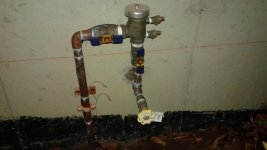
My setup is similar to the picture shown. I was trying with test port 2. First time i tried it was making a loud noise near BFP and not doing any thing. I then take the air hose off and put it back again and it worked for first zone. I let it run to empty and then recharge and tried on second zone. Again it was loud sound from BFP and didn't work after many tried. I then put the valve in and tried test port 1 and this time i see all air coming off from the top of BFP. What do I do? This is first time I am trying. Please help.
 
To avoid these ads, REGISTER NOW!
OP
B

boniam

Member
Joined
Nov 15, 2015
Messages
9
I don't know if it matters but I couldn't find 1/4 inch flare fitting so i took out test port and fitting my air hose in 1/8 opening on valve. Also if BFP is closed how to reset it.
 

CNGsaves

Well-known member
Joined
Sep 26, 2012
Messages
13,233
Location
KS and OK
Take the screws out of top of back flow preventer. Mine was just a simple baffle that went up and down. Grab the shaft and pull up on baffle and this closes off pathway for air to escape.

Use brass fittings or whatever it takes to build "port" that you can screw in quick-connect male air compressor fitting that you'll chuck on air compressor hose.

Let's SEE Pictures of your particular back flow preventer. How are you rigging up the "port" to connect to air supply ??
 
OP
B

boniam

Member
Joined
Nov 15, 2015
Messages
9
The BFP is febco 765. What could that loud sound be when air was not leaking from second port (bottom one.). Should i use top test port or bottom?

Could i have damaged BFP? How do i know that I haven't.

To connect air hose. I removed test port then went from 1/8 to 1/4 then added 1/4 air plug to connect the quick connect.
 

Attachments

  • sprinkler.jpg
    sprinkler.jpg
    140.5 KB · Views: 90
Last edited:

CNGsaves

Well-known member
Joined
Sep 26, 2012
Messages
13,233
Location
KS and OK
Seriously doubt you could have damaged BFP as it's simple one-way flap.

Looking at your setup, do you have Shut-Off INSIDE the house before the water gets outside ?? Presume you do as otherwise you'd have water pressure outside all winter in those copper lines (ie subject to freezing). Let's SEE Pics.

I'd install a T in copper line INSIDE house between the shutoff and when it exits the concrete wall. Sweat in threaded fitting in the T so you can screw in male air compressor fitting for quick chuck of air hose for winterizing/blowout.

^ ^ This will let you blow out ALL water beyond the shutoff, out through the BFP and ultimately through all the pipes/zones of sprinkler system.

When done blowing out, screw in plug to that T. Rinse & repeat every year !! ;)
 

purplezr2

Well-known member
Joined
Jun 1, 2010
Messages
5,292
Location
Central MN
Seriously doubt you could have damaged BFP as it's simple one-way flap.

Looking at your setup, do you have Shut-Off INSIDE the house before the water gets outside ?? Presume you do as otherwise you'd have water pressure outside all winter in those copper lines (ie subject to freezing). Let's SEE Pics.

I'd install a T in copper line INSIDE house between the shutoff and when it exits the concrete wall. Sweat in threaded fitting in the T so you can screw in male air compressor fitting for quick chuck of air hose for winterizing/blowout.

^ ^ This will let you blow out ALL water beyond the shutoff, out through the BFP and ultimately through all the pipes/zones of sprinkler system.

When done blowing out, screw in plug to that T. Rinse & repeat every year !! ;)

Do this but instead make a drop leg with on/off valve and then thread a quick connect on the end. This will allow you to leave the fitting in and also not have a mess of water when changing the plug vs fitting
 

CNGsaves

Well-known member
Joined
Sep 26, 2012
Messages
13,233
Location
KS and OK
^ ^ THIS !!! Much better for just a couple more pieces.
LIKE your way of thinking !!! :thumbup:

I do have the problem of finding that damn screw-in fitting that I have for mine every year !!! ;) However, mine is outdoors in control box in ground since I have a well.
 
OP
B

boniam

Member
Joined
Nov 15, 2015
Messages
9
So i took out top of BFP and attached are picture. It seems it is not easy to pull up baffle. It seems it comes from up from water pressure. Anyway i put it back in and tried again. And it worked for couple of zone and again air started coming out.

Do you think it will be better to blow out from bottom drain hose bib? That way it can probably seal the back flow preventer?

Yes i do have shut off valve in basement. I probably won't have time to modify this year so i am trying some how to make it work.
Also any idea why loud sound when blowed air from bottom test port?
 

Attachments

  • backflow1.JPG
    backflow1.JPG
    104.9 KB · Views: 39
  • backflow2.jpg
    backflow2.jpg
    142.6 KB · Views: 31

Rory Bellows

Well-known member
Joined
Jan 14, 2006
Messages
1,083
Location
Ohio
At my mom's house they take the backflow totally off for the winter. They blow out the system with a towable compressor. The pipe is just taped over where the backflow is removed. Done this way for 20+ years. This is done by a professional irrigation company. I do not know if they blow it out with or without the backflow removed.
 

theoldwizard1

Well-known member
Joined
Feb 22, 2011
Messages
43,132
Location
SE MI
Here is waht I do on an almost identical setup :


  • Shut off water inside the hose
  • Open the hose bib half way
  • Close the valve between the hose bib and the BFP.
  • Blow thought the top "test port" using what ever adapter is required for your air hose fitting.
  • Keep the pressure BELOW 50 PSI.
  • Only do 1 zone at a time.
  • When the pressure shown on the compressor regulator starts dropping, close the test port and allow the compress to "catch up".
  • Repeat. You may have to do this 2 to 4 or even 5 times depending on your compressor/air tank.
  • Move on to the next zone
  • When complete, leave all outside valves (including the hose bib) half way open

This will NOT guarantee that there is no water between you inside shut off and where it comes through the wall.

As for the noise, just repeat what you did before.
 
OP
B

boniam

Member
Joined
Nov 15, 2015
Messages
9
Thanks theoldwizard1

why do you do second step "Open the hose bib half way" just to drain water between house and BFP as much as possible?

I am doing the same thing as you described and using top port (after trying from second port bottom one). The problem is that it worked for two zones after i took out BFP top and put it back in but then it again started leaking air from the BFP top cover? Have you encountered this?
 
To avoid these ads, REGISTER NOW!

sublimate

Well-known member
Joined
Aug 4, 2010
Messages
776
Location
Colorado
What's the thought on blowing out your system THROUGH the BFP and PRV?
I've always understood that to be bad, but I hear people doing it.

Currently I take off the PRV (with a union fitting) and then attach a compressor fitting there (downstream of the BFP). But it would certainly be easier to leave it in place and just blow through it if it won't hurt anything.
 
OP
B

boniam

Member
Joined
Nov 15, 2015
Messages
9
I think the general thought is that if it can withstand the water pressure it can withstand 40-50 PSI that is used for blow out.

Looking at the internal it seems the bottom test port should have worked better. May be the puppet comes down anyway and pressure is not good enough to lift it up. That would explain loud noise. I think the key is to make the puppet seal with bonnet. I have heard many method. I am also going to try sealing the BFP with water and keeping the downstream closed and the hooking up air and opening downstream. Will that work better any experience?
 

CNGsaves

Well-known member
Joined
Sep 26, 2012
Messages
13,233
Location
KS and OK
My prior house had similar setup as OP but my BFP was much simpler. Mine transitioned to plastic right after the BFP so the downpipe was where I installed the port for blowing out the system. It had plug in the threaded hole all year long until it was time to blow out system.

Also inside basement, mine had T/shutoff and hose bib fitting so I could drain any water in the segment from shutoff valve upstream . . . to where the copper pipe went through concrete wall. That hose dropped down right into sump pump hole so draining was piece of cake.

In theory, I . . could . . have blown out system from 4 places:
a) my port on plastic downpipe outside
b) upper test port of BFP
c) lower test port on BFP, or
d) drain hose inside the house.

= = = = = = = = = = = =

OP . . . Thus, what you're trying to do is determine the EASIEST . . . and . . . effective "port" to use for blow out to get water out EVERYwhere.

I'd say keep jerry-rigging something this year through the test ports. I never like using those since ports were so small and hard to find fittings. Also, your BFP might fail and replacement may not have same size test ports. You will need to figure out BFP operation enough so you know how to hold open, or hold shut.

In spring, cut in T on downpipe of copper outside . . . OR . . . inside house between the shutoff valve and exterior wall.

Over winter, get some copper pipe & torch/solder to practice sweat joints ! ;)
 

theoldwizard1

Well-known member
Joined
Feb 22, 2011
Messages
43,132
Location
SE MI
why do you do second step "Open the hose bib half way" just to drain water between house and BFP as much as possible?
YES ! You don't want water freezing in that pipe !

I am doing the same thing as you described and using top port (after trying from second port bottom one). The problem is that it worked for two zones after i took out BFP top and put it back in but then it again started leaking air from the BFP top cover? Have you encountered this?
No, I have no encountered that problem.

Try starting with a lower air pressure, say 25 psi. Once it is going, you can crank it up to 50 psi. Also try putting a little bit of silicone paste lube (or just silicon spray) on those to rubber pieces on the baffle. You may have to replace them if they are old/stiff.
 
OP
B

boniam

Member
Joined
Nov 15, 2015
Messages
9
Thanks guys. I am most concerned about winterizing the pipes after BFP. The BFP and pipes below that can easily be drained as i have a drain port in basement after sprinkler shut off.

CNGsaves you mentioned " cut a T ... inside house between the shutoff valve and exterior wall". Won't that be same as two drain port that I already have before BFP (one outside and another one inside). I might try blowing through outside drain port before BFP. Has any body done it? Does it work? Do i need more pressure for check valve to operate.
 

CNGsaves

Well-known member
Joined
Sep 26, 2012
Messages
13,233
Location
KS and OK
^ ^ ^ If you have T and drain port inside house (ie after sprinkler water pipe shutoff and before exterior wall), then rig up connection to air hose and try blowing out your entire system from there. The only problem with that is you'll have to string your air hose through house out to compressor in garage. Also, you may have to tinker to BFP so your air pressure goes all the way through to your underground sprinkler lines.

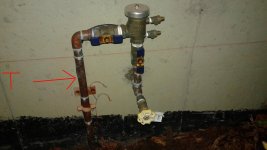
See PIC below for where I'd recommend you cut in T on downpipe of copper (see RED arrow). Protrude the T to left or right (your preference) and have ball valve and finally threaded fitting for your male air compressor quick connect fitting. You'll close the valve just after BFP and once you connect air hose the blow out process will be simple as you won't have to mess with BFP.

You'll cycle through blowing out all zones, and eventually open back up shutoff after BFP and blow out that water as well. Prior to this, you'll have opened that inside house drain for that water.
 

Attachments

  • Bonjam_sprinkler system_outside BFP_pic2.JPG
    Bonjam_sprinkler system_outside BFP_pic2.JPG
    142.8 KB · Views: 22

CNGsaves

Well-known member
Joined
Sep 26, 2012
Messages
13,233
Location
KS and OK
Thanks guys. I am most concerned about winterizing the pipes after BFP. The BFP and pipes below that can easily be drained as i have a drain port in basement after sprinkler shut off.

CNGsaves you mentioned " cut a T ... inside house between the shutoff valve and exterior wall". Won't that be same as two drain port that I already have before BFP (one outside and another one inside). I might try blowing through outside drain port before BFP. Has any body done it? Does it work? Do i need more pressure for check valve to operate.

Ooops, you're right that I keep forgetting you have that unique water spigot outside below the BFP. Sorry . . . brain fart !! ;)

You sure could rig that up spigot to connect your air hose for blowout. You would be blowing through the BFP so still have the "tinker with" issue to keep air going where you want it.
 
OP
B

boniam

Member
Joined
Nov 15, 2015
Messages
9
Thanks Guys. I tried again and it worked. I had to increase PSI to about 60 initially and BFV sealed. In some cases i had to remov air hose and quick connect it again after pressure built in. Anyway done with my 9 zone for this year. I might do it one more time over the weekend but it was nice to get as much as i could tonight as it is going to be 25 deg here, Thanks again for help.
 

logical

Well-known member
Joined
Aug 31, 2005
Messages
2,449
Location
Northern fringe of the Motor City Suburbs
I installed a valve and then a hose bib just past the BFP (on the sprinkler side). I shut off the inside water valve, drain via the hose bib, close the valve that is between the bib and the BFP and blow out through the bib. I always heard blowing through he BFP, especially the test ports, was just asking for trouble with the BFP.

Basically, I drain the BFP and then isolate it from the entire blow out process. from inside to outside I have inside valve, outside valve #1, BFP, outside valve #2, hose bib and on to the sprinkler zone valves.
 
To avoid these ads, REGISTER NOW!
Top Bottom