To avoid these ads, REGISTER NOW!

Squealing ball bearing race

John Timmins

Well-known member
Joined
Sep 1, 2008
Messages
861
Location
Flagler Beach, FL
I was getting my vintage outboard motor running today. After a while I started to hear a squeal. I know that's a outer ball bearing race starting to spin in the block. the bearing is on the crankshaft at the top

I know there's some kind of goo you can put on the outer race of the bearing and close the block up and torque the halves together. I know that repair is taught at the Mercury school in Orlando. It essentially glues the race to the block.

Can someone tell me what it's called? The Mercury instructor said there is more than one kind. Thanks, DaytonaJohn
 
To avoid these ads, REGISTER NOW!

djhnsn

Active member
Joined
Jan 22, 2017
Messages
30
What brand is the motor? I know Johnson and Evinrude use anaerobic sealer 0327361
 
OP
J

John Timmins

Well-known member
Joined
Sep 1, 2008
Messages
861
Location
Flagler Beach, FL
It is a Mercury outboard motor, a 1959 15 HP Mark 15A two cylinder

I looked at the Loctite and see they have a 609, 620, and 641. Now I'm MORE confused ! Hahahahaha
 

nadogail

Well-known member
Joined
Jan 23, 2009
Messages
32,020
Location
Coronado, CA
22 years ago I used product labeled Kwickmetal. My memory is a little hazy,
It was, I think a Loctite product.
 
OP
J

John Timmins

Well-known member
Joined
Sep 1, 2008
Messages
861
Location
Flagler Beach, FL
The ball bearing was new and might have 5 hours running time. Since I posted my question I've learned that the Loctite web page is not the place to find info about this kind of product. The Henkels web site that owns Loctite describes these, but I will probably end up phoning their tech line.
 

lowrollin70gmc

Well-known member
Joined
Jul 22, 2014
Messages
75
Location
Abercrombie, ND
The ball bearing was new and might have 5 hours running time. Since I posted my question I've learned that the Loctite web page is not the place to find info about this kind of product. The Henkels web site that owns Loctite describes these, but I will probably end up phoning their tech line.

I’ve found that Grainger’s product listings give info on what gaps the different locking compounds are designed for:

https://www.grainger.com/category/a...ckers-and-gasket-sealants/retaining-compounds
 

BillK

Well-known member
Joined
Aug 24, 2006
Messages
9,349
Location
Beautiful Southern Maryland
The ball bearing was new and might have 5 hours running time.

If that is true then I would be more concerned in finding out why it failed so soon. Is it getting lubricated properly ? If the bearing has actually spun in the aluminum case then I doubt that any type of sealer or loctite would fix it permanently.
 
OP
J

John Timmins

Well-known member
Joined
Sep 1, 2008
Messages
861
Location
Flagler Beach, FL
BillK, I have not opened up my outboard yet. I spoke to a friend who retired as chief inspector at Mercury and another guy today who is in his 50th and last year of sanctioned outboard racing - he has a complete machine shop. We will have our monthly antique outboard meet in a week or so. I will let all the mechanic gurus pitch in with their opinions. I had to get out of the way last time when I started to stuff my pistons and everybody took over.
I am reluctant to dimple anything to "hold" the outer race. I know the crankshaft is supposed to float some (.010"). The upper bearings are heat shrunk into where they go. No presses ever. everything cleaned 3 times with acetone. block sealed with 518 or Yamabond. Used digital SnapOn torque wrench to button everthing up. I doubled up to 25:1 oil gas ration for break-in running. I even wore the rings in pre-run as suggested by the head wrench of an IMSA GTP Corvette team.
I have no clue what went wrong yet but will do surgery on the power head shortly.
 
To avoid these ads, REGISTER NOW!

matt_i

Well-known member
Joined
Mar 14, 2008
Messages
10,737
Location
SE Michigan
Imo you need to measure the difference between the outer race and the bearing bore with a micrometer and a telescoping gage.

Classic fit is a "push" or "line to line" fit on the outer race (inner race is press .0005" per 1" of diameter), but these are bearings that go on machines and not necessarily an IC engine.
 

CraigStu

Well-known member
Joined
May 22, 2014
Messages
4,041
Location
Blacksburg, Va
I am curious, what do you mean here?
"I am reluctant to dimple anything to "hold" the outer race. I know the crankshaft is supposed to float some (.010")."
I have never dealt w/ outboard engines but have never heard of a .010" crankshaft float in any other engines. Which direction does it float.
 

Firebrick43

Well-known member
Joined
May 12, 2015
Messages
14,145
Location
West central Indiana
I am curious, what do you mean here?
"I am reluctant to dimple anything to "hold" the outer race. I know the crankshaft is supposed to float some (.010")."
I have never dealt w/ outboard engines but have never heard of a .010" crankshaft float in any other engines. Which direction does it float.

Most cranks have an axial float tolerances that .010" would be acceptable. Many .015" is the upper limit. Many would refer to this as endplay and would be vertical in an outboard. No engine should have .010 radial float on the bearings.

As for 25:1 oil, almost all 30-40 year old and older two strokes called out 25:1 oil ratios at least on break in and ran at the lowest 32:1. It wasn;t till much later that the oils got better and 40:1 or 50:1 ratios were acceptable. I wouldnt run even an old engine on 25:1 now with the quality of oils available. This is why many two stokes used to need carbon scraping every year or so. New synthetic oils are so good at 50:1 there is no carbon formation.
 
OP
J

John Timmins

Well-known member
Joined
Sep 1, 2008
Messages
861
Location
Flagler Beach, FL
UPDATE !
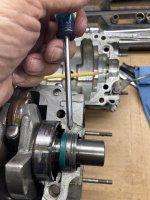
My 1959 Mark 15A has been rebuilt with New pistons, Rings, neeedle, roller and new ball bearings. New crankshaft seals - one up top and two at the bottom. The block went to the machine shop of the late Steve Litzell for analysis and port modifications. It has been broken in properly 10 hours or so with 25:1 Mercury Premium Plus and no ethanol gas. It has developed a squeal. All the ball bearings are OK and have not spun their races. At the bottom you can see that the lower crankshaft seal at the bottom has spun - no green paint on it.
I’m not sure what to do besides install a new seal and “glue” it with some Loctite 638 or Permatex 60950 then close up the block with 518 or Yamabond. I clean all mating surfaces with acetone several times to degrease mating surfaces.

The screwdriver is pointing at the green crankshaft seal, steel spacer ring, then the another crankshaft seal that’s squealing with the green paint worn off.
Suggestions welcome ....
 

greg13

Well-known member
Joined
Aug 2, 2018
Messages
497
Location
Weedsport, NY
BillK, I have not opened up my outboard yet. I spoke to a friend who retired as chief inspector at Mercury and another guy today who is in his 50th and last year of sanctioned outboard racing - he has a complete machine shop. We will have our monthly antique outboard meet in a week or so. I will let all the mechanic gurus pitch in with their opinions. I had to get out of the way last time when I started to stuff my pistons and everybody took over.
I am reluctant to dimple anything to "hold" the outer race. I know the crankshaft is supposed to float some (.010"). The upper bearings are heat shrunk into where they go. No presses ever. everything cleaned 3 times with acetone. block sealed with 518 or Yamabond. Used digital SnapOn torque wrench to button everthing up. I doubled up to 25:1 oil gas ration for break-in running. I even wore the rings in pre-run as suggested by the head wrench of an IMSA GTP Corvette team.
I have no clue what went wrong yet but will do surgery on the power head shortly.

I think you are taking thing a little too seriously here. Most of the things you are using to REBUILD it weren't even made when the motor was built the first time! I wonder how it ever ran for 50 years?
 
OP
J

John Timmins

Well-known member
Joined
Sep 1, 2008
Messages
861
Location
Flagler Beach, FL
Update:I installed 1.250 O.D. crankshaft seals. The correct part is 1.250" PLUS .005 "

I ordered the 1.255 diameter seals and have installed a new ball bearing from Mercury. I am confident it will be assemble just fine with no "bearing set glues" or any of that kind of product.

I will button up the crankcase with Locktite 518 or Yamabond after cleaning all the surfaces with acetone.
 

LS6 Tommy

Well-known member
Joined
Dec 27, 2013
Messages
26,162
Location
Northern NJ
I'm pretty sure your double oil dosage is your problem. The more oil, the leaner the mixture and you overheat, seize and spin a bearing. I can't count how many two stroke engines I've seen locked up or with spun bearings from being too lean because the owner thought more oil was better...

Tommy
 

oldmxracer

Well-known member
Joined
Jan 29, 2006
Messages
1,204
Location
Ohio
I'm pretty sure your double oil dosage is your problem. The more oil, the leaner the mixture and you overheat, seize and spin a bearing. I can't count how many two stroke engines I've seen locked up or with spun bearings from being too lean because the owner thought more oil was better...

Tommy

I was thinking the same thing, but did not post it !

Right or wrong for years every two stroke I play with regardless of age gets the same 50/ 1 Amsoil dominator mixture. Not had a problem.
 
Last edited:

ttpete

Well-known member
Joined
Mar 8, 2011
Messages
6,737
Location
Dearborn, MI
I'm pretty sure your double oil dosage is your problem. The more oil, the leaner the mixture and you overheat, seize and spin a bearing. I can't count how many two stroke engines I've seen locked up or with spun bearings from being too lean because the owner thought more oil was better...

Tommy

Bear in mind that the motor was made in 1959. At that time, Mercury specified their Quicksilver oil mixed at 25:1. Oils were different at that time and were nothing like today's synthetic two-stroke oils. OMC engines used one quart of 2-stroke oil to 6 gallons of gas, which was close to 25:1. At the time, I was in school and lived with my grandparents at their lakeside home during summer break, spending my days in our boat. I bought a lot of gas and oil because we water skied every day.

Those motors all used deflector top pistons and side-to-side scavenge and didn't make the horsepower 2-strokes make today. What they DID have was water cooling and adjustable main jets on the front panel, so they never had the lean condition problems of modern fixed-jet engines.

Later, in the 1980s, a friend and I did some vintage motorcycle road racing with his 2 sons as riders. The bikes were air-cooled Yamaha 250 and 350 twins. We used Castrol 30 weight bean oil in them. What we did do was monitor air density, and we had a graph that tied jet sizes to density readings. It worked very well, and we never had a seizure.
 
To avoid these ads, REGISTER NOW!
Top Bottom