
You are using an out of date browser. It may not display this or other websites correctly.
You should upgrade or use an alternative browser.
You should upgrade or use an alternative browser.
STAHLWILLE Jet Reamer Set
- Thread starter Wamsutta
- Start date
rlitman
Well-known member
I have the equivalent. Those appear to be bushing cutting broaches. Why do you ask?
I just now found out about those tonight. I also didn't know what a jet number meant. Come to find out, a #100 jet is 1.0 millimeters in diameter and a #35 jet is 0.35 millimeters in diameter. People are saying that jet reamers are far more accurate than jet drills. They say that jet drills wobble as they're drilling the hole.
Last edited:
SwissMetric
Well-known member
Jet Reamer Set 11085 (74310001 or 74 31 00 01):
16 pieces, in case, with holder.
Diameters: 0.33; 0.40; 0.45; 0.5; 0.6; 0.7; 0.75; 0.8; 0.9; 1.0; 1.1; 1.2; 1.4; 1.6; 1.8; 2.0 mm.
Swiss list price CHF 111.80 excl. 8.1 % VAT (approx. USD 122.13).
Street price should be much lower.
I'd simply get the original or an equivalent from a good manufacturer but never pay just for the "Stahlwille" marking. Many specialized automotive tools listed in the catalog are not made by Stahlwille, not even all sockets are made by Stahlwille, here mostly referring to some impact products. I can even confirm that some articles are or at least were made by... Hazet.
I never used it but it is not made by Stahlwille, you'll only pay a premium for the name. I don't know who is the original manufacturer but it's made in Germany based on the country of origin declaration, also I didn't check if Rennsteig makes such tools.
16 pieces, in case, with holder.
Diameters: 0.33; 0.40; 0.45; 0.5; 0.6; 0.7; 0.75; 0.8; 0.9; 1.0; 1.1; 1.2; 1.4; 1.6; 1.8; 2.0 mm.
Swiss list price CHF 111.80 excl. 8.1 % VAT (approx. USD 122.13).
Street price should be much lower.
I'd simply get the original or an equivalent from a good manufacturer but never pay just for the "Stahlwille" marking. Many specialized automotive tools listed in the catalog are not made by Stahlwille, not even all sockets are made by Stahlwille, here mostly referring to some impact products. I can even confirm that some articles are or at least were made by... Hazet.
I never used it but it is not made by Stahlwille, you'll only pay a premium for the name. I don't know who is the original manufacturer but it's made in Germany based on the country of origin declaration, also I didn't check if Rennsteig makes such tools.
KnurledNut
Well-known member
Not always. There are variations among jet manufacturers. In addition to the reamers, a jet gauge is necessary to accurately determine actual sizing.I also didn't know what a jet number meant. Come to find out, a #100 jet is 1.0 millimeters in diameter and a #35 jet is 0.35 millimeters in diameter.
It's looking like those carburetor jet gauges are intended for removable jets being how short they are. I've got an idle jet way down inside a passageway probably at least an inch below the surface.Not always. There are variations among jet manufacturers. In addition to the reamers, a jet gauge is necessary to accurately determine actual sizing.
rlitman
Well-known member
I'd probably be shopping here:
 www.esslinger.com
Stahlwille is NOT making these, so why pay for their markup and insane import prices?
www.esslinger.com
Stahlwille is NOT making these, so why pay for their markup and insane import prices?
As for wobble, reamers are tapered, so once they open up a hole to match their taper, they do not wobble. However now you have a conical and not cylindrical hole. Broaches also come in smooth and 5 sided varieties, with the smooth being not much more than smooth tapered needles. That's not going to "ream" much, but it will burnish, and is the safest option. Twist drills have the bad habit of drilling a reuleaux triangle biased hole (it's a shape of constant diameter) that's roughly cylindrical. A cylindrical hole doesn't hold onto a cylinder as tightly as two matching cones fit up, so yes, a broach has the capability to make a rounder and more perpendicular hole. That's critical for things like watch and clock bushings. I don't know how it relates to jets, but I guess it wouldn't hurt.
Jeweler's Workbench Broaches | Broaches For Jewelers | Esslinger.com
Browse broaches, jewelry, jewelry making tools, and jewelry making resources that will be sure to satisfy any of your needs.
www.esslinger.com
As for wobble, reamers are tapered, so once they open up a hole to match their taper, they do not wobble. However now you have a conical and not cylindrical hole. Broaches also come in smooth and 5 sided varieties, with the smooth being not much more than smooth tapered needles. That's not going to "ream" much, but it will burnish, and is the safest option. Twist drills have the bad habit of drilling a reuleaux triangle biased hole (it's a shape of constant diameter) that's roughly cylindrical. A cylindrical hole doesn't hold onto a cylinder as tightly as two matching cones fit up, so yes, a broach has the capability to make a rounder and more perpendicular hole. That's critical for things like watch and clock bushings. I don't know how it relates to jets, but I guess it wouldn't hurt.
I'm left wondering what the difference is between a broach and a reamer. I assume you don't rotate a broach; correct?I'd probably be shopping here:
Stahlwille is NOT making these, so why pay for their markup and insane import prices?Jeweler's Workbench Broaches | Broaches For Jewelers | Esslinger.com
Browse broaches, jewelry, jewelry making tools, and jewelry making resources that will be sure to satisfy any of your needs.
As for wobble, reamers are tapered, so once they open up a hole to match their taper, they do not wobble. However now you have a conical and not cylindrical hole. Broaches also come in smooth and 5 sided varieties, with the smooth being not much more than smooth tapered needles. That's not going to "ream" much, but it will burnish, and is the safest option. Twist drills have the bad habit of drilling a reuleaux triangle biased hole (it's a shape of constant diameter) that's roughly cylindrical. A cylindrical hole doesn't hold onto a cylinder as tightly as two matching cones fit up, so yes, a broach has the capability to make a rounder and more perpendicular hole. That's critical for things like watch and clock bushings. I don't know how it relates to jets, but I guess it wouldn't hurt.
KnurledNut
Well-known member
It's looking like those carburetor jet gauges are intended for removable jets being how short they are. I've got an idle jet way down inside a passageway probably at least an inch below the surface.

rlitman
Well-known member
Tapered broaches get rotated. You don't want to use too much force on something so delicate. These are the most primitive form of reamer, and as I said above, come in two flavors, smooth and pentagonal. Reamers usually have more complex cutting edges with smaller negative rake angles (i.e. reamers have sharp cutting edges like files, while tapered broaches work more by scraping).I'm left wondering what the difference is between a broach and a reamer. I assume you don't rotate a broach; correct?
These aren't the same thing as broaches you push through to cut a shape (like for making square holes).
Is 0.33 millimeters the smallest jet there is? I've got a Honda jet cleaning kit and the smallest wire in the kit says it's for #35 through #40 jets.Tapered broaches get rotated. You don't want to use too much force on something so delicate. These are the most primitive form of reamer, and as I said above, come in two flavors, smooth and pentagonal. Reamers usually have more complex cutting edges with smaller negative rake angles (i.e. reamers have sharp cutting edges like files, while tapered broaches work more by scraping).
These aren't the same thing as broaches you push through to cut a shape (like for making square holes).
07JPZ-001010B
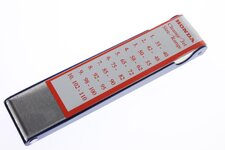
just going to tease me?
Have a link, brand or part number?