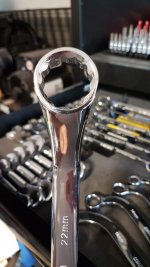
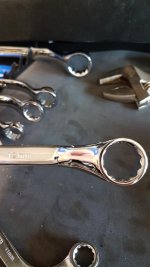
I just got a small set of Stahlwille’s Stabil 20 spanners (20/7N), and to my dismay they are pretty poorly made in vaunted Germany.
I have other Stahlwille spanners, so I knew not to expect a high finish quality. I even called the roughness of German tools charming in another post. This time the charm has worn a bit thin.
In the images below, I’ve used thick and thin blue arrows to show off-centre (non-concentric) broaching, although this is easier to see with the tool in your hand against the light. Try comparing the thickness of the chamfered area around the circumference and, in the case of the 8 mm, the thickness outside the chamfered area.
Red arrows point to flaws in the chrome plating or underlying steel, not that you need my arrows.
Click an image to see it larger.


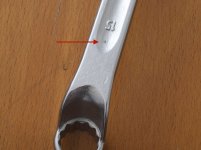

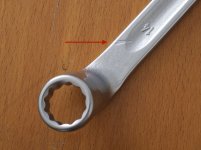

These are on top of the usual (for Stahlwille) slight asymmetries, grind marks, etc., on the sides of the spanners.
Can’t say I’m impressed.
I have other Stahlwille spanners, so I knew not to expect a high finish quality. I even called the roughness of German tools charming in another post. This time the charm has worn a bit thin.
In the images below, I’ve used thick and thin blue arrows to show off-centre (non-concentric) broaching, although this is easier to see with the tool in your hand against the light. Try comparing the thickness of the chamfered area around the circumference and, in the case of the 8 mm, the thickness outside the chamfered area.
Red arrows point to flaws in the chrome plating or underlying steel, not that you need my arrows.
Click an image to see it larger.
These are on top of the usual (for Stahlwille) slight asymmetries, grind marks, etc., on the sides of the spanners.
Can’t say I’m impressed.
 What's the definition of "tool polisher"? I'm wondering what percentage of GJers qualify for that badge.
 Good one. Are there other indicators?