To avoid these ads, REGISTER NOW!

Stainless stain shrinkage

bobj49f2

Banned
Joined
Nov 13, 2009
Messages
430
Location
SE Wisconsin
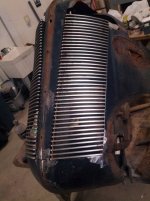
Does stainless steel shrink when welded? I am building a new grill for my '37 Buick using 3/16" stainless steel. There are 41 horizontal curved slats on each half of the grill. I had the slats laser cut to match the original grill. The original grill is pot metal and as is typical with these grills, the two halves are broke into two pieces. I want to make a new one out of stainless for two reasons, non-oxidizing and durability.

I made a jig to hold the grill parts in while I welded the parts together. There were spacing blocks in between each slat and the end blocks were permanent, spaced to equal the top and bottom of the original grill. Everything fit tight. I spot welded all of the parts together from the back, checked the fit and then finished welding from the front. Now when I place the grill into the jig there's about 3/16" gap between the bottom slat and the bottom stop of the jig. The only thing I can think of is the stainless shrunk as I was welding it. I tried to search the net on whether stainless shrinks when welded and the sites I found dealt with welding stainless pipe.

This is the grill. The right side in the picture, the driver's side, is the new grill, the left side is the old pot metal grill.
 

Attachments

  • picture256.jpg
    picture256.jpg
    108.6 KB · Views: 134
To avoid these ads, REGISTER NOW!

48RON54

Well-known member
Joined
Dec 27, 2013
Messages
2,666
Location
Inland Empire, CA
I have no idea but...........

I am into 30s/40s/50s GM vehicles and I have dozens of friends that are too.... And this is the first time I've ever seen someone repairing one of those old pot metal grills like that.

Good work!!!
 

zkling

Well-known member
Joined
Jan 23, 2007
Messages
16,939
All metals will distort and shrink to some degree when heated and fixed, then cooled (welded). Some specific stainless alloys are particularly bad about this. Although that sounds like quite a bit of movement in the grand scheme of your project. Can you take a close up of the welds. I have a feeling you are putting too much heat into the joints. The more heat the more distortion and movement you will have. I would also do a dimensional check to verify the parts were correct length and placement before they were welded.
 
OP
B

bobj49f2

Banned
Joined
Nov 13, 2009
Messages
430
Location
SE Wisconsin
I have no idea but...........

I am into 30s/40s/50s GM vehicles and I have dozens of friends that are too.... And this is the first time I've ever seen someone repairing one of those old pot metal grills like that.

Good work!!!

This is a fairly simple design. I had to do a CAD drawing of the individual slats, there are 15 different sizes. The grill is not flat, it had a curve in it from top to bottom that isn't noticeable from casually looking at it. After I had it welded I noticed the grill was flat so I placed over two 2X4s and gently stepped on it to get the curve. No way you'd ever be able to tweak a piece of pot metal like that and when does a part ever fit an old car perfectly? Other than the "shrinkage" I thought it was turning out pretty good.

Tomorrow I'll cut it apart and get two new pieces for the sides and reweld it. I could be using too much heat. I thought it was welding together really nicely. I'll try to turn the heat down and see what happens.
 

48RON54

Well-known member
Joined
Dec 27, 2013
Messages
2,666
Location
Inland Empire, CA
Well, it is great work!! Please keep us posted on the progress... I am really impressed! I don't think anything fits right on those old cars and to be honest I doubt they came out of the factory fitting all that dam well in the first place.
 

rsanter

Well-known member
Joined
Dec 22, 2007
Messages
18,505
Location
visalia ca
Yes and no
When welding you are applying the metal in the hot state. The hot wetland will have a larger volume than cold metal.
As the weld material cools it will spring and as a result will cause a shrinkage/draw/contraction....whatever you want to call it in the weld area. This is the general cause for the distortion or wrinkling that happens when you weld flat panels together.
When welding cast iron this is a petecular problem as when the weld shrinks it will pull on the adjacent material and actually cause a crack next to the weld.

One thing you can do for critical applications is to do some preheating of the base metal and then do your welding

Bob
 

dieselgarage

Well-known member
Joined
Dec 18, 2012
Messages
277
If you end up needing help with the welding let me know looks like we are close by. I have about 30 guys that weld nothing but stainless.
 

welder4956

Well-known member
Joined
Apr 8, 2010
Messages
3,067
Location
Birmingham, AL USA
Yes, stainless does shrink and distort easier that mild steel. The thermal expansion coefficient is higher. Anything you can do to minimize the heat will help, including use of heat sink compound or copper chill bars.
 
OP
B

bobj49f2

Banned
Joined
Nov 13, 2009
Messages
430
Location
SE Wisconsin
Thanks guys, I'll have to talk to the welding supply store and see if they have some kind of paste.

I'm going cut the grill apart tomorrow and weld in new sides.

I don't have much experience welding stainless, I've a good amount of mild steel and didn't realize there was much difference.
 
To avoid these ads, REGISTER NOW!

rsanter

Well-known member
Joined
Dec 22, 2007
Messages
18,505
Location
visalia ca
Another option
Use what you have as a standard. You now know how much it will/should shrink
Do some math and make the next one oversized just a little and let it shrink

Bob
 

mechan

Well-known member
Joined
Apr 16, 2009
Messages
401
I am not sure I would try to make the pieces over sized. Trying to guess on the amount of draw that each piece will incur would be fairly hard. Differences in the metal from the mill, the amount of heat you are inputing, amount of filler metal, and so on will cause the stainless to pull in different directions. I am not sure what your heat is or really the size of the cross sections, but I would suggest making your jig more rigid and jumping around a lot while you are welding these.

Where they are just slats in the grill they also do not need a *ton* of weld on them to hold. I am not able to tell how much weld you have on them, but you may want to consider reducing the amount of weld and as such this will reduce the amount of heat input. Also you may want to make your jig so that it follows the interior contour of the slats and you are able to tack them off to the jig to mitigate them pulling out of position.

I did not notice if you said if your jig is stainless steel or mild steel, but if it is mild steel and you are welding to it I hope you are taking into consideration it will rust in those areas over time unless passivated. Are you using 309 to make the weld from the slat to the jig if it is mild steel?
 
OP
B

bobj49f2

Banned
Joined
Nov 13, 2009
Messages
430
Location
SE Wisconsin
I am using a wooden jig, using hardwood, not sure what type of hardwood though. I had a friend who is a woodworker build it for me.

I work with companies that do food machinery and know about cross contamination between mild steel and stainless. I talked to them about passivating the stainless. I plan to use citric acid, it's safer to use and easier to get rid of. I'm using 304 stainless, since this isn't food grade I am using the cheaper stainless.

I'm going to tear the grill apart today and reweld it using smaller, cooler welds and see how that works out.
 

Attachments

  • jig01.jpg
    jig01.jpg
    72.7 KB · Views: 13

MoonRise

Well-known member
Joined
Nov 5, 2010
Messages
4,028
Location
NJ
Yes, stainless steel (or any 'common' metal) shrinks when it changes from its liquid (molten) state into its solid form/state.

The liquid molten metal (from the weld) shrinks as it cools. This can cause distortion or 'locked-in' stresses in the weldment.

Some possible solutions include really-really-really rigid jigs/fixtures (wood will generally NOT be rigid enough to resist the cooling contraction of molten steel) to hold the pieces while they are being welded (can minimize distortion but can cause those shrinkage stresses to stay in the weldment, which can then distort or crack/fail later, depending on the magnitude of those stresses), using a really-really rigid jig/fixture and then "stress relieving" the weldment afterwards, or compensating for the distortion/shrinkage before (or as) you weld (example: you know that a T-joint will 'pull' towards the first fillet weld, so you tilt the T towards that side before you weld it and 'allow' the shrinkage distortion to pull the joint back into the desired right-angle joint).

Also, nice tight fitment of the pieces minimizes distortion.

As does 'properly' tacking the joint(s) into position before welding, and also using a 'proper' weld sequence to try and minimize the distortion (after tacking the pieces together, you then try and make welds so that as one weld pulls in one direction, then the next weld pulls in the opposite direction to pull things back towards where you wanted them to end up).

Also, after having proper fit-up and proper tacking, use the minimum weld size needed(less heat and less molten weld bead results in less distortion).

You may also have to use a 'skip' weld or 'backstep' idea, where you do a little weld in one place and then skip to a different place and do a little weld there and then skip to another place and do a little weld there, etc, etc. Think of welding sheetmetal, if you tried to weld a continuous bead you would end up with some wicked nasty distortion, so you get good fitment first, then clamp and tack it and then do a whole bunch of small welds and you spread them out (and also wait for the metal to cool before doing the next small weld and also planish the weld beads as you go so that you mostly correct the small amount of small distortion from the small weld bead before you even start the next small weld bead, instead of trying to correct the cumulative distortion of all the welding at the end).

Fit it, jig/clamp it, tack it, weld it (small welds and minimize the heat input into the weldment).

Take lots of breaks and let the metal cool before doing the next small weld. Might be five minutes of actual welding arc time, but two hours of elapsed time with all of the tacking and cooling and do a small weld and cooling and small distortion correction before doing the next small weld and letting that cool and correcting the small distortion, etc, etc.
 
OP
B

bobj49f2

Banned
Joined
Nov 13, 2009
Messages
430
Location
SE Wisconsin
When I weld sheet metal I do tack weld the panels in and then skip around with small stitch welds to join the tack welds. While I'm doing this I use my air hose and blow on each weld to cool it off. I tried this with the stainless but probably didn't allow enough time between each weld. Does blowing air over stainless help or hurt to cool the welds?
 

Lazylaser

Member
Joined
Mar 7, 2014
Messages
12
Location
Pittsburgh
When welding bank vault & safe parts out of stainless our welders would use scrap pieces of granite stone that we kept in the freezer as a heat sink. :thumbup:
 

48RON54

Well-known member
Joined
Dec 27, 2013
Messages
2,666
Location
Inland Empire, CA
Do you have any more pics of the car? Do you have a build thread somewhere? Is it 2 door, 4 door, coupe, vert, etc? Does it have the fender mount spares? What are you plans on the build? Original/Custom/Hotrod?
 

hippie2cams

Well-known member
Joined
Jul 15, 2012
Messages
384
Location
Huffman,TX
Back when I was welding on Boiler tubes in the powerhouse industry, Novices would be amazed at how much the stainless tubes would draw when welded. Typical panels would draw as much as two inches in a 6 ft. panel. you start at your closest end and weld just a few tubes and watch the other end as it comes up, you have to be very careful to catch the gap on the other end and weld it before it traps itself and starts digging in to the upper panes and ruins your weldment. Sometimes you may have to grind out a weld gap to complete your welds. But I guess the correct answer is yes stainless shrinks at lot more than you can imagine.
 
OP
B

bobj49f2

Banned
Joined
Nov 13, 2009
Messages
430
Location
SE Wisconsin
Well, I tore the grill completely apart Friday. Cleaned all the weld boogers off the slats and started over with two new upright pieces. I also checked the jig and it was built a little too short, I thought we had checked it a couple of time before but somehow we overlooked that part.

Yesterday I remeasured everything, the original grill parts and the new parts and all of the gaps. It turned out I was off by only a few thousands on a couple of measurements but when you multiply them by 41, the number of slats, they really add up. I used my original jig with a little modifications and some thin shims and welded the grill up again. I also added a little extra for shrinkage. The grill came out as perfect as I think I'll ever get it. Every part of the new grill matches up to the old grill.

Thanks everyone for the help and suggestions.

48RON54, I do have a build page for it on my web site. It's a '37 Buick Special, four door and it came with two side mount spares, which I have been told is very rare for a Special, usually only the higher end Buick had them. It will be pretty much stock except for a 12 volt electrical and a few other upgrades:

www.fatfenderedtrucks.com
 

Attachments

  • picture257.jpg
    picture257.jpg
    130.2 KB · Views: 15
  • picture258.jpg
    picture258.jpg
    142.8 KB · Views: 18

zkling

Well-known member
Joined
Jan 23, 2007
Messages
16,939
Good job. Congrats on getting it done. Now just another trick to add to your tool box for future reference. :beer:
 
To avoid these ads, REGISTER NOW!
Top Bottom