
You are using an out of date browser. It may not display this or other websites correctly.
You should upgrade or use an alternative browser.
You should upgrade or use an alternative browser.
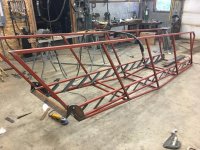
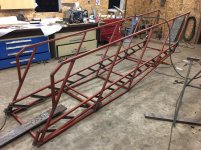
Staircase for a cabin
- Thread starter royce
- Start date
Marctrees
Well-known member
Looks good.
Holes not pre drilled in the short angles for the treads for a reason ?
Marc
Holes not pre drilled in the short angles for the treads for a reason ?
Marc
matt_i
Well-known member
Looks good! Is the tubing pre-primed by you, or did you buy it like that?
Are you going to supply the treads or the friend will put their own in (guessing wood)
Im intrigued by the sheave/cable design. Will look forward to pics
Are you going to supply the treads or the friend will put their own in (guessing wood)
Im intrigued by the sheave/cable design. Will look forward to pics
nitroracer20
Well-known member
Looks great, sweet concept. Too notch. Cant wait to see installed product with counterweights.
Thanks Nitro,
The owner picked it up this morning and we chatted about the rigging,
He has a couple of cool old steel mounted wooden blocks he will use and I have a chunk of 4" round bar for the counterweight.
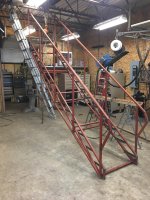
My bride had me raise it up, so she could see it at height.
It met her and the owners approval!
Royce
The owner picked it up this morning and we chatted about the rigging,
He has a couple of cool old steel mounted wooden blocks he will use and I have a chunk of 4" round bar for the counterweight.
My bride had me raise it up, so she could see it at height.
It met her and the owners approval!
Royce
Attachments
Marctrees
Well-known member
"My bride had me raise it up, so she could see it at height.
It met her and the owners approval!"
Starting to get too weird for me.
Marc
It met her and the owners approval!"
Starting to get too weird for me.
Marc
Graham08
Well-known member
Nice work on the ladder! It's pretty amazing what you can accomplish with a weight, cable, and pulleys. If you hit the geometry right, you can make it stay both up and down without having to latch it in either direction.
harley jim
Well-known member
Beautiful work Royce, as usual
Sent from my SM-A102U using Tapatalk
Sent from my SM-A102U using Tapatalk
Jazz1
Well-known member

Thanks Graham,
Here is a pic of the counterweight.
The owner will cut it to length at the proper weight.
I advised him to use the weight touching the floor for the high travel limit and to start with about 10 pounds of human force needed to help get the stairs started in the up direction.
It will take some experimenting.
Unless I'm seeing it backwards, the force on the cable will be greatest when the stairs are in the down position and the least when in the up position.
I think the thing to be careful with, is to have the stairs want to race up and the counterweight crash at the floor.
Royce
Here is a pic of the counterweight.
The owner will cut it to length at the proper weight.
I advised him to use the weight touching the floor for the high travel limit and to start with about 10 pounds of human force needed to help get the stairs started in the up direction.
It will take some experimenting.
Unless I'm seeing it backwards, the force on the cable will be greatest when the stairs are in the down position and the least when in the up position.
I think the thing to be careful with, is to have the stairs want to race up and the counterweight crash at the floor.
Royce
Attachments

Bighead38
Well-known member
I really want to see them installed.
matt_i
Well-known member
It seems like its going to need a "cam" or off-center pulley, etc. If the raising and lowering force felt by the person and balanced by a dead weight is to be the same thru the entire travel.
The "weight of the stairs" as felt by a cable is going to be changing relative to a fixed point as its center-of-mass pivots around a center point/shaft.
The "weight of the stairs" as felt by a cable is going to be changing relative to a fixed point as its center-of-mass pivots around a center point/shaft.
Matt,
I agree with the weight difference between being up and down.
I am hoping this can be done without a lot of complexity.
I'm guessing there is somewhere between 50 and 100 pounds difference in the force the cable will see between up and down, but I don't have the ability to calculate it.
I'm hoping the counterweight can be set so the stairs are not to heavy for a person to help lift them to get them started up and not have them race to the up position.
May need to control the accent with some form of friction.
It will be interesting to see the outcome
Royce
I agree with the weight difference between being up and down.
I am hoping this can be done without a lot of complexity.
I'm guessing there is somewhere between 50 and 100 pounds difference in the force the cable will see between up and down, but I don't have the ability to calculate it.
I'm hoping the counterweight can be set so the stairs are not to heavy for a person to help lift them to get them started up and not have them race to the up position.
May need to control the accent with some form of friction.
It will be interesting to see the outcome
Royce
jeepinerdeep
Well-known member
Nice fab work !
sbosecker
Well-known member
Says the the man with Richard Simmons on his avatar!!!
Touché!
Bighead38
Well-known member
Have you weighed it and found the balance points?
Graham08
Well-known member
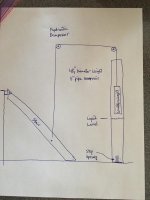
If this does not work as I feel it might, I was thinking about a hydraulic dampener.
Here is a rough concept sketch.
Royce
Cool idea on the damper!
I'm not sure if the Photobucket thing a couple years back wiped out my photos in my garage build thread, but I did a similar thing for my attic access, which was a framed, insulated, and drywalled structure over a stairwell. I was able to position the pulleys such that it held the access cover up, but the geometry changed enough where my counterweight didn't have enough mechanical advantage that I needed to latch it down.
Because the weight and geometry was appropriate, I didn't have issues with it racing up or slamming down, but it required minimal human effort to move. I had to weigh my access door and do a little trig to determine the final position of the components, but the end result was worth the effort.
Graham08
Well-known member
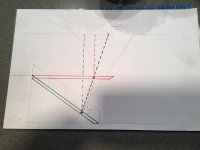
Here is a sketch with what I feel is a good block location.
It is a line that intersects the swing radius in the up and down locations.
Am I nuts to think this will give a good balance between up and down?
Royce
I noticed this post after I had already posted. I would make the cable 90 degrees to the stairs in the up position, then let it go away from 90 degrees when the stairs are down. That way the counterweight has less mechanical advantage when it's down, so the stairs will tend to stay down.
Cool idea on the damper!
I'm not sure if the Photobucket thing a couple years back wiped out my photos in my garage build thread, but I did a similar thing for my attic access, which was a framed, insulated, and drywalled structure over a stairwell. I was able to position the pulleys such that it held the access cover up, but the geometry changed enough where my counterweight didn't have enough mechanical advantage that I needed to latch it down.
Because the weight and geometry was appropriate, I didn't have issues with it racing up or slamming down, but it required minimal human effort to move. I had to weigh my access door and do a little trig to determine the final position of the components, but the end result was worth the effort.
4 foot of 4-1/4" round bar counterweight would displace about 24 pounds in water and may even slow the accent at the upper end of travel.
Royce
I noticed this post after I had already posted. I would make the cable 90 degrees to the stairs in the up position, then let it go away from 90 degrees when the stairs are down. That way the counterweight has less mechanical advantage when it's down, so the stairs will tend to stay down.
Graham,
Lets say in the up position, it takes 230 pounds to keep it up, with the cable at 90 degrees.
So, in the down position, how much human force do you think it would take to get it started?
The owners are a older couple and I fear it would take too much human effort to help it up.
Royce
Graham08
Well-known member
Graham,
Lets say in the up position, it takes 230 pounds to keep it up, with the cable at 90 degrees.
So, in the down position, how much human force do you think it would take to get it started?
The owners are a older couple and I fear it would take too much human effort to help it up.
Royce
It depends on how far overbalanced you have it, and the angular change in the cable from up to down.
Say you have it exactly balanced in the up position, so you barely have to pull down. You have 230 lb of tension in the cable, so when the cable is vertical, all of that tension is holding the staircase up.
Just to throw some numbers at it, if you have a 10' ceiling and use a standard 7/11 rise/run for stairs, that means the run of the staircase is 15.7', and the distance along your stringer is 18.6'. So that means your cable will be about 16 degrees to vertical with the stairs down. 230 * cosine(16) is 221 lb, so it's only going to take about 9 lb of effort to get it started back to the ceiling.
If you overbalance it slightly, there will be less force required to get it started up, but more to pull it down...and if you go too far, you'll need to latch it down. When I did my attic access, my counterweight was a box of lead shot, so I could adjust the weight slightly when I was done.
Thanks Graham for your input,
This is over my head by quite a bit.
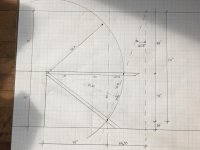
Here is a sketch with some numbers put to it.
With useing 230 pounds to balance in the up position and this new info, what do you think the weight is in the down position ?
I'm thinking it should have very little over balance and that the counterweight can be cut to length/weight after testing function with some lifting weights of a known weight
Thank you for your help
Royce
This is over my head by quite a bit.
Here is a sketch with some numbers put to it.
With useing 230 pounds to balance in the up position and this new info, what do you think the weight is in the down position ?
I'm thinking it should have very little over balance and that the counterweight can be cut to length/weight after testing function with some lifting weights of a known weight
Thank you for your help
Royce
Attachments
Last edited:
Graham08
Well-known member
Thanks Graham for your input,
This is over my head by quite a bit.
Here is a sketch with some numbers put to it.
With useing 230 pounds to balance in the up position and this new info, what do you think the weight is in the down position ?
I'm thinking it should have very little over balance and that the counterweight can be cut to length/weight after testing function with some lifting weights of a known weight
Thank you for your help
Royce
I see what you did. Basically you drew a line through your cable attachment in both the down and up positions to place the pulley. That makes the analysis easy. The upward force is the same for both since the angle of the cable is the same in both positions. It changes slightly over the staircase's downward travel, but not by a lot.
If you need 240 lb of force to hold it up, that means you'll need 256 lb of weight to tension the line, due to the 20.6 degree angle of the cable to vertical in both cases. 93.6% of the cable tension is pulling up.
In this configuration, you would probably need to latch it down just because the geometry is constant, and you'll want enough weight to hold it up.
Going off your sketch, if you move the pulley so the cable is vertical in the up position, it would be at 17.5 deg to vertical when the staircase is down. You would need 240 lb of weight to hold it up, which would apply 229 lb of vertical force in the down position. So you would need to lift up by 11 lb to get it started back up, but it would stay down by itself.
Last edited:
Graham,
I don't doubt it, but I am surprised that there is only a 11 pound differential, between up and down with the cable vertical in the up position.
Yes, I think it would be good not to have to latch it in either up or down position.
Can you explain the formula you used to figure the force with the 20.6 degree pull or any degree for that matter?
You have been a big help
Thanks again
Royce
I don't doubt it, but I am surprised that there is only a 11 pound differential, between up and down with the cable vertical in the up position.
Yes, I think it would be good not to have to latch it in either up or down position.
Can you explain the formula you used to figure the force with the 20.6 degree pull or any degree for that matter?
You have been a big help
Thanks again
Royce
Graham08
Well-known member
I'm just using cable tension * cosine(cable angle to vertical) to get the vertical force on the stairs. Because you're just using a hanging weight, the cable tension is just the weight.
Sent from my Pixel 2 XL using The Garage Journal mobile app
Sent from my Pixel 2 XL using The Garage Journal mobile app

Humm, I wonder if it would be worthwhile studying the pull down attic folding stairs they sell at costco and such places. Those units use springs to pull and hold them up and just light force on a string to lower (and unfold them). They stay down after you lower them. There is some kind of cant lever pivot action involved.
Sorry I can't provide more info on them.
Sorry I can't provide more info on them.
Graham08
Well-known member
Graham,
I took a stab at calculating the weights with moving the block location 6" from vertical in the up position.
I'm not sure I got it right, if it is not too much trouble, could you have a look at it?
Thanks
Royce
Your math checks. I get the 4 lb difference in upward force between the two angles.
Humm, I wonder if it would be worthwhile studying the pull down attic folding stairs they sell at costco and such places. Those units use springs to pull and hold them up and just light force on a string to lower (and unfold them). They stay down after you lower them. There is some kind of cant lever pivot action involved.
Sorry I can't provide more info on them.
I think it would
Thanks 2ool
Royce