To avoid these ads, REGISTER NOW!

Standardizing 220 Outlets, couple other questions

Augus7us

Well-known member
Joined
Jan 14, 2017
Messages
1,190
Location
Central Ohio
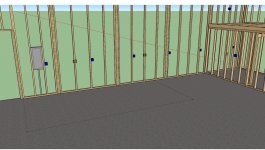
I asked about receptacle layouts in the past and I've now modeled it in Sketchup so let me know what you guys think, I'm open to rearranging it or adding to it.

I've modeled the two gang boxes for 110 in blue and the 220 in orange.

Here are the questions I was unsure about:

  • I'd like to standardize on a single 220 outlet so if I do need to move my tools it wont require rewiring stuff. Some type of NEMA twistlock?
  • How should I run my 110 circuits and what amps? 15 or 20amps? I was thinking alternating outlets on a different circuit (two total).

Here are some mock ups of what I have so far.

East Wall

attachment.php


West Wall

attachment.php


Back Wall

attachment.php


Compressor/Dust Collection Room

attachment.php
 

Attachments

  • electric-comp-r1.jpg
    electric-comp-r1.jpg
    129.2 KB · Views: 359
  • electric-es-r1.jpg
    electric-es-r1.jpg
    144 KB · Views: 362
  • electric-ws-r1.jpg
    electric-ws-r1.jpg
    147.1 KB · Views: 359
  • electric-rear-r1.jpg
    electric-rear-r1.jpg
    153.3 KB · Views: 359
To avoid these ads, REGISTER NOW!

GrayFlattop

Well-known member
Joined
Jan 18, 2018
Messages
1,060
Location
Chicago
I used 2-gang boxes for everything in the shop. For 120 V , I would put two receptacles in each box - each on a separate circuit. Not saying that you HAVE to do it this way, but this way I could plug my miter saw into one half and the shop vac in the other and never worry about overloading the circuit. Nothing but 20 amp wiring and breakers for the 120V side of the street.

As concerns "standardizing" the 240 V receptacles, well, there are different NEMA sizes of t/l receptacles based on amperage rating. To do this correctly, the overcurrent protection should be the same as the receptacle rating (i.e. use a 15 or 20 A receptacle on a 20 A circuit and a 30 A receptacle on a 30 A circuit. I'm not sure what sort of equipment you have, but for me, anything >30A is just hard-wired to a disconnect - or in the case of the 50A circuit for an arc welder - it's pretty unique. Everything else is 20A (for me anyway).
L%202P-3W_496x501.png
 

sberry

Banned
Joined
Jun 18, 2005
Messages
35,747
Location
Brethren, Michigan
I don't own a single thing twist lock. For this kind of garage make it as standard as possible. There is nothing wrong with a multi wire circuit especially if you have specific equipment planned but its really rare to actually have to run 2 at the same time in general areas and these buildings are relatively small, require gfci and there is no better way than to stay simple and wire a circuit to a box.
I think you said sharpening biz, couldn't hurt to have a couple circuits pass thru those rooms.
 
Last edited:

sberry

Banned
Joined
Jun 18, 2005
Messages
35,747
Location
Brethren, Michigan
Real air comps get hardwired, so does AC and welders use 6-50. I got a hi power pressure washer most don't have but everything else in the place but hoist is 120V. There are places, some true wood working shops can use that ****, even makes sense but for JHomeowner/residential make it all common 120 stuff.
My Bud down the road has a dozen different machines, 90% of the time pulls one out and hooks to the same cord. I had 2 occasions in 25 years where I ran a cord over a few ft for something I didn't have wired extra.
I think you said sharpening biz, couldn't hurt to have a second circuit pass thru those rooms. Do you already have machines that run on "220"
 
Last edited:

American Locomotive

Well-known member
Joined
Jan 8, 2017
Messages
11,183
Location
Rhode Island
Don't even waste your time with 15A 120v outlet circuits. Keep it 20A with 12 gauge wire. For lighting, you can do 14 gauge and 15A.

As for the 240v outlets, it really depends on what kind of equipment you are using. If you have smaller stuff like table saws, planers, table routers, etc.. that use 20A or less of 240v, I would just use NEMA 6-20 outlets and skip the twist-locks.
 
To avoid these ads, REGISTER NOW!

sberry

Banned
Joined
Jun 18, 2005
Messages
35,747
Location
Brethren, Michigan
You could get most of the downstairs on a couple circuits, gfci and all and would leave a method to add a wire if it should come to that. If this is a working shop and still under organization get some general stuff in so you can plug in a saw and add some as you go when laying out some tools. Don't get excited to button up every last inch with drywall. Leave a scheme to get back to the panel, one with enough spaces its no big deal to add a couple should the world change.
 
OP
A

Augus7us

Well-known member
Joined
Jan 14, 2017
Messages
1,190
Location
Central Ohio
Thanks Guys good stuff.

GrayFlattop's assumption is correct, most of my 220 stationary tools are 20amp circuits. Some will be shared, I'll run a few dedicated for specific tools that need it or I'll run two at a time.

I thought I read a few posts where guys liked the twist locks. I don't see a real need for them, never had issues in the old shop. But I didn't want to install all this and post a photo and you guys tell me I should have used twistlocks!

Something that slipped my mind that Sberry mentions is hard wiring stuff. I ran conduit in my old shop and would just punch out a hole in the side of the box and use a compression fitting and romex. Since I won't have any conduit here, I'm assuming I'd come in the front of the box/faceplate? I'm drawing a blank, maybe its just been a long day and I'm forgetting something obvious.

Also for boxes do you guys prefer the metal or plastic boxes?

-Clint
 

American Locomotive

Well-known member
Joined
Jan 8, 2017
Messages
11,183
Location
Rhode Island
Twist locks are good for equipment that shakes and moves around a lot, or cord drops hanging from ceilings, etc... There is very little benefit to the average homeowner.
 
To avoid these ads, REGISTER NOW!
Top Bottom