To avoid these ads, REGISTER NOW!

Standardizing on 240v 3phase Outlets

GRB

Well-known member
Joined
May 6, 2014
Messages
828
Location
SoCal
For those of you that have somewhat mobile light duty 3 phase equipment, what outlets/plugs have you used as a standard?

I'm going to be moving stuff around for a while and the equipment is likely to end up in a different building than where it started. I'm thinking standardized outlets might make this easier.

Even thinking I could hook up 240v single phase equipment to the same outlets as long as it doesn't need a neutral for internal 120v.

I'm thinking a 20a or 30a circuit would be fine as the largest machines would be 2hp and it is unlikely that more than 2 would be one at any one time.

Just looking for some ideas here.
 
To avoid these ads, REGISTER NOW!

sherlocktk

Well-known member
Joined
Mar 30, 2011
Messages
131
Location
Orange County, CA
I like the L15-30 as a lot of generators have this plug, makes it easier to find extension cords "done" in this method instead of spending $60 on plugs to DIY.

NOTE: I really mean L14-30, I swapped/forgot the 14/15 numbers.
 
Last edited:

Norcal

Well-known member
Joined
Mar 16, 2008
Messages
13,769
I like the L15-30 as a lot of generators have this plug, makes it easier to find extension cords "done" in this method instead of spending $60 on plugs to DIY.

Single phase devices should not be used for 3 phase PERIOD!
 
OP
G

GRB

Well-known member
Joined
May 6, 2014
Messages
828
Location
SoCal
Single phase devices should not be used for 3 phase PERIOD!
That is what i was thinking. Thanks for the confirmation.

I was being told that a lot of people use L14-x but my research seemed to indicate that is single phase, with some info saying it is for 208v 3phase.

I was thinking L15-20 for this light equipment as a standard. Seems everything says L15 is 3phase with ground. I have a 20a 3phase breaker for the panel in this building. Eventual shop building will need panel replaced so hate to pay big money for a larger 3 phase breaker for this old panel when eventually there won't be any 3 phase equipment in this building. Not trying to cut corners, just be a bit practical.

First piece of equipment is a surface grinder that has a 3 wire cord. It also has a 120v cord for lubrication pump and another for a light. Manual says to also add a ground but there is no ground connection on the unit. Thinking of changing to a 4 wire cord and grounding to the chassis internally. I've moved and plugged in a lot of similar units and can't remember seeing a separate ground on any.
 
Last edited:

wyliesdiesels

Well-known member
Joined
Aug 14, 2012
Messages
20,068
Location
Modesto, CA
That is what i was thinking. Thanks for the confirmation.

I was being told that a lot of people use L14-x but my research seemed to indicate that is single phase, with some info saying it is for 208v 3phase.

I was thinking L15-20 for this light equipment as a standard. Seems everything says L15 is 3phase with ground. I have a 20a 3phase breaker for the panel in this building. Eventual shop building will need panel replaced so hate to pay big money for a larger 3 phase breaker for this old panel when eventually there won't be any 3 phase equipment in this building. Not trying to cut corners, just be a bit practical.

First piece of equipment is a surface grinder that has a 3 wire cord. It also has a 120v cord for lubrication pump and another for a light. Manual says to also add a ground but there is no ground connection on the unit. Thinking of changing to a 4 wire cord and grounding to the chassis internally. I've moved and plugged in a lot of similar units and can't remember seeing a separate ground on any.

Couldve looked up a NEMA chart instead of bouncing back and forth with misinformation.

https://www.stayonline.com/reference-nema-locking.aspx

NEMA 14 is single phase 125v/250v 3 pole 4 wire grounded. 14-30 is used for dryers and 14-50 is used for ranges starting on 1996 code cycle.

Prior to that it was 10-30 and 10-50 which is 125v/250v 3 pole 3 wire non grounded.

Is the grinder 240v 3Ø? If so how old is it? It may be so old that it didnt have a ground. I would definitely ground it. Or its possible someone hacked the cord and didnt use a grounded plug. Have a pic?

You would use a L15-20...

I'm pretty sure the 15 series receptacles don't have a Neutral.

NEMA 15 is 3Ø 3 pole 4 wire grounded/ no neutral.

OP doesnt need a neutral according to his OP but then later brings up 120v accessories...
 
OP
G

GRB

Well-known member
Joined
May 6, 2014
Messages
828
Location
SoCal
I started this with the thought that I have pretty much a clean slate and was looking for the best way to do this. Web searches gave lots of suggestions for L14-20 but seemed to be mostly home shops with phase converters and saying the choices made because they were low cost. Then I started looking for description of L14-20 and found conflicting info. I'm not likely to use extension cords but might want to put in several outlets but can't see the cost of outlets being a big factor.

That chart in the link seemed to be the best info I found. I did find other info that seemed different, thinking some was even on the same site.

It is my understanding that all surface grinders are 3Ø due to smoothness but I understand there are some very recent very low end machines that are 1Ø like a $3000 Grizzly.

This one is 208/240/480v 3Ø. My buildings for this business has 240v 3Ø.

It looks like this version was introduced in the 1980s. The only manual I found was for an earlier version that specified ground. All of the high end CNC equipment we had were grounded, most to a ground rod driven into the ground next to them. Different class of machines.

The unit has two additional 120v plugs for the accessories, grounded of course even though one cord just runs a light.......

I would run ground wire in the emt connected to panel that has ground rod directly under it. Panel in the eventual shop building will be the same way but I have not installed panel yet.

So, my reasoning on using a 4 wire cord is so that I wouldn't have to run a separate ground cable on this AND other equipment. Small equipment like this will likely move around a bit, eventually landing in the next building after I finish it. Bigger equipment would get dedicated circuit in the "new" building. I'm open to other suggestions but not sure what other equipment I will get. Not likely to buy much unless it is really cheap. Probably take a number of items that are free like this was.

Here is the unit. Definitely the load limit for my Honda Ridgeline with a press in front of it.
 

Attachments

  • Harig612Ballway.jpg
    Harig612Ballway.jpg
    117.1 KB · Views: 35
Last edited:

sherlocktk

Well-known member
Joined
Mar 30, 2011
Messages
131
Location
Orange County, CA

ttpete

Well-known member
Joined
Mar 8, 2011
Messages
6,737
Location
Dearborn, MI
If you're not going to be rolling it around, why not put a disconnect on the wall and hard wire it? Most 3 phase is done that way.
 

matt_i

Well-known member
Joined
Mar 14, 2008
Messages
10,742
Location
SE Michigan
I standardized on L14-30 about 18 years ago for machines drawing less than 30A. There has never been an issue in either of the two shops wired as such (the first one was demo'd out when I moved). I own the responsibility not to unplug under load. I don't think the plug can tell whether its a 120v or a 240v as long as its not expected to be seamlessly crossed into a "standard" system. The metal poles and stabs are just conductors.

Now everybody can freak out.
 
Last edited:

wyliesdiesels

Well-known member
Joined
Aug 14, 2012
Messages
20,068
Location
Modesto, CA
I started this with the thought that I have pretty much a clean slate and was looking for the best way to do this. Web searches gave lots of suggestions for L14-20 but seemed to be mostly home shops with phase converters and saying the choices made because they were low cost. Then I started looking for description of L14-20 and found conflicting info. I'm not likely to use extension cords but might want to put in several outlets but can't see the cost of outlets being a big factor.

That chart in the link seemed to be the best info I found. I did find other info that seemed different, thinking some was even on the same site.

It is my understanding that all surface grinders are 3Ø due to smoothness but I understand there are some very recent very low end machines that are 1Ø like a $3000 Grizzly.

This one is 208/240/480v 3Ø. My buildings for this business has 240v 3Ø.

It looks like this version was introduced in the 1980s. The only manual I found was for an earlier version that specified ground. All of the high end CNC equipment we had were grounded, most to a ground rod driven into the ground next to them. Different class of machines.

The unit has two additional 120v plugs for the accessories, grounded of course even though one cord just runs a light.......

I would run ground wire in the emt connected to panel that has ground rod directly under it. Panel in the eventual shop building will be the same way but I have not installed panel yet.

So, my reasoning on using a 4 wire cord is so that I wouldn't have to run a separate ground cable on this AND other equipment. Small equipment like this will likely move around a bit, eventually landing in the next building after I finish it. Bigger equipment would get dedicated circuit in the "new" building. I'm open to other suggestions but not sure what other equipment I will get. Not likely to buy much unless it is really cheap. Probably take a number of items that are free like this was.

Here is the unit. Definitely the load limit for my Honda Ridgeline with a press in front of it.

A ground rod/grounding electrode and equipment grounding conductor/EGC are 2 different animals. Never confuse the 2.

Electrodes are for lightning suppression as well as stablizing and limiting voltage potential to earth.

EGCs are for providing a low impedance fault current pathway.

A grounding electrode does not provide what an EGC provides.

EGCs are for preventing shock potential on pathways not intended to be energized such as tool equipment and motor chassis, raceway, electrical panels, sheetmetal siding and steel framing.

You want your tools grounded to prevent shock hazard especially while using the tool. Again, a ground rod wont provide this...

And EMT, when ran continuously and installed properly, is a code permissable EGC, so no need to run separate ground wire.
 

wyliesdiesels

Well-known member
Joined
Aug 14, 2012
Messages
20,068
Location
Modesto, CA
I standardized on L14-30 about 18 years ago for machines drawing less than 30A. There has never been an issue in either of the two shops wired as such (the first one was demo'd out when I moved). I own the responsibility not to unplug under load. I don't think the plug can tell whether its a 120v or a 240v as long as its not expected to be seamlessly crossed into a "standard" system. The metal poles and stabs are just conductors.

Now everybody can freak out.

So youre using the single phase devices on 3 phase equipment/circuits and thus using the devices outside their rating?
 

Matt Matt

Well-known member
Joined
May 11, 2017
Messages
523
Location
Ontario
At one point, I believe a L14–30, L14–20, 14–15, 14–20, 14–30, 14–50, 14-60 we’re all allowed to be permitted to carry each conductor, up to 300 V to ground(including three phase) . I believe this changed in 1994. A white designation became apparent. I believe now, no plug on the property is allowed to have common dispute...(this means certified electrician in house maintaining all the regulation ) in industrial application it is somewhat allowed . In consumer/residential application, everything needs/should be changed. I’ll try to clarify this with my technician, but I believe as soon as the machine has been moved new electrical standards apply.
 
Last edited:
OP
G

GRB

Well-known member
Joined
May 6, 2014
Messages
828
Location
SoCal
matt_i,
I wouldn't freak out. As long as you understand it and are comfortable with it, AND are the only person touching it, I can see how it would work. I looked at buying an old shop that had an in-house licensed electrician. He did some things that were clearly not right but they knew the system and how to make it work. For example, there was a row of external grinders all hard wired into the same circuit. It would support two at once but not more. They normally ran one, rarely two, and never more. It worked that way for 30+ years.
 
OP
G

GRB

Well-known member
Joined
May 6, 2014
Messages
828
Location
SoCal
So what I'm considering is running one 240v 3Ø circuit down one wall in each building. This would have multiple outlets like a typical 120v 20a circuit. Any light duty 3Ø and 1Ø tools can use this circuit. Any tools that would draw significant current would get a dedicated circuit after locations are finalized.

So does anyone see wiring a 240v 1Ø tool with a L15-20 plug that connects to the proper two wires inside the plug. Or is this also not suggested and i should add a second receptacle at each location or use an adapter cord?
 

matt_i

Well-known member
Joined
Mar 14, 2008
Messages
10,742
Location
SE Michigan
So youre using the single phase devices on 3 phase equipment/circuits and thus using the devices outside their rating?

Absolutely. Two of the four poles are already rated for 240vac, the ground is rated for ground. So I'm throwing 240vac at a pole theoretically rated for 120vac, but which still has to be good for 30A.

I'm not sure how they could be cheapened up to cause a problem on 240vac that would not be a problem on 120vac. The neutral can't cross the ground otherwise it wouldn't work with GFI. Or in my system I would have shorted phase-to-ground sometime in the last 18 years. Its my personal belief that the standard exists so equipment can be moved around and not damaged by finding an out-of-standard condition, iow its "error proofed" for non-electricians by virtue of the discrete pole and pocket designs.

Its sort of a spirit of the law v. letter of the law thing. I feel comfortable in my own courtroom ;)
 
Last edited:

cj7jeep81

Well-known member
Joined
Jul 11, 2006
Messages
463
Location
S.E. Indiana
I was in a similar boat, seemed like every piece of three phase equipment I bought had a different plug on it. I wanted a plug for my 3 phase plasma cutter, as I plan to eventually build a long extension cord for it to use it anywhere in my shop. When I do that, I will also build some short adapters to go to a normal 50amp 240v circuit, so I can use the same 75' cord for a long welder extension cord as well.

I bought these on Ebay. I found a lot with a handful of the male/female combos, then bought a lot of just the males.
https://www.ebay.com/itm/Lot-of-2-H...:qX8AAOSwcOlanr1s:sc:USPSPriority!47037!US!-1

The rest of my machines are hard wired, but having all these plugs gives me the ability to quickly wire up a new machine to test, or as I recently did, hooked up a machine I was selling that was no longer hard wired.
 
To avoid these ads, REGISTER NOW!

Mr. T

Well-known member
Joined
Sep 4, 2013
Messages
636
Location
Central PA
So does anyone see wiring a 240v 1Ø tool with a L15-20 plug that connects to the proper two wires inside the plug. Or is this also not suggested and i should add a second receptacle at each location or use an adapter cord?


Happens everyday in industry. If you were running a bunch of things like this it might be wise to balance the load over the phases though.
 

alfredeneuman

Well-known member
Joined
Mar 3, 2011
Messages
4,592
Location
Fullerton, CA
All of the high end CNC equipment we had were grounded, most to a ground rod driven into the ground next to them. Different class of machines.

I worked as a maintenance electrician in the '70s.
The techs for the companies hooked up their CNC machines, disconnected the ground provided with the circuits, and demanded we drive ground rods for their "sensitive machines".
We reconnected the grounds after they left, and never had any complaints about their operation.

It wasn't legal then, and it's not legal now.
 
Last edited:

Bert_

Well-known member
Joined
Dec 24, 2016
Messages
9,775
Location
NW Iowa
Absolutely. Two of the four poles are already rated for 240vac, the ground is rated for ground. So I'm throwing 240vac at a pole theoretically rated for 120vac, but which still has to be good for 30A.

I'm not sure how they could be cheapened up to cause a problem on 240vac that would not be a problem on 120vac. The neutral can't cross the ground otherwise it wouldn't work with GFI. Or in my system I would have shorted phase-to-ground sometime in the last 18 years. Its my personal belief that the standard exists so equipment can be moved around and not damaged by finding an out-of-standard condition, iow its "error proofed" for non-electricians by virtue of the discrete pole and pocket designs.

Its sort of a spirit of the law v. letter of the law thing. I feel comfortable in my own courtroom ;)

This is not the point. You could also use a regular 120v outlet (5-15) and feed it 240V, it would probably work fine. But what happens is someone comes along and, thinking the outlet is wired correctly, plugs is a 120v device. Not good, stuff gets smoked.

Last fall I was at a facility that had a bunch of 14-50 receptacles fed with 240v 3 phase. One of the crews working there had some stuff plugged into one of those outlets (plasma cutter, iron worker) all 240v single phase stuff with a 50A plug and a few adapters for 6-50, 10-50, and a 14-50. Luckily nothing in the equipment was connected to neutral. I just shook my head.

Point is that plugs and receptacles are standardized for a reason. If I have a 14-30 at my house it will work the same as one at your house. Nothing goes bang.
 
Last edited:

Matt Matt

Well-known member
Joined
May 11, 2017
Messages
523
Location
Ontario
I have a stinger leg that is 412 to ground. I have 6 pieces of machinery that share the same 15a circuit L17-30 (I keep the stinger on blue lines opposite of the ground Prong). I also have a stinger 208 to ground that is on a blue line that is shrinked orange having L15-20 opposite of ground. Nobody should randomly plug their Machines into my outlets.

5 of the 6 of my machines have transformers & switch gear in them that do not like the stinger/wild leg. My wild/stinger leg is generated by RPC and Transformers.

This is why most auction companies just cut the line. Even if there is a plug.

I’m not advocating this, but a three-phase circuit 240v can efficiently run on 120/240 wiring Devices, uncertified.
 
Last edited:

wyliesdiesels

Well-known member
Joined
Aug 14, 2012
Messages
20,068
Location
Modesto, CA
Absolutely. Two of the four poles are already rated for 240vac, the ground is rated for ground. So I'm throwing 240vac at a pole theoretically rated for 120vac, but which still has to be good for 30A.

I'm not sure how they could be cheapened up to cause a problem on 240vac that would not be a problem on 120vac. The neutral can't cross the ground otherwise it wouldn't work with GFI. Or in my system I would have shorted phase-to-ground sometime in the last 18 years. Its my personal belief that the standard exists so equipment can be moved around and not damaged by finding an out-of-standard condition, iow its "error proofed" for non-electricians by virtue of the discrete pole and pocket designs.

Its sort of a spirit of the law v. letter of the law thing. I feel comfortable in my own courtroom ;)

That is foolish.

And even electricians make mistakes. No one is perfect and nor remember everything.

Why not make it fool and danger proof.

Unless you like playing with fire and danger...:3gears: :FIREdevil :Violent:

And youre violating the listing...

I have a stinger leg that is 412 to ground. I have 6 pieces of machinery that share the same 15a circuit L17-30 (I keep the stinger on blue lines opposite of the ground Prong). I also have a stinger 208 to ground that is on a blue line that is shrinked orange having L15-20 opposite of ground. Nobody should randomly plug their Machines into my outlets.

5 of the 6 of my machines have transformers & switch gear in them that do not like the stinger/wild leg. My wild/stinger leg is generated by RPC and Transformers.

This is why most auction companies just cut the line. Even if there is a plug.

I’m not advocating this, but a three-phase circuit 240v can efficiently run on 120/240 wiring Devices, uncertified.

How do you have a 412v stinger leg?
 
OP
G

GRB

Well-known member
Joined
May 6, 2014
Messages
828
Location
SoCal
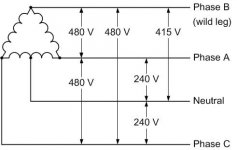
Would probably have to be 480v Delta.
480v across any two Legs.
Center tap in between two to give you 240v to neutral.
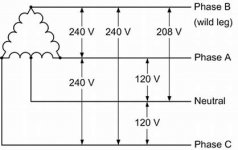
412/415v from the hot leg to neutral. I assume you aren't supposed to use this pole singly just as you aren't supposed to connect anything to my hot leg on my 240v Delta.
My system is the same except half the voltage. Mine is the earlier standard where the hot leg was C instead of B.
Diagrams:
 

Attachments

  • 480V-Delta.jpg
    480V-Delta.jpg
    13.7 KB · Views: 9
  • 240V-Delta.jpg
    240V-Delta.jpg
    13.8 KB · Views: 8
Last edited:

Bert_

Well-known member
Joined
Dec 24, 2016
Messages
9,775
Location
NW Iowa
How do you have a 412v stinger leg?

He mentioned a phase converter which by nature is a delta configuration.

Any time you have a delta with a center tapped neutral you will have a high leg. 480v delta = ~412v from high leg to the ground.


I'm assuming he's running a transformer 240v - 480v. I do think it's a bit strange to see a transformer with a center tap on the 480v side, I'd be curious to see the transformer
 
Last edited:

Matt Matt

Well-known member
Joined
May 11, 2017
Messages
523
Location
Ontario
Rotary phase converter, into auto transformer 240-600. The generated leg or wild leg can vary from 375-415 to ground. Two natural legs 310-325 to ground. Hot to hot can vary from 560–600. That’s why I’m using L17–30.
 
Last edited:

Bert_

Well-known member
Joined
Dec 24, 2016
Messages
9,775
Location
NW Iowa
Rotary phase converter, into auto transformer 240-600. The generated leg or wild leg can vary from 375-415 to ground. Two natural legs 310-325 to ground. Hot to hot can vary from 560–600. That’s why I’m using L17–30.

Oh duh, I didn't look to see what a L17-30. 600v must be common in canada.

I'm still a little curious about the transformer. Since you have a high leg it must be delta with one winding center tapped. I wouldn't think any common transformer would have that center tap.
 

Matt Matt

Well-known member
Joined
May 11, 2017
Messages
523
Location
Ontario
Oh duh, I didn't look to see what a L17-30. 600v must be common in canada.

I'm still a little curious about the transformer. Since you have a high leg it must be delta with one winding center tapped. I wouldn't think any common transformer would have that center tap.

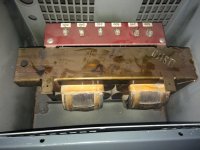
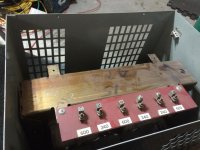
I hope these photos show. When doing step-up transformers, how do you stay code compliant? A custom delta/wye 208/600 Will work safely . But have fun sourcing....

This part is going off topic but… autotransformers are only the transformers that do not have a specification as to step up or step down. Most often they are bilingual by manufacture specifications.

Why are isolation Transformers dangerous to step up voltages? Why are they not permitted under the NEC?

Shirley they will work.... but… My whole system is on a 60 amp GFCI breaker....
 

Attachments

  • ABC92300-A34A-4B72-BD10-ACBB64706AB2.jpg
    ABC92300-A34A-4B72-BD10-ACBB64706AB2.jpg
    134.7 KB · Views: 23
  • F041BAA7-422A-4D1A-BF85-E4FA141B478C.jpg
    F041BAA7-422A-4D1A-BF85-E4FA141B478C.jpg
    148.5 KB · Views: 19
  • 72AC6961-62FF-4F85-BF80-421596420350.jpg
    72AC6961-62FF-4F85-BF80-421596420350.jpg
    138.3 KB · Views: 17
  • 13467783-D3B5-45B7-B740-0C1B44801CC2.jpg
    13467783-D3B5-45B7-B740-0C1B44801CC2.jpg
    150.7 KB · Views: 21
Last edited:

wyliesdiesels

Well-known member
Joined
Aug 14, 2012
Messages
20,068
Location
Modesto, CA
Would probably have to be 480v Delta.
480v across any two Legs.
Center tap in between two to give you 240v to neutral.
412/415v from the hot leg to neutral. I assume you aren't supposed to use this pole singly just as you aren't supposed to connect anything to my hot leg on my 240v Delta.
My system is the same except half the voltage. Mine is the earlier standard where the hot leg was C instead of B.
Diagrams:

He mentioned a phase converter which by nature is a delta configuration.

Any time you have a delta with a center tapped neutral you will have a high leg. 480v delta = ~412v from high leg to the ground.


I'm assuming he's running a transformer 240v - 480v. I do think it's a bit strange to see a transformer with a center tap on the 480v side, I'd be curious to see the transformer

yeah i understand the concept of the stinger leg and where it comes from. Ive worked on many delta services.

What i was getting at is I have never seen a center tapped 480v transformer.

If its not center tapped and bonded to ground then the voltage seen is capicitive coupling.

Oh duh, I didn't look to see what a L17-30. 600v must be common in canada.

I'm still a little curious about the transformer. Since you have a high leg it must be delta with one winding center tapped. I wouldn't think any common transformer would have that center tap.

Thats what I was curious about as well. I fully understand center tapped delta. Just never seen it in 480v fashion.... doubt his is center tapped... which means voltage to ground is floating...
 
Last edited:

wyliesdiesels

Well-known member
Joined
Aug 14, 2012
Messages
20,068
Location
Modesto, CA
I hope these photos show. When doing step-up transformers, how do you stay code compliant? A custom delta/wye 208/600 Will work safely . But have fun sourcing....

This part is going off topic but… autotransformers are only the transformers that do not have a specification as to step up or step down. Most often they are bilingual by manufacture specifications.

Why are isolation Transformers dangerous to step up voltages? Why are they not permitted under the NEC?

Shirley they will work.... but… My whole system is on a 60 amp GFCI breaker....

Sure but does the high side have a center tap? Post a pic of the wiring diagram...
 
Last edited:

Matt Matt

Well-known member
Joined
May 11, 2017
Messages
523
Location
Ontario
Sure but does the high side have a center tap? Post a pic of the wiring diagram...
Which question are you responding to or replying to? You forgot to highlight in red.
Are you looking for center tap on auto transformer? With only one winding?
 
Last edited:

Bert_

Well-known member
Joined
Dec 24, 2016
Messages
9,775
Location
NW Iowa
I see, I kept missing the fact that this is an autotransformer. So there isn't any grounding on the high voltage side, nor does there need to be.

Many larger isolation transformers are rated for reverse feed. It's not uncommon to use them that way. Once and a while someone wiring a transformer this way will not ground the secondary side since there is often no center tap. The correct thing to do would be to ground one of the phases but many people can't wrap their head around that concept.
 

Matt Matt

Well-known member
Joined
May 11, 2017
Messages
523
Location
Ontario
I see, I kept missing the fact that this is an autotransformer. So there isn't any grounding on the high voltage side, nor does there need to be.

Many larger isolation transformers are rated for reverse feed. It's not uncommon to use them that way. Once and a while someone wiring a transformer this way will not ground the secondary side since there is often no center tap. The correct thing to do would be to ground one of the phases but many people can't wrap their head around that concept.

I apologize for taking this post off to left field. My only position was that when I am doing wiring a wiring devices (as a electrical idiot) (i.e. plug or outlet) I always keep the high leg opposite of ground in a electrical device. My suggestions are only my suggestions and the electrical engineers here will give good suggestions with D-y, y-D,D-D, y-y,auto....

And,
I prefer wiring devices used properly... but, under some situations, I just deal with what I’m dealt...Deliver and walk away with no cord.With a note. Certified electrician contact 1-***–***–XXXX before hook up or all Service/warranty is void.

I work with big machines with many transformers and many motors. Generally roll Mills. But I am only the machinist/die maker that need power checks.
 
Last edited:

86turbodsl

Well-known member
Joined
Jul 1, 2005
Messages
6,558
Location
Michigan
Back to the original topic, what cheap plugs/outlets are available to carry 3Ph power to machines that the OP wants to move around?

I ask because i want to do the same thing. Not everybody is in a position to buy multiple $$$ hubbel 3ph plugs and outlets.
 

cj7jeep81

Well-known member
Joined
Jul 11, 2006
Messages
463
Location
S.E. Indiana
Back to the original topic, what cheap plugs/outlets are available to carry 3Ph power to machines that the OP wants to move around?

I ask because i want to do the same thing. Not everybody is in a position to buy multiple $$$ hubbel 3ph plugs and outlets.

Posted this earlier, but $17 for a twistlock set up that's good to 50 amps. I have a roughly 5' cord coming off a box with a female end, then I can put the male end on the machines. You can buy the male's by themselves really cheap as well. Nice thing about these is they are very easy to find on Ebay.

https://www.ebay.com/itm/171954181042?rmvSB=true
 

matt_i

Well-known member
Joined
Mar 14, 2008
Messages
10,742
Location
SE Michigan
Had I to start today, I'd probably go with a NEMA L15-30, today there's many sellers and the price point is much lower on both twistlock plugs and receptacles. Back when I started acquiring 3 phase machines 18 or 19 years ago and figuring out how to wire the shop there weren't all of the sellers competing for business and driving prices lower and so I pushed the much more widely available L14-30 into service.

They're expensive, but make that the first "accessory" for a "new" machine purchase and it won't be so bad. The edge and fixture tooling you need typically makes the L and R purchase seem pretty small. Unless you got a "you ****" deal and got a whole lot of stuff for little money. :) And even then the twist Lock plug and Receptacle won't be too much.
 
Last edited:

Matt Matt

Well-known member
Joined
May 11, 2017
Messages
523
Location
Ontario
I primarily work out of three shops. One is my own and personal. My personal shop I like to keep kosher with electrical code as much as I can. (One of my shops is in residential and is not supposed to have more than 150 V to ground distributed. And I struggle with this as I only have two transformers.) I should have six.

The other two shops I work in, work under temporary placement industrial . Each machine needs a physical lock out and disconnect at each Machine and wiring device (that allows machine disconnect power) via plug outlet. Main disconnect is connected to a mushroom key on the wall for 30ish machines (jail style)and each machine has its own fused disconnect 25 feet in the air. Maybe for fun, I’ll do it little video when I’m in the shop tomorrow.


Every time I go to the electrical supplier, the joke is females are always more expensive...

Yeah, I bite the bullet and buy the $30 male and the $40 female L-15’s-20-30 and when I’m playing with L17’s-30 they are about $40 male and $60 female.
 
Last edited:
To avoid these ads, REGISTER NOW!
Top Bottom