
You are using an out of date browser. It may not display this or other websites correctly.
You should upgrade or use an alternative browser.
You should upgrade or use an alternative browser.
Stanley screwdriver ww2
- Thread starter algor
- Start date
RTM
Well-known member
You may find some info in this thread, probably covers them best.
 www.garagejournal.com
Stanley USA Plastic Handled Screwdrivers 1932- Present
For the past several days I have been working on this history of Stanley USA plastic handled screwdrivers from the earliest catalog I can find that lists them, the 1932 catalog, all the way up to today. I was going to originally have wood handled screwdrivers too, but that would have just been...
www.garagejournal.com
Dave455
Well-known member
I can help a bit, but the answer depends in which country you are in, and the country of manufacture of the drivers?
Stanley in the U.S. introduced acetate handled screwdrivers before the war. They called the material “Stanloid” and I have seen it referred to as “CAB” (Cellulose Acetate Butyrate). It might be, or it might be Cellulose Acetate.
I don’t know if these drivers were ever called “100 series” but the part numbers started with 100, so they might have been.
Sometime in the early 50’s they introduced the “100 Plus” series. The handles were amber acetate with black flutes, and the blades were forged. These were high quality tools.
In the U.K. Stanley also produced the “100 Plus” drivers. The quality of the British made drivers was comparable with the U.S. ones, maybe better?
These were very desirable tools at the time, as the handles were so much more durable than wooden ones. The material used for the British made handles was definitely cellulose acetate. Although in theory less shatter resistant, it doesn’t degrade and has no smell.
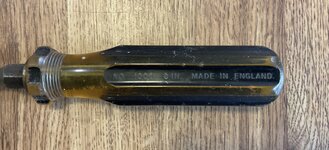
Here is one purchased by my Grandfather in that era.

Sometime in the late 60’s / early 70’s Stanley in the U.K. switched to a clear acetate with red flutes for the handles. Still durable handles, but the blades were never (in the opinion of my Father) quite as good as the earlier ones. They are not forged the entire length, for a start.
I can vaguely recall that these were sold as “60 Series “. I can also recall that they were sold in parallel to the ”100 Plus” for some years. I can remember Dad seeking out the former….!

Pozidriv drivers had blue fluted handles.

These 60 Series were produced into the 1980’s. Although not quite as good as the earlier 100 Plus, they were still decent. I don’t know if these were produced in the U.S.
Stanley in the U.K. also produced a range with yellow handles (no coloured flutes) in this era, but these seemed to be bought by industrial customers. I don’t recall seeing them in shops.
Sometime in the mid 1980’s Stanley in the U.K. re introduced the “100 Plus”. They changed the colours of the handles back to amber, with black or blue flutes. The blades were basically the same as the previous style though, so these were really “100 Plus” in name only. I quite liked them though, and bought quite a few. I still have new ones in my stores.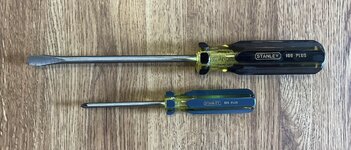
They were, however, discontinued quite quickly.
You can tell a new “100 Plus” by the lack of a forged blade, and also by the varnished blade to prevent corrosion. The earlier ones were of better steel and didn’t need this!
Stanley in the U.S. introduced acetate handled screwdrivers before the war. They called the material “Stanloid” and I have seen it referred to as “CAB” (Cellulose Acetate Butyrate). It might be, or it might be Cellulose Acetate.
I don’t know if these drivers were ever called “100 series” but the part numbers started with 100, so they might have been.
Sometime in the early 50’s they introduced the “100 Plus” series. The handles were amber acetate with black flutes, and the blades were forged. These were high quality tools.
In the U.K. Stanley also produced the “100 Plus” drivers. The quality of the British made drivers was comparable with the U.S. ones, maybe better?
These were very desirable tools at the time, as the handles were so much more durable than wooden ones. The material used for the British made handles was definitely cellulose acetate. Although in theory less shatter resistant, it doesn’t degrade and has no smell.
Here is one purchased by my Grandfather in that era.
Sometime in the late 60’s / early 70’s Stanley in the U.K. switched to a clear acetate with red flutes for the handles. Still durable handles, but the blades were never (in the opinion of my Father) quite as good as the earlier ones. They are not forged the entire length, for a start.
I can vaguely recall that these were sold as “60 Series “. I can also recall that they were sold in parallel to the ”100 Plus” for some years. I can remember Dad seeking out the former….!
Pozidriv drivers had blue fluted handles.
These 60 Series were produced into the 1980’s. Although not quite as good as the earlier 100 Plus, they were still decent. I don’t know if these were produced in the U.S.
Stanley in the U.K. also produced a range with yellow handles (no coloured flutes) in this era, but these seemed to be bought by industrial customers. I don’t recall seeing them in shops.
Sometime in the mid 1980’s Stanley in the U.K. re introduced the “100 Plus”. They changed the colours of the handles back to amber, with black or blue flutes. The blades were basically the same as the previous style though, so these were really “100 Plus” in name only. I quite liked them though, and bought quite a few. I still have new ones in my stores.
They were, however, discontinued quite quickly.
You can tell a new “100 Plus” by the lack of a forged blade, and also by the varnished blade to prevent corrosion. The earlier ones were of better steel and didn’t need this!
Last edited:
Dave455
Well-known member
The design of the “100 Plus” is something of a classic, and I can understand why. It’s almost perfect for “general purpose” use, and is a good deal better than many newer (cheaper) designs.
In an interesting postscript, the design influenced many copies, a lot of which are still produced.
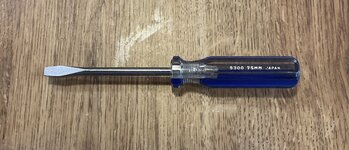
These drivers were imported to the U.K. from Japan in the 1980’s. The quality is quite good and the design influence is clear.
The Vessel “Crystaline” is obviously also heavily influenced. Strangely, Vessel don’t offer these in the U.K. or Europe where the style would be recognised.
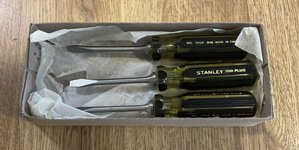
My last ever purchase of 100 Plus drivers took place in the early 2000’s. I bought the stores of an engineering company that had been bought out. Hidden at the back was a box of four brand new 100 Plus drivers. These are probably the very last of the original design, dating from the early 70’s.
In an interesting postscript, the design influenced many copies, a lot of which are still produced.
These drivers were imported to the U.K. from Japan in the 1980’s. The quality is quite good and the design influence is clear.
The Vessel “Crystaline” is obviously also heavily influenced. Strangely, Vessel don’t offer these in the U.K. or Europe where the style would be recognised.
My last ever purchase of 100 Plus drivers took place in the early 2000’s. I bought the stores of an engineering company that had been bought out. Hidden at the back was a box of four brand new 100 Plus drivers. These are probably the very last of the original design, dating from the early 70’s.
Private Lugnutz
Well-known member
@algor
First of all, welcome, Alberto! I recognize your username from G503.com, even though it was several years ago. You and I have had many pleasant discussions there, as well as email, and even some "horse trading"! I am Wingnutt on G503.com.
I didn't see this thread and discussion when you originally posted it.
Based on catalogs, "Stanley 100" is not a term they used as a branding device in the vintage era.
They used the term "100 Plus" for decades, since the 1920's at least, well before WWII, and they continued to use it throughout WWII, and after WWII - for their top of the line highest quality wood-handled screwdrivers.
The part number was No. 1001 for the standard blade, in various sizes. No. 1003 for what they called a "small" blade, referring to what are known in other nomenclatures, including military, as "electrical" or "cabinet" style blade. Note that they made other wood-handled screwdrivers, including "Hurwood" and Regular, which were lower quality and price.
Some time between 1935 and 1937, Stanley introduced the "Stanloid" line (with composite handles). Part numbers were similarly No. 100X scheme, depending on type (Standard, Close-Quarter, electrical, etc). The "Stanloid" line supplanted the "100 Plus" line in quality and price point, but it did not replace them. Stanley continued to produce the "100 Plus" wood handled screwdrivers throughout WWII and well after, even after they introduced other composite-handled lines (e.g., "Victor" and "Hercules").
In 1953, Stanley started branding their top line composite-handled screwdrivers (formerly branded "Standloid") as "100 Plus". Note that they were still making the wood-handled "100 Plus" line at the same time!
HERE is a link to the Stanely page of the Internet Archive International Tool Catalog Library. It contains literally hundreds of Stanley catalogs, brochures, price lists and other supplemental material from 1855 well into the modern era (1990's), including the annual 1941, 1942, 1947, 1949, and 1953 catalogs, all with Screwdrivers sections, which are the catalogs you will want to dip into. I have the page sorted by date. Just scroll down from there.
First of all, welcome, Alberto! I recognize your username from G503.com, even though it was several years ago. You and I have had many pleasant discussions there, as well as email, and even some "horse trading"! I am Wingnutt on G503.com.
I didn't see this thread and discussion when you originally posted it.
It would help to know the context for your question and your terms. Are you trying to outfit a certain kit? Are you seeing references to "Stanley 100" and "Stanley 100 Plus" in an SNL or TM or other period document?I would like to know the difference between a Stanley 100 screwdriver and a 100 Plus.
Based on catalogs, "Stanley 100" is not a term they used as a branding device in the vintage era.
They used the term "100 Plus" for decades, since the 1920's at least, well before WWII, and they continued to use it throughout WWII, and after WWII - for their top of the line highest quality wood-handled screwdrivers.
The part number was No. 1001 for the standard blade, in various sizes. No. 1003 for what they called a "small" blade, referring to what are known in other nomenclatures, including military, as "electrical" or "cabinet" style blade. Note that they made other wood-handled screwdrivers, including "Hurwood" and Regular, which were lower quality and price.
Some time between 1935 and 1937, Stanley introduced the "Stanloid" line (with composite handles). Part numbers were similarly No. 100X scheme, depending on type (Standard, Close-Quarter, electrical, etc). The "Stanloid" line supplanted the "100 Plus" line in quality and price point, but it did not replace them. Stanley continued to produce the "100 Plus" wood handled screwdrivers throughout WWII and well after, even after they introduced other composite-handled lines (e.g., "Victor" and "Hercules").
In 1953, Stanley started branding their top line composite-handled screwdrivers (formerly branded "Standloid") as "100 Plus". Note that they were still making the wood-handled "100 Plus" line at the same time!
HERE is a link to the Stanely page of the Internet Archive International Tool Catalog Library. It contains literally hundreds of Stanley catalogs, brochures, price lists and other supplemental material from 1855 well into the modern era (1990's), including the annual 1941, 1942, 1947, 1949, and 1953 catalogs, all with Screwdrivers sections, which are the catalogs you will want to dip into. I have the page sorted by date. Just scroll down from there.
Last edited:
Wingnutt It's a real pleasure to see you here too, it's been a long time!
First of all I have to apologize because I wrote "Stanley 100" instead of "1008" and this certainly created some confusion...(sorry, I'm getting old! )
In the last years I worked to complete some Signal Corps Tool sets and a typical screwdriver of these sets is the Stanley 1008 (6R16890) 10" blade with "Stanloid" handle . Now your brief explanation clarify me a lot of doubts about the wartime screwdrivers.Thanks for the link, I have a lot of material to read this weekend!
First of all I have to apologize because I wrote "Stanley 100" instead of "1008" and this certainly created some confusion...(sorry, I'm getting old!
)In the last years I worked to complete some Signal Corps Tool sets and a typical screwdriver of these sets is the Stanley 1008 (6R16890) 10" blade with "Stanloid" handle . Now your brief explanation clarify me a lot of doubts about the wartime screwdrivers.Thanks for the link, I have a lot of material to read this weekend!
esben57
Well-known member
My Mother and her Sister worked at the Sheffield site, Woodside, mid 1960's to 1984.The design of the “100 Plus” is something of a classic, and I can understand why. It’s almost perfect for “general purpose” use, and is a good deal better than many newer (cheaper) designs.
In an interesting postscript, the design influenced many copies, a lot of which are still produced.
These drivers were imported to the U.K. from Japan in the 1980’s. The quality is quite good and the design influence is clear.
The Vessel “Crystaline” is obviously also heavily influenced. Strangely, Vessel don’t offer these in the U.K. or Europe where the style would be recognised.
My last ever purchase of 100 Plus drivers took place in the early 2000’s. I bought the stores of an engineering company that had been bought out. Hidden at the back was a box of four brand new 100 Plus drivers. These are probably the very last of the original design, dating from the early 70’s.
Still have a couple of screwdrivers.