To avoid these ads, REGISTER NOW!

Steel Post Base Sizing; Q for Structural Engineers

teamextreme

Well-known member
Joined
Aug 10, 2013
Messages
867
Location
Lakewood, CO
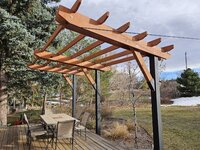
I'm building a cantilevered pergola using square steel posts with a base plate anchored to concrete caissons with J-bolts in the concrete. When I was sizing things I thought 4" posts would likely be plenty strong, but I wanted a more substantial look, so I went with 6" posts. The largest sonotubes HD sells are 12", so I bought these. Unfortunately, working from both ends of the equation here I am trying to squeeze things into too small a space. The largest 4-hole base plate that will fit on a 12" sonotube is 8". The problem is an 8" baseplate will not fit on a 6" post. I have 2 solutions;
1. Upsize the sonotube. This is a PITA, since I've got to source them from who knows where and the holes are already dug so I'd have to re-work them. Plus, I've already bought the 12" sonotubes, 8" base plates, etc. and I hate to waste all that, but this may be the more correct solution. The holes are dug and next step is concrete, so I'm re-thinking before the point of no return.
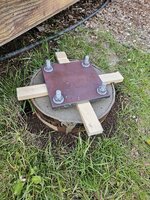
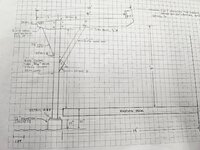
2. The easier and my planned solution shown in the drawing/picture (but now I'm second-guessing myself); mount the baseplate to the post at a 45 degree angle. The 8" baseplate wont fit the 6" post for proper bolt clearance when placed "normally" in a parallel fashion, but mounting it at a 45 degree angle with the bolts in the center of each flat side instead of at the corners, everything fits.
My question is; is there a structural issue with option 2 or a reason I shouldn't go that route? I've never seen baseplates mounted in this fashion, but I can't see why it would be an issue.
 

Attachments

  • 20240501_195755.jpg
    20240501_195755.jpg
    839.8 KB · Views: 108
To avoid these ads, REGISTER NOW!

readhead

Well-known member
Joined
Dec 8, 2012
Messages
6,175
Location
Durango, Co.
It won’t be an issue and it is not uncommon. How is the top of this column connected at the top? Another option would be to weld the anchor bolts to the base plate and embed the plate in the concrete. Then you can weld the column to the embed. This is a very common practice for exposed steel construction. A very clean look without exposed bolts.
 
OP
T

teamextreme

Well-known member
Joined
Aug 10, 2013
Messages
867
Location
Lakewood, CO
It won’t be an issue and it is not uncommon. How is the top of this column connected at the top? Another option would be to weld the anchor bolts to the base plate and embed the plate in the concrete. Then you can weld the column to the embed. This is a very common practice for exposed steel construction. A very clean look without exposed bolts.
Not an issue and not uncommon, great! That's what I suspected and was hoping to hear. The top of the column will be free standing, I guess you'd say, with a wood beam mounted at an angle, close to horizontal, "cantilevered", the post being its only support. Interesting alternate technique you describe. That would certainly fix the problem as well and I hadn't thought of that. This would make the install very permanent is the only draw back.
 
OP
T

teamextreme

Well-known member
Joined
Aug 10, 2013
Messages
867
Location
Lakewood, CO
What about making your on base square instead of using round sonotube
You mean use a square sonotube? There's a post about that right now where the poster wants to use square and can't find it and everyone is explaining the reasons why (bad idea, too much force on a square structure).
 

PCustoms

Well-known member
Joined
Jul 23, 2011
Messages
22,284
Location
VT
I don't quite follow how a 12" footing, 8" baseplate and 6" column doesn't fit, but a 4" column will be fine for this.

If you want it to look more substantial wrap it in PVC trim
 
OP
T

teamextreme

Well-known member
Joined
Aug 10, 2013
Messages
867
Location
Lakewood, CO
I don't quite follow how a 12" footing, 8" baseplate and 6" column doesn't fit, but a 4" column will be fine for this.

If you want it to look more substantial wrap it in PVC trim
If you look at the drawing I included, the 8" baseplate corners touch the edge of the 12" footing. The 8" baseplate fits on the 6" column as shown in the drawing, but if you rotate the baseplate 45 degrees to "normal" alignment, the bolt holes and corners of the post are on top of each other. The hole to hole distance on the 8" baseplate is 6".
 

Kaizen

Well-known member
Joined
Jan 9, 2015
Messages
6,938
Location
New England
You mean use a square sonotube? There's a post about that right now where the poster wants to use square and can't find it and everyone is explaining the reasons why (bad idea, too much force on a square structure).
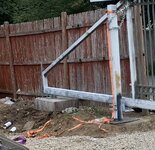
No make a square plywood form with the bolts in it. I had two that i used for this 1200+ pound sliding gate. You can see them to the left of the picture. One block needed to be higher but the one at the post is subgrade. Each block was about 800+ of concrete. Putting the jbolts in the concrete gives you the ability to put in spacers to true up the post.
A 6 inch post is probably way overkill and very heavy if you are going 8 feet high. What is the rest of this design look like? Have you thought of just a 4" and dress it out with wood to get the heft you want?


IMG_70261.JPG
 

strutaeng

Well-known member
Joined
Dec 12, 2011
Messages
2,246
Location
Dallas, TX
There's nothing wrong with the anchor bolt layout on the sketch.

However, typically for 12" diameter piers, only a single number 8 rebar is what my office usually uses. Any pier with a column/baseplate direct on top will be an 18" diameter pier minimum, to get the anchor bolts inside the cage of the pier (those get a spiral cage with 6 bars around the perimeter). Especially if there's any significant shear or uplift on that column.

May or may not matter here.

A 12" pier with a square pier cap (sized accordingly) is another option.
 

BillK

Well-known member
Joined
Aug 24, 2006
Messages
9,298
Location
Beautiful Southern Maryland
If you look at the drawing I included, the 8" baseplate corners touch the edge of the 12" footing. The 8" baseplate fits on the 6" column as shown in the drawing, but if you rotate the baseplate 45 degrees to "normal" alignment, the bolt holes and corners of the post are on top of each other. The hole to hole distance on the 8" baseplate is 6".
Personally I would cut about an inch off each corner of the base plates and call it a day. They are probably overkill anyway so it certainly wont affect the strength.
 

Dig Doug

Well-known member
Joined
Apr 16, 2018
Messages
1,084
You mean use a square sonotube? There's a post about that right now where the poster wants to use square and can't find it and everyone is explaining the reasons why (bad idea, too much force on a square structure).
Frame it out if wood, build a square box
if it needs to match the outside on the house square is easier to add a veneer - unless it’s stucco

Im not sure what your situation is… or the look your after or don’t care, maybe not visible


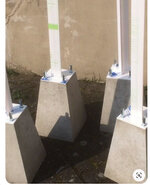
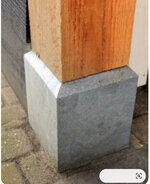
a few pics I found on line to give you a few ideas

one picture shows a 90 square corner

another one shows the corners w/ a chamfer

do you need to grout under the column base?

IMG_9881.jpegIMG_9883.jpegIMG_9882.jpegIMG_9884.jpeg
 

Dig Doug

Well-known member
Joined
Apr 16, 2018
Messages
1,084
IMG_9885.jpegIMG_9886.jpegIMG_9888.jpegIMG_9887.jpegThere area few ways to do this, Im Not sure what your plans spec out.

but
if you dont want to see the base plate and nuts bolts etc you can set the base plate recessed so the finished product
looks like this

On the taper look with the white posts you need to pay attention to the concrete thickness around the anchor bolts or get extra long bolts or long all thread

that was just to give you an idea for a different IMG_9890.jpegIMG_9889.jpeglook
 
Last edited:

Yankeefarmer

Well-known member
Joined
Jul 25, 2011
Messages
1,169
Location
Connecticut
All the replies here are focusing on the column base to concrete connection. No one has commented that the loads into the concrete are from a cantilevered pergola, and no description of that structure has been provided. Will the 12” pier be sufficient to withstand wind loading in combination with an overturning moment? Admittedly, I might be misunderstanding what the completed structure will look like.
 

strutaeng

Well-known member
Joined
Dec 12, 2011
Messages
2,246
Location
Dallas, TX
All the replies here are focusing on the column base to concrete connection. No one has commented that the loads into the concrete are from a cantilevered pergola, and no description of that structure has been provided. Will the 12” pier be sufficient to withstand wind loading in combination with an overturning moment? Admittedly, I might be misunderstanding what the completed structure will look like.
That's exactly what I was thinking in over here just now...

If it's what I'm thinking, there will be axial, shear and moment on that connection, and probably significant values. The pier must have sufficient capacity for the loads, but also stiffness so it does deflection sideways.

I designed a cantilevered trellis for a park a few years ago. The landscape architect wanted these board-formed concrete columns, 24" square and like 14' tall. I believe we used 24" piers with a pier cap. The cantilever was like 8'.
 

Walkers

Well-known member
Joined
May 17, 2021
Messages
3,912
Location
Cave Creek Az
All the replies here are focusing on the column base to concrete connection. No one has commented that the loads into the concrete are from a cantilevered pergola, and no description of that structure has been provided. Will the 12” pier be sufficient to withstand wind loading in combination with an overturning moment? Admittedly, I might be misunderstanding what the completed structure will look like.
Oh jaysus, we should probably review the footings of his house as well!
 

Kaizen

Well-known member
Joined
Jan 9, 2015
Messages
6,938
Location
New England
All the replies here are focusing on the column base to concrete connection. No one has commented that the loads into the concrete are from a cantilevered pergola, and no description of that structure has been provided. Will the 12” pier be sufficient to withstand wind loading in combination with an overturning moment? Admittedly, I might be misunderstanding what the completed structure will look like.
yup i asked above. same thought. tension and counterweight
 
OP
T

teamextreme

Well-known member
Joined
Aug 10, 2013
Messages
867
Location
Lakewood, CO
Thanks for the replies! I pulled the trigger and poured yesterday. I used a triangle structure of 1/2" rebar welded together. Here is some additional info on the structure since people are asking...
Dig Doug posted several pics of base connection examples and it brings up another question I've had. Should the baseplates be mounted against nuts below them or against the concrete? I've seen it both ways and I'm not sure if there is a correct way or better way or does it depend on the application? If mounted against nuts should it be grouted?20240426_175433.jpg20240502_191554.jpg20240502_191600.jpg20240503_162738.jpg
 
To avoid these ads, REGISTER NOW!

strutaeng

Well-known member
Joined
Dec 12, 2011
Messages
2,246
Location
Dallas, TX
Thanks for the replies! I pulled the trigger and poured yesterday. I used a triangle structure of 1/2" rebar welded together. Here is some additional info on the structure since people are asking...
Dig Doug posted several pics of base connection examples and it brings up another question I've had. Should the baseplates be mounted against nuts below them or against the concrete? I've seen it both ways and I'm not sure if there is a correct way or better way or does it depend on the application? If mounted against nuts should it be grouted?20240426_175433.jpg20240502_191554.jpg20240502_191600.jpg20240503_162738.jpg
Ho-Lee Chit Batman! 😵‍💫
 
OP
T

teamextreme

Well-known member
Joined
Aug 10, 2013
Messages
867
Location
Lakewood, CO
How deep are the holes? The engineers will be along soon. Just a side note, did you use weldable rebar?
36" deep. Weldable rebar? You've got to be shitting me. Never heard of such a thing. It's steel, it's weldable. I'm not building the Hoover dam here. Rebar is not even required in this application by my City, I added it to go above and beyond.

Ho-Lee Chit Batman! 😵‍💫
Care to elaborate? Am I screwing something up majorly?
 

readhead

Well-known member
Joined
Dec 8, 2012
Messages
6,175
Location
Durango, Co.
I was a structural steel fabricator for twenty three years and there is a type of rebar specifically for welded applications. I don’t recall the alloy number right now. Rebar is pretty low quality steel but it works for what it is intended for. You can weld it but it isn’t structurally sound. In this particular case rebar is definitely required. You are treating the pier like a footing under a post that is connected within a framing system. It is far from that. It is an extension of the column which is very different. The rebar comment was mainly for the uninformed.

There are several things going on here. You are dealing with a bending moment, wind load and uplift. I suspect that you are way short of concrete and the base plate should be larger to spread the connection load. Like I said the engineers will be poking their heads in soon.

I think the idea is for the most part sound. It will work until it doesn’t.
 
OP
T

teamextreme

Well-known member
Joined
Aug 10, 2013
Messages
867
Location
Lakewood, CO
I was a structural steel fabricator for twenty three years and there is a type of rebar specifically for welded applications. I don’t recall the alloy number right now. Rebar is pretty low quality steel but it works for what it is intended for. You can weld it but it isn’t structurally sound. In this particular case rebar is definitely required. You are treating the pier like a footing under a post that is connected within a framing system. It is far from that. It is an extension of the column which is very different. The rebar comment was mainly for the uninformed.

There are several things going on here. You are dealing with a bending moment, wind load and uplift. I suspect that you are way short of concrete and the base plate should be larger to spread the connection load. Like I said the engineers will be poking their heads in soon.

I think the idea is for the most part sound. It will work until it doesn’t.
Unfortunately nobody has chimed in yet. I am really curious as to the details of the concerns. I understand your statements about bending moment, etc., however there should be minimal wind load and uplift due to the fact that the overhang portion is completely open and only consists of a pair of 2x10's attached to each post and 6 2x6's attaching them at 90 degrees. No roof, etc. I did some calcs on the weight that would provide the bending moment. The total weight per post is 56.8 lbs. The one civil engineering course I took decades ago is a faint memory, but IIRC, that would equate to a 56.8 lb point load at a distance 4 feet from the post, or 227 ft/lbs of moment. This doesn't seem like much to me. What I don't know is what the next step is to translate that to the load/moment at the base. Can anyone elaborate?
 

Yankeefarmer

Well-known member
Joined
Jul 25, 2011
Messages
1,169
Location
Connecticut
With where you are in your project, I would just proceed and keep an eye on the finished project to see if it wants to go anywhere. I have no civil engineering background, but it seems to me that the only resistance to the bending moment must be provided by friction between your concrete pier and the soil. At the time I raised my concern, you had not provided any indication of how far out the pergola was cantilevered, so it seemed reasonable to mention that the baseplate may not be the only concern.
 

Bill T

Well-known member
Joined
Mar 28, 2009
Messages
140
Location
Easley,S.C.
Peanut gallery has officially chimed in- if you intend to weld reinforcing steel, the bars should be manufactured to ASTM A706 specs. Basically this bar has the correct ratio of carbon for adequate weldability. You probably use ASTM A615.
 

Fatboy148!

Well-known member
Joined
Mar 11, 2023
Messages
248
Nice looking project. I have no idea if it will hold up over time but my question is why? I really don’t understand the interest in them and my daughter-in-law wants to put one over their patio to the tune of $5k for the kit. Does a structure such as this provide shade? What does it do besides look nice?
 

firebirdparts

Well-known member
Joined
Jun 8, 2016
Messages
10,578
Location
Kingsport, TN
I think mostly it's just for feelings. You create the illusion that you're in a room. I think it's interesting that they avoid providing shade, but then of course you could get shade in a certain spot (away from it) early and late.
 

Boogerman

Well-known member
Joined
Jan 28, 2021
Messages
832
Location
aspen cove hill
Ho-Lee Chit Batman! 😵‍💫

36" deep. Weldable rebar? You've got to be shitting me. Never heard of such a thing. It's steel, it's weldable. I'm not building the Hoover dam here. Rebar is not even required in this application by my City, I added it to go above and beyond.


Care to elaborate? Am I screwing something up majorly?
You may or may not be screwing something up, depends on what your structure needs for strength.

The way you did the rebar essentially made your footing the same as unreinforced concrete for the purpose of the strength of the J bolts, base plate and non-compressive loads from your steel columns. If plain concrete is sufficient for your loads, you're okay.

The rebar cage should be round and be within 2 inches of the outside of the concrete and extend to within 2 or 3 inches of the top of the concrete. The j bolts should fall within the cage of the rebar reinforcement. The function of the reinforcement is to hold together the concrete inside the reinforcement as it tries to split and crack as the j bolts try to pull out due to uplift and column twisting and bending. If the bolts are outside the cage, the concrete just splits and pieces tip off the outside, opening up cracks that allow the bolts to pull out. Your triangular cage would be useful for a single bolt that penetrated down the middle of the triangle, if the bolt was long enough to extend 6 inches or more into the area enclosed by the cage.

The concrete that is effective in carrying loads is essentially the part that is contained within the rebar cage. You have a tiny little triangle of concrete that is effective, the rest is essentially along for the ride, and for dead weight until it splits and cracks because of lack of reinforcement.

You essentially took ineffectual action, just to do something, instead of doing something that was useful.
 
OP
T

teamextreme

Well-known member
Joined
Aug 10, 2013
Messages
867
Location
Lakewood, CO
Nice looking project. I have no idea if it will hold up over time but my question is why? I really don’t understand the interest in them and my daughter-in-law wants to put one over their patio to the tune of $5k for the kit. Does a structure such as this provide shade? What does it do besides look nice?
The purpose for mine is to provide shade; in the form of 2 shade sails that will be installed between the beams in the summer. They will be removed for winter to avoid snow loads.
 

NUTTSGT

Super Moderator
Staff member
Joined
Sep 14, 2009
Messages
50,863
Location
Northern Central Ohio
Any advice given now is for future reference or the next guy.

OP is done with his project and enjoying it. It does look nice.
 

PopcornSutton

Well-known member
Joined
Jun 10, 2024
Messages
777
Location
Northern Tip of VA
Some engineers get bent out of shape over welding rebar, and perhaps there is a reason. Sometimes it's needed if the rebar cage is going to be lifted and placed by crane. When the A&E has a fit, we would add "scrap" rebar within the cage and weld to those, for a means of picking the cage. Same for making a form tie through a form. But keep in mind, rebar is tied into place for one reason, just to hold it in position during the pour. Tie wire has zero effect on the structure, tack welding something on the cut end of a rebar is about the same.
 
To avoid these ads, REGISTER NOW!
Top Bottom